
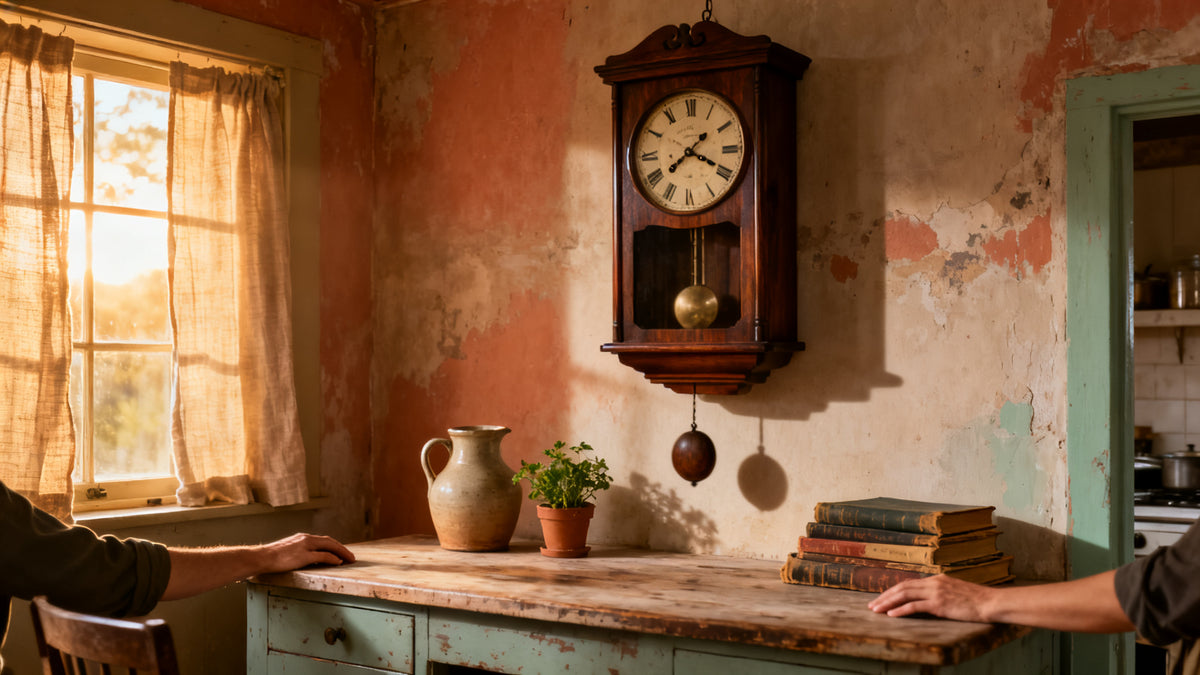
There's something about a pendulum wall clock in a farmhouse kitchen that just feels right. The soft tick, the gentle swing, the way it anchors a whole wall without trying too hard. It's not nostalgia, exactly. It's more that some design choices age well because they were never really trendy to begin with.
If you're trying to find the right pendulum wall clock for a farmhouse kitchen, the choices can feel overwhelming fast. Rustic? Industrial? Cuckoo? Chalet? I spent six months shuffling a 35 cm clock from wall to wall in my own kitchen before realizing the problem wasn't the placement; it was the size. This guide skips the vague advice and gets to what actually narrows it down.
⭐ Key takeaways
- A pendulum clock adds rhythm and warmth to a farmhouse kitchen without shouting for attention.
- Wood and forged iron are the two materials that read most naturally in rustic settings.
- Size relative to wall space matters more than most guides admit: too small and it disappears, too big and it crowds the room.
- Quartz pendulum clocks give you the aesthetic without the mechanical upkeep of a true weight-driven movement.
- Placement and wall height change how a clock reads in a kitchen, more than the clock face itself.
Why a Pendulum Clock Belongs in a Farmhouse Kitchen
A pendulum clock fits a farmhouse kitchen because both are built around rhythm: the steady swing echoes the quiet pace of bread rising and meals made from scratch. It's a visual and almost auditory cue that slows a space down in a way a flat-dial clock simply cannot replicate.
Farmhouse kitchens tend to mix rough textures with warmth: exposed wood beams, stone counters, ceramic crockery, linen curtains. A pendulum clock, especially one in solid wood or forged metal, slots right into that material vocabulary. It doesn't compete with the room. It becomes part of it.
Compare that to a sleek flat-dial clock or a digital display: both are fine in the right context, but in a kitchen built around honest materials and slow living, they tend to feel like an imported afterthought. The pendulum's movement makes time feel tangible in a way a static dial never will. That's not a small thing in a room you spend real time in every day.

Materials That Work (and One That Doesn't)
In a farmhouse kitchen, the best pendulum clock materials are solid wood, reclaimed wood composites, and forged iron, because all three already exist in the room in some form. When a clock shares its material with your shelves or hardware, it reads as intentional rather than decorative in a forced way.
Solid Wood and Bamboo
Natural wood grain brings warmth and texture. A darker walnut finish works well above lighter counters. Bamboo reads slightly more modern but still earthy enough for most farmhouse styles, especially if the kitchen leans Scandinavian-rustic. Look specifically for silent quartz movements here: a ticking clock in a quiet farmhouse kitchen can feel soothing to some and genuinely irritating to others, so it's worth knowing what you're buying before it arrives. I've had readers tell me they returned a clock purely because nobody warned them about the tick. It's on the product page; it's just easy to miss.
Forged Iron and Blackened Metal
Heavier and more architectural, iron pendulum clocks anchor a wall rather than simply decorating it. They work especially well above a farmhouse table or alongside open shelving with cast-iron cookware. The visual weight is substantial, so these clocks tend to need more wall to breathe. A 60 cm diameter clock on a half-wall above a window? Perfect. The same clock squeezed between cabinets? Crowded.
What to Avoid
Polished chrome, bright white plastic, and high-gloss lacquer all read as modern-urban rather than farmhouse. Even if the clock shape is traditional, a chrome frame immediately flattens the warmth of natural materials around it. The same goes for overly ornate baroque detailing: a farmhouse kitchen is considered, not fussy. That distinction matters more than it sounds.
💡 Did you know?
The pendulum as a timekeeping device was first described by Galileo Galilei around 1602, after he noticed a swinging lamp in Pisa Cathedral keeping surprisingly consistent time. Christiaan Huygens built the first working pendulum clock in 1656. For roughly 300 years, the pendulum was the most accurate way to measure time available to ordinary households.
Getting the Size Right for Your Kitchen Wall
The most common mistake with farmhouse kitchen clocks is going too small: a 30 cm clock on a wall with 2.5-meter ceilings reads as decoration, not statement. Farmhouse kitchens almost always have the vertical space to do more. A pendulum clock typically works best between 40 cm and 70 cm in diameter or height, depending on the wall.
A quick way to check before you buy: cut a piece of cardboard to the clock's dimensions and hold it against the wall where you plan to hang it. Step back to the kitchen entrance. If it feels undersized at a glance, it probably is. If it feels slightly bold, it's likely just right. Pendulum clocks earn visual weight through their movement, not just their silhouette, so they read bigger in real life than they measure on a spec sheet.
| Wall Width | Recommended Clock Size | Notes |
|---|---|---|
| Under 90 cm | 30-40 cm | Slim chalet or cuckoo designs work here |
| 90-150 cm | 40-55 cm | Most rustic pendulum clock styles hit this range |
| 150 cm or wider | 60-70 cm or taller floor designs | Statement pieces, forged iron, large cuckoo |
Quartz vs. Mechanical Pendulum: an Honest Comparison
For a farmhouse kitchen, a quartz pendulum movement is almost always the more practical choice: accurate time, no weekly winding, unaffected by cooking humidity. It costs considerably less to maintain too, which matters when a kitchen is working hard every day.
Genuine mechanical pendulum clocks, particularly weight-driven or spring-wound movements, are beautiful objects. But a kitchen is probably the most demanding environment you can put them in. Humidity from boiling water, temperature swings from the oven, vibration from cabinet doors: all of these affect the regulation of a mechanical movement. Enthusiasts accept that trade-off. Most homeowners don't want to deal with it.
Quartz pendulum clocks solve this by using a battery-powered motor to both keep time and swing the pendulum. And here's the detail worth knowing: the quartz pendulum is purely decorative, driven by its own small motor completely separate from the timekeeping circuit. That's actually useful. It means you can stop the swing entirely in a noisy kitchen without losing a second of accuracy. Most owners never realize they have that option.

Where to Hang It: Placement That Makes Sense in a Kitchen
The most effective placement for a farmhouse kitchen pendulum clock is on a free wall visible from the main cooking area, centered above a table, bench, or open shelving unit. This creates a vertical axis that grounds the clock in the room's composition rather than leaving it floating on bare plaster.
Height and Eye Line
A common guideline is to hang the bottom of the clock at roughly 150-160 cm from the floor when the room is used standing. But farmhouse kitchens with high ceilings often benefit from going slightly higher, letting the pendulum swing freely in the lower portion of the visual field. If you have beams or a plate rack below, treat the clock as a crown above them: it reads better when it has something below anchoring its visual weight. Allow at least 20 cm below the case for the pendulum's full arc before it hits a shelf or rail.
What Feng Shui Actually Says (and Why It's Practically Useful)
Feng Shui generally advises against placing clocks directly above a stove, sink, or exterior door. The reasoning varies by school, but the practical logic holds up independently: above a stove, steam and grease accelerate the aging of any clock movement and face. Above a sink, moisture does the same. Above a main door, a large swinging object feels visually unstable to anyone entering.
The recommended Feng Shui placement for a kitchen clock is on the east or southeast wall, associated with energy and growth. Many farmhouse kitchens naturally face this direction with morning light, so the placement often coincides with where the light is best anyway. Traditional wisdom and practical aesthetics land in the same spot. That's always a good sign.

Style Pairings: Matching the Clock to Your Kitchen's Specific Character
Farmhouse style isn't one thing: it covers austere Shaker kitchens, maximalist cottage interiors, and industrial loft conversions, and the right pendulum clock varies sharply between them. A quick read of your room's dominant materials and finish palette is usually enough to narrow the field to two or three options rather than forty.
Shaker or Modern Farmhouse (Clean Lines, White and Wood)
These kitchens suit slim wooden pendulum clocks with minimal detailing. A bamboo or pale birch round dial with a simple dark pendulum rod keeps the room's lightness. The Shaker design principle is that every object earns its place through usefulness, not decoration, so a clock that also performs beautifully fits the ethos perfectly. Avoid ornate carved details or heavy distressing here: a fussy clock fights the simplicity that makes these kitchens work.
Cottage or Country Kitchen (Warm Tones, Collected Feel)
This is where cuckoo clocks and chalet designs thrive. The warmth of aged wood, hand-painted details, and even a bit of whimsy reads as charming rather than kitschy when the room already has a collected, layered quality. A darker walnut case with a brass dial face works particularly well against cream or sage-painted walls. If the kitchen has open shelving stacked with mismatched ceramics and dried herbs, a chalet-style cuckoo clock with carved pine detailing belongs right in that mix. Warm wood tones anchor the layered cottage look without trying to match every element exactly.
Industrial Farmhouse (Exposed Brick, Black Metal Hardware)
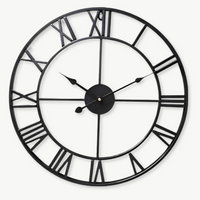
Forged iron or blackened metal pendulum clocks belong here. An industrial farmhouse pendulum clock with an open gear frame or a Roman numeral dial in black metal picks up the room's hardware language directly. These tend to be heavier and more architectural, usually 50-70 cm, and genuinely anchor a wall the way a piece of art would. The key is consistency: if your tap fittings, shelf brackets, and cabinet handles are all matte black, a gloss-finished clock face breaks the spell. Stay in the same finish family.


Caring for a Pendulum Clock in a Kitchen Environment
A kitchen pendulum clock faces more environmental stress than the same clock in a hallway or bedroom, mostly from cooking moisture and airborne grease, so a small amount of regular attention genuinely extends its life.
Once a month, wipe the clock face and pendulum with a dry microfiber cloth. If your kitchen produces a lot of steam or uses a wood-burning stove, check the back of the case twice a year for any discoloration or warping. Wooden cases are most vulnerable here: a small hairline crack in the finish is cosmetic, but persistent moisture getting into the wood itself can eventually affect the case's integrity.
For quartz movements, the main maintenance is battery replacement. Most kitchen pendulum clocks use a single AA or C battery for the movement and a second for the pendulum motor if the swing is electrically driven. Keep the same battery brand in both slots for more consistent performance. It's a small point, but it matters for clocks that run two independent circuits.
If the pendulum stops swinging but the clock still keeps time, the pendulum motor battery is likely low. If the clock loses time gradually, the movement battery is the one to replace. These are different cells on most designs, so it's worth checking both before assuming a fault. I've seen people return perfectly functional clocks because they replaced only one battery when both needed attention.

Beyond the Kitchen: When the Same Clock Works in Other Rooms
A rustic wooden pendulum clock chosen for a farmhouse kitchen often works equally well in an entryway or dining room, which matters if you're investing in a piece you want for years. The best farmhouse pendulum clocks read well across the ground floor of a house precisely because the material vocabulary is consistent.
If you're buying one clock and want it to work in multiple rooms over time, pick a neutral material: a mid-tone wood or a simple blackened metal rather than something very specific to one context. A cuckoo clock with heavy chalet carvings is wonderful in a mountain-style kitchen but reads oddly in a minimalist dining room. A clean bamboo pendulum clock moves rooms without any effort at all.
The full pendulum clock collection includes designs that cross between kitchen, dining, and living room easily. If you're working toward a broader look for the ground floor, the rustic wall clock range and the wooden wall clock selection are worth browsing together: the overlaps between all three reveal which styles have the most cross-room flexibility.
FAQ
Where should a clock be placed in a kitchen according to Feng Shui?+
Feng Shui generally recommends placing a kitchen clock on the east or southeast wall, away from the stove, sink, and main entry door. The east wall association with morning energy and growth aligns well with kitchen activity. Avoid positions directly above water or fire sources, both for Feng Shui reasons and practical ones: heat and moisture accelerate wear on any clock mechanism.
Who invented the pendulum clock?+
The pendulum clock was invented by Dutch mathematician and physicist Christiaan Huygens in 1656. He was inspired by Galileo Galilei's earlier observations around 1602 that a pendulum's swing period stays remarkably consistent regardless of arc size. Huygens translated that principle into a working clock mechanism, dramatically improving timekeeping accuracy over the verge escapements that preceded it.
Is a quartz pendulum clock as accurate as a mechanical one?+
For everyday kitchen use, a quartz pendulum clock is actually more accurate than most home mechanical movements. A good quartz movement typically gains or loses no more than a few seconds per month, while a home mechanical pendulum clock needs careful regulation and is sensitive to temperature, humidity, and vibration. In a kitchen specifically, the environmental factors make the quartz movement the more reliable choice for consistent timekeeping.
What size pendulum clock works best in a farmhouse kitchen?+
For most farmhouse kitchens, a clock between 40 cm and 60 cm in diameter or height strikes the right balance. Smaller clocks (under 30 cm) tend to disappear on the kind of open walls farmhouse kitchens usually have. Larger clocks above 70 cm work beautifully on wide feature walls but can feel imposing in compact galley-style kitchens. A pendulum adds 15-20 cm of vertical movement below the case, so factor that clearance in before choosing your hanging height.
Can I stop the pendulum swing on a quartz clock without affecting timekeeping?+
Yes. On a quartz pendulum clock, the pendulum is driven by a separate small motor that has no connection to the timekeeping circuit. Stopping the swing, or removing the pendulum entirely, has zero effect on how accurately the clock keeps time. This is one of the genuine practical advantages of quartz over mechanical: you can silence the visual motion in a busy kitchen without touching the timekeeping function.
What are some clock brands known for farmhouse-style pendulum designs?+
Traditional pendulum clock makers with a strong rustic heritage include Hermle and Kieninger in Germany, long associated with Black Forest-style movements and wooden cases. For contemporary farmhouse interpretations in natural materials, smaller design-focused brands have produced bamboo, reclaimed wood, and forged iron designs that bring the pendulum aesthetic into modern kitchens without the upkeep of vintage mechanical movements. The pendulum clock collection here covers both directions.