

You're standing in the clock aisle, or more likely scrolling at midnight, and you keep circling back to the same question: pendulum or not? Both tell time. Both hang on a wall. But they do completely different things to a room, and once you understand why, the choice gets a lot simpler.
The debate between a pendulum clock vs regular wall clock isn't really about timekeeping accuracy - it's about how much presence you want your clock to have, how much attention you're willing to give it, and which aesthetic feels honest to the way you actually live.
⭐ Key takeaways
- Pendulum clocks are statement pieces - they demand wall space, visual attention, and periodic leveling adjustments.
- Regular wall clocks are quietly versatile: smaller rooms, busy walls, and high-traffic areas are where they win.
- The pendulum's swing is decorative as much as mechanical - it adds life and rhythm to a room, but it isn't for everyone.
- Maintenance needs differ significantly: standard quartz clocks need almost nothing beyond a battery change.
- Both styles can be genuinely beautiful - the question is fit, not superiority.
What a Pendulum Clock Actually Does to a Room
A pendulum clock introduces visible, rhythmic movement to a space - something almost no other wall object achieves - making the room feel inhabited and alive even when no one is in it. The arc of the pendulum catches light differently with each pass. It draws the eye on a subconscious level. Guests notice it without quite knowing why.
That movement is the whole point, really. When Christiaan Huygens built the first working pendulum clock in 1656, he was solving a precision problem - pendulums swing at a consistent rate governed by their length, so they regulated early clockwork more reliably than anything before them. But what started as an engineering solution became an aesthetic signature. The pendulum stayed long after quartz movements made it technically unnecessary.
In a large living room or a formal hallway, that kinetic quality is genuinely valuable. The clock becomes a focal point without competing with furniture or artwork for static attention. It has its own pace. Rooms with high ceilings, exposed brick, or traditional millwork tend to absorb a pendulum clock naturally - the proportions make sense and the swing reads as deliberate rather than decorative-for-the-sake-of-it.

The specific rooms where pendulums work best
Living rooms with one strong anchor wall are the classic home for a pendulum clock. It needs some breathing room on either side - roughly 30 cm minimum - so the pendulum arc isn't visually cramped. Hallways with tall ceilings are another natural fit: a grandfather-style pendulum cabinet clock at the end of a corridor has been a design move for centuries for good reason.
Dining rooms work well too, particularly if the aesthetic leans traditional, Scandinavian farmhouse, or industrial. The steady rhythm during a meal feels comfortable rather than intrusive. Kitchens, though? Generally less ideal. A pendulum clock needs a perfectly level wall to swing correctly, and kitchens often have uneven backsplash surfaces, ventilation vibrations, or cluttered wall space that fight against it.
💡 Did you know?
Galileo Galilei observed the isochronous properties of pendulums as early as 1637 - watching a swinging chandelier in Pisa Cathedral and timing it against his own pulse. He never built a clock from the idea, but his notes laid the groundwork for Huygens' invention nearly twenty years later.
What Regular Wall Clocks Do (and Why That's Underrated)
A well-designed standard wall clock is one of the most adaptable objects in interior design - it slots into Scandinavian, industrial, minimalist, and farmhouse spaces alike without asking anything structural from the room around it. No swing radius to plan for. No leveling requirements. No question of whether the room is "big enough."
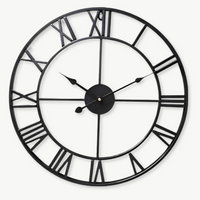
What most people underestimate is how much personality the category actually carries in its materials. A 60 cm open-frame steel clock with exposed gears reads immediately as industrial and architectural. A 50 cm silent-sweep gold metal piece feels quietly glamorous against a linen-white wall. A bamboo-and-wood clock brings warmth to a Scandinavian or Japandi space that a metal dial simply cannot. The form factor is neutral; the material and finish carry the entire personality.
Regular wall clocks are also just more practical in certain real-life conditions. Bedrooms are the clearest example. If you share a bedroom, a silent quartz sweep movement with no pendulum and no chime is simply the right call. Same logic applies to home offices, nurseries, and any space where background sound is already managed carefully.

The case for going bigger without going pendulum
One argument people skip over: scale and drama are not exclusive to pendulum clocks. A large-format clock - 60 cm, 80 cm, or beyond - fills a wall just as confidently, and in some contexts more so. The difference is that the drama is static rather than kinetic. The clock becomes architecture rather than sculpture-in-motion.
Living and dining rooms with a shared kitchen behind them, minimalist loft spaces, and contemporary homes with clean plaster walls often respond better to a large static clock than a swinging pendulum. The pendulum can feel period-incongruent in those settings - beautiful in isolation, but slightly at odds with everything else in the room.

Maintenance: The Honest Comparison
Maintenance requirements between a pendulum clock and a standard quartz wall clock are genuinely different - not dramatically so, but enough to matter in a busy household - and many buyers discover this only after the clock is on the wall. Worth talking through plainly before you commit to either style.
Standard quartz wall clocks: minimal upkeep
A quartz-movement wall clock, whether it has a sweep hand or a step hand, runs on a single AA or C battery. Most batteries last between 12 and 18 months. When the hands slow down or stop, you swap the battery. That is essentially the entire maintenance routine for the majority of modern wall clocks.
Silent sweep movements - which replace the second hand's step-tick with a smooth continuous rotation - add no extra maintenance burden. They just eliminate the sound. No oiling, no leveling, no seasonal adjustment required.
Pendulum clocks: what they actually ask of you
Battery-operated pendulum clocks are closer to standard clocks than you might expect. Many use a quartz movement that drives the pendulum cosmetically - the swing looks traditional, but the timekeeping is handled by electronics. These need very little attention beyond battery changes.
Mechanical pendulum clocks are a different matter. A true mechanical pendulum clock needs to hang on a plumb, level wall - even a few degrees of tilt can cause the pendulum to swing unevenly, which throws off the timekeeping. Temperature changes affect the pendulum rod length, which in turn affects the swing rate. Oiling the escapement and gear train every few years is recommended by most clock repair specialists. Some mechanical movements need winding weekly or monthly depending on the spring design.
None of this is prohibitively difficult, but it does ask something of you. If that level of involvement feels like a pleasure - like tending something with a pulse - a mechanical pendulum clock rewards that attention. If it sounds like a chore, go quartz.
| Feature | Pendulum Clock | Regular Wall Clock |
|---|---|---|
| Movement type | Mechanical or battery-quartz | Quartz (step or sweep) |
| Maintenance effort | Low (quartz) to moderate (mechanical) | Very low - battery only |
| Wall leveling required | Yes - especially mechanical | No |
| Sound profile | Tick, possible chime, swing sound | Silent sweep or soft tick |
| Visual impact | Strong - kinetic movement | Strong - size and finish dependent |
| Room size needed | Medium to large (swing clearance) | Any room size |
| Best room match | Living room, hallway, dining room | Any room including bedroom, kitchen |
| Style range | Traditional, farmhouse, rustic, Nordic | Minimal, industrial, contemporary, rustic |
Sound: The Detail That Changes Everything in Practice
Sound is the most underestimated factor in this choice, and the one that generates the most buyer regret when ignored. You can live with a clock you find slightly less beautiful than you hoped. You cannot easily live with a sound that disrupts your sleep or concentration.
A traditional mechanical pendulum clock produces three layers of sound: the tick-tock of the escapement, the whoosh or slight air displacement of the pendulum arc, and - in chiming models - the hourly or half-hourly bell or gong sequence. In a stone cottage or a timber-beamed farmhouse kitchen, that layering of sounds is part of the entire appeal. It feels like the house breathing.
In a modern apartment with hard floors and low ceilings, those same sounds amplify and reflect. What felt romantic in a showroom can feel relentless by 3 a.m. Reflective surfaces like polished concrete or ceramic tile make ticking louder than you'd expect - worth checking before you hang a mechanical movement in a kitchen or bathroom.
Aesthetic Fit by Interior Style: A Practical Guide
Matching a clock to your interior style is less about strict rules and more about understanding which details carry visual weight in a given aesthetic, and whether a pendulum adds to that weight or fights it. Here's what actually works across the most common interior styles in 2026.
Scandinavian and Nordic interiors
Both styles work here, with caveats. A Nordic pendulum clock with clean lines, natural wood, and a simple dial fits perfectly - the rhythm of the swing reads as calm rather than ornate. Avoid heavy baroque or dark-stained pendulum cases; they conflict with the lightness Nordic interiors depend on. Standard wall clocks in birch, bamboo, or warm-toned metal are equally at home and arguably more flexible across different wall configurations.
Industrial and loft aesthetics
This is where large-format standard wall clocks genuinely dominate. Exposed brick and open steel beams call for bold, graphic timepieces - oversized metal dials with minimal decoration, exposed gear mechanisms, or aged iron frames. A pendulum clock can work in an industrial space, but it tends to read as vintage-room-within-a-loft rather than cohesive to the aesthetic. The static drama of a 60 cm metal clock on brick is typically the stronger choice.
Traditional and farmhouse styles
Pendulum clocks were invented for these interiors. Dark wood cases, Roman numerals, chiming movements, and visible pendulum swings are completely at home in a farmhouse hallway or a traditionally furnished living room. Standard clocks work too, but they tend to disappear rather than anchor. If the room has crown molding, paneling, or antique furniture, a pendulum clock earns its keep.
Contemporary minimalist spaces
Minimalist interiors are, almost by definition, about reduction. A pendulum clock introduces visual complexity - the case, the pendulum, the arc of movement - that can feel like too much against a wall with nothing else on it. A single oversized minimalist wall clock in brushed metal or matte black often makes a stronger, cleaner statement. That said, a very simple pendulum clock with an open case and a clean dial can work beautifully as the sole object on a large white wall.


When the Pendulum Makes Sense for Your Space - Five Honest Signals
Rather than a checklist of rules, here are five real signals that a pendulum clock is probably the right fit for the space you have in mind. If three or more resonate, you're on solid ground.
- Your living room or hallway has one large, relatively empty wall - at least 100 cm wide - with nothing else competing for attention. The pendulum clock becomes the anchor rather than a cluttered addition.
- Your interior has a traditional, farmhouse, or Nordic character. The clock will feel like a natural extension of what's already there, not a deliberate styling effort.
- You genuinely enjoy the sound of a ticking clock. Some people find it deeply comforting. If you do, you'll probably love a mechanical pendulum. If you're neutral or sensitive to background noise, go quartz or silent sweep.
- The wall you have in mind is on an interior wall, not an exterior wall where seasonal temperature swings could affect mechanical movements.
- You're not planning to put the clock in a bedroom or home office where silence is part of the room's function.
"A clock that fits a room is invisible in the best possible way - you stop seeing it as an object and start feeling the room as complete."
Elena Rossi, CasaClock
Browsing the Full Range: Pendulum Clocks Worth Considering
If you've decided the pendulum route is right for your space, the range matters. A well-stocked pendulum clock collection spans everything from battery-operated Nordic designs to traditional wood-cased chiming movements, and the right one depends as much on wall dimensions as aesthetic preference.
Pendulum Clock
21 pendulum clock models - from silent Nordic designs to traditional wood-cased pieces - to find the one that suits your wall, your style, and your noise preferences.
21 products
Browse the collection →Frequently asked questions
How does a pendulum clock keep time?+
In a mechanical pendulum clock, the pendulum swings at a fixed rate determined by its length. Each swing releases one tooth of the escape wheel, which in turn advances the gear train by one counted step. That counted step drives the hands forward. The pendulum's consistency - typically one swing per second - is what keeps the clock accurate. In battery-operated pendulum clocks, the quartz movement handles timekeeping and the pendulum swings decoratively, powered separately by the same battery.
Why does a pendulum clock run slow, and how do you fix it?+
The most common cause is that the pendulum bob has shifted too low on its rod, making the swing arc longer and therefore slower. Most pendulum clocks have a small rating nut or adjuster at the base of the pendulum - turning it to raise the bob shortens the effective pendulum length and speeds the clock up. Other causes include an unlevel wall (which creates uneven swing arcs), worn gear pivots, or low battery in quartz-driven models. If raising the bob slightly doesn't fix a persistent slow rate, checking the wall level is the logical next step.
Why does the pendulum stop swinging after a few minutes?+
This almost always comes down to one of three things: the clock isn't hanging level (so the pendulum is swinging unevenly, losing energy with each arc), the mainspring or battery is too weak to keep the escapement releasing correctly, or there's a mechanical obstruction - a dust buildup, a bent hand touching the dial glass, or a worn pivot that's adding friction. Start by checking the level with a small spirit level held against the clock case. If the case is level and the pendulum still stops, replace the battery (or wind the spring if mechanical) and try again before looking at internal parts.
Can I use a pendulum clock in a bedroom?+
Technically yes, but it depends heavily on the specific clock and how sensitive you are to sound at night. A battery-driven pendulum clock with a quartz movement is often quieter than a standard ticking clock - the swing itself produces very little sound and the quartz tick is minimal. A mechanical chiming pendulum clock in a bedroom is a different story: the hourly chime will wake most light sleepers. If you want the aesthetic of a pendulum in a bedroom, look specifically for models described as "silent sweep" or "quartz pendulum" and check that chime functions can be switched off or don't exist on that model.
Is a pendulum clock more accurate than a regular wall clock?+
Not in a modern home context. A well-maintained mechanical pendulum clock is an impressive piece of precision engineering, but a standard quartz wall clock - even an inexpensive one - typically keeps better time day-to-day because quartz oscillators are essentially unaffected by temperature, humidity, or wall level. The accuracy advantage of pendulums belongs to their era: before quartz, they were the most reliable timekeepers available. Today, accuracy is the last reason to choose a pendulum. You choose a pendulum clock for the aesthetics and the experience.
Which is easier to install - a pendulum clock or a regular wall clock?+
A regular wall clock wins on installation simplicity every time. One hook, one nail, done. A pendulum clock - especially a mechanical one - needs a level hook, a plumb wall surface, and often a few minutes of adjustment once it's hanging to get the swing balanced left-to-right (called "in beat"). Most battery-driven pendulum clocks are more forgiving than their mechanical counterparts, but it's still worth having a small spirit level on hand when you hang any pendulum model.