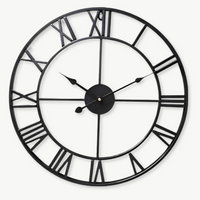


Walk into a well-designed lobby or cafe and you'll feel it before you can name it: the room has a focal point. Often, it's a clock. A large wall clock for commercial space decor does something no piece of art quite does - it combines visual authority with a function every visitor immediately understands. But choosing the wrong one is surprisingly easy to do, especially when the priorities shift from "looks nice at home" to "holds up in a busy, high-traffic environment."
Whether you're furnishing a co-working lobby, a coffee shop, a hotel corridor, or an open-plan office, the logic is different from decorating a living room. Scale matters more. Readability at a distance matters. Durability and maintenance matter. And the clock still needs to look intentional, not like it was grabbed from a hardware store at the last minute.
Here's what actually works, and why.
⭐ Key takeaways
- Commercial spaces need clocks that read clearly from at least 5-6 meters away - that usually means 50 cm (20 in) minimum diameter, often larger.
- Silent quartz movements are non-negotiable in spaces where conversation, focus, or atmosphere matter.
- Metal frames (iron, brushed steel, aluminium) outlast wood in high-humidity or high-traffic areas like kitchens, cafes, and corridors.
- The clock's style must align with the space's design language - an industrial clock in a minimalist hotel lobby creates friction, not character.
- Placement height and lighting conditions in commercial rooms are usually more extreme than at home: account for both before you buy.
Why Size Is the First Decision, Not the Last
In a commercial setting, a clock that looks bold in a product photo can disappear entirely on a 4-meter wall, and a clock that seems oversized at home becomes exactly right in an open-plan office. This is where most people go wrong: they size for a domestic wall, then hang it in a space with double the ceiling height and triple the floor area.
A useful rule of thumb: for every meter of wall width, you want roughly 10-12 cm of clock diameter. A feature wall that's 4 meters wide calls for a clock of at least 40-50 cm. A large lobby entrance or an industrial cafe with exposed ceilings often needs 60-80 cm to register as intentional decor rather than an afterthought.
Reading distance: the test nobody mentions
Stand where your visitors naturally spend time. In a waiting room, that might be 3-4 meters from the wall. In a cafe, it could be 6-8 meters across the room. The hands and numerals need to be readable from that distance without squinting. Clocks with open-dial abstract designs or very thin hands often look stunning up close and practically unreadable from the other side of the room.
Numerals or markers with strong contrast - black on white, white on matte black, gold on dark grey - consistently perform better in commercial readability tests. Minimalist designs work beautifully in smaller private offices or hotel rooms; for shared high-traffic areas, clarity wins over subtlety.

The Silence Question: Why Ticking Clocks Don't Belong in Commercial Spaces
A ticking clock in a quiet office or cafe is one of those things nobody mentions until it becomes unbearable, and then it's all anyone can think about. This is not a minor aesthetic preference. In an open-plan workspace, a mechanical tick at 40 dB registers clearly across the room during quiet periods. In a cafe where atmospheric music is part of the brand experience, it creates a competing rhythm that nobody consciously identifies but everyone subconsciously dislikes.
A silent wall clock with a sweep quartz movement is the standard to specify. The second hand moves in a continuous sweep rather than a step-click motion, producing zero audible tick. Battery-operated silent clocks are also far easier to maintain in a commercial context: no winding, no power cable routing through walls, no service calls.
Materials That Last: Matching Frame to Environment
The environment inside a commercial space is harder on materials than most people expect - temperature swings from HVAC systems, higher ambient humidity in kitchens and cafes, cleaning products used on nearby surfaces, and the occasional knock or vibration all add up over time.
Metal frames: the commercial default
Iron, brushed steel, and aluminium frames handle commercial wear reliably. They're easy to wipe down, they don't warp with humidity changes, and a good powder-coat finish resists scuffs. The industrial aesthetic of an open-dial metal wall clock also works naturally with exposed brick, concrete walls, and high-ceiling warehouse conversions - which describes a significant share of the cafe and co-working market right now.
A 50 cm metal clock at 9 mm slim profile sits nearly flush against the wall, creating minimal shadow and reducing the visual weight in rooms that are already heavily furnished. When clients ask us what large wall clock for commercial space fits an industrial loft fit-out, this profile almost always comes up first.
Wood frames: when conditions allow
Solid wood and bamboo clocks bring genuine warmth to boutique hotels, private meeting rooms, and wellness studios. They're not the right call for a kitchen, a cafe directly above a coffee machine, or any wall that gets direct sunlight for most of the day. In stable indoor environments with controlled temperature and low humidity, real wood ages well and develops character rather than deteriorating.
Bamboo is denser and more moisture-resistant than most softwoods, making it a reasonable commercial choice in slightly warmer environments: a yoga studio, a spa reception, a wine bar with good ventilation.


Matching Clock Style to Commercial Interior: A Practical Breakdown
The most common mistake in commercial clock selection is picking a style that fights the room rather than completing it - a heavily ornate pendulum clock in a sleek tech office, or a clean Scandinavian dial in a rustic brick-walled tavern. Neither is wrong in isolation. Both are wrong for that specific context.
| Space type | Recommended style | Material to prioritise |
|---|---|---|
| Open-plan office | Minimalist or Nordic abstract | Metal, slim profile |
| Industrial cafe or bar | Industrial exposed-gear or open-dial metal | Iron, brushed steel, or reclaimed wood |
| Boutique hotel lobby | Octagonal or geometric designer clock | Metal with gold or brass finish |
| Wellness studio or spa | Bamboo or natural wood, minimal | Bamboo, solid wood |
| Co-working space | Geometric or mirror-finish modern | Metal or acrylic, 50 cm+ |
| Restaurant / bistro | Vintage or Roman numeral statement | Aged metal or distressed wood |
💡 Did you know?
The large public clock as a commercial fixture has roots in 18th-century railway stations and town halls, where a single readable timepiece served an entire crowd. The logic hasn't changed: one well-placed clock at the right scale beats a dozen small clocks scattered around the room. Modern commercial designers often apply the same principle, using one oversized statement piece rather than multiple smaller ones.
Placement Rules for High-Ceiling and Large-Format Rooms
Commercial spaces break most of the domestic placement rules, and the center-of-wall logic that works in a living room often produces a clock that floats disconnected in a tall space. The fix is to anchor the clock to an architectural element or a piece of furniture below it.
How high is too high?
In a room with 3-meter ceilings, a clock hung at eye level (roughly 150-160 cm to the center) works exactly as it does at home. In a room with 4-5 meter ceilings, you can go higher - but the center of the clock face should stay at or below 200 cm. Higher than that and the dial becomes hard to read at an angle without tilting your head back, which nobody does naturally while moving through a lobby.
The wall below the clock matters as much as the clock itself. A reception desk, a console table, a shelf, or even a row of coat hooks creates a visual anchor that makes the clock feel placed rather than floating. Without it, even a beautifully chosen piece looks like it was hung first and thought about second.
Lighting: natural vs. artificial in commercial rooms
Most commercial spaces rely on overhead artificial lighting with occasional windows, the opposite of a domestic setting with strong diffused daylight. A clock face that looks warm and readable under natural light can disappear under cool LED overheads if the contrast isn't strong enough. High-contrast dial finishes - matte black with white or gold markers - hold up consistently across different lighting temperatures. Reflective mirror or polished chrome finishes can create glare under overhead spots, which looks striking in photos but frustrates people who need to actually read the time.


Three Scenarios, Three Different Answers
There is no single "best" oversized commercial clock: the right answer changes completely depending on what the space is trying to do and who it's trying to impress. Here are three scenarios that come up most often, and what genuinely works in each.
The corporate office: authority without decoration
Executive offices and client-facing meeting rooms need clocks that communicate competence quietly. That means clean lines, no visible gear mechanisms, minimal ornamentation, and a scale that reads as deliberate without being theatrical. A 50 cm metal clock with an abstract open dial in matte black or brushed steel hits this tone exactly. The silent wall clock movement is non-negotiable here: a ticking clock in a boardroom signals distraction, not efficiency.
One co-working operator who furnished twelve meeting rooms told us the single most-commented-on detail wasn't the furniture or the lighting - it was the clocks. "Guests kept asking what brand they were," she said. "It made the rooms feel considered." That's exactly what a well-chosen commercial office clock does: it signals intention without announcing itself.
The independent cafe: personality and practicality
A well-run cafe uses its decor to tell a story. Clocks work particularly hard in this context because customers are frequently checking the time (catching a train, finishing a meeting break, timing a coffee before a commute). The clock needs to be readable at a glance from multiple seating positions, which usually means 60 cm or larger and a high-contrast dial. Vintage-style or industrial metal clocks with Roman numerals sit naturally in the warm, slightly worn aesthetic of most independent coffee shops. Browse the large wall clock collection for options in the 50-90 cm range that balance readability with genuine character.
The boutique hotel lobby: first impressions last
Hotel lobbies are the one commercial context where a clock can be purely sculptural without sacrificing function - because guests check their phones, not the wall, for precise timing. This opens up more expressive options: geometric shapes, gold finishes, open architectural frames. The designer wall clock range covers exactly this territory, with pieces that hold a room's attention without competing with reception furniture or artwork.
"A clock is the only object in a room that everyone looks at, but nobody really sees."
Common observation among commercial interior designers - it points to why the wrong clock disappears, and the right one holds the room together.
Practical Decisions Before You Order
Getting the right oversized clock for a commercial space comes down to five practical decisions made in the right order - none of them complicated, but skipping one usually means returning a product or rehanging it twice.
- Measure the wall and the viewing distance. Write both down before you start looking at products.
- Identify the dominant material palette in the space: warm wood tones, cool concrete and metal, or a mix. The clock frame should pull from that palette, not introduce a new one.
- Check the lighting conditions at the time of day when the space is busiest. Is it cool overhead LED, warm tungsten, or natural daylight? High-contrast dials perform better under artificial light.
- Confirm the movement type before ordering. Silent sweep quartz is the standard to insist on. Battery-operated is simpler to maintain in a commercial setting than any hardwired or mechanical option.
- Plan the anchor element below the clock. A reception desk, a console table, or even a cluster of plants gives the piece visual grounding. Without it, even a beautifully chosen clock reads as forgotten.
For spaces that need multiple clocks across different rooms or floors, keeping to a consistent style family rather than mixing aesthetics across the building produces a more coherent impression. The industrial wall clock collection and the large wall clock range both offer enough variation in size and finish to furnish an entire commercial fit-out within a single visual language.
FAQ
What size clock do I need for a commercial space?+
For most commercial spaces, 50 cm (20 in) is the practical minimum. Large lobbies, open-plan offices, and cafes with long sightlines often need 60-80 cm to read clearly from across the room. A useful starting point: aim for roughly 10-12 cm of diameter per meter of wall width.
Are silent clocks suitable for busy commercial environments?+
Yes, and they're actively preferable. Silent sweep quartz movements have no audible tick - the second hand moves in a continuous motion rather than step-clicking. In offices, cafes, and hotel lobbies where ambient atmosphere matters, this eliminates a persistent low-level distraction that most people don't consciously notice until it's pointed out.
What material holds up best in a commercial setting?+
Metal frames (iron, brushed steel, powder-coated aluminium) are the most durable choice for high-traffic or variable-humidity environments like cafes, corridors, and kitchens. Solid wood and bamboo work well in stable indoor environments - private offices, wellness studios, boutique hotel rooms - but are less suited to spaces with frequent temperature swings or cleaning product exposure.
How high should I hang a large wall clock in a tall commercial room?+
Keep the center of the clock face at or below 200 cm from the floor, even in rooms with 4-5 meter ceilings. Higher than that and the dial becomes awkward to read without tilting your head back, which people won't do in a natural flow of movement. Anchoring the clock to a furniture element or architectural feature directly below it - a reception desk, a console, a shelf - helps it read as placed rather than floating.
Can I use one clock style across multiple rooms in a commercial fit-out?+
Yes, and it usually looks better than mixing styles. Choosing clocks from within the same design family - the same material palette, finish, and dial language - creates visual coherence across a building without making every room identical. You can vary size (smaller for meeting rooms, larger for the lobby) while keeping the aesthetic consistent.
What's the difference between an open-dial wall clock and a standard clock face?+
An open-dial wall clock has no solid disc backing behind the hands - the frame, numerals, and hands are visible against the wall itself, giving the piece a lighter, more architectural look. This works well in industrial and minimalist commercial interiors where you want presence without mass. The trade-off: contrast relies entirely on the wall colour behind it, so a pale wall with pale hands can reduce readability from a distance.