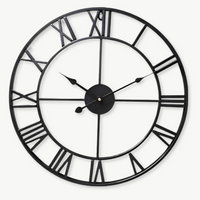


A staircase wall is one of the most overlooked canvases in any home. It's tall, it's visible from multiple angles, and it sits in your peripheral vision every single day. A large round wall clock for a staircase wall does something most art prints and gallery walls simply can't: it anchors the entire vertical space with a single, confident focal point. No need to layer fifteen frames. One well-chosen clock, hung at the right height, turns that awkward climbing wall into the most interesting part of your home.
The challenge is getting it right. Too small and the clock gets swallowed by the architecture. Too ornate and it fights with the staircase's own lines. Here's what actually works, style by style.
⭐ Key takeaways
- Staircase walls need clocks at least 45 cm (18 in) in diameter - and often 50-60 cm for real drama.
- Round shapes contrast the staircase diagonal lines better than square or rectangular designs.
- Clock center should sit at adult eye level on the landing, not mid-flight.
- Silent quartz movement is non-negotiable: tick noise bounces hard off staircase surfaces.
- Match material to your railing: wood rails want warm wood or bamboo, metal railings want metal dials.
Why Round Beats Every Other Shape on a Staircase Wall
A staircase is built from diagonal lines, sharp angles, and repeating geometric steps, which makes a circle the one shape that breaks the pattern without competing with it. Square clocks echo the stair risers and feel redundant. Rectangular pieces, however beautiful, read as a painting replacement rather than a statement. A round clock creates visual relief: the eye relaxes when it finds a curve in a sea of angles.
There's also a practical reason. Staircases are typically viewed from below, from above, and from the side, all at the same time if you have an open-plan layout. A circle looks equally composed from every viewing angle. A rectangle only reads well head-on. You don't get to control where your guests stand when they first see it, so a shape that works from everywhere is simply the smarter bet.
💡 Did you know?
The staircase wall tradition of displaying a single oversized clock dates back to Victorian railway stations and public buildings, where a large clock above the stairs served as a communal time-check before pocket watches became common. Homeowners brought the gesture indoors during the Arts and Crafts movement of the early 1900s, treating the clock as architectural rather than purely decorative.

Sizing Rules: How Large Is Large Enough for a Staircase Wall
On a staircase wall, a clock smaller than 45 cm (18 inches) in diameter will look like it belongs on a kitchen counter, not a statement wall. The minimum threshold for real visual impact at height is around 50 cm (20 inches). Most staircase walls span at least 2.4 meters of vertical height, and the eye calibrates scale against that backdrop automatically. I've watched people hang a 35 cm clock on a generous staircase wall and immediately feel like something was off, even before they could name the problem. Size confidence is part of the piece's personality.
The Proportional Formula That Works
A useful rule: the clock diameter should be at least one-quarter of the wall's horizontal width at the point where it hangs. If your staircase wall is 2 meters wide at the landing, a 50 cm clock sits comfortably. If the wall narrows to 1.2 meters at mid-flight, 45 cm is the practical ceiling before the piece starts feeling cramped against the edges.
For walls wider than 2.5 meters, think grand entry halls or double-height stairwells, push to 60 cm or beyond. A 60 cm clock on a wide staircase wall reads as architecture, not decoration. It holds the room in a way a cluster of small prints never will.
When to Use a Single Clock vs. a Grouped Arrangement
One large clock almost always beats a cluster of smaller clocks on a staircase. The diagonal movement of the stairs already gives the wall enough visual energy. Adding multiple clocks creates noise rather than rhythm. The exception: if you have a very long staircase wall with two distinct landing areas, you might pair one large clock (50-60 cm) near the top landing with a smaller accent piece (30 cm) further down, treating them as a loose series rather than a symmetrical pair.
⚠️ Common mistake
Going one size smaller than your gut says. Nearly everyone who does the paper-template test (tape a paper circle to the wall and live with it for a day) ends up ordering bigger than their first instinct. The staircase's height makes clocks read smaller than they do at furniture level. When in doubt, size up. You'll thank yourself every time you pass.

Placement Height: Where to Actually Hang It
The single most common mistake is hanging a staircase clock at mid-flight height, where it's only readable for a brief moment while climbing. The correct position is at the first-floor landing level, where the clock can be read both from the bottom of the stairs and from the upstairs hallway. Think of it as placing a painting that needs to work from two rooms at once.
Think of it this way: you want the clock to be functional, not just decorative. If you have to be three steps up to read it, it stops doing its job half the time. Aim for the clock center to sit at 155-165 cm from the landing floor, standard adult eye level. From the bottom of the stairs, you'll look slightly up to it, which is actually ideal for creating that sense of architectural drama.
Accounting for the Staircase Angle
On walls that slope with the staircase pitch, placement becomes trickier. Keep the clock on the flat vertical section near the top landing rather than on the raked section that follows the stairs. Hanging on a raked wall means the clock will never quite look level, and even a few millimeters of visible tilt on a 50 cm clock reads wrong from twenty feet away. When a customer asked about this recently, the answer was always the same: find the nearest flat section, even if it means going slightly higher than ideal. Level always wins.

Material Matchup: Connecting the Clock to Your Staircase
The material of your clock should echo at least one element already present in the staircase, not mirror it exactly, but rhyme with it. A matching material creates harmony; a contrasting one creates intentional tension. Both can work. What doesn't work is ignoring the staircase entirely and hanging a clock that belongs in a different room.
Wood Railings and Treads
If your staircase features oak, walnut, pine, or painted wood railings, warm materials like bamboo or solid wood clock faces feel native to the space. The grain picks up the warmth of the handrail and the treads. Natural bamboo and solid wood clocks in the 40-50 cm range are particularly good here because they read as intentional without being matchy-matchy. A matte black finish on a wood clock adds contrast without introducing a new material family.
Metal Railings and Industrial Staircases
Wrought iron, brushed steel, or powder-coated metal railings call for metal clock faces. The visual language is already industrial or contemporary, and a soft wood clock can feel out of place, like a picnic basket at a penthouse party. Open-frame metal clocks, abstract dial designs, and models with exposed geometric structures all sit naturally in this context. Brushed gold and matte black finishes both work well against dark metal railings.
Painted or Plaster Walls with No Visible Railing
When the staircase wall is simply a long expanse of white or off-white plaster, you have the most freedom. This is where a large round statement clock in any material can do its best work. The wall becomes a blank background, and the clock does all the talking. Consider the clock as you'd consider a painting: what mood do you want at the base of your stairs? Calm and Scandinavian, warm and organic, or something with a bit of industrial edge?

Three Clock Styles That Consistently Work on Staircase Walls
A staircase wall has genuinely different demands from a living room: the viewing angles are wider, the wall proportions are taller, and you're usually moving past it rather than sitting in front of it. That changes which clock styles perform well. Three in particular keep earning their place in this specific context, across different home styles and staircase widths.
The Open-Frame Metal Dial
An open-frame metal clock, one where the dial is built from geometric lines rather than a solid face, works brilliantly on staircase walls because it doesn't block the wall behind it. The clock registers as a strong graphic element, but the wall color or texture still comes through in the negative space. This is especially useful on narrower staircase walls where a solid disc of 50-60 cm would feel heavy and crowding.
Abstract Nordic metal dials, orbital frame designs, and open-circle formats all fall into this category. They're also easier to read from unusual angles, since the hands and numbers are never obscured by a solid face.
The Solid Wood Round
A solid, face-forward round wood clock, in bamboo, oak, walnut, or natural log, reads as warm and grounded on a staircase wall. It's the opposite design choice from the open-frame: instead of lightness, you get substance. Solid wood rounds work best on wide, light-colored walls where the material's warmth doesn't get lost. They're also the most forgiving of different interior styles: a warm bamboo round sits comfortably in Scandinavian, rustic farmhouse, and even contemporary spaces.
The Pendulum Clock with Visible Swing
A pendulum clock on a staircase wall adds something the other styles don't: movement. The pendulum swings at the edge of your vision as you pass, which creates a small moment of visual delight every time you use the stairs. It doesn't need to be a traditional grandfather clock style. Modern acrylic or bamboo pendulum designs keep the movement without the heritage weight.
One practical note: pendulum clocks need a stable, vibration-free wall. Staircase walls that shake perceptibly when people walk heavily can interfere with the pendulum's rhythm. In most residential homes this isn't an issue, but it's worth checking before committing. A pendulum clock hung on a solid brick or concrete staircase wall rarely has any trouble; drywall on a lightweight timber frame is the case worth testing first.


Silence Matters More on a Staircase Than Anywhere Else
Staircase walls are acoustic amplifiers: hard surfaces on three sides with minimal soft furnishing to absorb sound, meaning a ticking clock echoes through the entire home. This is non-negotiable: any large clock you hang there must have a silent quartz sweep movement.
A sweep movement means the second hand glides continuously rather than clicking forward in steps. Zero tick, zero echo, zero 2 a.m. regret. Most contemporary large-format wall clocks now include sweep movements as standard, but it's always worth checking the product specification before buying. "Quartz" alone doesn't guarantee silence.
| Feature | Standard Quartz | Silent Sweep Quartz |
|---|---|---|
| Second hand motion | Step (click per second) | Continuous glide |
| Noise level | Audible tick | Completely silent |
| Best location | Workshop, garage, utility room | Staircase, bedroom, open plan |
| Typical battery life | 12-18 months | 12-24 months |
| Staircase suitability | Not recommended | Strongly recommended |
Staircase Styles Matched to Clock Designs
The staircase style you're working with narrows the clock choice considerably: what reads as sophisticated in a minimalist white hallway can look completely lost in a Victorian terrace with dark wood paneling. A quick style audit before you shop saves a lot of time and at least one return label.
Modern Minimalist Staircases
Clean-line floating stairs, white walls, cable or glass railings: this is the environment where open-frame metal clocks perform best. Think abstract dials, orbital designs, and geometric frames with minimal text. Matte black and brushed steel finishes both work well. The clock needs to read as architectural detailing rather than applied decoration.
Traditional and Period Staircases
Turned wooden spindles, painted newel posts, carpet runners on the treads: a period staircase has a lot of texture and detail already. The clock needs enough visual weight to compete without adding clutter. A solid round wood clock in a warm finish, or a vintage-style metal clock with Roman numerals and aged patina, both feel at home here. Avoid hyper-modern acrylic designs; they jar against the period warmth.
Rustic and Farmhouse Staircases
Rough-hewn wood, stone floors, exposed beams: the rustic staircase rewards clocks with natural material stories. A hand-shaped solid wood clock or a natural bamboo round both carry the right texture. The grain is the detail here; a clock that looks perfectly machined and uniform will feel off in a space that celebrates natural imperfection.
Industrial Loft Staircases
Metal treads, open risers, brick or concrete walls: this is where bold scale, raw materials, and exposed mechanics come into their own. A large metal clock with exposed gears, Roman numeral dials, or a heavy frame presence works well. Industrial wall clocks in 50-60 cm diameters earn their place here by matching the scale of the architecture rather than trying to soften it.

Lighting the Clock: How to Make It Shine Day and Night
A large round wall clock on a staircase wall looks very different under natural daylight versus evening artificial light, and most people only think about one of those conditions when choosing a piece. Getting both right takes a moment of planning but completely changes how the clock reads after dark.
Natural light from a staircase window or skylight will pick out the texture of a wood grain or the sheen of a metal frame beautifully. This is called raking light: it hits at an angle and reveals surface detail. Matte finishes tend to look warmer in raking light; polished or brushed metal surfaces catch highlights and create presence.
For evening lighting, consider whether your staircase has a ceiling light directly above the landing. If so, you may already have enough downlight to read the clock comfortably. If the staircase runs between floors with only wall sconces, the clock face might be in shadow. A small directional picture light mounted above the clock, angled 30 degrees downward at the face, solves this entirely and adds a sense of gallery intentionality to the placement.
"The staircase is the spine of a home. Everything leads to it, and everything leads from it."
Traditional saying in European interior design circles
The Hanging Itself: Weight, Fixings, and the One Measurement You Must Check
A 50-60 cm wall clock weighs between 1.5 kg and 4 kg depending on material, which means a single wall anchor rated for at least 5 kg is the absolute minimum. Checking your staircase wall type before drilling is the step most people skip, and it's the one that creates the most drama when ignored.
Plasterboard (drywall) staircase walls are common in newer builds. They need a proper wall anchor rather than a standard screw, because the hollow cavity behind provides no grip for a wood screw alone. Solid brick or concrete walls, typical in older homes, take a rawl plug and screw with no drama, but you'll need a hammer drill. Lath-and-plaster walls found in Victorian and Edwardian homes need the most care: locate a stud with a stud finder before drilling, or use a specialist plaster anchor.
The one measurement to check before drilling: distance from the hanging point to the clock's visual center. Most large round clocks hang from a single hook near the top of the frame, which means the clock center sits 25-30 cm below the nail. Mark your target center height, measure up by that offset, and that's where the nail goes. Sounds obvious until you've hung a 55 cm clock at the wrong height and have to fill the hole and start again.
FAQ: Large Round Wall Clocks for Staircases
What size large round wall clock works best for a staircase wall?+
For most residential staircases, a clock between 50 cm and 60 cm (20-24 inches) in diameter provides genuine visual impact without overwhelming the wall. Narrower staircase walls can work with 45 cm; wide landing walls or double-height stairwells can handle 60 cm and beyond. Use the one-quarter rule: clock diameter should be roughly one-quarter of the wall's horizontal width at the hanging point.
What size is too large for a staircase wall clock?+
A clock becomes too large when its diameter exceeds one-third of the wall's horizontal width at the hanging point. On a standard 1.2 m wide staircase wall, that puts the ceiling at roughly 40 cm, which is why wider landing walls are the better location for 60-70 cm pieces. On very wide walls (2.5 m plus), even 80-90 cm clocks can work if the design is open-frame rather than solid-face, since negative space keeps the piece from feeling oppressive.
How high should a wall clock be hung on a staircase wall?+
Position the clock center at 155-165 cm from the landing floor level, standard adult eye height when standing on the landing. Avoid hanging the clock at mid-flight height, where it's only readable for a brief moment while climbing. The goal is a clock that works from both the bottom of the stairs and from the upstairs hallway.
Can I hang a clock on a raked (sloped) staircase wall?+
Technically yes, but it's rarely a good idea. A clock hung on the raked section of a staircase wall will always appear slightly tilted from the landing viewpoint, no matter how carefully you level it. The raked surface itself is angled, so "level on the wall" and "level to the eye" are two different things. The practical solution: place the clock on the flat vertical section near the top or bottom landing, not on the diagonal section that follows the stair pitch. Even a small flat section of 60-70 cm is enough for a well-chosen clock.
Do I need a silent clock for a staircase wall?+
Yes, strongly. Staircase walls have hard surfaces on multiple sides and rarely have soft furnishings to absorb sound. A ticking clock in that environment echoes through the whole home. Look specifically for a silent sweep quartz movement, where the second hand glides continuously rather than stepping forward in one-second clicks.
Can I hang a pendulum clock on a staircase wall?+
Yes, and the effect can be genuinely beautiful. The swinging pendulum adds movement to a space you pass through rather than sit in. The main check: make sure your staircase wall doesn't transmit heavy vibration from footfall on the stairs or nearby doors. In most homes this isn't a problem. Modern bamboo and acrylic pendulum designs keep the visual interest without the traditional heritage weight.
What material should a staircase wall clock be made from?+
Match the material to your staircase. Wood railings and treads pair well with bamboo, solid wood, or warm-finish clocks. Metal railings suit open-frame metal or geometric metal dials. Painted plaster walls with no railing give you the most freedom: that's where you can choose based on mood, organic wood for warmth, abstract metal for a contemporary feel, or a vintage-style piece for character.