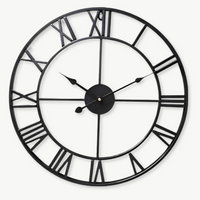


Choosing how big a wall clock should be for your living room is the kind of decision that looks simple until you're standing in a hardware store holding a tape measure and second-guessing everything. You bring a clock home, hang it on the wall, step back, and one of two things happens: it disappears into the paint, or it takes over the room like it owns the place. Neither is what you wanted.
Here's what actually works: sizing a clock to your wall is less about personal taste and more about proportion. Once you understand the ratios, the choice becomes obvious. This guide breaks it down by wall dimension, furniture scale, and ceiling height, so you walk away with a number, not just a feeling. And if you've ever wondered why some living rooms just feel right the moment you walk in, proportion is almost always the answer.
⭐ Key takeaways
- A clock face should cover roughly one-third to two-thirds of the wall width behind it.
- In most living rooms, a 40-60 cm (16-24 in) clock hits the right visual weight.
- The furniture below a clock anchors its scale: match the two together, not just the wall.
- High ceilings call for larger clocks; low ceilings reward restraint.
- A clock placed above a sofa reads differently from one placed on an empty accent wall - each has its own sizing logic.
The One-Third Rule: Reading Your Wall Before You Buy
The fastest way to size a wall clock is to measure the wall section where it'll hang, then aim for a diameter between one-third and two-thirds of that width. Below one-third, the clock reads as an accessory. Above two-thirds, it starts to feel like wallpaper. The sweet spot sits somewhere in that middle band, and where exactly depends on whether the clock is sharing the wall with other elements or standing alone as a focal point.
Here's how that plays out in practice. Say you have a sofa wall that's 280 cm (about 110 inches) wide. One-third is 93 cm; two-thirds is 186 cm. That's a wide range, but it tells you something useful: a 40 cm clock would be too small, and a 180 cm clock would be absurd. For this wall, the realistic target is 60-90 cm, depending on how much else is competing for attention.
If the wall is narrower, say 150 cm, a 50-60 cm clock fills it confidently. For a very narrow accent wall, 90 cm wide or less, a 30-40 cm clock creates presence without crowding. It's worth knowing that decorative wall clocks have been used as room anchors since at least the 17th century, when French horlogers placed large pendules murales above mantlepieces precisely because they understood what a well-proportioned clock does to a room's sense of order.

What changes when the wall is empty
An empty wall without furniture below it has a different visual center of gravity. On a completely bare wall, a clock needs more diameter to hold the space because there's nothing else to balance it visually. Designers often recommend going 10-15 cm larger than you'd choose for a furnished wall for exactly this reason.
If you plan to add art, shelves, or a console table below later, size the clock for the finished room, not the current empty state. Otherwise you'll be replacing it in six months.
Room Size vs. Clock Size: The Numbers That Actually Help
Your room's dimensions give you a useful starting range; the specific furniture arrangement inside tells you where within that range to land. A 30 m² living room and a 15 m² one call for very different clocks, but neither is strictly governed by floor area alone. Think of it as two filters: room size narrows the field, furniture arrangement picks the winner.
| Room / Wall Width | Recommended Clock Size | Best Use Case |
|---|---|---|
| Small living room (wall under 180 cm) | 30-40 cm (12-16 in) | Single accent wall, compact apartment |
| Medium living room (wall 180-280 cm) | 40-60 cm (16-24 in) | Above sofa, solo focal point |
| Large living room (wall 280-400 cm) | 60-80 cm (24-32 in) | Statement piece, open-plan space |
| Very large or open-plan (wall over 400 cm) | 80 cm+ (32 in+) | Architectural anchor, loft-style space |
These are starting points, not rules etched in stone. The right size for your space also depends on how busy the wall already is. A gallery wall with eight frames calls for a larger clock to compete. A minimalist white wall calls for intentional sizing, not just whatever's in stock. Get that balance right and the whole room settles.
💡 Did you know?
Interior designers often use the "newspaper test" to mock up clock sizes before buying. Tape sheets of newspaper together to the diameter you're considering, stick them to the wall with painter's tape, and live with it for a day. The shape on the wall tells you more than any tape measure reading will.
How the Furniture Below Changes Everything
When a clock sits above a sofa, console table, or fireplace mantle, its size needs to relate to that piece of furniture, not just the wall. The general principle: the clock should be narrower than the furniture it hovers over. Slightly narrower. If your sofa is 220 cm wide, a 60-70 cm clock will feel balanced. An 80 cm clock on that same sofa starts to feel like it's competing instead of complementing.
The gap between the furniture and the clock matters too. Aim for 20-30 cm between the top of a sofa back and the bottom edge of the clock. Any closer and the arrangement feels cramped. Any further and the connection between the two elements breaks, and the clock floats.
Above a fireplace: a different calculation
Fireplaces have their own proportional logic. The mantle shelf is usually 120-150 cm wide. A clock centered above it at 50-60 cm diameter sits well, though many people go slightly larger here because the fireplace opening creates a strong visual anchor below. Going up to 70-75 cm above a standard fireplace often works when the room has high ceilings, because the vertical space needs filling too, not just the horizontal.

Ceiling Height: The Variable Everyone Forgets
Ceiling height affects how large a clock can look before it starts to feel heavy, and it changes the ideal hanging height too. Standard ceilings run 240-260 cm. In that context, a 60 cm clock reads as substantial. In a room with 320 cm ceilings, that same clock shrinks visually because there's so much vertical space around it.
Rooms with low ceilings (under 240 cm) are more forgiving of smaller clocks, but there's a trap here: going too small in a low-ceilinged room makes the space feel cramped rather than cozy. Aim for 40-50 cm in a low-ceilinged space, and hang the clock at eye level rather than high up, which only exaggerates how low the ceiling feels.

The hanging height question
The standard advice is to hang a clock so its center sits at eye level, roughly 155-165 cm from the floor. That works well for a clock on its own. When the clock is placed above furniture, the furniture below determines the hanging height more than any formula does. The gap rule (20-30 cm above the furniture) takes precedence.
One practical shortcut: hold the clock at its intended height before drilling anything. Step back to the opposite side of the room. If you have to look up to read it, it's too high. If it competes with the sofa back visually, it's too low. The right height is where your eye lands naturally when you walk into the room.
Clock Shape and How It Shifts the Size Equation
Round clocks follow the diameter rules above, but square and rectangular clocks take up more visual space per centimeter than their circular counterparts. A 60 cm square clock reads heavier than a 60 cm round one because its corners push into the corners of your peripheral vision. If you're drawn to square designs, size down by about 10-15 cm relative to what the wall measurement would suggest for a round clock.
Starburst and sculptural metal clocks are their own category entirely. These designs extend outward with decorative arms or rays, so the visual footprint is significantly larger than the clockface itself. A starburst with a 30 cm face might span 70 cm tip-to-tip. Size starbursts by their full span, not the face diameter alone.
For minimalist or Scandinavian-style clocks with open faces and thin frames, the dial can go slightly larger than the formula suggests. Their low visual density means they don't crowd a wall the way a heavily decorated clock would at the same size. An industrial-style clock in raw metal or aged iron, on the other hand, carries real visual weight even at modest sizes, so treat it more like a square format: apply the 10 cm size-down principle and you'll land right.

Open-Plan Living Rooms: When the Wall Is Just One Part of a Bigger Space
Open-plan spaces present a sizing challenge because the "room" doesn't end at a door, and the clock has to hold its own against a much larger visual field. A clock that works perfectly in a defined 20 m² living room can look like a postage stamp when that same space flows into a kitchen and dining area with no walls separating them.
The practical solution is to identify the specific wall section the clock will occupy, measure that section independently, and size accordingly. The one-third to two-thirds rule still applies, but now you apply it to the visible wall panel rather than the full room width.
In open-plan spaces, going larger almost always works better than going smaller. A 70-80 cm clock becomes an anchor point that pulls the seating area into focus and gives the eye a clear focal point. Anything under 50 cm in a truly open-plan room tends to read as decoration rather than design intention.

When to Break the Formula (and When Not To)
Proportion rules exist to prevent mistakes, not to eliminate personality. A deliberately oversized clock used as a piece of graphic art on an otherwise bare industrial wall is a real design choice. An intentionally small clock clustered into a gallery arrangement of prints and mirrors makes complete sense too. Context is everything.
Where the formula is hardest to ignore: above a sofa in a symmetrically arranged room. That placement has almost no visual forgiveness. Too small, and it reads as an afterthought. Too large, and it competes with the sofa rather than complementing it. In symmetrical setups, the ratios are non-negotiable.
Where you have more latitude: a single blank accent wall with no furniture below it, a hallway transition wall, or a corner nook where you're deliberately playing with scale as a design element. Those are the spaces where sizing up by 20-30% beyond the formula can create a genuinely striking moment.

The Quick Reference: Size by Placement Type
Different placements in a living room each have their own sizing sweet spot, and knowing them removes most of the guesswork before you ever pick up a tape measure. Here's what works, placement by placement.
- Above a 2-3 seat sofa (180-220 cm wide): 40-60 cm clock, centered horizontally, 20-30 cm above the sofa back.
- Above a fireplace mantle (120-150 cm wide): 50-70 cm clock, centered, at least 15 cm above the mantle surface.
- Standalone on a large empty wall (over 300 cm wide): 60-90 cm clock, hung at eye level, ideally complemented by one other element (a plant, a shelf) to avoid floating.
- As part of a gallery wall: 30-45 cm clock, treated as one element among many, sized to its panel within the arrangement, not the full wall.
- Above a console or sideboard (120-180 cm wide): 40-55 cm clock, positioned so its lower edge sits 20 cm above any objects on the console surface.
- In a corner with low ceiling: 30-40 cm clock, hung lower than standard; the intimacy of scale matches the intimacy of the corner.
"A clock too small for its wall is invisible. A clock too large for its wall is loud. Neither tells you the time the way you actually want to know it."
A principle repeated across interior design studios from Milan to Copenhagen
Sizing a Clock for a Living Room You're Still Decorating
Buying a clock for a room still in progress is one of the most common sizing traps, and the fix is simpler than you'd think. You pick a size that works now, but the room will look different once the sofa arrives, once the curtains go up, once the rug defines the seating zone.
The best approach: decide where the clock goes before you commit to a size. Then take a photo of that wall from the sofa position. Print it or use your phone screen. Sketch in rough circle sizes digitally, or stick the paper cutout method. Sizing against a photograph of the actual wall rather than a mental image gives you a much more accurate sense of how the final result will read.
For rooms still being furnished, err toward a slightly larger clock than the current state suggests. Furniture fills space visually, and a clock that looks right with bare walls often reads too small once the room is complete. When in doubt between two sizes, take the larger one. It's far easier to make a statement clock work than to rescue a clock that's too small.
Frequently asked questions
What is the ideal clock size for an average living room?+
For an average living room with walls between 180-280 cm wide, a clock between 40-60 cm (16-24 inches) in diameter works well. This range is large enough to read comfortably from a sofa and proportional enough not to dominate the wall. A 50 cm clock is the most versatile starting point for a medium-sized room.
How high should I hang a clock above a sofa?+
Leave 20-30 cm between the top of the sofa back and the bottom edge of the clock. This gap creates a clear visual connection between the furniture and the clock without making the arrangement feel crowded. If your sofa back sits at around 90 cm from the floor, the clock's bottom edge should sit at roughly 110-120 cm.
Can a clock be too big for a living room wall?+
Yes. When a clock exceeds two-thirds of the wall width it occupies, it starts to read as oversized rather than as a statement piece. The visual effect can make a room feel smaller and the clock less intentional. The exception is a very bare, large wall in a loft or open-plan space where scale is deliberately exaggerated as a design choice.
Does ceiling height affect what size clock I should buy?+
Yes, ceiling height affects both the ideal clock size and where the clock should sit on the wall. High ceilings (above 280 cm) support larger clocks, as the vertical space amplifies the visual mass of everything on the wall. Low ceilings (under 240 cm) call for more restraint; hanging the clock at eye level rather than high on the wall also helps the ceiling feel less oppressive.
Should a wall clock be the same width as the furniture below it?+
No. A wall clock placed above furniture should generally be narrower than the furniture below, typically about one-quarter to one-third of the furniture's width. A sofa that's 220 cm wide pairs well with a 55-70 cm clock. Matching widths creates a rigid, predictable look; slightly narrower reads as deliberately composed.
Can I hang a wall clock on a textured or uneven wall?+
Yes, with the right hardware. Textured walls (exposed brick, rough plaster, paneling) need a proper anchor: use a wall plug rated for masonry if it's brick, or find the stud if it's paneled drywall. The size rules don't change, but keep in mind that textured surfaces add their own visual texture to the backdrop, which means a clock with a very thin, minimalist frame can disappear. A bolder frame or larger diameter tends to read more clearly against a busy wall surface.
What are the best materials for a living room wall clock?+
The best material depends on the room's style. Solid wood (oak, walnut, birch) suits Scandinavian and warm minimalist interiors; it reads quietly on the wall and ages beautifully. Brushed or powder-coated metal works well in industrial or contemporary spaces; it holds contrast against light walls without competing with soft furnishings. Ceramic and glass-face clocks fit transitional and classical interiors. For most living rooms, wood is the safest starting point because it works across styles and sizes without visual risk.