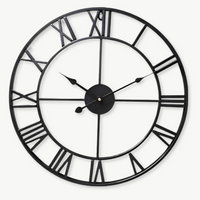


A 60 cm clock on a standard wall does one of two things: it anchors the room with quiet confidence, or it looks like someone made a sizing mistake. The difference comes down to about four things, none of which are complicated once you know what to look for. An extra large wall clock at 60 cm or bigger is a genuine focal point, not a decoration you tuck in a corner, and that changes how you think about placement, room scale, and style from the start.
Most people who buy oversized clocks do it because they have a big empty wall and want something that fills it without looking like a gallery-ready art print. That's a completely valid reason. But the clocks that really land, that make visitors stop and notice, tend to be chosen for a different reason: they fit the proportional logic of the space around them.
⭐ Key takeaways
- 60 cm is the minimum diameter to consider "extra large" - many go to 80 cm or even 100 cm+
- Wall height and furniture scale determine whether a big clock reads as bold or just oversized
- Material weight matters: metal clocks above 3 kg need proper wall anchoring, not a picture hook
- Silent quartz movement is non-negotiable at this size, especially for living rooms and bedrooms
- Industrial, vintage gear, and open-frame designs work especially well at large diameters because they add visual texture without blocking the wall entirely
What "Extra Large" Actually Means in Wall Clock Sizing
60 cm is the threshold where a timepiece stops being background decor and starts setting the tone for everything around it. Below 30 cm, a clock reads as an accent. Between 30 cm and 50 cm, it holds a wall reasonably well. Above 60 cm, it becomes architecture for the room.
The most common sizes above 60 cm you'll find in the market run to 70 cm, 80 cm, and 90 cm, with a handful of statement pieces reaching 100 cm or beyond. Each step up broadly doubles the visual impact, because the human eye perceives area, not diameter. A 90 cm clock has a face area of roughly 6,360 cm² while a 60 cm clock comes in at around 2,827 cm², so the larger one covers more than twice the wall surface. That's worth keeping in mind when you're comparing options on screen.
The standard size bands at a glance
| Diameter | Category | Best rooms | Minimum wall width recommended |
|---|---|---|---|
| 30-45 cm | Standard | Bedroom, kitchen, hallway | 80 cm |
| 45-59 cm | Large | Living room, open-plan kitchen | 120 cm |
| 60-79 cm | Extra large | Living room, loft, stairwell | 150 cm |
| 80-100 cm+ | Oversized / statement | Open-plan spaces, commercial lobbies, feature walls | 200 cm+ |
These aren't strict rules. A well-chosen 60 cm industrial gear clock can work on a 130 cm wide chimney breast in a Victorian flat, because the surrounding plasterwork and the clock's open frame create breathing room. What kills a big clock isn't the diameter; it's crowding.

Which Rooms and Walls Can Actually Carry a 60 cm Clock
Buying the right clock for the wrong wall is the most common oversized clock mistake. Not every wall in your home is proportioned to handle a clock above 60 cm, and a few quick checks before you commit will save you the hassle of returning a piece you genuinely loved on screen.
The living room: where oversized clocks belong
The living room is the natural home for an extra large wall clock at 60 cm or bigger. Ceilings tend to run higher, walls are wider, and the room already expects a focal point. The wall above a sofa, above a fireplace, or on the main feature wall opposite the entry are all strong candidates.
The key check: measure the wall segment you're targeting, not the whole wall. If there's a window cutting the wall at 80 cm, you're working with an 80 cm wide panel. A 60 cm clock on that panel will look squeezed on both sides. Move to a different wall, or scale down to 45 cm and own the smaller format.
For walls 180 cm or wider with a ceiling height of 240 cm or above, a 60-80 cm clock reads as deliberately scaled. Go to 90 cm on walls above 250 cm tall, and you're into real statement territory.
Hallways and stairwells: the underused vertical opportunity
A tall stairwell wall is one of the best places for an oversized clock in a home, precisely because people don't expect it there. The eye travels up naturally, and a 70-80 cm clock placed at mid-landing height creates a moment that a standard painting can't replicate.
Hallways are trickier. Most hallway walls are narrow (under 100 cm), and a 60 cm clock will dominate in a way that feels claustrophobic rather than dramatic. Here, a large wall clock with an open frame, like a gear design or an exposed-movement piece, works better than a solid face because the eye can see through it to the wall surface.
Open-plan kitchens and dining areas
The long wall above a kitchen island or dining table is a good candidate, especially in homes where the kitchen opens to a living area. The clock becomes a shared visual anchor for both zones. Keep materials warm (wood, aged metal, bamboo) so the clock bridges kitchen and living room rather than belonging exclusively to one.
Spaces that struggle with oversized clocks
Small bedrooms with low ceilings rarely benefit from a 60 cm clock. The scale fights the room rather than owning it. A compact bedroom reads better with something in the 30-40 cm range. Home offices with floor-to-ceiling shelving on most walls also leave little room for a statement piece without competing with storage.
💡 Did you know?
The oversized clock trend in home interiors traces back to 1950s American diners and European train stations, where large-diameter clocks on plain walls served a purely practical purpose: visibility at distance. When loft conversions became fashionable in the 1990s, designers borrowed the aesthetic deliberately, pairing industrial clock faces with exposed brick and bare concrete. The functional became decorative, and the format stuck.
That history still shows up in contemporary homes. A recent customer Elena spoke with had converted a Victorian warehouse flat in Bristol: bare brick walls, polished concrete floor, steel-frame windows. She'd been living with a standard 35 cm kitchen clock on the main wall for two years and said it looked, in her words, "like a watch on a giant's wrist." The switch to an 80 cm open-frame gear design didn't just fill the wall; it gave the room a reference point that the furniture could finally orient around.
Style Pairings That Work at This Scale
Style coherence between clock and room matters more above 60 cm than at smaller sizes, because the clock is visible from across the space and its character reads from further away. A rustic farmhouse clock on a sleek minimalist wall looks accidental. The right pairing makes the clock look inevitable.
Industrial and loft interiors
This is the strongest natural pairing for oversized clocks. Exposed brick, concrete floors, steel-frame windows, and visible beams all share one quality: they're honest about materials. A gear-motif wall clock, an open-frame metal design, or a clock with a distressed aged finish fits that same logic. The clock reads as belonging to the architecture, not as decoration applied on top.
For this style, look for metal frames, visible gear teeth, Roman numeral dials on iron or aged steel, and dark finishes. Diameter above 60 cm works particularly well here because loft spaces tend to have high ceilings and longer wall runs.

Scandinavian and minimalist rooms
Clean lines, white walls, warm wood tones, and very little decorative noise. Here, the oversized clock is the decoration. It has to be enough on its own. Simple dial, natural materials, and strong contrast between the face and the wall all matter more than complexity of design. A large round wooden clock on a pale plaster wall is a complete composition.
At this scale, silent quartz movement is especially important in Scandinavian-style spaces, because acoustic minimalism is part of the aesthetic. A ticking clock at 60+ cm is audible from across the room; a silent sweep movement keeps the peace. Pale oak, birch, or light ash finishes pair particularly well with the hygge-influenced palette of off-white walls and linen textiles that define this style.
Elena's note on this style: "The most common mistake I see is people choosing a clock with too many elements, decorative numerals, ornate hands, a patterned bezel, and then wondering why the room feels busier than they intended. In a Scandinavian interior, restraint in the clock IS the style choice. One strong material, one clean form, nothing extra."

Vintage and farmhouse styles
Distressed finishes, Roman numerals, and warm aged metals all scale up well. A vintage gear clock at 80 cm on a shiplap wall, or a dome-front metal clock above a reclaimed wood console table, hits a familiar-but-elevated note. These styles are forgiving about slight size mismatches, because the worn aesthetic absorbs imperfections better than a razor-clean minimalist wall does.

Weight and Wall Fixing: the Part Most People Skip
A heavy metal clock needs a rated wall anchor, not a picture hook. A 60 cm metal wall clock can weigh anywhere from 1.5 kg to 5 kg depending on the frame material and thickness, and the difference in how you fix it to the wall is significant. Lightweight acrylic or thin-gauge metal clocks at the lower end of that range are fine on a standard picture hook into drywall, provided you hit a stud or use a proper wall anchor.
Clocks above 3 kg want a proper anchor regardless. That means a wall plug rated for plasterboard (not just a nail), or a screw directly into a wall stud. Solid metal clocks with a heavy frame, particularly those with thick backplates, concentrate all the weight on one or two fixing points. Check the back of the clock before buying: a single central keyhole mount on a 4 kg clock is workable; two or three fixing points spread the load much better.
What to check before you hang
- Weight listed in the product specs (aim for the actual weight, not an estimate)
- Number of mounting points on the back of the clock
- Whether your wall is drywall over timber studs, solid brick/block, or a hollow partition
- Whether you need a wall anchor (Rawlbolt or equivalent) or can screw directly into masonry
For brick and masonry walls, almost any properly plugged fixing will hold. For drywall partitions, stud-finding and anchor selection matter more. A toggle bolt anchor rated for 10+ kg gives you room to breathe.
Open-Frame vs. Solid-Face: How the Design Affects the Feel of the Room
At extra large diameters, the open-frame vs. solid-face choice changes how the room absorbs the clock. This decision matters more than almost any other design call, because it determines whether the clock commands the wall or sits within it. Get it right and the clock feels intentional. Get it wrong and even the perfect size and finish will seem off.
Solid-face clocks
A solid dial at 60 cm is a substantial visual block. On a plain wall with room to breathe on either side, that's fine, even great. It commands attention the way a painting does. But in a narrower space, or on a wall that already has texture (exposed brick, panelling, patterned wallpaper), a solid face competes with what's behind it rather than complementing it.
Solid-face oversized clocks tend to work best: above a sofa on a plain plaster wall, as the single focal point on a dining room wall, or centered above a fireplace where the mantle and surround frame it naturally.
Open-frame and gear clocks
An open-frame design lets the wall show through the clock's structure. At 60-90 cm, this reduces the visual mass considerably and lets the clock sit in a room without dominating it. Gear-motif and open-frame clocks at oversized diameters are particularly versatile: they bring sculptural interest without blocking the architectural character of the wall behind them.
The trade-off: open frames tend to be more visually complex up close, with more details competing for attention. In a very minimalist room, that complexity can read as too busy. In industrial and eclectic interiors, it's exactly right.

Silent Quartz Movement at Large Sizes: Why It's Not Optional
A larger clock case resonates more, making standard quartz tick noticeably louder than in compact models. A 60 cm clock with a standard tick movement produces a noticeably louder sound than a 30 cm clock, because the longer hands travel further per step and the larger case amplifies the acoustic by-product. In a bedroom or a home office where quiet matters, that tick becomes an active irritant within a few days of hanging the clock.
Silent sweep movements solve this by driving the second hand in a continuous smooth arc rather than a step-by-step tick. The movement is mechanically identical in accuracy, but eliminates the sound entirely. At large diameters, this isn't a nice-to-have; it's the version worth buying.
Most quality oversized wall clocks now specify their movement type. Look for "silent quartz," "sweep quartz," or "no-tick" in product specifications. If a listing doesn't mention the movement type at all, that's usually a sign the manufacturer hasn't prioritized it.

Where to Browse a Full Range of Oversized Options
Browsing by collection lets you compare scale, style, and material side by side in a way that a keyword search never quite does. You get a genuine read on how each finish reads at the sizes you're actually considering, from 45 cm statement pieces up to 90 cm room anchors, before you commit to anything.
Every clock in the collection below ships with a silent quartz movement as standard, and product pages include the exact weight so you can plan your wall fixing before the box arrives. If you're still deciding between two diameters, the large wall clock collection is organised to make that comparison easy.
How to Confirm Proportions Before You Buy
The paper template test is the single most reliable check before buying an oversized clock. Cut a circle to the clock's exact diameter, tape it to the wall at the intended height, and leave it up for at least 24 hours. It sounds obvious, but most sizing mistakes happen because people assess a space with an empty wall and then add furniture or open a door and realize the dynamic has changed.
A few checks that help alongside the template:
- Stand at the furthest point in the room from the wall. Does the paper circle read as the right scale from there?
- Open any doors that sit near the wall. Does the clock clear the door arc completely?
- Photograph the paper template on the wall. Photos compress scale in a way your eye in the room doesn't, so a photo test catches things the direct view misses.
- If you're hanging above furniture (a sofa, a console), leave at least 20-25 cm between the top of the furniture and the bottom of the clock. Less than that and the clock appears to be sitting on the furniture rather than on the wall.
For rooms where you're considering a 60 cm wall clock for a large living room, the template test frequently reveals that you could go bigger, not smaller. Rooms with high ceilings and long sofas absorb a 70-80 cm clock more comfortably than people expect. It's one of those cases where committing to scale pays off every time you walk into the room.
Frequently asked questions
What is the biggest standard wall clock size available?+
Most clock retailers cap their standard range at 90-100 cm in diameter. Above that, clocks are typically custom-made or manufactured as commercial or hospitality pieces. For residential use, 80-90 cm is the practical upper limit for most homes, and only works well on walls wider than 200 cm with ceiling heights above 250 cm.
What sizes do extra large 60 cm+ wall clocks come in?+
Above 60 cm, the most common sizes are 60 cm, 65 cm, 70 cm, 75 cm, 80 cm, and 90 cm round dials. Rectangular or irregular shapes vary more widely. Some manufacturers offer two-size options (like 60 cm and 80 cm variants) within the same design, which is useful if you want to match the aesthetic but need to adjust for your specific wall.
Do extra large wall clocks need special wall fixings?+
It depends on the weight. Clocks under 2 kg on drywall are generally fine with a standard picture hook and a drywall anchor. Clocks between 2-5 kg should use a rated wall anchor or a screw into a wall stud. Anything above 5 kg needs masonry fixings if on a brick or block wall, and toggle bolts or stud-screws if on a drywall partition. Always check the product weight in the specifications before buying.
Can an oversized wall clock work in a small room?+
Rarely, unless the room has an unusually tall ceiling or a long unbroken wall run. In most small rooms, a clock above 60 cm creates a crowded feel rather than drama. The exception is a deliberate design choice where the oversized clock is the only decorative element on the wall - keeping everything else minimal can make the contrast work. But it's a risk, and the paper template test is essential before committing.
Is a silent movement important at 60 cm and above?+
Yes. Larger clocks amplify ticking noticeably compared to compact models, because bigger hands, a larger case, and more resonant materials all contribute to the sound. In living rooms and bedrooms especially, a silent sweep quartz movement is worth prioritizing. Most quality oversized clocks now offer silent movements as standard; check product specs for "silent quartz" or "sweep movement" before purchasing.
Which style of oversized clock works best in a Scandinavian or minimalist room?+
For Scandinavian and minimalist interiors, the best oversized clocks have a single clean material (natural wood, brushed aluminum, or matte white), a simple uncluttered dial, no decorative numerals, and a silent sweep movement. The clock should feel like it grew from the wall rather than being placed on it. Pale oak and birch finishes suit the typical off-white and linen palette of these rooms particularly well. Avoid clocks with multiple materials, ornate hands, or visible gears, those read as too busy against a restrained backdrop.