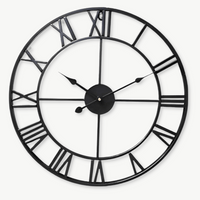


You've moved into a space with one of those walls. You know the kind: wide, bare, slightly intimidating. The kind where a gallery shelf of small frames would look like postage stamps, and a single piece of art never quite fills it. A large metal industrial wall clock is often the answer, but the category is huge, and not everything that looks good in a product photo earns its place in a real room.
I've spent a good amount of time living with oversized industrial clocks across different interior styles, from exposed brick lofts to modern open-plan living rooms. What follows is an honest breakdown of what actually works, why the good ones work, and the specific details that separate a statement piece from a regrettable impulse buy.
⭐ Key takeaways
- Diameter matters more than you think: most rooms need at least 50 cm (20 inches) for a clock to read as intentional decor rather than functional afterthought.
- Frame finish tells the whole story: matte black iron ages gracefully, chrome does not.
- Movement type changes daily life: silent sweep motors are worth paying for in living spaces.
- Industrial style has three real sub-styles (steampunk, factory minimal, raw iron) and they don't all mix the same way.
- Weight is rarely listed accurately by sellers. Always check and plan your wall anchor accordingly.
Why Industrial Clocks Hit Differently on a Large Wall
There's a reason the industrial aesthetic keeps coming back. It isn't nostalgia. It's honesty. Where most decor hides its construction behind paint and polish, industrial design puts its rivets, its welds, and its raw metal right up front. On a large wall, that transparency reads as confidence.
A clock is one of the few decorative objects that also performs a function everyone in the room uses. That combination of visual weight and utility is exactly what a large, empty wall needs. It gives the eye somewhere to land and gives the room a rhythm.

The industrial format also scales naturally. A farmhouse wreath or a framed print gets lost at 80 cm. A skeletal iron clock at 80 cm looks like it was made for the wall. The open frame construction keeps the visual mass from feeling heavy: you see the wall through the spokes and the exposed gear cutouts, so it fills space without blocking it.
💡 Did you know?
The exposed-gear clock aesthetic traces its roots to 19th-century American factory towns, where wall clocks in machine shops had open iron cases so workers could visually inspect the mechanism for malfunctions. The decorative "visible movement" look that appears in so many modern industrial clocks is a direct nod to that industrial pragmatism.
The Three Sub-Styles of Industrial Wall Clocks (and Why They're Not Interchangeable)
Calling something "industrial" covers a lot of ground. When you're shopping for a large metal industrial wall clock, it helps to know which sub-style you're actually looking at, because they suit different spaces and different walls.
Factory Minimal: Less Is More Iron
Think a large flat iron ring dial with clean Arabic or Roman numerals, no exposed gears, matte black finish, and slim hands. This is the workhorse of the category. It works in modern spaces, Scandinavian interiors, and mixed contemporary-industrial rooms equally well. The restraint is what makes it versatile. You can hang this above a white plaster wall and it holds the space without demanding a brick backdrop.
Look for: even dial face, no faux rust treatments, hands with contrast (white or brass against black is reliably sharp), and a bezel that sits flush rather than protruding awkwardly.
Steampunk: Gears, Cogs, and Layers
Steampunk industrial clocks are the most visually complex of the three. Multiple dial layers, exposed gear motifs (often decorative rather than functional), riveted edges, and finishes that combine aged brass, oil-rubbed bronze, and dark iron. At their best, they're genuinely beautiful objects. At their worst, they're busy to the point of exhaustion.
The rule here: one steampunk clock, one strong wall. Don't compete with it. A brick wall works. A gallery wall behind it does not. These clocks need clear space around them to breathe. Also worth knowing: the layered construction means they often sit 8 to 12 cm off the wall, so plan for that depth visually.
Raw Iron: The Skeleton Frame
Skeleton frame clocks have no solid dial backing. The numbers and chapter ring float on exposed spokes, and you see straight through to the wall behind. This is the most dramatic of the three formats when it works. The wall becomes part of the clock. On a brick or textured plaster wall, the depth and shadow play is genuinely striking.
The catch: on a plain white wall, a skeleton frame clock can look unfinished. The wall needs to have something going for it. Stone, reclaimed wood paneling, a deep moody paint color, exposed concrete: any of these make a skeleton clock look intentional. A flat white builder-grade wall makes it look like something is missing.

Sizing a Large Metal Industrial Clock: The Numbers That Actually Matter
Most guides give you the same rough rule: clock diameter should be about one-third to two-thirds the width of the furniture piece below it. That's a useful starting point, but for industrial clocks specifically there are a few nuances worth knowing.
The 50 cm Floor: Why Smaller Doesn't Feel Industrial
Industrial design language depends on visual mass. A 35 cm metal clock on a big wall reads as a small clock, not an industrial statement. The aesthetic only kicks in around 50 cm (roughly 20 inches) and gets progressively more impactful up to 80 cm (about 32 inches). Beyond 90 cm, you're into genuine statement territory: impressive in the right space, overwhelming in a smaller room.
A solid sizing guide for common spaces:
- Living room accent wall (3+ meters wide): 70-90 cm diameter hits the sweet spot.
- Open-plan kitchen/dining area: 60-75 cm works without dominating the functional space.
- Home office or studio: 50-65 cm, positioned where it's readable from the desk without fighting other visual elements.
- Loft or converted industrial space: 80-120 cm can work if the ceiling height supports it. The taller the room, the larger the clock can go.
- Narrow hallway or entryway: Avoid very large formats here. A 45-55 cm piece with a slim profile is enough to create a moment without blocking the flow.
| Room Type | Recommended Diameter | Best Sub-Style |
|---|---|---|
| Large living room | 70-90 cm | Any; skeleton shines here |
| Kitchen / dining | 60-75 cm | Factory minimal works best |
| Home office | 50-65 cm | Minimal or skeleton |
| Loft / converted space | 80-120 cm | Steampunk or skeleton |
| Entryway / hallway | 45-55 cm | Factory minimal |
Height Placement: Where Most People Get It Wrong
The default instinct is to hang a clock at eye level. For a small clock, that's reasonable. For a large industrial clock that's meant to anchor a wall, it's usually too low. The center of the clock should sit roughly 150 to 165 cm from the floor when there's no furniture directly below it. When there's a sofa or console table, the bottom edge of the clock should clear the top of the furniture by at least 25 cm.
Going higher than expected is rarely a mistake with industrial clocks. They're designed to be read from a distance and appreciated from across the room. Treat them like art, not like a kitchen timer.
What to Look For in a Large Metal Industrial Clock: A Practical Checklist
The product listing isn't always honest about what matters. Here's what to check before committing.
Movement Quality: The Silent Sweep Question
Cheap quartz movements tick. A loud tick isn't just annoying: it draws attention to itself in a way that undermines the design. In a living room or bedroom, a silent sweep movement (sometimes listed as "sweep movement" or "non-ticking") is the difference between a clock you love and a clock you eventually take down.
For a large clock in a busy, high-noise space, a standard quartz movement is fine. For anything near a seating area, a reading nook, or a bedroom, prioritize silent. Good silent movements in large format clocks typically need a higher-torque motor to move heavier hands, so a silent movement in a 70+ cm clock is a sign of genuine quality.
Frame Finish Durability: What Actually Lasts
Most large industrial clocks use one of three finish approaches: powder coating, electroplating, or hand-applied patina treatments.
Powder-coated matte black is the most durable for everyday use. It resists scratches, doesn't show fingerprints aggressively, and holds its appearance for years without maintenance. If you're hanging a clock in a kitchen where airborne grease is a factor, powder coat is what you want.
Electroplated finishes (the shinier black or chrome-adjacent looks) scratch more easily and show wear over time, especially on the dial bezel where hands get set. They can look great new, but check reviews for longevity.
Hand-applied patina treatments (the aged rust, oil-rubbed bronze, or distressed iron looks) vary wildly by manufacturer. On a quality piece, the finish is sealed and stable. On a cheap version, it can flake, fade unevenly, or rub off on anything that touches it. If you're spending real money on a patina finish, ask specifically whether it's sealed and whether the finish is stable for indoor humidity fluctuations.
Weight and Wall Anchoring: The Part Listings Underplay
A 70 cm metal clock can weigh anywhere from 1.5 kg to over 4 kg depending on frame thickness and construction. Most listings are optimistic about this. If the description says "lightweight," treat that as marketing. Measure the frame material in the photos if you can.
For anything over 2 kg, a single picture hook isn't enough. You want a screw into a wall stud, or a proper wall anchor rated for at least twice the clock's weight. The visual consequence of a large industrial clock falling is not just broken metal: it's a significant hole in your wall. Over-engineer the hanging system and you'll never think about it again.

How Industrial Clocks Interact With Different Interior Styles
The assumption that an industrial clock only fits an industrial room isn't quite right. These clocks are more adaptable than their aesthetic suggests. Here's what actually works, from experience.
In a Modern Minimalist Space
A large black metal industrial wall clock with a minimal factory frame reads as contemporary rather than industrial in a modern minimalist room. The key is keeping the rest of the wall clear and choosing a clock with clean typography: Arabic numerals in a bold sans-serif, or no numerals at all with just hour markers. The metal adds material warmth that white walls and concrete floors often need.
In a Farmhouse or Rustic Interior
Industrial and farmhouse styles overlap more naturally than people expect. Both draw from utilitarian American design traditions. A skeleton-frame iron clock over a shiplap wall, or a factory-style clock above a reclaimed wood dining table, works because the honest-material quality matches. Avoid the steampunk sub-style here: the layered brass-and-iron complexity tends to fight the organic simplicity of farmhouse decor.
In a Scandinavian or Nordic Interior
This is where the factory-minimal sub-style really earns its keep. A large flat metal clock with a clean white or cream face and matte black frame sits very naturally in a Scandinavian context. The geometric precision and absence of ornament aligns perfectly with Nordic design values. Keep the hands slender. Choose Arabic numerals over Roman if the rest of the space is modern.
In a Mid-Century Modern Room
Be careful here. True *mid-century modern* interiors have a very particular material palette: teak, walnut, warm terracotta, mustard, olive. A cold black iron clock can clash with the warmth of that palette. An industrial clock with a brass or aged bronze finish works much better. The warm metal tone bridges the gap between the industrial aesthetic and the mid-century warmth.

Placement Strategies That Make a Large Clock Look Considered, Not Random
Putting a clock on a wall isn't automatically enough. The placement needs to make sense within the room's spatial logic. A few approaches that work consistently:
The Anchor Above Furniture
Hanging a large industrial clock directly above a sofa, dining table, console, or desk creates a visual hierarchy. The clock anchors the furniture grouping and signals intentionality. This works best when the clock's diameter is roughly two-thirds of the furniture piece's width. Too narrow and it floats unattached. Too wide and it overpowers.
The Solo Statement Wall
One large clock, one wall, nothing else. This is the most direct use of the industrial aesthetic and the hardest to overthink. The clock simply needs to be at the right height and the right scale. Leave 30-40 cm of clear wall on each side as a visual border. The empty space isn't wasted: it's what gives the clock presence.
The Asymmetric Composition
Pairing a large clock off-center with a smaller complementary element (a wall-mounted shelf, a cluster of three small framed pieces, a single large plant) can create a more dynamic arrangement than a centered clock alone. The industrial clock naturally becomes the dominant visual anchor, and the smaller element creates visual balance without competing. Keep the secondary element in a material that echoes the clock: raw wood, aged metal, matte ceramic.
"The clock is not the decoration. The clock is the reason the wall makes sense."
A sentiment shared by many interior designers working with large-scale wall decor
The Large Metal Clock and LED: When Technology Meets Industrial Aesthetic
A newer category worth considering: large metal industrial wall clocks with LED backlighting or illuminated dials. These sit at the intersection of industrial and contemporary design and work particularly well in spaces that transition between day and evening use: home bars, entertainment rooms, home offices that double as evening gathering spaces.
The appeal is practical as well as aesthetic. A large clock face in a dim room is hard to read without getting up to check. A backlit dial solves that quietly. The best versions use warm amber or soft white LEDs (in the 2700K-3000K range) rather than harsh cool-white, keeping the atmosphere intact. A harsh blue-white LED on a raw iron frame looks like an industrial accident. A warm amber glow on the same frame looks like evening light catching polished brass.
There are a few things to look for specifically in this subcategory. First, check whether the LED strip is replaceable or hardwired. A replaceable strip means the clock can outlast the lighting component. Second, look for a brightness dimmer or at minimum an on/off switch: you want control over how much the clock glows without having to replace a battery-powered unit every time you want softer light. Third, check the frame depth. LED-lit clocks typically sit 5-8 cm off the wall to accommodate the lighting module, which means they need heavier wall anchoring than their visual profile suggests.
One honest caveat: not every LED clock on the market is worth the premium. The weakest versions use thin plastic frames with a metal-look paint finish, not actual cast or pressed iron. The weight gives it away. A genuine metal-framed LED clock in a 70 cm format will weigh at least 2.5 kg. If the listing says it's under 1.5 kg, the frame isn't real iron, and it'll look like it under real light.

Common Mistakes When Buying a Large Industrial Wall Clock
After seeing a lot of well-intentioned large clock purchases go sideways, the same patterns keep coming up. These are the ones worth knowing before you order.
Ordering Without a Paper Template
Before committing to any large-format clock, cut out a paper circle to the exact diameter and tape it to your wall for a day. What looks enormous in theory often looks smaller in context. What looks manageable in a product photo can overwhelm a room you haven't measured carefully. This sounds tedious. It prevents returns.
Ignoring the Wall Surface
A skeleton-frame iron clock on a featureless white wall is a disappointment waiting to happen. A dense steampunk clock on a patterned wallpaper creates visual chaos. The wall and the clock need to be considered as a pair, not separately. If your wall isn't interesting, choose a clock with a solid backing. If your wall has texture and character, a skeleton frame will reward it.
Prioritizing Looks Over Movement Quality
The cheapest large metal industrial clocks use movements that are loud, inaccurate over time, or both. A clock that needs resetting every few weeks becomes a chore. A clock with a quality sweep movement running on good batteries will be silent and accurate for years. The movement is the one internal component you can't see in photos. It's also the one that determines whether you love or resent the clock six months after hanging it.
Forgetting About Natural Light Glare
Metal surfaces reflect light. If your wall gets direct afternoon sun, a highly polished or chrome-adjacent industrial clock can create glare that makes the dial hard to read and the room uncomfortable. Matte and brushed finishes handle this much better. If you have a sun-facing wall, this isn't a small consideration.
Large Wall Clock
Every large-format option in one place: from minimal metal designs to oversized statement pieces, filtered by the scale that actually fills a wall.
83 products
Browse the collection →Caring for a Large Metal Industrial Clock Over Time
Metal clocks require almost no maintenance, but there are a few habits that keep them looking good for years.
Dust the frame with a dry microfiber cloth every couple of weeks. On powder-coated surfaces, avoid anything abrasive: even a rough paper towel can leave micro-scratches that dull the finish gradually. For patina finishes, avoid moisture: a damp cloth can lift an unsealed patina treatment in patches.
Battery changes are worth doing on a schedule rather than waiting for the clock to stop. A quality AA battery in a standard quartz movement typically lasts 12 to 18 months. High-torque movements for large clocks can draw more power. Check the movement specs: some manufacturers recommend specific battery brands for large movements. Using a heavy-duty alkaline rather than a bargain battery reduces the risk of leakage inside the movement, which is the main cause of premature movement failure.
If the clock develops a slight rattle, check the hands first. Large metal hands on a heavy dial can shift slightly during shipping or from vibration. Adjusting them back into the correct plane (so the minute hand clears the hour hand cleanly without scraping) is usually a two-minute fix that restores the clock to perfect operation.
Five Questions Worth Asking Before You Finalize Your Choice
These aren't rhetorical. They're the checklist I run through before recommending any large clock purchase:
- What's on the wall directly below the clock? The answer shapes the right diameter and style more than almost any other factor.
- Is the wall in a quiet zone or a high-activity zone? This tells you whether a silent sweep movement is a preference or a practical requirement.
- What's the dominant material palette in the room? Warm metals (brass, bronze) for warmer rooms. Cold metals (matte black iron) for cooler, more contemporary spaces.
- Does the wall get direct sunlight at any point in the day? Affects both readability and finish longevity.
- Is the wall a stud wall, plasterboard, or masonry? This determines the right anchoring approach before you even choose the clock.
The Bottom Line
A large metal industrial wall clock is one of the most satisfying single purchases you can make for a large wall. It's functional in a way a framed print isn't, and it carries visual weight in a way a small decorative object never can. But it only works if the scale, sub-style, movement quality, and wall surface are all considered together. Get those four things right and you'll stop noticing the clock as a purchase. It'll just be part of the room, the way the best pieces always are.
If you're still narrowing down your options, the large wall clock collection is a good place to filter by size and finish. And if you're weighing industrial against other statement styles, the guide to choosing the right wall clock for your space covers the broader decision in the same level of detail.
Frequently asked questions
What size industrial wall clock works best for a large living room?+
For most large living rooms (walls 3 meters or wider), a clock with a diameter between 70 and 90 cm reads as an intentional focal point rather than a functional accessory. Anything under 60 cm on a big wall tends to look underpowered. If your room has high ceilings (3 meters or more), you can go up to 100 cm without the clock feeling oppressive.
Do large metal industrial wall clocks have silent movements?+
The better ones do, yes. Silent sweep movements require a higher-torque motor to drive heavy metal hands, so they cost more to produce. Look specifically for "sweep movement" or "non-ticking" in the product description. If it isn't mentioned, assume it ticks. You can also swap out most standard quartz movements yourself for a silent aftermarket version, though it's simpler to choose one with a silent movement from the start.
Can a large industrial clock work in a non-industrial interior?+
Absolutely. The factory-minimal sub-style (flat iron frame, clean dial, matte black finish) works naturally in Scandinavian, modern minimalist, farmhouse, and even transitional interiors. The steampunk and layered-gear versions are more specific to industrial or eclectic spaces. Choosing the right sub-style matters much more than worrying about whether your room is "industrial enough."
How do I hang a heavy metal wall clock safely?+
For any clock over 2 kg, skip picture hooks and use a screw anchored into a wall stud or a heavy-duty wall anchor rated for at least twice the clock's weight. Use a stud finder first. If you're on plasterboard without a stud at the right position, a toggle bolt (butterfly anchor) is your best option. Always check the exact weight of the clock, not the "lightweight" claim in the listing. Over-engineered hanging costs nothing extra and means you never think about it again.
How high should a large wall clock be hung?+
When there's no furniture below, the clock's center should sit roughly 150-165 cm from the floor, which puts it at comfortable viewing height from a standing position. When there's a sofa or console table below, leave at least 25 cm between the top of the furniture and the bottom edge of the clock. Going slightly higher than instinct suggests usually looks better with large-format clocks, since they're designed to be read from across the room.
Are LED industrial wall clocks worth buying?+
Yes, for the right space. LED-backlit industrial clocks work especially well in entertainment rooms, home bars, and offices that double as evening gathering spots. Look for warm amber or soft white LEDs (2700K-3000K), a dimmable circuit, and a genuine iron frame (weight is your best indicator: real metal at 70 cm should weigh at least 2.5 kg). Avoid versions with plastic frames painted to look like iron: the LED glow makes the material difference obvious under low light.