
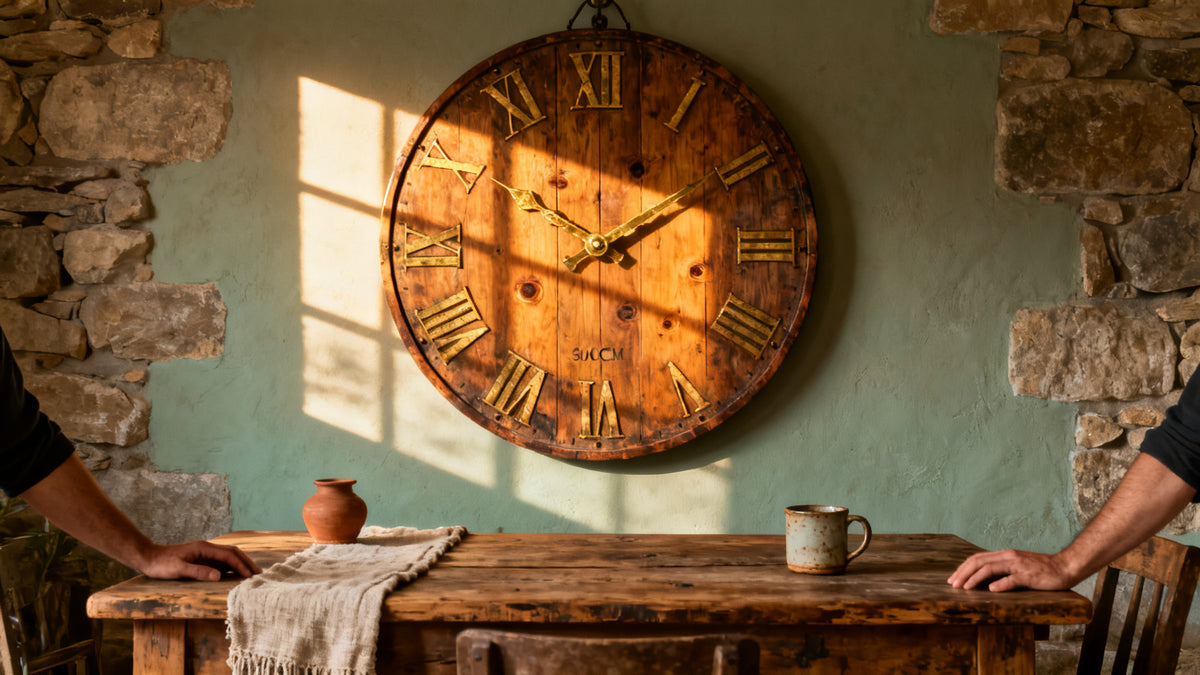
There's a moment when you hang the right clock and the whole room suddenly makes sense. A large wooden wall clock in rustic style does that more reliably than most decor choices, because wood reads as natural, lived-in, and permanent all at once. Not trendy. Not fussy. Just there, doing its job beautifully.
But "rustic wooden" covers a lot of ground. A chunky reclaimed-pine clock with iron hands tells a completely different story from a bamboo clock with minimal Roman numerals. The grain, the finish, the diameter, the placement: each one matters. Get them right together, and you've created something that feels intentional. Get one wrong, and it just looks like a clock you grabbed.
Here's how to read each factor before you buy.
⭐ Key takeaways
- Diameter of 45 cm (18 in) or more reads as a statement piece; below that it disappears on a large wall.
- Open grain species like oak, ash, and reclaimed pine are the most authentic for rustic interiors.
- Finish depth (raw, oiled, stained, veneered) changes the warmth and formality of the same clock entirely.
- Wall placement math: the clock's center should sit at or just above average eye level, roughly 155-165 cm from the floor.
- Silent quartz movements matter more in rustic-style clocks than people expect: the tick-free version lets the wood do the talking.
Why Size Changes Everything in a Rustic Room
Scale is the first decision, and it's the one most buyers get wrong. A 25 cm clock on a plaster farmhouse wall reads as decoration. A 50 to 60 cm large wooden wall clock on the same wall reads as architecture. The surface area of the wood face needs to be large enough for the grain to register from across the room. That's the whole game.
The threshold most designers use is 45 cm (roughly 18 inches) as the entry point for "statement." Below that diameter, you're competing with the surrounding wall. At 50 cm, you're setting the tone for the space. At 60 cm or above, you're making a commitment, and that's not a bad thing if the wall can carry it.
How to Calculate the Right Diameter for Your Wall
A rough formula works well here. Measure the width of the wall section where the clock will hang. Aim for the clock's diameter to be roughly one-third to two-thirds of that width. So a 120 cm wide chimney breast calls for a clock between 40 and 80 cm wide. That gives the piece room to breathe without looking like it got lost.
Ceiling height plays a role too. High ceilings above 250 cm in a barn conversion or open-plan kitchen support larger diameters naturally. Standard 240 cm ceilings work better with 50 to 55 cm rather than pushing 70 cm, which can feel heavy.

Above Furniture: The Rule That Actually Works
Hanging a large rustic wall clock above furniture anchors the composition. A console table, a farmhouse bench, or a wood sideboard gives the clock visual weight it can't generate on its own in the middle of an empty wall. The gap between the top of the furniture and the bottom of the clock should be roughly 15 to 25 cm. Tighter looks deliberate. Looser looks like an accident.
Reading Wood Grain: What Species Actually Says "Rustic"
Grain pattern is what your eye picks up first from six feet away. Open, prominent grain reads as rustic. Tight, fine grain reads as modern or Scandinavian. The species matters before the finish does. Not all wood carries the same mood, and that distinction shapes every buying decision downstream.
Oak is the most forgiving choice. Its grain is open and pronounced without being chaotic, which means it works in farmhouse kitchens, stone-walled living rooms, and even contemporary spaces that want one warm anchor. Ash runs similarly but with a slightly cooler, silvery undertone.
Reclaimed pine and fir are the more overtly rustic option. The knots, nail holes, and variation in color that come from genuinely old timber are exactly what makes the piece feel like it has a history. A reclaimed-wood clock face can look like it came off a barn door, and in the right context, that's perfect.
💡 Did you know?
Bamboo is technically a grass, not a wood, but its tight grain structure and warm honey tones make it a natural fit for rustic and organic interiors. It's also among the fastest-renewing natural materials used in clocks today, reaching harvest maturity in three to five years versus decades for oak.
Bamboo is worth mentioning separately. Its linear grain reads as clean and natural rather than heavily rustic, which makes it a better fit for spaces mixing organic materials with a lighter hand. Think open-shelf kitchens, hallways with rattan or woven grass furniture, or Japandi-influenced rooms.
Engineered Wood and Veneers: When It Works and When It Doesn't
MDF cores with wood veneer finishes are common at mid-range price points. When the veneer layer is generous and applied well, it's hard to distinguish at viewing distance from solid wood. The trade-off is at the edges: solid wood shows natural end grain and has a slight irregularity that reads as authenticity. Veneer on MDF has perfectly clean edges that look more considered but less alive.
For a rustic aesthetic, solid wood or thick veneer on a solid board will always feel more honest than thin laminate. If the product listing doesn't specify the core material, the weight per unit area is a reasonable proxy: a genuinely solid 50 cm clock will feel heavier than a veneered equivalent.
| Wood Type | Grain Character | Best Rustic Context |
|---|---|---|
| Oak | Open, pronounced, warm golden tones | Farmhouse kitchens, stone-walled living rooms |
| Reclaimed Pine | Heavy knots, color variation, nail marks | Barn conversions, industrial-rustic lofts |
| Walnut | Medium grain, deep chocolate tones | Moody dining rooms, study, library walls |
| Bamboo | Tight linear grain, warm honey tone | Natural kitchens, Japandi, organic-modern spaces |
| MDF + Veneer | Consistent, clean edges, lighter weight | Budget-conscious picks where viewing distance is large |
Finish Depth: How Oil, Stain, and Raw Wood Change the Mood
Finish controls the room's warmth from across the space. The wrong one can push an otherwise beautiful clock into "cheap" territory. Raw, oiled, stained, and lacquered finishes each produce a completely different reading from a distance, and they suit different rooms for different reasons.
Raw and Lightly Oiled Finishes
A raw or lightly oiled wood face shows the most grain and the most color variation. The wood looks like it was cut, shaped, and sealed just enough to stop it drying out. This finish works best in rooms that lean heavily rustic or wabi-sabi: exposed beams, natural plaster, stone floors. It's the most honest and the most demanding. The room needs to meet it halfway.
Hardwax oil finishes add a slight depth to the grain without changing the color much. The wood looks fed and alive rather than raw and dry. This tends to be the most versatile rustic finish across different interior styles.

Stained and Aged Finishes
Dark walnut or ebony stains on pine or ash create a deliberate aged look. The underlying grain still shows through, but the piece reads as older and more serious. A dark-stained rustic wall clock works in living rooms that have leather furniture, wrought iron light fixtures, or deep-toned textiles. It can look heavy in an all-white farmhouse kitchen unless you balance it with other dark accents.
Weathered grey or white-wash finishes push the clock toward coastal rustic or Scandinavian farmhouse territory. The grain becomes muted and the whole effect is cooler and airier. These work beautifully in rooms with lots of natural light and pale linens.

Lacquered and Sealed Finishes: The Trade-Off
A hard lacquer seals the wood completely. The grain is protected and the surface has a slight sheen. The problem for rustic interiors is that sheen: it catches light in a way that reads as manufactured rather than natural. If the product description mentions "high-gloss" or "UV lacquer," it will look polished rather than organic. That's not wrong, but it's a different aesthetic altogether.
For genuine rustic warmth, prioritize matte or satin finishes. Matte surfaces absorb rather than reflect light, and that absorption is exactly what makes a wooden wall read as warm rather than cold.
Clock Hands and Numerals: Small Details That Shift the Whole Look
Hands and numerals are the only elements you're actually "reading" in the piece. They do more visual work than most people expect. The wrong numeral style on the right wood face can undermine the whole thing, even when every other decision was correct.
Roman vs. Arabic: Which Reads More "Rustic"?
Roman numerals have a longer association with traditional and antique timepieces, so they tend to reinforce a rustic or farmhouse feeling more naturally. Arabic numerals can feel more contemporary on the same wood face. Neither is strictly correct, but if the room is heavily rustic, Roman numerals usually carry less visual tension.
Some rustic wooden clocks drop numerals entirely, using simple marks or natural wood pegs at the hour positions. This works beautifully in minimal organic interiors but can look unfinished in a more traditionally furnished room.
Hand Styles and Metal Finishes
Spade or leaf-shaped hands in aged iron or antique brass pair naturally with warm wood tones. Polished chrome or stainless steel hands on a rustic wood face create a jarring modern-rustic contrast that's sometimes intentional but often just looks inconsistent. If the clock face is dark walnut or reclaimed pine, aged brass hands will disappear into the warmth beautifully. If the face is lighter oak or ash, black iron hands provide definition without fighting the grain.

Where to Hang It: Room-by-Room Placement Logic
Each room has a different logic for where a clock earns its place. A large rustic wooden wall clock works in almost any room with the right anchor point, but hanging it in the wrong spot wastes both the clock and the wall.
Kitchen and Dining Room
Above a door frame, above open shelving, or centered on a feature wall behind the dining table: these are the three positions where a large kitchen clock earns its keep. The kitchen is the room where people actually need to check the time while cooking, so pure decoration logic isn't enough. The clock should be readable from the stove or the table, not just beautiful from directly in front.
A rustic wooden clock in a farmhouse kitchen ties together mixed materials in a way few other single pieces can. If you have open wood shelves, terracotta tiles, and linen textiles already, a large oak or reclaimed pine clock pulls all of it into a coherent story.
Living Room Feature Wall
The living room gives the clock more room to be purely decorative. Center it on a chimney breast, above a fireplace (keeping it well above any direct heat source), or on a bare wall where it becomes the primary focal point. At 55 to 60 cm diameter, a rustic wooden clock on a white or off-white wall functions the way a painting does: it's the thing you see first when you enter the room.
Pair it with a cluster of smaller framed prints or botanical pieces to its side, rather than below it, to avoid the "gallery wall from a template" effect. The clock anchors the center; the smaller pieces extend the composition to one side or both.

Hallway and Entryway
The entryway is chronically underrated as a clock location. A large rustic clock above a coat rack, a bench, or a console table creates the first impression of the home. It says something about how the household lives. Warm wood grain in a narrow hallway immediately makes the space feel less clinical and more like a home.
For narrow hallways specifically, keep the diameter proportionate to the wall width. A 45 cm clock works in a hallway where a 60 cm one would overpower the space. As a rule, keep the clock's diameter under half the wall's width in any narrow corridor. The rustic wall clock collection spans a range of diameters worth browsing if hallway scale is a constraint.
The Movement Question: Silent Quartz vs. Mechanical in a Rustic Clock
Silent quartz versus mechanical is a real quality-of-life choice, not just a technical footnote. In a large wooden rustic clock, the movement you choose affects the daily experience of the room just as much as the finish or the grain. Getting this right matters especially because the natural warmth of wood sets an expectation of calm.
Why Silent Quartz Wins for Most Rooms
A standard step-quartz movement advances the second hand in discrete ticks, roughly 60 per minute. In a quiet room, that tick becomes the dominant sensory experience. The wood face looks calm and organic; the sound contradicts it. A wood-faced clock with a loud tick starts to feel like a grandfather clock without the gravitas of one.
Silent sweep quartz movements eliminate that entirely. The second hand glides continuously rather than stepping, and the room stays quiet. For bedrooms, studies, or living rooms where you spend long quiet hours, this is a meaningful quality-of-life difference. According to clock movement manufacturers like Hermle and Seiko Instruments, silent sweep mechanisms use a higher-frequency motor (typically 1,024 Hz versus the standard 1 Hz pulse) to produce smoother motion with no audible click.
For a busy kitchen where ambient noise already covers the tick, silent movement matters less. But at the price points where well-made rustic wooden wall clocks sit, silent movement is increasingly standard and worth confirming before buying.
Mechanical Movements: When the Tick Is the Point
A mechanical or spring-driven movement tells a different story altogether. These movements need winding (weekly for most eight-day movements) and they do tick audibly. In the right context, that tick is desirable. A large reclaimed-pine clock in a farmhouse study, where you work alone in relative quiet, benefits from a mechanical presence. The tick becomes part of the room's atmosphere rather than a distraction.
The practical trade-offs are real though. Mechanical movements require periodic servicing every five to ten years to clean and re-oil the gear train, something a quartz movement never needs. They're also more sensitive to being hung slightly off-level, which can affect the beat (the rhythm of the tick) and eventually the timekeeping accuracy. If you want the tactile pleasure of winding without full mechanical complexity, a quartz pendulum movement gives you the visual rhythm of a swinging pendulum with battery-powered reliability.
"Wood remembers the tree it came from. A good clock remembers the wall it hangs on."
Traditional cabinetmaker's saying, Northern Europe
Battery type is worth a quick check too. Most silent quartz movements run on a single AA battery with a typical life of 12 to 18 months. Some larger clocks with heavier hands use C-cell batteries for more torque. It's not a dramatic difference, but knowing it in advance means you're not hunting for the right battery when the clock stops at midnight.
Mixing Rustic Wood Clocks with Other Interior Styles
Rustic wooden clocks work across a surprisingly wide range of styles. The single most common misconception is that they only fit fully rustic or farmhouse interiors. The right wood and finish combination travels well, from stark minimalism to layered industrial spaces.
Rustic Wood in a Modern Minimalist Room
One large natural-wood clock on an otherwise bare wall in a minimal room creates a deliberate organic focal point. The key is restraint everywhere else. If the room has clean lines, white walls, and simple furniture, the wood clock becomes the single warm gesture that stops the space from feeling cold. It's one piece doing a lot of work, and it can handle it.
Rustic Wood in an Industrial Space
Brick walls, steel frames, and concrete floors are natural partners for reclaimed wood. A large reclaimed-pine or rough-sawn oak clock on a brick wall in a loft conversion or open-plan studio reads as intentional and considered rather than decoratively conflicted. The raw materials speak the same language. Browse the industrial wall clock collection for pieces that blend aged metal frames with wood elements across both aesthetics.
Rustic Wood in a Coastal or Cottagecore Interior
Weathered grey or white-washed oak finishes slot naturally into coastal and cottage interiors. A large driftwood-finish clock on a white-painted plank wall, with wicker baskets and linen cushions below it, is a very specific image that a lot of people are going for right now. It works because the materials carry the same lightness.
Wooden Wall Clock
73 wooden clocks in silent quartz, from slim birch dials to carved bamboo statement pieces for every rustic or natural interior.
73 products
Browse the collection →Care and Longevity: What Keeps a Wooden Clock Looking Good for Years
A solid-wood wall clock is a long-term investment. A few simple habits will keep the wood from fading, cracking, or warping over the years. Wood responds to humidity and light more than most home decor materials, and a clock lives on the wall through all of it.
Humidity and Placement Cautions
Direct steam from a kettle or dishwasher, prolonged exposure to bathroom humidity, or placement directly above a radiator can all cause wood to move over time. Movement means slight warping of the face, which affects how the clock hangs and eventually how the movement functions. Kitchens are fine as long as the clock isn't directly in the steam path. Most well-sealed wooden clocks handle normal domestic humidity without any issue. Extreme swings, like unheated stone buildings or beach houses closed for winter, are harder on the wood.
⚠️ Heads up
Avoid hanging any solid wood wall clock directly above a radiator or heat source. The repeated heating and cooling cycles dry out the wood faster than ambient room conditions, and the expansion and contraction can gradually loosen the clock movement from its housing over time.
Cleaning and Surface Maintenance
Dry or barely damp microfiber cloth for dust. Nothing wet directly on the wood. If the finish is oiled rather than lacquered, a very occasional thin wipe of the same oil (linseed, tung, or hardwax oil depending on the original finish) can refresh the depth of color after several years. It's a five-minute task that makes a real difference to a piece that starts to look dry or faded. Lacquered surfaces need nothing more than the cloth.
Check the battery once a year regardless of whether the clock has stopped. A leaking battery in the housing can stain or damage the back of the clock in ways that don't affect its function but are frustrating to discover. Most AA batteries in silent quartz movements last well beyond 12 months, but the annual check is worth the habit. For more options across different sizes and wall contexts, the large wall clock collection covers 83 pieces from 45 cm to oversized formats.
Frequently asked questions
What diameter counts as "large" for a wooden wall clock?+
Most interior designers use 45 cm (18 inches) as the lower threshold for a statement piece. At that size, the clock holds visual weight on a standard wall. For high-ceiling rooms or large feature walls, 55 to 65 cm tends to be the sweet spot. Above 70 cm, the clock begins to function more like a sculptural installation than a timepiece.
What size rustic clock works in a narrow hallway?+
For a hallway less than 120 cm wide, 38 to 45 cm diameter is the practical ceiling. The clock should not exceed roughly one-third of the wall's width, or it will feel like it's crowding the space. A lighter-finished clock (oiled oak, whitewashed ash) keeps narrow corridors feeling airy rather than heavy. Reclaimed pine with heavy knots and dark tones can make a small hallway feel even smaller, so save that for a bigger wall.
Does a rustic wooden wall clock work in a modern interior?+
Yes, often very well. One large natural-wood clock on a bare minimalist wall becomes a deliberate organic counterpoint to clean lines. The key is restraint: if the rest of the room is simple, the wood clock carries the warmth by itself. If the room already has many warm or rustic elements, a second one adds to that story without competition.
Silent quartz vs. mechanical: which is better for a rustic clock?+
Silent quartz is better for most rooms. It's accurate, battery-powered, requires no servicing, and keeps the room quiet, which lets the wood do the talking. A mechanical movement is better if you want the ritual of winding and the audible tick as part of the atmosphere, such as in a study or a farmhouse living room you find comforting with ambient sound. Mechanical movements do need servicing every five to ten years and are sensitive to being hung slightly off-level.
What's the difference between a solid wood and an MDF-core wooden clock?+
Solid wood shows natural grain on both the face and the edges, has slight color variations across the surface, and handles humidity better over time. MDF with veneer has consistent, clean edges and is often lighter in weight. From normal viewing distance, a good veneer is hard to distinguish from solid. For a rustic aesthetic, solid or thick-veneer options feel more honest, but both can look excellent on the wall.
How high should I hang a large wall clock?+
The center of the clock should sit at roughly eye level for a standing adult, typically 155 to 165 cm from the floor. When hanging above furniture, keep the gap between the top of the furniture and the bottom of the clock between 15 and 25 cm. This creates a grounded composition rather than a clock floating in space. In tall rooms, going slightly higher than eye level can look intentional and dramatic rather than off.