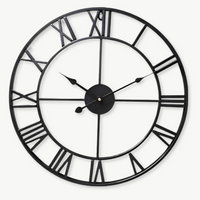


The stairwell landing is the wall everyone sees and nobody thinks to decorate. You pass it a dozen times a day. Guests catch it the moment they step inside. And yet it often sits bare, or worse, stuck with a tiny frame that looks lost against all that vertical space. A large wall clock for a stairwell landing solves both problems at once: it fills the wall with intention and gives the eye somewhere to land.
This isn't about following a trend. It's about recognizing that the stairwell has real potential as a focal point, and a clock, more than almost any other object, earns its place there by being genuinely useful every single day.
⭐ Key takeaways
- Stairwell landings need clocks that read well from a distance and from multiple angles.
- For most standard landings, a diameter of 50 to 80 cm (20 to 32 in) hits the visual sweet spot.
- Placement height matters more than most people realize: center the clock face at roughly 160 to 170 cm from the nearest floor level.
- Style choice depends on sightlines: open-frame and reflective designs work well in narrow, darker stairwells.
- A clock that ticks audibly in a stairwell echoes. Silent sweep movement is worth paying for.
Why the Stairwell Landing Is Such a Hard Wall to Dress
The stairwell landing sits at an awkward intersection of vertical travel, changing light, and multiple sightlines that most standard decor objects simply aren't designed to handle. Unlike a living room wall where you stand roughly the same distance away each time, the stairwell wall gets viewed from below (looking up the stairs), from the landing itself (standing level), and from above (coming back down). A small piece looks wrong from all three angles. Only something with real visual weight holds up.
There's also the height problem. Stairwell walls often run two stories high, which makes the usable section above the landing feel exposed and slightly vertiginous. A clock anchors it. It gives the eye a fixed point to settle on instead of drifting up toward the ceiling or down toward the floor.
Then there's light. Many stairwells get indirect natural light at best, and artificial light that shifts through the day. A clock face needs enough contrast to be readable at a glance without squinting, which is why dial design matters as much as diameter here.

What Size Clock Works Best on a Stairwell Landing
For a standard stairwell landing with a wall width between 120 and 200 cm, a clock diameter of 50 to 80 cm (roughly 20 to 32 in) gives the proportions that read correctly from multiple distances without overwhelming the space. Go smaller than 45 cm and the clock disappears against the wall. Go much larger than 90 cm and it can feel oppressive in a narrow stairwell where you're forced to stand close.
Matching Clock Diameter to Wall Width
A useful rule: the clock face should occupy between 30 and 45 percent of the wall's usable width. So on a wall that's 150 cm wide, aim for a clock between 45 and 67 cm across. That range gives breathing room on both sides while still commanding the space. For wider, grander stairwells, like the kind you find in older period properties or open-plan homes, a clock of 80 to 100 cm is appropriate and looks intentional rather than oversized.
When an Oversized Clock Is Actually the Right Call
Some stairwells benefit from going deliberately large. If your landing wall is tall (ceiling height above 280 cm), a clock that tops out at 60 cm can look underwhelming even at a sensible width. In those cases, an elongated oval or vertical metal frame, rather than a wide round dial, can fill vertical space more elegantly without becoming a statement that competes with the architecture.
💡 Did you know?
The grand staircase clock has a long history in European domestic architecture. In 18th-century English manor houses, a longcase (grandfather) clock was often placed at the foot of the staircase specifically because it could be read from the upper landing, the hall, and the entrance all at once. The idea of the stairwell as a natural home for a significant timepiece is much older than it might seem.

How High to Hang a Large Clock on a Stairwell Wall
The most reliable placement is to center the clock face at approximately 160 to 170 cm from the landing floor, not from the lower stair level. This puts the clock at natural eye level when you're standing on the landing, and keeps it readable from partway up the stairs without requiring you to crane your neck upward.
The common mistake is measuring from the stair level below. That places the clock too high relative to the landing and makes it feel like it floats untethered. Measure from where you actually stand when you pause. It sounds obvious, but it's the mistake that explains most badly-positioned stairwell wall clocks out there.
Adjusting for the Staircase Angle
If your staircase runs at a steep angle and the landing wall isn't clearly separated from the slanted ceiling above the stairs, you may need to drop the clock slightly lower, around 150 cm from the landing floor, to keep it in the natural sightline as you ascend. A quick test: tape a piece of paper to the wall at your intended height and check it from three positions, bottom of the stairs, midway, and the landing itself. The center of the paper should remain visible and roughly at eye level from all three spots. If it doesn't, adjust before you drill.

Style and Material: Matching the Clock to Your Stairwell Aesthetic
The stairwell has its own architectural character, and the clock needs to work with it, not against it: mismatches in frame and finish create friction the eye picks up from the first step. A heavy ornate frame on a clean contemporary staircase looks like a prop. A sleek minimal dial against hand-hewn stone looks marooned. The best choices feel inevitable.
Industrial and Loft-Style Stairwells
Exposed brick, steel railings, concrete walls. Here, metal-frame clocks with an aged or matte black finish slot in naturally. Open-gear designs or Roman numeral dials on a distressed face amplify the industrial register without costume-shop literalism. The goal isn't matching; it's belonging.
Traditional and Period Stairwells
Painted paneling, turned balusters, plaster cornicing. A round clock with a dark wood or brass frame and clean numerals (Roman or Arabic, both work) respects the architecture. Avoid anything too graphic or contemporary here; the clock should look like it's always been there.
Scandinavian and Modern Minimalist Stairwells
Bare white walls, simple oak treads, no clutter. A large wooden wall clock with a natural grain finish adds warmth without competing with the pared-back aesthetic. At 45 to 60 cm, it becomes the single deliberate object on the wall. That's exactly what minimalist spaces need: one thing, chosen carefully. If you're still exploring options in this style, our large wall clock collection has a dedicated section of Scandinavian-inspired pieces worth browsing.
Open-Plan Contemporary Homes
Where the stairwell connects to a living area or kitchen, the clock becomes part of a longer sightline. Reflective finishes (mirror glass, brushed metal) work well here because they pick up light from the adjacent room and make the transition feel cohesive. An oval or elongated frame shape also helps distinguish the stairwell zone from the room it opens onto.
| Stairwell Style | Recommended Frame | Ideal Size Range |
|---|---|---|
| Industrial / Loft | Aged metal, open gear, distressed finish | 60 to 80 cm (24 to 32 in) |
| Traditional / Period | Dark wood, brass, round frame | 50 to 70 cm (20 to 28 in) |
| Scandinavian / Minimalist | Natural wood, no-index dial, slim profile | 45 to 60 cm (18 to 24 in) |
| Open-Plan Contemporary | Mirror, brushed metal, oval or elongated | 50 to 80 cm (20 to 32 in) |
The Noise Question: Why Silent Sweep Matters on a Landing
A stairwell amplifies sound in ways a living room doesn't: the enclosed vertical shaft acts like a resonance chamber, and a standard quartz tick can fill the entire staircase with an audible rhythm that becomes genuinely irritating within days. This is one context where a silent sweep movement isn't a luxury feature; it's a practical requirement.
Silent sweep movements drive the hands in a continuous, smooth arc rather than a step-and-click motion. No tick. No echo. The clock becomes a visual object rather than an acoustic one, which is exactly what a stairwell needs. Most quality clocks from 50 cm upward come with silent sweep as standard; under that size, it's worth confirming in the product specs before buying.


What to Put Around the Clock (and What to Leave Out)
The stairwell landing works best when the clock is the single dominant object on that wall, not one item in a gallery arrangement competing for attention with framed photos and decorative plates. A large clock already carries enough visual information. Crowding it diminishes both the clock and the other pieces.
What does work well alongside a large stairwell clock: a small shelf or console at landing level, directly below the clock, with one or two simple objects (a plant, a single vase, a lantern). This creates a grounded composition where the clock has an anchor point. The shelf or console should be 60 to 80 cm wide, which is enough to create the visual relationship without looking cluttered.
What rarely works: a full gallery wall with the clock as one element among many. From the stairs, all those competing pieces turn into visual noise. The clock stops reading as a statement and starts reading as part of the wallpaper.
"Give the clock the wall. Everything else gets a shelf."
Elena's rule for stairwell styling
Lighting the Clock: Making It Work After Dark
Stairwells often rely on a single overhead fixture, which creates harsh top-down light that flattens a clock face and makes the hands hard to read at night. A small directional spotlight or picture light aimed at the clock from slightly above and to the side solves this completely. It creates the same raking light effect you see in galleries: shadows that reveal texture and depth rather than washing them out.
If rewiring isn't practical, a battery-powered picture light clipped to the top of the clock frame is a genuinely effective alternative. Look for one with a warm white bulb (around 2700K) rather than cool white; it keeps the stairwell feeling warm and domestic rather than clinical.
For households with children or elderly residents, a motion-activated clock with a backlit display solves the night navigation problem directly: the display wakes when someone enters the stairwell and returns to sleep automatically. It's a different aesthetic from the decorative large-format wall clocks described above, but in the right context it's the practical choice.

Fixing a Large Clock Safely on a Stairwell Wall
A clock between 50 and 80 cm in diameter with a metal frame can weigh anywhere from 2 to 6 kg, and a stairwell is not a spot where you want to discover your fixings were inadequate. Working at height on a staircase ladder is genuinely awkward. Take the extra time to fix it right the first time.
For standard plasterboard walls, use a proper plasterboard anchor rated for at least twice the clock's weight. For solid plaster or masonry walls, a single masonry screw or wall plug driven into the mortar line (not the brick or block face) will hold reliably. Most large clocks come with a single hanging point at the top rear; check this before choosing your anchor type.
The weight of the clock also affects which wall surface you're working with. If you're not sure whether your stairwell wall is plasterboard, solid plaster, or masonry, a quick knock test tells you: a hollow sound means a plasterboard cavity behind; a dense thud means solid. When in doubt, a stud finder or a call to a local handyperson before drilling is always worth it.
One practical point: have a second person hold the ladder steady while you work. On a staircase, a standard 180 cm ladder needs to be positioned with one foot lower on a tread and the other higher, which creates an uneven stance. A ladder stabilizer or a helper makes this much safer and much less stressful.
Frequently asked questions
What size wall clock works best for a stairwell landing?+
For most standard stairwell landings, a clock between 50 and 80 cm (20 to 32 in) in diameter gives the right visual weight without overwhelming a narrow space. The clock face should cover roughly 30 to 45 percent of the wall's usable width. Very tall stairwells with ceiling heights above 280 cm can take larger formats, particularly elongated oval or vertical frames that fill vertical space naturally.
How high should I hang a wall clock on a stairwell landing wall?+
Center the clock face at approximately 160 to 170 cm measured from the landing floor, not from the lower stair level. This keeps it at natural eye level when you're standing on the landing, and still readable from partway up or down the stairs. If your staircase is steep and the wall isn't clearly separated from the slanted ceiling above, drop the clock slightly to around 150 cm.
Are oversized wall clocks still in style in 2026?+
Yes, particularly in spaces where scale is actually appropriate, like stairwells and open-plan living areas. What has shifted is the preference away from cheap oversized clocks with thin, spindly hands toward designs with genuine material quality: solid wood, metal, meaningful frame detailing. A large clock that looks substantial holds its place in a room; one that looks like a prop tends to date quickly.
Should I use a silent clock in a stairwell?+
Almost always yes. The vertical shaft of a stairwell amplifies sound, so a standard quartz tick that you'd barely notice in a carpeted living room can become quite pronounced on a bare plaster or painted staircase. A silent sweep movement drives the hands continuously without any audible click. Most quality clocks at 50 cm and above include this as standard; it's worth confirming in the specs for anything smaller.
Can I hang a gallery wall around a large stairwell clock?+
It rarely works as well as it looks on a mood board. From the staircase, multiple pieces at different heights and sizes create visual noise that prevents any single piece from reading clearly. A more effective approach is to let the clock be the dominant wall object and add a simple shelf or console table directly below it with one or two grounded accessories. That creates a composed vignette rather than a cluttered display.
How do I hang a heavy wall clock safely on a stairwell wall?+
Use a plasterboard anchor rated for at least twice the clock's weight on hollow walls, or a masonry screw into the mortar line on solid walls. Always have a second person steady the ladder while you work: staircase ladders sit on uneven treads and are significantly less stable than ladder placement on flat ground. Check the hanging point on the clock's back before buying your fixings, as most large clocks use a single top-rear hook rather than two points.