
A pendulum wall clock for home decor does something no silent quartz disc can replicate: it moves. The slow, deliberate swing catches your eye from across the room. It turns a blank wall into a living focal point. And once you understand why that matters, it's hard to look at a static clock the same way again.
There's a reason pendulum clocks have been hanging in homes for more than three centuries. They didn't survive on nostalgia alone. They survived because they work beautifully, they look extraordinary, and they bring a kind of rhythmic calm to a room that's genuinely hard to replicate with any other single object.
I've styled more walls than I can count, and the question I get most often isn't "which color?" or "which size?" It's "would a pendulum clock work here?" The answer is almost always yes, with the right model and the right placement. This guide covers everything: how the mechanism actually works, which interior styles suit them best, where to hang them, what to avoid, and how to style the wall around one so it feels intentional rather than inherited.
⭐ Key takeaways
- A pendulum clock adds movement and visual rhythm to a wall, making it a live decorative element.
- Traditional mechanical pendulums need leveling and regular winding; modern quartz pendulums are mostly maintenance-free.
- Height, surrounding furniture, and wall color all affect how a pendulum clock reads in a room.
- Traditional, rustic, industrial, and even some mid-century modern interiors all have a natural fit for pendulum styles.
- Chime volume and pendulum sound are real factors to consider before buying, especially for bedrooms or open-plan living.
What Actually Makes a Pendulum Clock Tick (and Swing)
The pendulum is not decorative by origin: it is the actual engine of timekeeping, controlling the clock's gear release through a device called the escapement. When you see that slow arc, you're watching physics doing its job. I find that detail genuinely exciting, and I think it changes how you feel about hanging one on your wall.
The key principle is called isochronism, a term the physicist Galileo Galilei first observed in the 1580s when he noticed that a swinging lamp in the Pisa cathedral seemed to take the same time to complete each arc, regardless of how wide that arc was. Christiaan Huygens built the first working pendulum clock in 1656, and the mechanism he designed was so accurate it transformed navigation, science, and everyday life across Europe.
In a traditional mechanical pendulum clock, the pendulum regulates everything. The escapement catches and releases the gear train with each swing. A winding mechanism, either a key or hanging weights, provides the energy. The clock needs to hang on a level surface because even a slight tilt changes the swing arc and throws off the timekeeping.
Modern versions simplify this considerably. Quartz-powered pendulum clocks use a battery-driven movement for timekeeping, while the pendulum swings independently on a small motor for visual effect. This means no winding, no leveling requirements, and no sensitivity to drafts or vibrations. The trade-off is that the pendulum's swing is decorative rather than functional, though for most homes, that distinction rarely matters.

💡 Did you know?
A pendulum's natural period depends only on its length, not its weight. Double the length of a pendulum, and it swings about 41% slower. This is why grandfather clocks, with their long pendulums, beat exactly once per second, while smaller mantel pendulums beat faster. Clockmakers have been exploiting this relationship since Huygens patented his design in the 1650s.
Mechanical vs. Quartz Pendulum Clocks: Which One Is Right for Your Home
The choice between a mechanical and a quartz pendulum clock comes down to three things: upkeep willingness, timekeeping precision, and whether the authentic behavior of a mechanical movement matters to you. Neither is objectively better; they serve different kinds of owners. I've owned both, and I'll tell you honestly which I reach for depending on the room.
Mechanical Pendulum Clocks: The Authentic Experience
A fully mechanical pendulum clock needs winding, usually every 7 or 8 days for a standard 8-day movement. It needs to hang plumb, meaning perfectly vertical. It's sensitive to temperature, drafts, and vibrations. If the room gets significantly colder in winter, the pendulum rod expands slightly, the swing slows, and the clock falls behind. Serious collectors use temperature-compensated pendulums made from two metals with different expansion rates to counteract this.
What you get in return is extraordinary. The tick is organic, slightly irregular across the escapement's cycle in a way that a quartz movement never replicates. The chime, if present, comes from a genuine hammer striking a real gong or rod. The whole clock feels alive in a way that's genuinely hard to explain until you've lived with one. My own Hermle-movement bracket clock has been on my study wall for six years, and I still stop to listen to it chime on the quarter hour.
Westminster chimes play a four-note sequence on each quarter hour and are almost always mechanical on traditional pendulum clocks. The tune itself comes from Handel's Messiah, specifically a phrase from "I Know That My Redeemer Liveth," and was first adapted for the clock tower at the University of Cambridge in 1793.
Quartz Pendulum Clocks: The Practical Choice
Quartz pendulum clocks run on one or two AA batteries, keep time to within about 15 seconds per month, and need no leveling. The pendulum swings on a separate small motor and can often be switched off if the visual motion becomes distracting in a bedroom. Many models include a night-silence function that mutes chimes automatically between 10pm and 7am.
For most homes, a quartz pendulum delivers 90% of the visual impact at a fraction of the maintenance. The pendulum still swings. The case still draws the eye. And you're not resetting the time every few weeks. If I'm styling a rental apartment or a client's open-plan kitchen where convenience wins, quartz is my honest recommendation every time.
| Feature | Mechanical Pendulum | Quartz Pendulum |
|---|---|---|
| Timekeeping | Varies; can drift ±1-2 min/week | Very accurate; ±15 sec/month |
| Maintenance | Wind every 7-8 days; oil every 3-5 years | Replace batteries once every 1-2 years |
| Pendulum function | Controls timekeeping directly | Decorative; independent motor |
| Chime quality | Real gong or rod; rich, resonant tone | Speaker; quality varies by model |
| Leveling required | Yes; must hang plumb | No |
| Price range | $150 to $2,000+ | $40 to $400 |
Which Interior Styles Work Best with a Pendulum Wall Clock
Pendulum wall clocks are more stylistically flexible than most people assume, and they have clear natural homes where the visual language clicks into place without effort. Here's where they genuinely earn their spot, based on what I've seen work repeatedly in real rooms rather than styled photoshoots.
Traditional and Classic Interiors
This is the obvious pairing, and it works because the vocabulary matches perfectly. Dark oak cases, brass pendulums, Roman numerals, Westminster chimes, and carved wood details all speak the same design language as crown moldings, wingback chairs, and Persian rugs. A traditional pendulum clock in walnut or mahogany against a deep-colored wall, like forest green, navy, or burgundy, reads as an anchoring heirloom rather than a decorative afterthought.
The key is scale. A traditional pendulum clock should feel substantial in the room. If the case measures less than 50 cm in height, it tends to look undersized against classic architectural details. Most traditional models run from 60 cm to 120 cm tall, which allows them to hold their own next to tall furniture.
Rustic and Farmhouse Interiors
Rustic pendulum clocks, typically in reclaimed wood, forged iron, or aged pine, feel completely at home in farmhouse kitchens, stone-walled cottages, and open-plan living spaces with exposed beams. The weathered, imperfect quality of a rustic pendulum case mirrors the texture of natural materials around it, creating visual coherence without any effort.
In a farmhouse kitchen, a pendulum clock above an Aga or a wide wooden dresser is a genuinely classic combination. The swinging pendulum adds rhythm to a space that's already full of activity and warmth. If the case has visible grain or a hand-finished distressed look, even better. I styled one above a Belfast sink wall last year and the client still messages me about how much she loves it.
Industrial and Loft Spaces
Exposed brick, steel beams, concrete floors, and iron pipe shelving all share one quality: they telegraph age and honesty about materials. An industrial pendulum clock in aged iron or brushed steel slots into this vocabulary naturally. The mechanical character of a visible pendulum resonates with the "honest construction" aesthetic that defines industrial interiors.
What you want here is a case that shows its material clearly, no lacquered wood veneer, no delicate gilding. Raw iron, hammered metal, or oxidized bronze are all ideal. Dial faces with large Arabic numerals in a station-clock style often work better than Roman numerals in these spaces.

Mid-Century Modern and Transitional Interiors
This is where the choice gets more considered. A heavy traditional pendulum case will usually fight against mid-century furniture rather than complement it. But slimmer, more architectural pendulum designs, particularly those with clean lines, minimal ornamentation, and a case in lighter wood like teak or ash, can bridge the gap well.
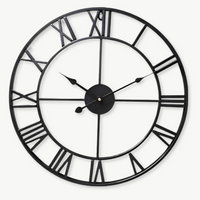
Some contemporary clockmakers now produce pendulum designs with geometric cases or open-frame metalwork that read as modern while retaining the swing. These versatile pieces sit comfortably in transitional spaces, homes that mix vintage furniture with clean contemporary architecture.
Scandinavian and Minimalist Spaces
Be selective here. Most traditional pendulum cases carry too much visual weight for a strict Scandinavian interior. The ones that work are slim-profile designs in pale birch or ash, with minimal dial decoration and a simple disc pendulum. The movement matters more than the case in a minimalist space, which is why a sleek, modern pendulum clock can become more of a focal point against a white wall than a heavily ornamented traditional piece in a cluttered room.
Where to Hang a Pendulum Clock: Height, Room, and Wall Placement
Placement is the single most common place people go wrong with a pendulum wall clock for home decor, and the mistakes are almost always about height and clearance, not style. Get these two things right and the clock will look intentional from day one.
The Right Hanging Height
The traditional rule is to hang the clock so the center of the dial sits at approximately eye level, around 155 to 165 cm from the floor. This holds for most living rooms and hallways. In a kitchen or utility space where you're often moving around and glancing up, hanging it slightly higher at 170 to 180 cm works better because you're not standing directly in front of it most of the time.
The more important practical concern is pendulum clearance below the case. Most pendulums swing to within 10-15 cm of the case bottom. If you're hanging the clock above a sideboard, shelf, or console table, measure the gap carefully. The pendulum needs to swing freely without catching on anything placed below it. A gap of at least 30 cm between the bottom of the pendulum's swing and any surface is a safe working minimum.
Best Rooms for a Pendulum Clock
The living room is the most natural home, particularly a wall above a fireplace, behind a sofa, or anchoring a gallery wall arrangement. The hallway is a close second. A pendulum clock in a hallway has a long history in European homes; it sets the tone for the whole house and greets anyone who enters. The swinging pendulum creates a sense of welcome and time that few other objects can match.
Kitchens suit pendulum clocks well, particularly open-plan or farmhouse kitchens where there's real wall space. Bedrooms require more thought. If the clock has a chime, a bedroom placement only makes sense if the night-silence function reliably mutes it, or if you genuinely don't mind Westminster quarter-chimes at 3am. A mechanical pendulum without a chime silence option is a bedroom wall decoration only if you can tune out the tick, which some people find soothing and others find maddening. I personally can't sleep through it, so I keep my mechanical ones downstairs.
Wall Color and Background
Dark cases need breathing room against a light wall. If your wall is already deep-toned, consider a case in a contrasting finish, perhaps aged brass against charcoal, or pale oak against sage green. The pendulum's swing needs visual space around it to read properly; if it disappears into a cluttered wall or a very dark background, the whole effect is lost.
A single pendulum clock on a plain wall is almost always more powerful than the same clock competing with other artwork. If you want to incorporate it into a gallery wall, give it a clear visual hierarchy by positioning it at the center of the arrangement with smaller pieces flanking it.

The Sound Question: Chimes, Ticking, and Living with a Pendulum Clock
Sound is the aspect of pendulum clocks that most online guides gloss over, and it's the one that determines whether you love your clock six months after hanging it or quietly move it to the garage. Be honest with yourself about noise before you buy. I've made this mistake once, and moving a beautiful mahogany chime clock out of my bedroom at midnight is not an experience I'd recommend.
Chiming Clocks: What to Know Before You Commit
Westminster chimes play a four-note melody on each quarter hour and the full sequence plus the hour count on each hour. That means a chiming pendulum clock makes noise up to 48 times in a 12-hour period. At 3pm, it plays the full melody and then strikes three times. At 12 noon, it plays the full melody and then strikes twelve times. This is part of the charm for many people. It becomes the heartbeat of the house.
Others find it intrusive after a few weeks, particularly in open-plan homes where the chime carries into every room. Many quality pendulum clocks include a chime-silence lever, a night-silence mechanism that automatically mutes chimes between 10pm and 7am, or a volume control. If a chime is part of the reason you want a pendulum clock, verify these features are present before purchasing. A clock without a night-silence function will wake you unless you're a genuinely sound sleeper.
The Tick
Mechanical pendulum clocks tick audibly, often quite loudly. The tick-tock sound comes from the escapement releasing the gear train with each swing. It's measured, rhythmic, and to many ears, deeply comforting. Cottage, library, and study settings often feel more alive with that sound in the background.
Quartz pendulum clocks vary. Some use a quartz sweep movement for the hands, which is silent, while running the pendulum on a separate motor that produces its own soft click. Others use a standard quartz step movement that ticks once per second. Always check whether a quartz pendulum clock has a sweep (silent) or step (ticking) movement if quiet operation matters to you.
"A clock that ticks is a clock that breathes."
Common saying among clock restorers, often attributed to 19th-century English clockmakers
How to Style the Wall Around a Pendulum Clock
A pendulum clock is already a visual composition in itself, and the styling choices around it either reinforce that or undermine it. The goal is to give the clock what it needs: context, breathing room, and a visual anchor below it. This is the part I personally find most satisfying because there's a real craft to it.
The Space Below the Clock
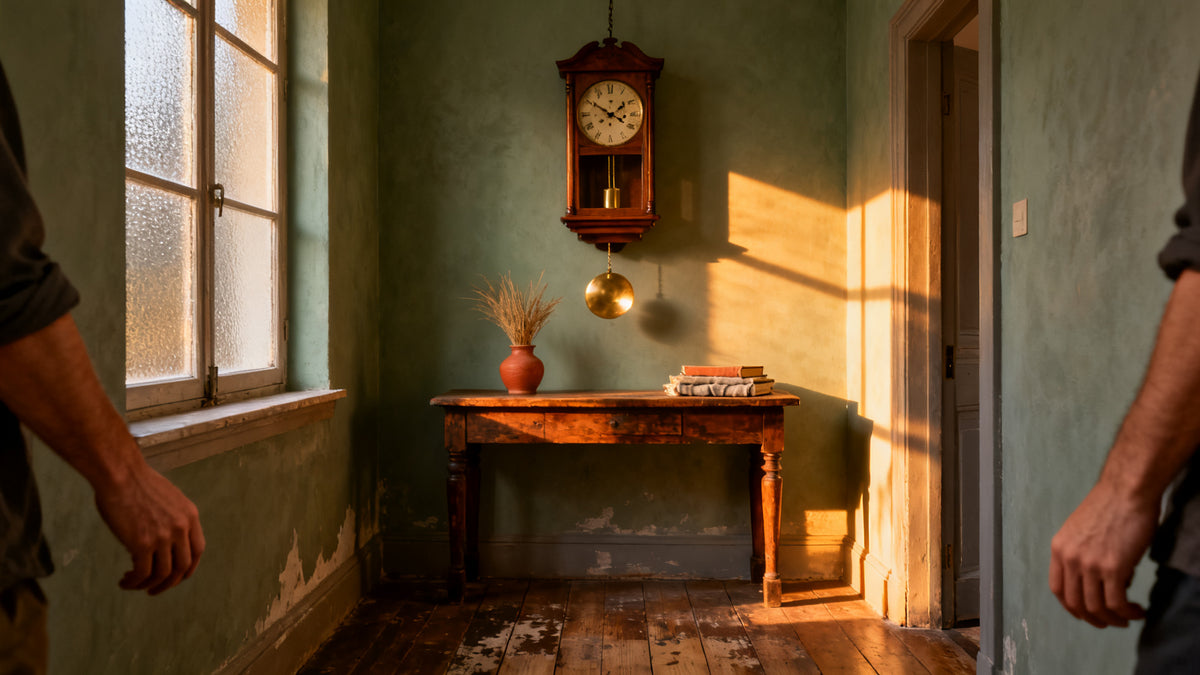
This is where the room comes together. A pendulum clock hung above a console table, a narrow sideboard, or a fireplace mantel creates an immediate vertical composition. The table below acts as a landing pad for the eye after it follows the clock down. Keep the arrangement simple: a low vase of dried grasses, a small stack of books, a single candle. Nothing that competes with the clock, everything that complements its weight.
In a hallway with no furniture, the clock can hang lower, with a small wooden shelf added specifically to give it a base. A reclaimed wood shelf at about 90 cm from the floor, holding a single plant and a key bowl, creates the same effect. The pendulum then swings in the visual space between the clock face and that shelf, which makes the movement even more apparent.
Gallery Wall Integration
Pendulum clocks can sit within gallery walls, but they need to be the visual anchor rather than a peer. Position the clock at the geometric center of the arrangement, or at the top of a stacked composition. Leave a clear margin of about 15-20 cm between the clock case and the nearest frame. This isolation of the clock within the grouping signals that it's the primary object.
Mix media carefully. Framed photographs, botanical prints, and ceramic wall art all coexist comfortably with a traditional pendulum clock. Metal sculptural pieces or large canvas works tend to fight with it rather than support it.
Wall Color Pairing
Dark walnut or mahogany cases pair best with warm neutrals (linen, oatmeal, soft terracotta), forest greens, and navy. Oak or pine cases suit whites, pale grays, sage, and dusty blue. Aged iron or industrial cases: brick red, concrete gray, deep charcoal, warm white. Pale ash or birch cases: crisp white, pale gray, blush, any Scandinavian neutral.
The metallic element of the pendulum itself is a small but useful detail. A brass pendulum disc references warm metal tones in the room: brass lamp bases, copper cookware visible through the kitchen doorway, gold picture frames. A chrome or steel pendulum pairs with cooler finishes and cleaner lines.


Shopping for a Pendulum Clock: What the Specs Actually Mean
Most product descriptions for pendulum clocks include technical details that require translation before they mean anything useful, so here's what to look for and what to ignore. I've been through enough confusing listings to know the specs that actually matter.
Movement Type
As covered above, this is the most important spec. Look for "quartz sweep" or "silent sweep" if you want a quiet clock. "Quartz step" or just "quartz" without further description usually means a standard ticking movement. "Mechanical" or "8-day movement" means the authentic wind-up type. "German movement" or "Hermle movement" is a quality marker; Hermle is a well-regarded German clockmaker whose movements are used in many quality pendulum clock cases worldwide.
Case Height vs. Total Height
Manufacturers sometimes list case height (the wooden body) separately from total height including the finial or decorative crown at the top. Always check total height, including any top ornament, against your wall space. A clock listed at 60 cm case height might measure 75 cm with its finial, and that extra 15 cm matters if there's a low ceiling or a shelf above it.
Pendulum Length and Clearance
Longer pendulums produce a slower, more stately swing. A pendulum of 30 cm or more produces a beat rate that's visually calming and easy to follow across a room. Shorter pendulums swing faster and can look slightly nervous on a large wall. For a living room or hallway installation, aim for a pendulum that extends at least 25 cm below the case bottom.
Chime Types
Westminster is the most common, the four-note sequence most people recognize as the standard clock chime. Whittington chime uses a different eight-note sequence, less familiar but arguably more melodic. St. Michael is a third option found on some older movements. Many contemporary pendulum clocks play Westminster only; models with multiple chime options let you switch between them.
Case Materials
Solid wood cases hold up better than veneer over particleboard, particularly in rooms with fluctuating humidity, like kitchens. Metal cases in real cast iron or forged steel are heavy but durable. Eco-resin cases, used in some cuckoo and carved-style designs, offer a carved-wood aesthetic with better resistance to humidity and impact. Weight is a rough proxy for quality in clock cases, though not an infallible one.

Setting Up and Regulating a Pendulum Clock at Home
Most quartz pendulum clocks are ready to hang straight from the box, but mechanical ones need a proper setup process, and skipping even one step can mean the clock never keeps time accurately. Here's what that process actually looks like in practice.
Hanging and Leveling
Use a solid wall anchor rated for at least twice the clock's weight. Most traditional pendulum clocks weigh between 4 and 12 kg, so a standard picture hook is not adequate. A single 6 mm wall anchor in masonry or a toggle bolt in drywall is the right starting point. Check that the mounting point is exactly level before hanging.
Once the clock is on the wall, use a small spirit level placed on top of the case or against the side of the pendulum rod to verify it's hanging plumb. If the clock leans even slightly, the pendulum's natural swing path is disturbed and the clock will gain or lose time. Adjust the hanging position until tick and tock sound equal in length, that equal beat is the clearest sign that the pendulum is swinging correctly.
Regulating the Rate
Most mechanical pendulum clocks have a small rating nut at the bottom of the pendulum rod. Turn it clockwise to raise the pendulum bob, which shortens the effective pendulum length and speeds the clock up. Turn counterclockwise to lower the bob, which slows it down. A single full turn of the rating nut typically changes the rate by about 30 seconds per day, though this varies by clock.
Set the clock to the correct time and check it after 24 hours. If it's running fast, lower the bob slightly. If running slow, raise it. Repeat until the rate is stable. This regulation process can take a week or two of small adjustments to dial in precisely, which is part of the ritual that mechanical clock owners genuinely enjoy.
Starting the Pendulum
Give the pendulum a gentle push to one side and release it. It should swing freely and the clock should begin ticking immediately. If the pendulum stops within a few minutes, the clock is not level, the mainspring needs winding, or there's an issue with the escapement. For quartz pendulum clocks, the pendulum motor starts automatically when batteries are inserted, often after a 30-second calibration period.
💡 Did you know?
In a properly regulated mechanical pendulum clock, every tick and every tock should sound identical in both volume and interval. Clockmakers call this "in beat." A clock running "out of beat" produces an uneven tick-TOCK rhythm, loses time inconsistently, and may stop entirely on its own. Learning to hear the difference is one of the first practical skills any clock collector develops.
Caring for a Pendulum Clock: Keeping It Running for Decades
A well-maintained mechanical pendulum clock can run reliably for 50 years or more, but it needs periodic attention that most owners underestimate until a problem occurs. Think of it like a car: ignore the service intervals and things get expensive fast.
Cleaning the Movement
Mechanical clock movements accumulate dust and their lubricating oils oxidize over time. Most horologists recommend a full cleaning and re-oiling every 7 to 10 years under normal conditions, or every 5 years if the clock is in a dusty environment. This is a job for a qualified clock repairer, not a DIY project. Disassembling an escapement without experience tends to end badly.
Between professional services, keep the case closed if it has doors, and avoid placing the clock near heating vents where circulating air carries dust directly into the movement. A light dusting of the case exterior with a soft cloth is all the regular maintenance the case itself needs.
Glass and Case Care
The glass door on a traditional pendulum clock case is often attached with small brass hinges. Clean it with a dry microfibre cloth rather than glass cleaner, which can run into the case and reach the movement. Wooden cases benefit from an occasional wax or polish suitable for the finish; most traditionally finished walnut or mahogany cases respond well to a beeswax polish applied once or twice a year.
Quartz Pendulum Clock Maintenance
These require almost nothing. Replace batteries when the clock starts losing time or the pendulum slows. Use quality alkaline batteries rather than budget options, as cheap batteries can leak and damage the movement housing. Leaking batteries in any clock are a serious risk; check and replace them on a fixed annual schedule rather than waiting for the clock to show symptoms.
⚠️ Heads up
Never use WD-40 or general-purpose lubricants on a clock movement. These products are not clock oils; they attract dust, gum up the escapement over time, and can cause permanent damage to gear pivots. If a mechanical clock needs oiling, use purpose-formulated clock oil, available from horological suppliers, or take the clock to a repairer.
Pendulum Clocks as Heirlooms: Buying Vintage and Antique
Buying a vintage or antique pendulum clock is a genuinely different transaction from buying a new one, with real rewards but real risks if you don't know what you're examining. I've bought three vintage pendulum clocks over the years. One was a perfect find. One needed a full service I hadn't budgeted for. One had a replaced dial I didn't spot until I got it home. Here's what I check now.
What to Check When Buying a Secondhand Pendulum Clock
Start with the movement. Ask the seller to demonstrate that the clock runs. Listen to the tick for at least five minutes; a healthy mechanical movement maintains a steady, even beat. An irregular tick, a grinding sound, or a click that varies in volume suggests worn pivots or a damaged escapement. These are repairable, but factor a professional service cost into your budget.
Check the pendulum bob for damage or replacements. An original brass bob, particularly on a 19th or early 20th-century clock, adds to both the character and the value. A replaced bob in a different metal or size may indicate the original was lost or the clock was modified at some point.
Look at the case joints and veneer. Separating veneer at corners or joints is common in old clocks and usually repairable with hide glue, but severe warping or water damage to the case wood can be difficult to fix without specialized restoration work.
Movement Age and Origin
German movements from makers like Hermle, Urgos, or Kieninger are considered some of the most reliable produced in the 20th century. English fusee movements from the 18th and early 19th centuries are genuinely collectible. French movements from the Belle Époque period (roughly 1890 to 1914) tend to have elegant cases but vary more widely in movement quality.
American pendulum clocks from Seth Thomas, New Haven, and Gilbert are common on the secondhand market and generally affordable. They are good workhorses rather than fine horological instruments, but many are still running after a century with basic maintenance. An 1890s American shelf clock with an 8-day pendulum movement in good original condition is often the best entry point for a first-time vintage buyer, combining authenticity, accessibility, and reasonable pricing.
Beyond the Living Room: Unexpected Places Where Pendulum Clocks Work
The standard advice puts pendulum wall clocks in living rooms and hallways, and that's largely correct, but a few non-obvious placements work remarkably well and are genuinely worth considering. These are the rooms where I've been most surprised by how right it feels.
The Home Library or Study
A pendulum clock in a room full of books is a natural combination. The tick of a mechanical movement creates a background rhythm that many readers and writers find genuinely conducive to focus. The literary and intellectual associations of a pendulum clock, its long history in European study rooms and libraries, feel earned rather than affected. A smaller bracket clock with a pendulum visible through a glazed door works particularly well on a shelf between two columns of books.
The Kitchen in a Period Home
Period kitchens with painted cabinetry, flagstone floors, and Aga-style ranges are natural homes for pendulum clocks. A clock above the range or above the main kitchen dresser becomes the room's timekeeper in a way that feels domestic and grounded. Keep it simple in terms of case style: a painted wooden case or a simple pine longcase in a reduced format reads much better in a kitchen than a heavily gilded mahogany case.
The Staircase Wall
Staircases are underused as clock positions. A pendulum clock positioned on the wall at the bottom of the stairs, or at the first landing, works well because it's seen from multiple angles and distances throughout the day. The swinging pendulum catches the eye from the top of the stairs looking down, from the bottom looking up, and from the side as you pass. This multi-angle visibility is something very few wall decorations can offer. Keep the mounting secure and ensure the pendulum's swing path clears the stair handrail.
The Bottom Line: Why a Pendulum Clock Is Worth It
A pendulum wall clock for home decor earns its place on the wall the way almost nothing else does: it moves, it sounds, it marks time in a way you can see and hear. It's one of those rare objects that works harder than it looks.
I've styled a lot of walls. I've tried nearly everything on them. And I keep coming back to pendulum clocks because they do something that framed prints, mirrors, and floating shelves simply can't: they add rhythm to a room. That slow, deliberate swing turns a static wall into something that breathes. That's not a marketing line. It's just what happens when you live with one.
If you're starting from scratch, my honest advice is this: pick the case style that fits your room's existing materials (not the one you wish you had), choose quartz if maintenance feels like a barrier, choose mechanical if you genuinely enjoy a clock that asks something of you, and hang it slightly higher than you think you need to. You can always move it down. You can't unsee a pendulum crammed into a corner.
Browse the living room wall clock collection for pendulum styles across every price range, or start with the full wall clock range if you want to compare pendulum designs side by side with other statement pieces. Either way, the wall is waiting.
Frequently asked questions
Do pendulum wall clocks need to be level to work?+
Mechanical pendulum clocks must hang plumb and level to keep accurate time. Even a slight tilt changes the swing arc of the pendulum and causes the clock to gain or lose time. Quartz pendulum clocks use a battery movement for timekeeping and a separate motor for the decorative pendulum swing, so they are not sensitive to wall angle in the same way.
Can a pendulum clock work in a bedroom?+
Yes, with the right model. A quartz pendulum clock with a silent sweep movement and a night-silence chime function works well in a bedroom. A mechanical pendulum clock with an audible tick and chimes is a different matter: some people find the rhythm soothing, others find it impossible to sleep through. Know yourself, and check the specs for night-silence capability before buying.
What is the difference between a pendulum clock and a grandfather clock?+
A grandfather clock, formally called a longcase clock, is a freestanding floor clock with a tall case that encloses the entire pendulum and weights. A pendulum wall clock is mounted on a wall, with the pendulum visible below the case. Both use a pendulum mechanism, but a grandfather clock's long pendulum (typically about 99 cm, designed to beat exactly once per second) requires a substantial floor-standing case to house it.
How high should a pendulum wall clock be hung?+
The standard guidance is to hang the clock so the center of the dial sits at approximately eye level, around 155 to 165 cm from the floor in most living rooms. More important is ensuring the pendulum has adequate clearance below: at least 30 cm of free space between the bottom of the pendulum's swing arc and any surface or object below the clock.
How often does a mechanical pendulum clock need servicing?+
Most horologists recommend a full cleaning and re-oiling every 7 to 10 years under normal domestic conditions, and every 5 years in dusty environments. In addition to periodic servicing, the clock needs winding every 7 or 8 days (for an 8-day movement) and occasional rate adjustment via the pendulum rating nut. These regular tasks take less than two minutes.
What style of pendulum wall clock suits a modern home?+
For modern and contemporary interiors, look for slim-profile pendulum clock designs in pale ash, birch, or open-frame metal with minimal dial decoration and a simple disc pendulum. Avoid heavily carved cases or ornate gilded finials, which belong in traditional settings. Some contemporary clockmakers now produce geometric open-frame pendulum designs that work naturally in minimalist Scandinavian or mid-century modern spaces.