
A small bedroom has a particular kind of pressure on it. Every object you put in that room either earns its place or quietly makes the space feel more cramped. Clocks are no different. The wrong one, too bulky, too loud, too visually busy, turns what should be a restful retreat into a sensory obstacle course. The right one, though? It pulls the whole room together and makes you feel like you actually planned something.
How to pick a clock for a small bedroom is genuinely one of those decisions where a little extra thought upfront saves you a lot of regret later. This guide walks through everything that actually matters: the right diameter, where to hang it, which mechanism to choose, and how to match style to a room that doesn't have much margin for error.
Quick summary
- For most small bedrooms, a clock between 10 and 18 inches (25-45 cm) is the right range - anything larger fights the room.
- Silent quartz or sweep movements are non-negotiable if you're a light sleeper.
- Side wall placement (not directly facing the bed) keeps the clock functional without becoming a sleep anxiety trigger.
- Thin profiles and light-colored dials keep a compact room visually open.
- Your clock's material should echo at least one other element already in the room.
Why Size Is the First Decision When Picking a Clock for a Small Bedroom
When picking a clock for a small bedroom, size comes first because scale mistakes are the hardest to fix: a clock that's too small vanishes, while one that's too large becomes a confrontation every time you glance at the wall. Most people go one of two ways: they pick a clock that's too small because they're scared of overwhelming the room, or they grab something statement-sized because it was beautiful in the store. Both are understandable. Neither tends to work well in a tight bedroom.
The general rule that holds up across most rooms is the two-thirds principle: your clock's diameter should fill roughly two-thirds of the wall width it occupies. In a small bedroom, that usually means the clock is sharing a wall with furniture, a window, or a door, so "the wall" is often a narrow section rather than an open expanse.
Size by room context, broken down clearly:
- Very compact rooms (under 100 sq ft / 9 m²): 10-14 inches (25-35 cm). Big enough to read from the bed, small enough to stay in proportion.
- Standard small bedrooms (100-150 sq ft / 9-14 m²): 14-18 inches (35-45 cm). This is the sweet spot for most people.
- Small bedroom with one generous empty wall: You can push to 20-22 inches (50-55 cm) if the rest of the room is kept clean.
Go too small and the clock becomes invisible, an afterthought you squint at from the doorway. Go too large and every glance at the wall becomes a confrontation. Neither outcome serves the room, and in a space this compact, scale mistakes are the hardest to ignore.

Did you know?
The idea of having a clock in the bedroom only became widespread in the early 20th century, once affordable alarm clocks replaced the bell-ringers who used to walk through neighborhoods waking factory workers. Before that, clocks were primarily a living room or parlor fixture, the bedroom was considered a space for rest, not timekeeping.
The Mechanism Question: Choosing a Quiet Clock for a Small Bedroom
For a small bedroom, a silent quartz or sweep movement is the only mechanism worth choosing: standard stepping motors tick at 30-40 decibels, enough to disrupt light sleepers, while silent and sweep options eliminate that noise almost entirely. This is the part most clock guides mention once and move on from. It deserves more attention, because the mechanism is what you live with at 3am.
Traditional quartz movements work on a stepping motor: the second hand ticks forward in discrete jumps, producing that familiar ticking sound. In a quiet bedroom at night, that ticking can register at 30-40 decibels, about the level of a whispered conversation. For light sleepers, that's genuinely disruptive. Even for heavy sleepers, it creates a background hum of awareness that prevents the deepest rest.
There are two better options for a bedroom:
- Silent quartz movement: Uses a modified stepping motor designed to absorb vibration. The second hand still steps, but produces almost no audible sound. These are widely available and usually cost no more than a standard movement.
- Sweep (continuous) movement: The second hand moves in a smooth, continuous arc rather than discrete steps. Completely silent. Often found in higher-quality timepieces and associated with a more refined aesthetic, closer to what you'd see in a well-made Swiss or German Präzisionsuhr.
If you're browsing clocks and the product description doesn't mention "silent" or "sweep," assume it ticks. In a living room or kitchen, that's fine. In a bedroom, it's worth paying close attention to.

Placement Rules That Actually Hold Up When You Pick a Clock for a Small Bedroom
The four placement rules that consistently work are: side wall over facing the bed, eye level when standing, anchored above a piece of furniture, and away from windows to avoid glare on the dial. Where you mount the clock matters as much as the clock itself. In a small bedroom, you don't have the luxury of "finding a blank wall." You're making choices within constraints. These four placement principles have never steered anyone wrong.
Side wall over directly facing the bed
Mounting a clock on the wall directly opposite the bed sounds logical, you can read it from bed without moving. The problem is that it also means the clock is the first thing you see when you wake up and the last thing in your field of vision at night. For people prone to clock-watching, this becomes a sleep problem. A side wall placement lets you check the time with a slight turn of the head without the clock dominating your visual field from the pillow.
Eye level when standing, not when lying down
The instinct to mount a clock at "lying in bed" height actually makes the room feel lower and smaller. Standard mounting height is roughly 57-60 inches from the floor (eye level for an average standing adult). This keeps the clock in proportion with the rest of the room's visual rhythm and avoids that low-slung, cramped feeling compact rooms can easily develop.
Above a nightstand or dresser
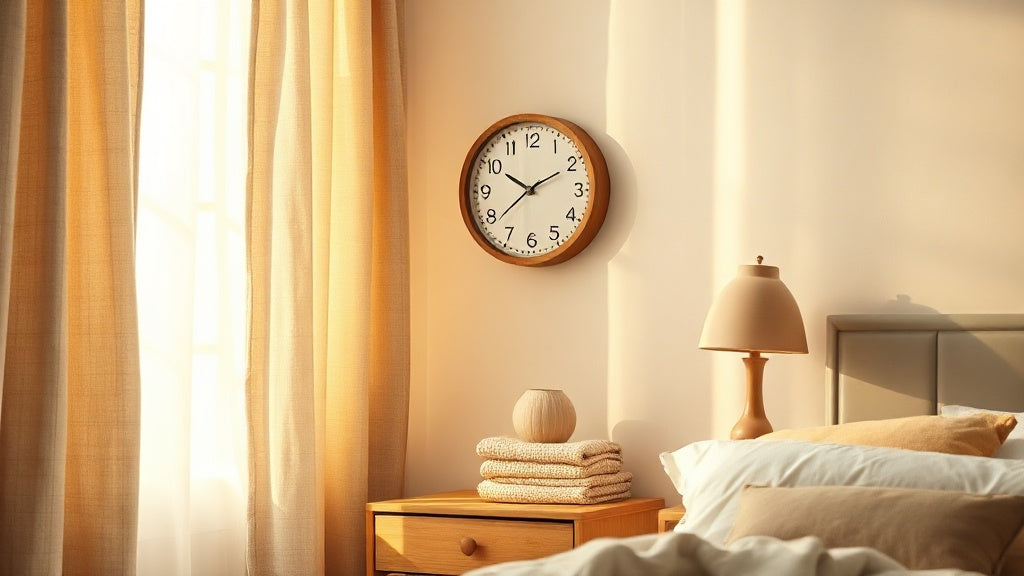
Anchoring the clock above a piece of furniture grounds it in the space. A clock floating on an otherwise empty wall in a small room can look lost. Above a nightstand, it creates a small composition, lamp, surface, clock, that reads as intentional rather than accidental.
Away from windows when possible
Morning light hitting a glass dial creates glare that makes the clock unreadable precisely when you most want to read it. If a window-adjacent placement is your only option, choose a matte or wood-faced clock over a glass one. An open-grain oak or walnut dial scatters light rather than reflecting it.

How to Match Clock Style to a Small Bedroom Without Overthinking It
The simplest way to match a clock's style to a small bedroom is to look at the two or three materials already dominant in the room and choose a clock that echoes at least one of them, without introducing a completely foreign element. A small bedroom is not the place for a clock with a lot going on. The room is already working hard, it has to feel restful, personal, and functional all at once. The clock you choose should add to that atmosphere, not fight it.
Here's a practical way to think about it: look at the two or three materials already dominant in your bedroom. Wood tones? Metal hardware? Woven textures? Ceramic lamp bases? Your clock should echo at least one of those materials. This isn't about matching everything perfectly, it's about not introducing a completely foreign material that pulls the eye out of the room's logic.
Minimalist and Scandinavian styles
Clean dials, thin hands, no numerals or simple indices, light birch or ash finishes, soft white. These work in almost any small bedroom because they're visually quiet. They do their job without asking for attention. If your bedroom is neutral-toned and uncluttered, a Scandinavian-style clock is the easiest path to something that just feels right. The Danish design tradition built an entire aesthetic philosophy around this idea: that a well-made object should disappear into a room, not shout from it.
Warm natural wood
A wooden clock face, whether oak, walnut, or bamboo, adds texture and warmth without visual weight. Wood doesn't reflect light aggressively, so it reads as calm on the wall. It also ages quietly: the grain can shift slightly with humidity and light over years of use, which gives the clock a subtle life of its own. Works particularly well in bedrooms with linen bedding, cotton curtains, or rattan side tables.
Vintage and artisan styles
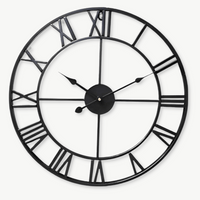
These can absolutely work in a small bedroom, but the key is restraint elsewhere. If you want a clock with Roman numerals, aged patina, or decorative details, keep the surrounding wall spare. One interesting clock reads as a deliberate choice; one interesting clock surrounded by gallery wall photos and hanging plants reads as clutter. The objet unique principle applies: make it the hero, or don't hang it at all.
What to avoid in small spaces
- Highly reflective metal or mirror-faced dials (amplify visual noise)
- Clocks with pendulums that require significant clearance below
- Ornate frames with lots of carved or laser-cut detail (visually busy from a distance)
- Digital displays with bright backlighting (disrupts sleep and dominates the room at night)
- Clocks with chimes or hourly sounds (charming in a living room, maddening in a bedroom)

| Clock Feature | Good for Small Bedrooms | Better for Other Rooms |
|---|---|---|
| Movement | Silent quartz or sweep | Standard stepping quartz, chime |
| Diameter | 10-18 inches (25-45 cm) | 24+ inches (60+ cm) |
| Dial finish | Matte, wood, linen, soft white | High-gloss mirror, bright metallic |
| Frame depth | Slim profile (under 1.5 inches) | Deep shadow box, 3D gear designs |
| Numerals | Simple, clean, or none | Highly ornate Roman, large Arabic |
| Light emission | None, or faint glow hands only | Backlit digital display |
Wall Clocks vs. Tabletop Clocks: Which Actually Works Better in a Small Bedroom?
Wall clocks are the better default for a small bedroom because they use vertical space rather than the scarce horizontal surface area that nightstands and dressers already compete for. It's a question worth asking honestly. Wall clocks are the default recommendation for bedrooms because they use vertical space rather than horizontal surface area, which is genuinely scarce in a small room. A nightstand already holds a lamp, perhaps a book, a phone. Adding a clock to that surface often tips the balance from "well-arranged" to "piled up."
That said, a compact tabletop clock has a strong case in one specific situation: when your walls are already doing a lot of work (shelving, artwork, window) and there simply isn't a clean section of wall left for a clock without it fighting with something else. A small analog desk clock with a silent sweep movement, placed on the nightstand or dresser, solves the timekeeping problem without adding anything to the walls.
The trade-off is visibility. From across the room or from bed, a wall-mounted clock at eye level is readable with a quick glance. A tabletop clock requires more deliberate looking, fine at the bedside, less useful if you want to check the time from the doorway or while getting dressed.

The Colour and Contrast Question Nobody Warns You About
In a small bedroom, you want enough contrast for the clock to be readable from bed, but not so much that it becomes the loudest visual in the room: match your clock's tone to your wall colour before you commit. A clock that looked perfect in a store or in an online photo can disappear completely against a wall at home, or jump out aggressively, depending on contrast. It's one of those things you don't see coming until the clock is already hanging and you're squinting at it from across the room wondering what went wrong.
In a small bedroom, you generally want enough contrast to make the clock readable from bed, but not so much that it becomes the loudest visual in the room. A few practical checks:
- Light walls (white, cream, pale grey): A clock with a light dial and thin dark hands will be readable and subtle. A dark-framed clock will be more of a statement. Both can work, but the dark frame commits the clock to "focal point" status, so make sure that's what you want before you commit.
- Dark or moody walls (deep green, charcoal, navy): A light-faced or brass-accented clock reads clearly without feeling stark. Avoid matte black clocks on dark walls, they simply won't be visible.
- Textured or wallpapered walls: Choose a clock with a clean, defined border. Against a busy background, a clock with an open or cutout frame will merge visually and become unreadable.
The goal isn't to blend the clock into the wall. It's to make it readable at a glance while still belonging to the room's palette. Think of it as being present without shouting.
Does Your Bedroom Style Actually Need a Wall Clock?
Most bedrooms genuinely benefit from a wall clock because it lets you check the time without triggering the phone-check spiral that pulls you into emails and alerts at 2am. Worth asking, honestly. Some bedroom aesthetics, hyper-minimal, spa-influenced, Japanese wabi-sabi, deliberately keep walls bare. In those rooms, a clock feels like an intrusion. And phones have replaced the functional need for a visible clock in a lot of households.
But here's what I keep coming back to: a clock in the bedroom does something a phone can't. It lets you check the time without the reflexive phone-check spiral that ends with you reading emails at 2am. A glance at the wall gives you the information and nothing else. For that reason alone, a well-chosen bedroom wall clock earns its place for most people.
The key word is "well-chosen." A clock that adds visual noise, ticks audibly, or sits awkwardly on a wall it doesn't suit will make you regret it. One that fits the scale, matches the mood, and stays silent while you sleep? That's a small addition that changes how a room feels to be in, not just how it looks in a photo.
"A room without a clock has no pulse. A room with the wrong clock has too loud a one."
Interior design principle, the timepiece as a calibrating element of a room's rhythm
How to Pick a Clock for a Small Bedroom When You're Overwhelmed by Options
The fastest way to cut through the options is to filter in this order: set your size range, then require silent or sweep movement, then match a material already in your room, then check profile depth, then read noise-specific reviews. The sheer number of clocks available online is genuinely overwhelming. This filtering sequence narrows things down fast, without requiring you to look at four hundred product pages:
- Set your size range first. Measure the wall section where you're planning to hang it. Divide that width by 1.5 for your maximum diameter. Set an upper limit in your search and stick to it.
- Filter for silent or sweep movement. This removes a large portion of options immediately, and rightly so for a bedroom context.
- Match at least one material. If your room has warm wood tones (furniture, flooring), look in the wooden clock category. If you've got metal hardware and a more industrial feel, look at metal-framed options with a matte or brushed finish rather than polished chrome.
- Check the profile depth. A clock with a deep shadow box frame or heavy casing will project noticeably from the wall and can feel heavy in a small room. Slim profiles (under 1.5 inches / 4 cm deep) read lighter and sit more gracefully on a compact wall.
- Read the noise reviews specifically. Look for customer mentions of how quiet the clock is at night. This is the one performance metric that product photos simply can't tell you, and it matters more in a bedroom than in any other room of the house.

When the Clock You Love Is "Too Big" for Your Room
A larger clock can still work in a small bedroom if the wall around it is kept completely clear: negative space is what lets an oversized piece breathe rather than overwhelm. Sometimes you fall for a clock that's genuinely beautiful but technically too large for the wall you have in mind. There's a way to make this work without it feeling forced.
The trick is negative space. A larger clock needs emptiness around it to breathe. If you want to hang a 20-inch clock in a small bedroom, the wall around it needs to be clear, no gallery wall additions, no floating shelves crowding the sides. Let the clock be the single decision on that wall. Remove something else rather than trying to fit everything in.
This is actually a principle that applies to small bedroom decor broadly: choosing a clock for a small bedroom is sometimes as much about what you remove as what you add. One well-scaled, well-placed clock does more for a room than three smaller decorative pieces fighting for the same wall. It's the same logic that makes a single large artwork feel more intentional than a cluttered gallery arrangement in a tight space.
A Few Things Worth Knowing Before You Mount Anything
Before mounting any clock in a small bedroom, check battery access, verify hanging hardware, confirm level alignment, and plan to replace batteries at the first sign of stuttering rather than waiting for the clock to stop. Practical, slightly boring, but genuinely useful. These are the things that cause regret two years after installation if you don't think about them now.
- Battery access: Check where the battery compartment is before you mount. Some clocks require you to remove the whole clock from the wall to change batteries. Others have accessible compartments on the front face. The latter is much less annoying over years of use.
- Hanging hardware: Cheaper clocks sometimes ship with a single small nail hole and no bracket. If you're hanging on drywall without a stud, use a proper picture-hanging anchor rated for at least twice the clock's weight.
- Check for level before marking: A slightly tilted clock in a small room reads as wrong in a way that a tilted piece of art might get away with. Use a small spirit level before marking your final position.
- Battery type matters for silence: Even a silent mechanism can produce subtle vibration if it's fighting a low battery. Replace batteries at the first sign of the second hand stuttering, not after the clock stops entirely.
Frequently Asked Questions: How to Pick a Clock for a Small Bedroom
What type of clock is best for a bedroom?+
An analog wall clock with a silent quartz or sweep movement is the most practical choice for a bedroom. Silent movements produce no audible ticking, which matters a great deal in a quiet room at night. Analog dials are easier to read at a glance than digital displays, and they don't emit light that disrupts sleep. For style, minimalist Scandinavian or natural wood designs tend to suit bedroom environments best because they're visually calm rather than demanding. If you're exploring the options, the bedroom clock collection has every piece pre-filtered for quiet movement and restful aesthetics.
Should you have a clock in a small bedroom?+
Yes, for most people, a bedroom clock serves a genuine purpose beyond pure decoration. A wall clock lets you check the time without reaching for your phone, which is a meaningful sleep hygiene benefit, since phone checks almost always trigger other alerts and distractions. The key is choosing a clock that's silent, appropriately sized, and placed where it's readable without being the first thing you see from the pillow. Get those three things right and a bedroom clock is an asset, not a disruption.
What size wall clock works best in a small bedroom?+
For most small bedrooms, a diameter between 10 and 18 inches (25-45 cm) is the right range. Very compact rooms (under 100 sq ft) are better served by the lower end of that scale (10-14 inches). Standard small bedrooms with a bit more wall space can comfortably take 14-18 inches. Going larger is possible if the rest of the wall is kept completely clear, but it requires treating the clock as a solo statement rather than one element among several.
Where should a clock be placed in a small bedroom?+
The best placement is on a side wall at standard eye level (around 57-60 inches from the floor), rather than directly facing the bed. This keeps the clock readable with a slight turn of the head without making it the focal point from the pillow, which can subconsciously trigger clock-watching anxiety. Positioning it above a piece of furniture like a dresser or nightstand grounds it visually and creates a composed arrangement that reads as intentional rather than accidental.
Can a ticking clock affect sleep quality?+
It can, particularly for light sleepers. A standard stepping quartz movement produces around 30-40 decibels of ticking sound, roughly equivalent to a hushed conversation. In a quiet bedroom at night, that sound is noticeable and can interfere with falling asleep or returning to sleep after waking. Silent quartz movements and sweep mechanisms eliminate this issue almost entirely. If you already own a ticking clock and it bothers you, placing it inside a closed wardrobe overnight is a temporary fix while you find a replacement.
What clock style works best in a small minimalist bedroom?+
In a minimalist bedroom, the best clock is one that does as little visual work as possible while still being readable. That usually means a clean dial with no numerals or simple index markers, thin hands, a slim profile (under 1 inch deep), and a finish that blends with the wall rather than contrasting sharply. Scandinavian-style clocks in white, soft grey, or pale birch consistently perform well in these settings. The design philosophy is the same as the room itself: nothing extra, everything intentional.