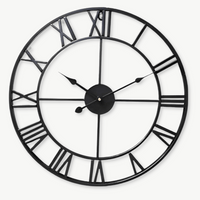


A man cave earns its character from the things you choose to put in it. Not the things you have to put in it. The TV mount, the bar fridge, the electrical outlets, those go where they go. But a clock? That one's yours. A vintage industrial clock for a man cave is the kind of piece that stops a visitor in their tracks, and it does it without saying a word.
The problem is that "industrial clock" covers a huge range. There's a real difference between a cheap stamped-metal piece from a box store and a proper gear-driven timepiece that looks like it was salvaged from a 1920s factory floor. This guide cuts through the noise and tells you what actually works in a man cave context, and why.
⭐ Key takeaways
- Size matters more than style; a clock under 40 cm reads as decoration, not statement
- Exposed gears and raw metal finishes are the hallmarks of authentic industrial design
- Brick, wood paneling, and concrete walls all respond differently to clock placement
- Rotating gear clocks add movement and draw the eye; static face clocks anchor a wall
- Silent quartz movement is worth prioritizing in a space where you watch films or host
Why the Man Cave Calls for a Different Kind of Clock
A man cave demands a clock that reflects its own personality: industrial design, with raw iron, exposed mechanics, and aged patinas, fits the space better than any other style because it carries real history and looks like it belongs there. Most rooms are furnished defensively. People pick things that won't offend anyone. A man cave is the opposite. It's built around a specific personality, a specific hobby, a specific idea of what a good evening looks like. The clock on that wall should reflect that same logic.
Industrial design fits the man cave better than almost any other style. Raw iron, exposed mechanics, weathered brass, dark patinas, these materials carry a sense of history. They look like they've been somewhere. A polished chrome clock with a white minimalist face would feel out of place on an exposed brick wall. An aged iron clock with open gear work? That wall was made for it. If you're still exploring the broader category, the industrial wall clock collection is a good place to orient yourself before committing to a style.

The other reason industrial clocks work so well here is scale. Man caves tend to have more wall space than a typical bedroom or kitchen. Industrial clocks are designed to fill space, they're built large, they're built bold, and they don't apologize for it. A 50 cm or 60 cm piece on a garage bar wall looks intentional. That same clock in a narrow hallway would feel aggressive.
The 7 Industrial Clock Styles Worth Knowing
The seven industrial clock styles worth knowing range from rotating gear showstoppers to open-frame skeleton pieces and Americana clocks, each suited to a different man cave aesthetic, wall surface, and atmosphere.
1. Rotating Gear Clock
This is the showstopper. A rotating gear clock has actual moving mechanical elements, usually large interlocking cogs that turn visibly as time passes. You can watch them move. Guests will watch them move. Some designs are purely decorative, with a separate quartz movement handling timekeeping; others run entirely from the gear mechanism itself.
The best rotating gear clocks are heavy. You feel that when you unbox one. Cast iron or steel construction, genuine machined gears, sometimes with a copper or antique brass finish. They work best on a solid wall with a proper anchor point; these aren't pieces you hang on a single picture nail.

2. Rotating Dial / Spin Time Clock
A subtler cousin of the rotating gear clock. Instead of exposed gears, the time display itself rotates, typically two spinning discs that show hours and minutes. The mechanism is usually hidden, which gives the piece a cleaner silhouette. From across a room, it reads as abstract sculpture until you realize it's telling the time.
This style suits a man cave with a more polished aesthetic, think exposed brick and leather rather than raw concrete and scaffolding planks. It's industrial without being aggressive about it.
3. Factory / Loft-Style Face Clock
The most classic option. A large circular face, often 50-60 cm across, with bold Arabic or Roman numerals, a dark or antique frame, and hands that are visible from across a room. These are inspired by clocks that were hung in warehouses, rail stations, and factory floors in the early twentieth century.
The appeal here is legibility. You can actually read this clock at a glance from the couch, the bar, the billiards table. It does the practical job well and it looks the part doing it.
💡 Did you know?
The oversized factory clock became a design object largely by accident. During 1970s and 1980s loft conversions in New York and London, architects kept the original industrial hardware, clocks included, because replacing it was expensive. Buyers ended up paying premiums for apartments that still had the old factory clock on the wall. The aesthetic was born from pragmatism, not curation.
4. Open-Frame / Skeleton Clock
The movement is exposed. No solid face, just a frame, the hands, the mechanism, and empty space in between. This style reads as art more than timekeeping, which is exactly what makes it interesting on a man cave wall. You're not just looking at a clock. You're looking at the mechanics of time itself.
Skeleton clocks tend to be lighter than solid-face industrial pieces. That makes placement more flexible. They work well against a single contrasting wall, dark slate, raw wood paneling, even a painted brick section.
5. Steampunk Hybrid
Steampunk takes industrial aesthetics and pushes them further, more gears, more copper pipe detailing, sometimes mixed materials like glass domes over small internal mechanisms. The line between clock and sculpture is intentionally blurred.
These work best in a man cave that has a clear thematic direction. A space with aviation memorabilia, vintage maps, Edison bulbs, steampunk fits right in. In a sports bar-style cave, it can feel incongruous. Context matters here more than with other styles.

6. Vintage Americana / Route 66 Style
Technically adjacent to the industrial category, but worth including here. These clocks use retro typography, muted color palettes, and period-correct design references to evoke mid-century American roadside culture. Think neon diner signs without the neon, the same warmth, achieved with wood and print.
A bamboo-based Route 66-style clock is lighter on the wall than cast iron, and the visual language reads as relaxed and nostalgic rather than raw and mechanical. Better for a garage bar with a laid-back atmosphere than for a serious workshop-aesthetic space.

7. Colorful Industrial Metal Clock
Not everyone wants dark and moody. Some man caves lean toward bold color, think sports team palettes, vintage sign aesthetics, or garage art. A large metal clock with colored accents in the 50 cm range can work as the visual anchor for that kind of space. The metal frame keeps it grounded in the industrial family; the color stops it from feeling too heavy.
Matching the Clock to the Wall Surface
Matching an industrial wall clock to your specific wall surface is the step most buyers skip: exposed brick, dark paint, wood paneling, and raw concrete each call for a different clock style, finish, and level of contrast to read correctly. This is where most people go wrong. They choose a clock based on how it looks on its own, not how it looks on their specific wall. The wall surface changes everything. Choosing the right vintage industrial clock for a man cave is as much about reading your wall as it is about picking a style you like.
| Wall Surface | Best Clock Style | What to Avoid |
|---|---|---|
| Exposed brick (red/brown) | Dark iron gear clock, open-frame skeleton | Busy copper/bronze, merges with brick tones |
| Dark painted wall (charcoal, navy) | Aged brass face clock, antique white face | Black iron frames, disappear into the wall |
| Wood paneling (dark stain) | Metal frame any style, steampunk hybrid | Wooden clock frames, no contrast |
| Raw concrete / plaster | Large factory-face clock, rotating gear | Light-colored or pastel clocks, feel staged |
| Painted drywall (white/grey) | Any style, most flexible surface | Small clocks, gets lost on an open wall |
Size, Height, and Placement Rules That Actually Hold Up
The rules that actually hold up are simple: go at least 50 cm wide, keep anything under 40 cm off a large man cave wall, hang the center between 150 cm and 175 cm high, and place the clock away from the TV's line of sight.
The Size Question
For a man cave, anything under 40 cm tends to disappear. That's not a rule for every room, a 30 cm clock looks beautiful in a narrow kitchen corridor, but man caves have proportions that demand more. The sweet spot for most spaces is 50 to 70 cm. Rotating gear clocks and large feature pieces can push to 80 cm or beyond without feeling excessive, particularly on a wall that spans four meters or more.
Hanging Height
Industrial clocks are typically hung at or slightly above eye level, between 150 cm and 175 cm to the center of the clock face. On a bare wall without furniture beneath, you have more flexibility. When there's a bar counter, shelving unit, or billiard table below, treat the wall as a vertical composition: the clock is the upper anchor, the furniture the lower anchor, and the gap between them should be roughly one-third of the wall's total height.
The Fireplace and TV Problem
Two spots where people frequently try to place a man cave clock: above the fireplace mantel and beside the TV. Both can work, with caveats.
Above a fireplace: the wall above a mantel is a natural focal point, but a clock there competes with the fire itself. If the fireplace is only used occasionally, a large gear clock above it reads as the room's centerpiece. If the fire is lit regularly, the flickering light can actually make the clock face harder to read and creates a visual rivalry. Better, in that case, to place the clock on an adjacent wall where it's visible but not competing.
Beside the TV: the TV is already the dominant visual element in most man caves. A clock directly beside it pulls the eye in two directions. Place the clock on the perpendicular wall, the one you see when you're not looking at the screen, and it becomes part of the room's atmosphere rather than a distraction.

What "Silent Quartz Movement" Actually Means for a Man Cave
Silent quartz movement means the second hand sweeps continuously with no tick; for a man cave used as a cinema room or quiet late-night retreat, that near-silent operation is worth prioritizing over a wider choice of clock styles. Most clocks run on one of two mechanisms: a standard quartz movement with a tick-tock pulse, or a silent sweep movement where the second hand glides continuously without sound.
In a bedroom, the tick-tock of a standard movement keeps people awake. That's the classic use case for silent sweep. But in a man cave, the question is different. When you're watching a match or a film at reasonable volume, you won't hear the clock anyway. When the room is quiet, late night, just you and a glass of something, you might. Whether that ticking is charming or irritating is genuinely personal.
Here's the practical breakdown: if your man cave doubles as a cinema room with acoustic panels and low ambient noise, go silent. If it's a garage bar where there's usually background noise and you like the sound of a ticking clock, standard quartz is fine and will have more clock styles available to you. Rotating gear clocks for man caves typically run on a separate battery-powered quartz movement regardless of how dramatic the gear display looks; the rotating gears are often driven by a secondary motor, so they're near-silent in practice.

The Budget Reality: What Different Price Points Actually Get You
Budget determines material reality: under $80 buys a painted finish over thin steel, $80 to $200 delivers genuine metal construction, and $200 or more is where rotating gear clocks and cast iron statement pieces actually live. Industrial clock pricing spans a wide range, and the differences between price points are more concrete than in many decor categories. Knowing what each tier actually delivers helps you avoid the most common buying mistake: overpaying for a paint finish that mimics what you should be getting from the material itself.
- Under $80: Lighter materials, often MDF or thin stamped steel with a distressed paint finish applied over it. The industrial aesthetic is printed or painted on rather than inherent to the material. Fine for a casual space, but they won't have the physical presence of a real metal clock. At this price, check listed weight carefully; anything advertised at 60 cm that weighs under 900 g is almost certainly a thin-gauge stamped piece.
- $80 to $200: Real metal construction starts here. Heavier frames, genuine aged or brushed finishes, sometimes cast iron elements. The clock face and hands are typically higher quality, and the fit between components is tighter. Silent sweep mechanisms are more common at this tier. This is where a factory-face or skeleton clock starts to feel like it earns its wall space.
- $200 to $450+: This is where rotating gear clocks and architectural-scale pieces live. You're paying for actual mechanical design, heavier gauge metal, and sometimes hand-finishing of the patina or brush marks. The mounting hardware tends to be more substantial as well, which matters when you're asking a wall to hold 4 kg or more. These pieces are investments in the room, not just accessories. Over a decade, the cost-per-year of a quality piece becomes remarkably low.
A useful rule: weigh the clock in your hand before buying (or check the listed weight if buying online). A proper vintage industrial clock for a man cave at 50 cm should feel substantial. If a listing shows a 60 cm clock that weighs under 1 kg, the materials aren't what you're imagining.
One more thing worth mentioning: the resale market for quality industrial clocks is healthy. A well-made cast iron piece from the $200-plus tier tends to hold value or appreciate slightly if you ever move or redecorate, which is rarely true of budget decor. That's not a reason to overspend, but it's a fair argument for buying one great piece rather than two forgettable ones.
"A well-designed clock can serve as the centerpiece of your home's interior decor."
The same holds twice over in a room built entirely around personal taste.
Browsing the Full Industrial Range
The full industrial clock range covers every style in this guide, from gear-driven statement pieces to factory-face classics and steampunk hybrids, all sized and built for man caves and garage bars that need a wall worth looking at.

Five Things That Separate a Great Industrial Clock from a Forgettable One
A great industrial clock earns its wall through material authenticity, proportional coherence, reliable movement, proper mounting hardware, and legibility from four meters away; forgettable clocks cut corners on at least three of those five. After spending time with a lot of these pieces, certain qualities come up consistently when a clock genuinely works in a space versus one that just fills the wall.
- Material authenticity: Real aged metal feels different from painted MDF. Run your hand across the surface and you'll know. The patina on a genuine iron clock is uneven, tactile, earned-looking. A painted finish is flat and uniform even when it's trying not to be.
- Proportion coherence: The hands, the face, and the frame should feel like they belong to the same object. On cheap industrial clocks, the hands are often undersized for the face, they look like they were swapped in from a smaller clock.
- Movement quality: A clock that loses or gains several minutes a week is annoying regardless of how good it looks. Quality quartz movements stay accurate for months between adjustments. If a product listing doesn't mention the movement brand or type, that's worth noting.
- Mounting hardware: Industrial clocks are heavy. Included mounting hardware should be appropriate for the weight. If a listing for a 3 kg clock includes a single thin wire hanger, factor in the cost of buying proper fixings separately. Wall anchors rated for the load are non-negotiable.
- Legibility at distance: This is the one people forget when shopping online. A clock face looks crisp in a product photo taken 50 cm away. From four meters across a man cave, fine decorative detail disappears and what matters is whether the hands and numerals are actually readable. Bold, high-contrast hands win every time.
Frequently asked questions
What size industrial clock works best in a man cave?+
For most man caves, 50 cm to 70 cm is the practical range. Smaller clocks get lost on large walls, and anything below 40 cm reads as decoration rather than a statement piece. Rotating gear clocks and architectural-scale pieces can push to 80 cm or larger on walls that span four meters or more. Check the wall dimensions before buying, and tape a paper template at the proposed size to test the visual weight before committing.
Do rotating gear clocks actually keep time accurately?+
Yes, with a caveat. Most rotating gear wall clocks use a standard battery-powered quartz movement for the actual timekeeping function, while the visible rotating gears are driven by a separate motor. The quartz movement is reliable and accurate to within a few seconds per month. The gear display mechanism is largely decorative. You get the visual spectacle without sacrificing timekeeping precision.
What's the difference between industrial and steampunk clock styles?+
Industrial clocks draw on real factory and warehouse aesthetics: raw iron or steel, utilitarian proportions, minimal decoration, dark or aged finishes. Steampunk takes those same materials and adds a layer of fantasy, more elaborate gear work, copper pipe details, Victorian-era design references, sometimes glass domes over internal mechanisms. Industrial clocks tend to look like they came from a real place; steampunk clocks look like they came from an imagined one. Both work in a man cave, but steampunk fits better when the space has a clear thematic direction.
Should I choose a silent movement clock for a man cave?+
It depends on how you use the space. If your man cave doubles as a home cinema or a quiet reading room, silent sweep movement is worth prioritizing. If there's usually background noise, music, a match on the TV, conversation at a bar, the ticking of a standard quartz won't be noticeable. Silent movement clocks do give you more comfort in quiet moments, and they're particularly worth choosing if the clock hangs near a seating area rather than above a bar counter.
Can a vintage industrial clock work in a garage bar as well as a finished man cave?+
Absolutely, in fact, the raw industrial aesthetic often looks more natural in a garage setting than in a finished room. Raw concrete floors, exposed ceiling joists, and metal shelving all reinforce the industrial language of the clock rather than contrasting with it. The main adjustment for a garage bar is material durability: avoid clocks with paper or printed faces if there's any chance of moisture or temperature swings, and opt for solid cast iron or powder-coated steel frames that won't deteriorate in a less-controlled environment.
How do I tell if an industrial clock is genuinely good quality before buying online?+
Check three things before placing the order. First, weight: a genuinely metal clock at 50-60 cm should list at least 1.5 kg, often closer to 2-3 kg for cast iron pieces. Second, materials: the listing should specifically name the frame material (cast iron, powder-coated steel, solid brass). Vague terms like "metal alloy" or "iron-look finish" often indicate a printed or painted surface rather than actual metal. Third, movement type: quality pieces name their movement (quartz sweep, Seiko movement, etc.). If none of these details appear in the listing, ask before buying or look elsewhere. A seller confident in their product will have those specs ready.