
Your hallway gets about three seconds. That's how long a guest takes to register what kind of home they've walked into before they even look for a place to hang their coat. A decorative pendulum clock for a hallway isn't a small decision - it's often the only piece of wall art in that narrow corridor, which means it carries the whole visual weight of a first impression.
Most people treat the foyer as an afterthought. A mirror, maybe a hook rack, done. But hang a pendulum clock with the right proportions in that space, and something clicks. The room gets a focal point, a rhythm, a personality. That gentle swing of the pendulum does something a static print can't: it moves, and movement draws the eye every single time someone passes through.
⭐ Key takeaways
- Hallway walls are narrow - pendulum clocks between 40 and 60 cm wide tend to work better than oversized pieces that crowd the space.
- The pendulum's movement is the feature: it draws the eye naturally in a corridor where nothing else moves.
- Silent quartz movement matters more in a hallway than anywhere else - you don't want a ticking echo in a bare-walled space.
- Style coherence between the clock and your entryway furniture is what makes the difference between "impressive" and "busy."
- Height placement is as important as the clock itself: aim for the center of the clock face at roughly eye level (around 155-165 cm from the floor).
Why the Hallway Is the Hardest Room to Decorate Well
The hallway is architecturally unforgiving: too narrow for furniture arrangements, too transitional for gallery walls, and too visible to leave bare. Most interior designers treat it as a compression zone - a space judged in a single glance. That constraint is actually what makes it ideal for a pendulum clock. You need one strong object, properly scaled, with enough visual depth to hold the room on its own.
Pendulum clocks carry historical weight that few other objects can match. They've been hanging in entrance halls since the 17th century - originally in wealthy homes where they signaled both wealth and punctuality to arriving guests. That associative memory still works. A well-chosen pendulum in a modern foyer reads as considered, not accidental.
The key word is "well-chosen." A clock that's too small disappears on the wall. One that's too large makes the hallway feel even tighter. The pendulum itself needs clearance - typically 10-15 cm below the clock body - so you need to account for the full hanging height when measuring your wall. Elena Rossi, whose eye for entryway scale is genuinely hard to argue with, puts it plainly: get the proportions right, and the room almost decorates itself around the clock.

Matching the Clock Style to Your Entryway's Existing Character
Before you look at any clock, look at your hallway floor, your front door, and your light fixture. Those three elements already tell you which aesthetic you're working within, and your pendulum clock needs to continue that conversation, not start a new one.
Marble and Acrylic for a Contemporary Foyer
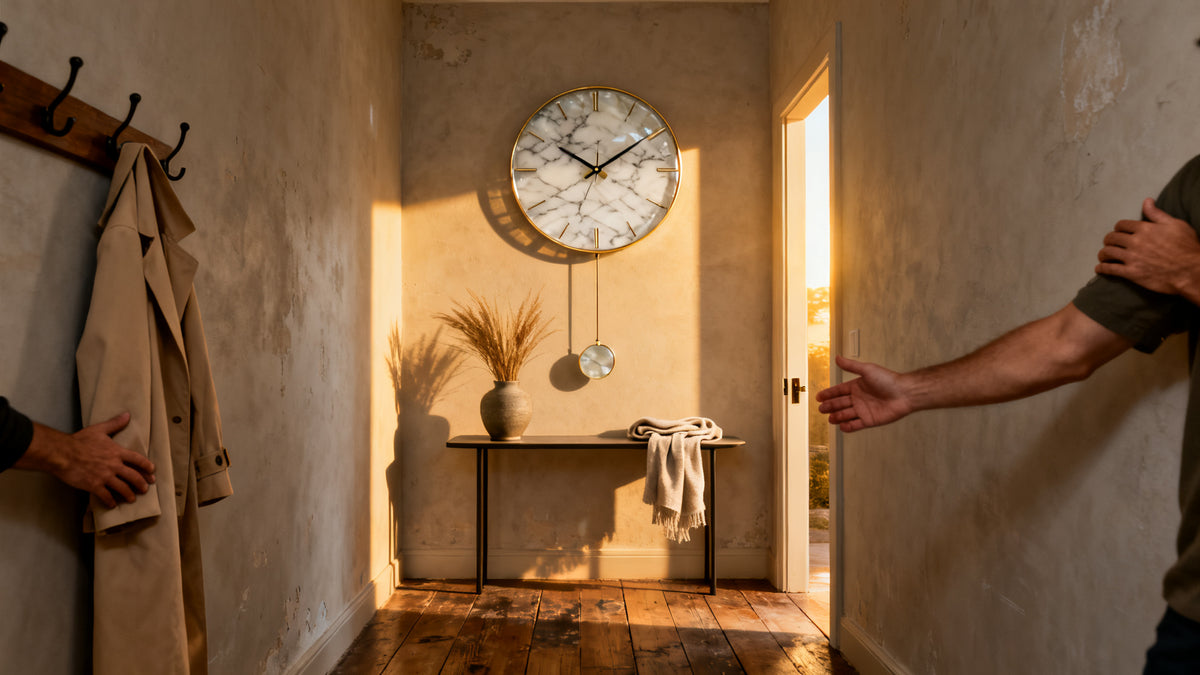
If your entryway has clean lines, light walls, and minimal furniture, an acrylic pendulum with a marble-pattern face is a natural fit. The material catches light differently at each hour as the natural light shifts. Acrylic sits much closer to the wall than a traditional wooden case clock - usually just 10-15 mm deep - which matters enormously in a narrow corridor where every centimeter of clearance counts.
The marble pattern reads as luxurious without committing to actual stone. It's lighter, more affordable, and frankly more practical in a space where coats and bags are constantly moving past. Elena's instinct here is Scandinavian minimalism: one strong material choice, nothing competing with it.

Wood and Chalet Styles for a Warm, Cottage-Feel Entrance
Warm-toned entryways with reclaimed wood furniture, woven baskets, or exposed brick call for something with more organic texture. A cuckoo-style pendulum clock, or a carved wooden case, brings that layered quality that makes a hallway feel genuinely inhabited rather than staged. The pendulum's motion feels less mechanical in this context - more like a heartbeat than a mechanism.
One thing worth knowing: a quartz-movement cuckoo clock needs no winding and runs on a standard AA battery, so there's no maintenance commitment. The charm is all there without the upkeep of a traditional mechanical piece.
Industrial Metal for Loft-Style Entryways
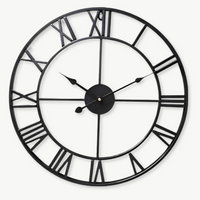
Exposed brick, concrete floors, or dark metal fixtures pair well with an industrial-style pendulum. Think brushed steel, iron tones, Roman numerals with a distressed finish. The pendulum in an industrial clock often has a more architectural quality - sometimes exposed gears or a metallic bob that catches the light as it swings.
At 60 cm, an industrial circular pendulum clock fills a wall without being fussy. In a hallway with high ceilings - anything above 2.5 m - you can go larger and it still reads as proportional rather than overwhelming.

The Practical Realities of Hanging a Pendulum Clock in a Hallway
A pendulum clock has specific placement requirements that a standard wall clock doesn't: the wall must be level, the clock must hang perfectly plumb, and there needs to be enough vertical clearance for the pendulum's full arc. No shelf or furniture below should interrupt that swing.
How Much Clearance Does a Pendulum Actually Need?
Most decorative pendulum wall clocks have a pendulum that extends 15 to 25 cm below the clock body. Add that to the clock's own height when you're calculating where to place your hook. A clock body of 40 cm with a 20 cm pendulum needs 60 cm of vertical wall space from hook to clearance point. In a hallway with a console table or hooks underneath, measure twice before you commit.
The pendulum also swings laterally - typically 5 to 10 cm either side. That's rarely a problem on an open wall, but if you're hanging the clock between two sconces or beside a door frame, check that the pendulum won't graze anything on its arc before drilling a single hole.
Level Is Not Optional
Unlike a standard clock, a pendulum clock that hangs even slightly off-level will either stop working or run inaccurately. The pendulum's physics depend on a true vertical axis. Use a level on the hanging bracket, not just your eye. This is the single most common installation mistake - and also the easiest to avoid.
Noise in a Corridor
A hallway is acoustically lively. Hard floors, bare walls, no soft furnishings to absorb sound - a ticking clock echoes noticeably in a foyer in a way it never would in a carpeted living room. This is why a silent sweep quartz movement is non-negotiable for most people. The pendulum can swing visually without any audible tick at all, which gives you all the aesthetic benefit without the metronome effect.
Some cuckoo clocks include an auto-silence function for nighttime hours - worth checking before you buy if your hallway is adjacent to a bedroom. Elena specifically flags this feature whenever she recommends a cuckoo to anyone living in a flat with thin partition walls.
💡 Did you know?
The word "pendulum" comes from the Latin pendulus, meaning "hanging." Galileo Galilei first noted in the late 1500s that a pendulum's swing period stays constant regardless of the arc's width - a property called isochronism. It was this observation that made the pendulum clock the most accurate timekeeping instrument in the world for over 270 years, from Christiaan Huygens's first pendulum clock in 1656 until the quartz era of the 20th century.
5 Pendulum Clock Styles That Work Specifically in Hallways
Not every pendulum clock translates well to a hallway context - some are designed for living rooms with generous proportions, others for a mantelpiece. These five styles consistently perform well in foyer and corridor settings, based on proportions, depth, and acoustic profile.
| Style | Best Hallway Match | Key Consideration |
|---|---|---|
| Marble acrylic | Contemporary, white or greige walls | Slim profile, light-reflective face |
| Carved wood / cuckoo | Warm, cottage, or rustic entryways | Check auto-silence if near bedroom |
| Industrial circular metal | Loft, exposed brick, dark-frame windows | Go large (60 cm+) for high ceilings |
| Black and gold mirror | Glam or Art Deco foyer | Mirror face amplifies light in dark corridors |
| Treehouse / sculptural resin | Family home, children's energy in the space | Acts as art piece, not just clock |
The Mirror-Face Pendulum: A Dark Hallway's Best Friend
Many hallways don't have a window. They rely entirely on artificial light, which makes them feel smaller and flatter than the rest of the home. A clock with a mirror or reflective face solves two problems at once: it bounces light back into the space, and it gives the visual impression of depth where there is none. The pendulum's swing in a mirrored face is also hypnotically beautiful - you catch it from the corner of your eye and it registers as movement in a different plane.

The Cuckoo Pendulum: More Versatile Than People Assume
Cuckoo clocks have an image problem. People picture the kitschy souvenir version and rule them out entirely. But a well-designed cuckoo wall clock with pendulum - particularly one with a treehouse or nature-themed sculptural body - reads as a sculptural art object from across the hallway. The cuckoo mechanism only announces itself on the hour, so outside of that moment it functions as a purely visual piece.
In a family home with young children, the hourly animation becomes a feature rather than a quirk. Kids tend to arrange themselves near the hallway just before the top of the hour. That's genuinely charming. Elena has this exact clock in her own entryway - she says the cuckoo call has become an unofficial family ritual at breakfast time.

The Sculptural Resin Pendulum: When the Clock Is the Art
Resin and sculptural-body pendulum clocks occupy a category of their own. A treehouse or nature-motif resin clock isn't trying to blend in - it's designed to be the room's conversation starter. In a neutral-toned family hallway, that bold presence earns its place. The organic curves of a resin body contrast beautifully with flat painted walls, and the pendulum's swing adds kinetic energy to something that already has strong visual weight. If you have children who greet the entryway with energy, a sculptural piece at their eye level turns a functional corridor into something they actually engage with.
Sizing Up Your Wall: The Numbers That Actually Matter
The right size depends on the wall width between your door frame and the nearest corner or fixture, not on the hallway's overall length. You're working with a vertical strip of wall, and the clock needs to sit within it without crowding the edges.
Here's a rough guide that works for most standard hallways:
- Wall width under 80 cm: stay at 30-40 cm clock diameter. A large pendulum clock here will make every person who walks past feel like they're squeezing by.
- Wall width 80-120 cm: 40-55 cm diameter works well. The pendulum's swing has room to read as intentional rather than cramped.
- Wall width over 120 cm, or a foyer alcove: 55-70 cm becomes a proper focal point. This is the size range where a pendulum clock starts to feel like architecture rather than decoration.
Ceiling height matters too. If your hallway has standard 2.4 m ceilings, a clock taller than 50 cm - body plus pendulum - can feel oppressive. With 2.7 m or higher, you gain visual breathing room and the pendulum's motion feels more graceful.
"The first room of a house tells the story of everything that follows."
Traditional principle of residential design
What to Pair with a Pendulum Clock in the Hallway
A pendulum clock works best when it anchors a small visual composition rather than hanging in isolation. But the hallway demands restraint, because overcrowding a narrow space is worse than leaving it sparse.
The most reliable pairing is a slim console table placed directly below the clock. The table grounds the vertical piece and creates a natural vignette: a small plant, a ceramic bowl for keys, a candle. That composition reads as intentional rather than decorative for decoration's sake.
If a console isn't possible due to clearance (you need to pass through without bumping into furniture), a row of three coat hooks below the clock works with the same anchoring logic. The clock and hooks read as a unified zone rather than two unrelated objects on the same wall. Elena favors this pairing in rental apartments where drilling for a heavy console bracket isn't always an option.
What to avoid: placing the clock directly beside a large mirror. Two reflective focal points in a narrow space compete with each other and the room reads as busy. Let the clock be the singular thing people look at.
Pendulum Clock
From marble acrylic to carved wood cuckoo designs, every pendulum style that works in a real hallway is here in one place.
21 products
Browse the collection →The Maintenance Reality Nobody Mentions
Battery-operated quartz pendulum clocks require almost no maintenance - typically one AA or C-cell battery per year. A few simple habits keep them performing well for a long time without any fuss.
Dust the pendulum bob regularly. It's the part most exposed to air circulation in a hallway, and dust accumulation on a metal or acrylic bob can subtly affect the swing's visual quality over time. A dry microfiber cloth every few weeks is enough.
If the clock slows or stops without an obvious reason, check for level before replacing the battery. Even a small shift in the wall hook - caused by seasonal expansion of plaster or a door slamming - can tilt the clock enough to stall the pendulum mechanism. Re-leveling takes thirty seconds and fixes the problem without any new parts.
Acrylic and plexiglass clock faces attract static and show fingerprints. An anti-static screen cleaner applied with a soft cloth keeps the face looking sharp, particularly important in an entryway where people naturally reach toward eye-level objects.
The bigger picture: a quality decorative pendulum wall clock bought for a hallway should easily last a decade with this level of care. The movement itself is the same quartz mechanism used in clocks found in hospitals and offices - it's not delicate. What you're really maintaining is the aesthetic: the gleam of the face, the smooth arc of the bob, and the precise level that lets the whole thing perform as intended. Elena's rule is simple: treat it like you would a good piece of framed art. Keep it clean, keep it straight, and it rewards you every time you walk through the door.
Frequently asked questions
What is a clock with a pendulum called?+
A clock with a pendulum is most commonly called a pendulum clock. Specific subtypes include the longcase clock (often called a grandfather clock when it stands on the floor), the bracket clock (a mantel or shelf version), and the Vienna regulator (a wall-hung precision type popular in 19th-century Europe). Most modern decorative pendulum wall clocks use a quartz movement with a cosmetic pendulum that swings but doesn't regulate the timekeeping mechanism.
What are the disadvantages of a pendulum clock?+
Traditional mechanical pendulum clocks need to be perfectly level to function, require regular winding, and are sensitive to temperature changes that cause the pendulum rod to expand or contract. Modern quartz pendulum clocks solve most of these issues - they run on batteries, keep accurate time regardless of pendulum movement, and need only occasional leveling. The main remaining consideration is that the pendulum needs vertical and lateral wall clearance, which can limit placement options in narrow hallways.
What wall clocks are in style right now?+
In 2026, the strongest trends for decorative wall clocks are: mixed materials (metal and acrylic together, wood and brass hardware), statement sizes above 50 cm in living spaces, and minimal-frame designs where the clock face is the full visual. For hallways specifically, marble-pattern acrylic pendulums and industrial circular metal clocks are performing well because they read as deliberate focal points rather than filler. Silent quartz movements are now the default expectation across all styles.
Do decorative pendulum wall clocks actually keep accurate time?+
Yes, modern decorative pendulum clocks keep accurate time because the timekeeping is handled by a battery-powered quartz movement, not the pendulum itself. The pendulum swings for visual effect only. Quartz movements are accurate to within a few seconds per month under normal conditions. The only thing that affects accuracy is a nearly depleted battery, which causes the hands to slow before stopping - replace it at the first sign of sluggishness rather than waiting for it to stop completely.
How high should a pendulum clock hang in a hallway?+
Place the wall hook so the center of the clock face sits at approximately 155-165 cm from the floor - roughly eye level for most adults. Then account for the full pendulum drop below the clock body, ensuring it doesn't reach a shelf, hook rack, or console table beneath. If you're using a console table as a visual anchor below the clock, leave at least 15-20 cm of clear space between the table surface and the bottom of the pendulum's swing arc.
Can I return a pendulum clock if it doesn't suit my hallway?+
Yes - all clocks in our collection ship with a standard return window. The practical advice is to use the paper-on-wall test before you hang the clock at all: tape a cut-out the size of the clock to your wall for a day or two and live with the shape in your space. That dry run costs nothing and almost always confirms whether the size is right before you commit to a hook in the plaster. If you do need to return, keep the original packaging - it makes the process straightforward.