
Somewhere along the way, cuckoo clocks got a reputation problem. You mention one and people picture a cluttered wooden chalet, a painted bird on a spring, and an aunt's hallway that smelled of lavender and old carpet. Fair enough. For decades, that was the cuckoo clock.
But the category has quietly changed. A modern cuckoo clock can be one of the most striking pieces on your wall, without a single carved pine tree in sight. What's happening now in the market is genuinely interesting: designers are keeping the mechanical soul of the thing while stripping away every element that felt dated.
If you've been curious but assumed they'd look out of place in your home, this is worth reading.
⭐ Key takeaways
- Modern cuckoo clock design has broken from the carved-chalet tradition, with Scandinavian, minimalist, and industrial styles leading the category.
- Silence control is now standard on most contemporary models, so the bird-at-3am problem is solved.
- Swiss and German Black Forest makers both produce contemporary versions, but independent designers have pushed things furthest.
- Placement matters more than style: a modern cuckoo clock works best as a focal point, not a filler piece.
- Build quality separates the pieces that age well from the novelty versions that don't survive a single move.
What Modern Cuckoo Clock Design Actually Means in 2026
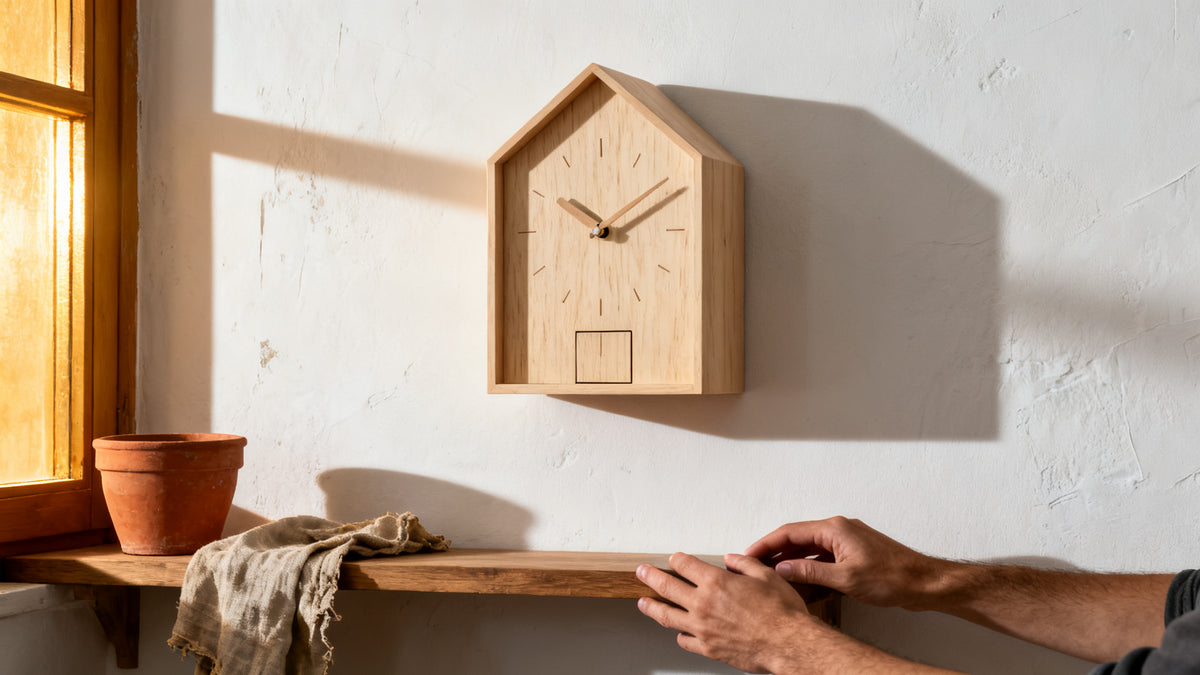
A modern cuckoo clock keeps the cuckoo mechanism, the bird that marks the hour, but replaces every traditional visual element with something that fits a contemporary home. That can mean a flat geometric case in matte black, a minimal Scandinavian frame in pale birch, an asymmetric architectural silhouette, or even an entirely abstract body where the bird emerges from clean negative space. The form changes. The function stays.
The shift started in the late 2000s when designers began questioning why the case had to look like a Black Forest souvenir. The movement underneath is a genuinely clever piece of engineering. It deserves a housing that doesn't apologize for itself. The best contemporary versions treat the case as a design object first, with the mechanical cuckoo as a surprising feature rather than the whole identity.
The three design directions driving the category now
Not every modern cuckoo clock looks the same. Three distinct directions have emerged, and they suit very different interiors.
- Scandinavian minimal: Clean lines, natural wood tones, almost no surface decoration. The case is flat, the hands are thin, and the cuckoo door is flush. These sit comfortably in Japandi or Nordic-influenced rooms where visual noise is unwelcome.
- Architectural / geometric: The case is treated as a small sculpture. Angular forms, asymmetric cutouts, contrasting materials (steel and walnut, brass and matte white). These work above a sideboard or in an open-plan living space where you want one piece doing all the design work.
- Neo-Black Forest: This one keeps some references to tradition but reinterprets them in a contemporary way. Cleaner woodworking, restrained color (often monochrome), no painted flowers or animals. Think of it as the original idea edited down to what actually matters.

The Silence Problem: Yes, It's Solved
The single biggest objection to cuckoo clocks has always been noise, and contemporary models have addressed it so thoroughly that it's no longer a real concern for most buyers. Almost every serious modern cuckoo clock ships with a night-silence switch, a sensor that detects darkness and automatically disables the call, or a manual on/off lever on the side of the case.
The movement itself varies by mechanism. Mechanical movements, the ones wound with weights or a key, produce the most authentic sound but need weekly attention. Quartz battery-powered movements are more consistent and require no winding. Some buyers strongly prefer the ritual of winding; others find it annoying after six months. Worth knowing before you buy.
💡 Did you know?
The original Black Forest cuckoo mechanism was first documented around 1730 in the Furtwangen area of what is now Baden-Wurttemberg, Germany. Early versions used a wooden flute-and-bellows system to produce the call. The same basic principle, two bellows activated by the movement, is still used in mechanical versions today. What's changed is everything around it.
Quartz vs. mechanical: a quick guide
| Factor | Mechanical movement | Quartz movement |
|---|---|---|
| Maintenance | Wind weekly (or daily on 1-day movements) | Replace batteries once or twice a year |
| Sound | Organic, varies slightly each hour | Consistent, often electronically reproduced |
| Night silence | Manual lever on most models | Often automatic (light sensor) |
| Price range | Generally higher, starts around $150+ | Wider range, from $40 to $300+ |
| Best for | People who enjoy the ritual of a living object | People who want zero-maintenance charm |
Styles That Work in Modern Homes (With Real Rooms in Mind)
The key to making a cuckoo clock feel at home in a contemporary space is treating it like any other statement piece: give it room to breathe, put it where the eye naturally lands, and don't compete with it. Here's how different interior styles handle it.
Minimalist and Scandinavian interiors
These rooms benefit most from the Scandinavian-minimal direction. A pale ash or birch case with a clean rectangular or teardrop silhouette disappears into the aesthetic when the bird isn't calling, then becomes the focal point when it does. The movement of a small figure on the hour is a moment of warmth in a room that can otherwise feel cold.
Keep the wall behind it clean. A single nail, no shelf, no gallery wall competing for attention. The clock is enough.
Industrial and loft spaces
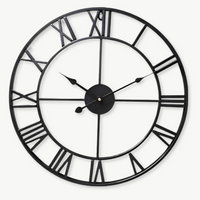
An architectural cuckoo clock in steel, iron, or dark stained wood reads extremely well against exposed brick or raw concrete. The contrast between the mechanical whimsy of the cuckoo and the hard surfaces around it creates exactly the kind of tension that makes a room interesting. Matte black and weathered metal finishes are the most compatible with this environment.
If you already have a collection of industrial wall clocks in this space, a contemporary cuckoo clock with a matching material palette fits the room's logic rather than interrupting it.

Traditional and transitional rooms
This is where the neo-Black Forest direction works best. A well-made version with restrained carving and a monochrome finish sits comfortably alongside antique furniture and warm textiles without looking like a joke or a museum piece. It's a bridge between old and new, which is exactly the kind of layering that makes transitional interiors feel considered rather than indecisive.
Where to Look and What to Avoid
The modern cuckoo clock market is split between legacy German manufacturers, Swiss independent studios, and a growing number of Scandinavian and East Asian design brands, and the quality differences between them are significant. Understanding what you're actually buying helps you avoid the common trap: paying a mid-range price for a low-quality mechanism dressed in a good-looking case.
What to check before buying
- Movement origin: German movements (Regula, Hubert Herr) and Swiss movements are the benchmark. If a listing doesn't mention movement origin, treat that as a yellow flag.
- Case material: Solid wood or quality metal lasts. MDF with a wood-effect print shows its age in two years. Feel the weight in photos (a genuinely solid case looks substantial), and read the product description for material specifics.
- Night silence mechanism: Check whether it's manual, automatic, or absent. If it's absent and you live with other people, you'll regret it within a week.
- Call duration: Better models call once per hour and twice at the half-hour. Budget versions sometimes call constantly or malfunction quickly. Reviews mentioning mechanism issues after 6 to 12 months are a reliable warning sign.
Price brackets and what they mean
Under $80: Almost always a quartz movement in a novelty case. Fine as a gift, not a long-term wall piece. Between $150 and $400: Where most solid modern designs live. Expect real wood or quality metal, a reliable movement, and design that holds up over time. Above $400: Hand-finished work, mechanical movements, limited production. Pieces in this range are bought once and kept for years.

The Pendulum Question
Many contemporary cuckoo clocks include a pendulum, and it changes the character of the piece considerably. A pendulum in motion reads as kinetic sculpture. It draws the eye on a continuous loop, creates a soft rhythm in the room, and makes the clock feel alive in a way that a static dial never does.
The design challenge is making a pendulum feel contemporary rather than fussy. What works: a minimal weighted disc or simple geometric bob in brass, steel, or dark wood. What doesn't: heavily ornate carved pendulums on a modern case. The mismatch reads immediately.
If you're considering a broader look at this subcategory, the pendulum clock collection covers 21 models across different styles, from architectural modern pieces to more traditional designs.


Making the Most of a Modern Cuckoo Clock at Home
Getting the placement right matters as much as choosing the right clock, and most people underestimate how much a few centimeters of wall space changes the whole reading of the piece. These are the decisions worth making deliberately rather than defaulting to whatever nail was already in the wall.
Height and wall space
The sweet spot for most cuckoo clocks is between 150 and 170 cm from the floor to the center of the dial. That puts it at eye level for a standing adult, which means you catch the cuckoo without craning your neck. If the clock has a pendulum, leave at least 25 to 30 cm below the case for it to swing freely without hitting a shelf or furniture edge.
Open wall space around the clock isn't wasted space. It's what lets the piece read as intentional rather than squeezed in.
Matching the room's existing material palette
A contemporary cuckoo clock doesn't need to match everything in the room, but it should speak the same material language. Warm wood tones work with rooms that already have wood furniture or flooring. Metal cases (black, brass, steel) integrate naturally into rooms that already have metal hardware, lighting, or accents. Mixing warm wood and cool metal in a single clock is fine; mixing it with a room that has neither tends to look disconnected.
The living room wall clock collection is a good reference point for how different materials look in real domestic settings, with 154 models across styles.
"A clock is furniture for the wall. It should live in the room, not visit it."
Common refrain among interior designers working with statement timepieces
Pairing with other wall pieces
A modern cuckoo clock can anchor a gallery wall, but it works best as the starting point rather than an afterthought. Place it first. Build the arrangement around it. When a cuckoo clock is the largest or most visually complex piece in a gallery wall, everything else frames it. When it's one item among equals, the cuckoo call interrupts a visual composition that wasn't designed for it.
If you want to explore the broader range of designer wall clocks available, 139 models cover everything from sculptural metal pieces to architectural geometric designs.
Frequently asked questions
Do modern cuckoo clocks still make the cuckoo sound?+
Yes. The cuckoo call is what defines the category. What modern versions have added is control over when it happens. Most contemporary models include either a manual silence switch or an automatic light sensor that stops the call during the night. So the sound is there when you want it and off when you don't.
Can a modern cuckoo clock work in a minimalist home?+
Absolutely. The Scandinavian-minimal direction specifically addresses this. Look for a flat case in pale wood or matte white, thin hands, and a flush cuckoo door with no surface ornamentation. When placed on a clean wall with nothing competing nearby, it reads as a considered design choice rather than a nostalgic quirk.
What is the difference between a 1-day and 8-day mechanical cuckoo clock?+
A 1-day movement needs winding every 24 hours. An 8-day movement only needs winding once a week. Both produce the same quality of sound and mechanism. The 8-day is the more practical option for anyone who doesn't want winding to become a daily task. The 1-day is typically more affordable.
Where should a cuckoo clock not be placed?+
Avoid humid environments like bathrooms. Avoid walls that get direct sunlight for extended periods, as this can warp wooden cases and fade finishes. For mechanical movements, avoid exterior walls in cold climates where temperature fluctuations can affect the movement's accuracy. And avoid placing it too close to a speaker or other vibration source, which can interfere with the pendulum if one is present.
Are modern cuckoo clocks made in Germany still?+
Yes. The Black Forest region in Baden-Wurttemberg still has active manufacturers producing both traditional and contemporary designs. The VdS certification (Verein die Schwarzwalder Uhrmacher) guarantees origin and craftsmanship for Black Forest pieces. Contemporary versions from this region tend to blend traditional movements with cleaner, more architectural cases.
How long does a quality cuckoo clock last?+
A well-made mechanical cuckoo clock with a German or Swiss movement, properly maintained and oiled every 5 to 8 years, can run reliably for several decades. Many Black Forest pieces from the 1970s and 1980s are still in daily use. Quartz versions last as long as the electronic components, typically 10 to 20 years before servicing is needed. The case material matters too: solid wood and quality metal outlast MDF and plastic by a wide margin.