
The pendulum clock has a reputation problem. Mention one to a friend who just renovated their apartment in Scandinavian minimalism, and you will get a look. Something between polite skepticism and mild horror. A wall clock with pendulum for a modern home sounds like a contradiction, until you see one that works. The right piece does not drag a room back in time. It gives it rhythm, weight, and a focal point that no flat-dial clock can match.
This is worth thinking through carefully. Because the difference between a pendulum clock that looks like a grandmother's heirloom and one that makes guests stop and ask "where did you get that?" comes down to a handful of specific choices. Material. Scale. Swing arc. Wall placement. Get those right, and a pendulum becomes the most alive thing on your wall.
⭐ Key takeaways
- Modern pendulum clocks work in contemporary homes when the material language matches the room's existing palette.
- Pendulum length directly controls tick tempo: longer swings feel slower, more meditative; shorter swings feel crisper.
- Placement height matters as much as style: the pendulum needs clearance below the clock body, typically 30-50 cm.
- Battery-powered quartz pendulum movements give you the visual rhythm without mechanical maintenance.
- A pendulum clock on a feature wall anchors furniture arrangement in a way a standard clock cannot.
Why the Pendulum Got Left Behind (and Why It's Coming Back)
The pendulum clock fell out of fashion not because it stopped being beautiful, but because mid-century modernism decided visible mechanics felt fussy. Minimalism doubled down on that verdict for decades. Flat dials, hidden movements, clean walls: that was the consensus. The pendulum was packaged alongside grandfather clocks and dark wood cabinetry, and the whole category got written off together.
What's shifted recently is the broader appetite for objects that do something visible. People want their rooms to feel lived in, not staged. A pendulum swings. It draws the eye. It has presence in a room the way a fish tank or a fireplace does, something kinetic in an otherwise static space. That kinetic quality is genuinely rare in wall decor, and designers have noticed.
The design world caught on. Contemporary makers started stripping the pendulum clock down to its essentials: a clean dial face, a minimal frame, and the swing. No bonnet. No ornate woodwork. No Roman numerals carved into mahogany. Just the movement, expressed honestly.
💡 Did you know?
Christiaan Huygens invented the pendulum clock in 1656, reducing timekeeping error from about 15 minutes per day to under 1 minute. For nearly three centuries, the pendulum was the most accurate timekeeping technology available to ordinary households. The swing you're watching is the same principle that once ran the world's best observatories.

What "Modern" Actually Means for a Pendulum Clock
When shopping for a wall clock with pendulum for a modern home, you're really asking for three things: contemporary visual language, low-maintenance operation, and apartment-friendly scale. Understanding each one separately makes the choice much clearer.
Contemporary Visual Language
This is about the materials and finish. A modern pendulum clock tends to favor metal over wood, but that's not a hard rule. What matters is that the frame, dial, and pendulum share a consistent material story. Brushed steel with a matte black pendulum reads industrial-modern. Light oak with a brass pendulum reads Japandi. Acrylic with chrome hardware reads pop-modern. Mixing a rustic carved wood case with a polished chrome pendulum creates visual static, and that's what makes a clock feel dated rather than designed.
Color matters too. Black, brass, warm grey, and matte white are the four safe families for a pendulum clock that integrates into a contemporary home. Avoid high-gloss finishes on the case; they tend to age poorly and pick up every fingerprint and scuff. A matte or satin finish reads cleaner on a wall.
Battery Quartz vs. Mechanical Movement
Most people imagine a pendulum clock needs to be wound. That's only true for traditional mechanical movements. Battery-powered quartz pendulum movements are now standard in contemporary pendulum wall clocks, and they work well. The pendulum swings on a quartz-driven motor, the hands sweep silently, and you replace one or two AA batteries once a year. No winding, no regulation, no service calls.
If you genuinely love the idea of a mechanical movement, the tradeoff is real: you gain authenticity and the satisfaction of a spring-driven mechanism, but you accept winding every 7-8 days, occasional regulation when seasons change, and eventual servicing. For most modern homes, quartz is simply the right answer.
Scale for a Real Wall
This is where a lot of purchases go wrong. A pendulum clock needs three distinct measurements to work: the dial diameter, the total height including pendulum, and the swing width at the bottom of the arc. The last one is the one people forget. A 25 cm bob swings roughly 30-40 cm wide at the base of the arc. That's horizontal clearance you need to account for below any furniture or trim.
For a standard 2.4 m ceiling apartment, a clock with a total hanging height of 80-110 cm tends to feel proportional. Anything taller risks feeling like it was designed for a foyer rather than a living room.

Matching a Pendulum Clock to Your Interior Style
The question isn't whether a pendulum clock fits a modern home. It's which version of modern you're working with, and that answer changes the clock you need. Here's how it breaks down across the four styles where pendulum clocks appear most naturally.
Scandinavian and Japandi Interiors
These rooms value restraint. Everything earns its place. A pendulum clock here needs to be quiet in its visual weight, even if it's large in diameter. Light wood, slim pendulum rod, minimal dial markings, possibly no numerals at all. The swing should feel meditative, not theatrical. Pale finishes in ash, birch, or light oak all integrate well. Avoid ornate pendulum bobs; a simple disc or teardrop in matching wood or matte brass is the right call.
Industrial and Loft Spaces
Exposed brick, concrete floors, steel fixtures: these rooms can take a larger, bolder clock. Dark iron frames, exposed hardware, oversized dials with Roman numerals, a heavier pendulum bob in aged metal. The movement doesn't need to be subtle here; it can be a genuine centerpiece. Scale up confidently. A 60 cm diameter clock with a 40 cm pendulum rod reads well against a full brick wall.
Mid-Century Modern
Walnut tones, tapered legs, warm amber light. A pendulum clock in this context works beautifully with a walnut or teak case and a brass pendulum. The dial should echo the period without being a costume, so clean numerals in a classic typeface rather than ornate script. This style has the most tolerance for a traditional pendulum silhouette, as long as the proportions stay spare.
Contemporary Eclectic
This is actually the most forgiving context for a pendulum clock. When a room already mixes materials and periods deliberately, the pendulum reads as a considered choice rather than a default one. Here you have room to pick something genuinely unusual: an acrylic dial with a brass pendulum, or a slate grey frame with a copper bob. The key is that the clock looks chosen, not inherited.

Where to Hang It: Placement That Makes or Breaks the Effect
Placement is the single biggest variable in whether a pendulum clock looks intentional or accidental. It's also the detail that most online guides skip entirely. Here's what actually works.
Height and Clearance
The clock face should sit at or slightly above eye level, which for most rooms means the center of the dial lands around 155-170 cm from the floor. Mount it too high and the pendulum disappears above furniture; mount it too low and it swings into the visual space of whatever is below it. Check your pendulum's full extension before you drill: measure from the hanging point to the bottom of the swing arc at maximum extension, then make sure that distance clears any shelves, consoles, or dado rail below.
Keep at least 5 cm of clearance on each side of the swing arc. Pendulums are sensitive to air currents, so avoid placement near vents, frequently opened doors, or windows without draught seals. A pendulum that gets knocked off rhythm by a door opening will re-regulate itself over a few minutes, but it's an annoyance you can design around.
The Feature Wall Principle
A pendulum clock works best as the only large object on a wall. This isn't a rule, but it's a strong tendency. The movement of the pendulum competes with adjacent art pieces or gallery walls. Give it a clean expanse of wall to itself, and the effect is completely different. The eye has nowhere else to go, and the swing becomes the room's quiet heartbeat.
Chimney breasts, the wall above a console table in a hallway, the wall at the end of a corridor, or the section of wall between two windows: these are natural anchor points that suit a pendulum clock better than a large flat clock, because they benefit from the vertical orientation the pendulum adds.
Furniture Below the Clock
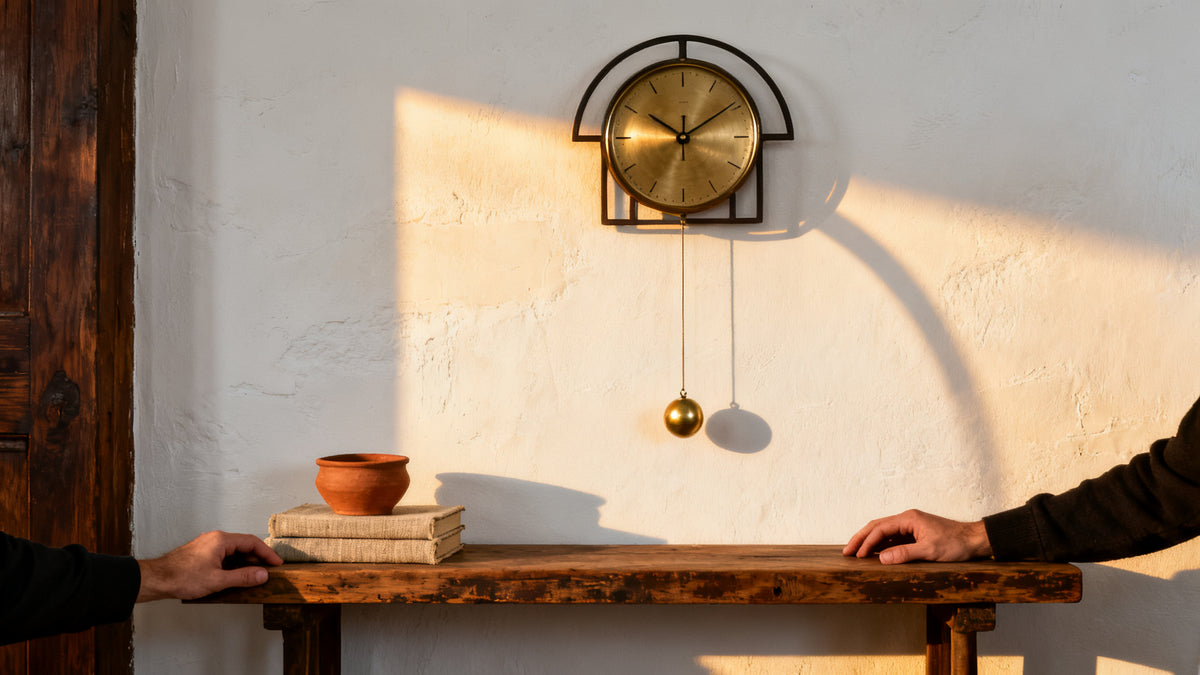
A pendulum clock looks particularly strong when there's a piece of furniture anchoring it below, a console table, a sideboard, or a narrow shelf. The relationship between the swinging pendulum and the static surface below creates a natural visual composition. Leave a gap of at least 20-30 cm between the bottom of the swing arc and the top of the furniture. This gap is where the visual tension lives; too close and it feels cramped, too far and the two objects lose their connection.
| Room Type | Recommended Clock Size | Ideal Placement |
|---|---|---|
| Open-plan living area | 60 cm+ dial, long pendulum | Feature wall above sofa or console |
| Hallway or entry | 35-50 cm dial, compact pendulum | End wall or above entry table |
| Home office | 30-40 cm dial, short pendulum | Side wall at eye level, away from desk screen |
| Dining room | 45-60 cm dial, mid-length pendulum | Wall opposite seating, centered above sideboard |
| Bedroom | Silent quartz only, 35-45 cm dial | Wall facing the bed, well above headboard height |
The Sound Question: Which Pendulum Clock Suits Your Home
Sound is the detail people research least and regret most when choosing a wall clock with pendulum for a modern home. There are three distinct options, and they suit different rooms and personalities.
Traditional mechanical pendulum clocks produce a full tick-tock with every swing. The tempo depends on pendulum length: a 30 cm pendulum completes roughly one full swing per second. That's a beat. Some people find it soothing, almost metronomic. Others find it intrusive after two weeks. It's genuinely a matter of personal preference, but it's worth sitting with the question honestly before committing.
Quartz pendulum movements with a standard stepping motor produce a tick on each second from the hand mechanism, independent of the pendulum swing. The pendulum moves continuously on its own motor and is purely decorative. The tick is quieter than a mechanical clock but still audible in a silent room.
Silent sweep quartz movements eliminate the audible tick entirely. The hands glide rather than step. Combined with a battery-driven pendulum motor, you get the full visual effect of a swinging pendulum with almost no sound output. This is the right choice for bedrooms, home offices, and open-plan living areas where background quiet matters. Many contemporary pendulum wall clocks now specify this as a feature, and it's worth confirming before purchase.

Pendulum Clocks as Statement Pieces in Small Spaces
A well-chosen pendulum clock can do more for a small space than almost any other single wall piece. The vertical orientation adds perceived height to a room, the movement adds life, and the visual weight means you don't need anything else on that wall. It's one of the smarter ways to place a pendulum clock in a modern home without overwhelming it.
In a compact flat, the secret is proportion. A slim pendulum rod with a small disc bob, a dial no wider than 35-40 cm, and a total hanging length under 80 cm: that combination reads modern and deliberate rather than oversized. Keep the wall behind it clear. Light or white walls make the best backdrop; they let the clock's silhouette read cleanly without competing textures.
Hallways are genuinely underrated pendulum clock territory. Most hallways have a natural dead wall at the far end that benefits enormously from a single strong vertical object. A pendulum clock here creates a moment as you enter, the kind of detail that makes a home feel considered rather than assembled. Keep the furniture below it simple: a narrow console or even just a coat hook arrangement is enough to ground it.

What to Look For Beyond the Design: Practical Specs That Matter
A few technical details separate a pendulum clock that lasts from one that frustrates. Here's what to check before buying, especially when comparing models side by side online.
- Movement type: Look for a quartz or sweep-quartz movement, not a cheap stepping motor. Sweep movements are quieter and gentler on the hands over time.
- Pendulum drive: Confirm whether the pendulum is mechanically linked to the movement or driven by a separate motor. For battery models, a dedicated pendulum motor is more reliable long-term.
- Weight of the case: Heavier cases (iron, solid wood, thick metal) mount more stably and vibrate less. Very light plastic-frame pendulum clocks tend to wobble when the pendulum reaches its arc extremes.
- Wall fixing: Check the mounting hardware supplied. A single-point keyhole hanger is fine for clocks under 1.5 kg; heavier pieces benefit from two-point mounting to prevent rotation over time.
- Battery type and access: AA batteries are universally available; some cheaper models use obscure sizes. Confirm the battery compartment opens without tools, particularly for cases with a closed back panel.
One more thing that rarely appears in product listings: pendulum sensitivity to level. A clock must hang perfectly plumb or the swing becomes asymmetric and eventually stops. This is fixable with a small spirit level and an adjustable wall hook, but worth factoring in when you're choosing your wall and fixing point. Walls that look flat often have minor irregularities at plaster level.

The Pendulum Clock as a Living Design Choice
There's a reason people who own a pendulum clock rarely replace it with something static. The movement changes the room in a way that's difficult to articulate until you've lived with it. Light hits the bob differently at different times of day. Soft afternoon sun catches the arc mid-swing and throws a brief glimmer across the wall. It's a small thing, and it's also not small at all.
A pendulum wall clock in a modern home is ultimately a statement about preferring objects that behave over objects that simply exist. That's a valid design philosophy, and it's one that gets more rewarding over time. The room doesn't just look different. It feels different. Quieter and more present, somehow, at the same time.
The collection of pendulum clocks spans 21 models, from compact designs suited to hallways and home offices to larger statement pieces for open living walls. If you're after something with more visual drama without the swing, the large wall clock collection is worth comparing side by side. And if sound matters, the silent wall clock range covers every style in sweep-quartz movement.
Frequently asked questions
Do modern pendulum clocks still need to be wound?+
Most contemporary pendulum wall clocks run on battery-powered quartz movements, so there's no winding required. You replace the batteries, typically AA cells, roughly once a year. Fully mechanical pendulum clocks that require manual winding are still made, but they're a deliberate heritage choice rather than the standard.
Can a pendulum clock work in a bedroom?+
Yes, but only if the movement is a silent sweep quartz. Traditional stepping motors produce an audible tick that most people find disruptive at night. Look specifically for clocks that describe their movement as "silent" or "sweep" rather than standard quartz. The pendulum itself, driven by a separate motor, produces minimal noise on well-made models.
How much wall clearance does a pendulum clock need?+
Plan for at least 5 cm of clearance on each side of the swing arc, and confirm the total hanging height including the pendulum's lowest point. Most pendulum clocks list their total dimensions, but some only give the dial size. The pendulum rod and bob typically add 30-50 cm below the case. Check this before measuring your wall space.
Why does my pendulum clock stop after a few swings?+
The most common cause is that the clock isn't hanging level. A pendulum requires the clock case to be plumb vertically for the swing to be symmetric. Use a spirit level and adjust the hanging hook until the case is perfectly upright. On battery models, also check whether the batteries are fresh; a low battery produces inconsistent motor output that disrupts the pendulum's rhythm.
What style of pendulum clock suits a minimalist home?+
Look for a clock with a clean dial, minimal or no numerals, a slim pendulum rod, and a simple disc or teardrop bob. Materials like light wood, matte white, or brushed steel all integrate well with minimalist palettes. Avoid ornate pendulum bobs, carved cases, and high-gloss finishes. The silhouette should feel drawn rather than sculpted.
How do I place a pendulum clock in a small space?+
Choose a slim profile: dial no wider than 35-40 cm, total hanging length under 80 cm, and a slender pendulum rod with a small disc or teardrop bob. Mount it on a plain light-coloured wall with nothing competing alongside it. A hallway end wall or the wall above a narrow console table are ideal spots; the vertical orientation actually adds perceived height to a compact room rather than crowding it.