
There's a moment in almost every home where a wall feels wrong. Too empty, too generic, nothing with a real point of view. A modern cuckoo clock for the living room solves that problem in a way most wall art simply can't: it moves, it marks time, and it carries a 300-year-old story into a space that might otherwise feel like a furniture catalog. Finding one that fits a room that isn't a Bavarian hunting lodge is exactly the interesting part.
That tension between tradition and contemporary taste is exactly where the most interesting cuckoo clocks live right now. Designers across Europe and Japan have been rethinking the form for years: stripping away the carved wood animals, flattening the silhouette, playing with matte black and brushed metal finishes. The result is a category that genuinely earns its place on a modern wall.
⭐ Key takeaways
- Modern cuckoo clocks work in contemporary living rooms when they drop the carved forest motifs and simplify the silhouette.
- Mechanical vs. quartz battery movement is the most important practical choice - both have real trade-offs worth understanding.
- Placement height and wall context matter more than the clock itself: get these right first.
- The cuckoo call is optional on most modern models - many have night silence or manual on/off switches.
- German Black Forest craftsmanship remains the benchmark for quality, but Italian and Scandinavian designs have created a credible alternative aesthetic.
What Actually Makes a Cuckoo Clock "Modern"
A modern cuckoo clock keeps the bird-on-the-hour mechanism but redesigns every other element for a contemporary interior: flat planes, neutral finishes, and a simplified case that reads as sculpture rather than souvenir. That definition is worth holding onto, because the word "modern" gets applied to a lot of things that are simply smaller versions of the traditional chalet shape.
The traditional Black Forest cuckoo clock, as most people picture it, dates its current form to around the 1850s. The chalet style (the house-shaped case with water wheels and milk maids) came later still, in the early 20th century, as a commercial interpretation of the original leaf-and-bird design. So when a designer strips all that back, they're not abandoning the tradition. They're returning to it. The first cuckoo clocks from the Schwarzwald were much simpler than what tourists buy in Triberg today.
What you're looking for in a genuinely modern version:
- A case that could pass as a wall sculpture when the bird is at rest
- Finishes in matte black, pale ash wood, concrete grey, or warm brass rather than dark walnut
- A minimal or absent pendulum, or a pendulum redesigned as a geometric element
- Clean dial typography, often without numerals at all
- A cuckoo mechanism that feels deliberate rather than folksy
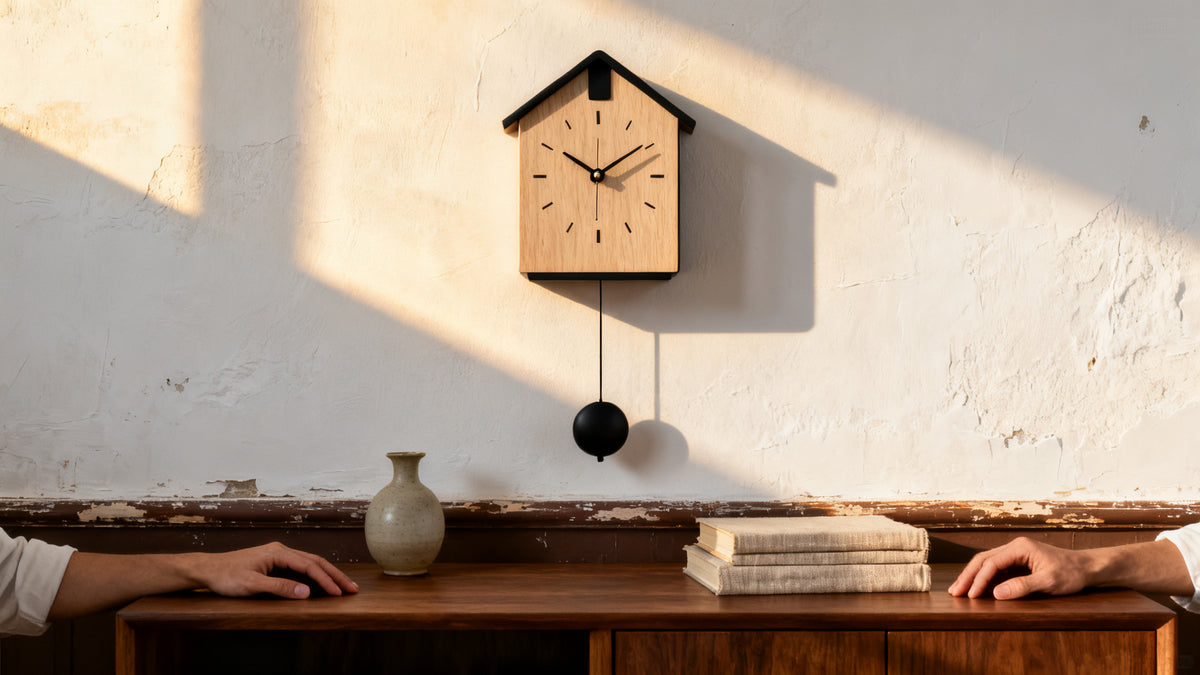
None of that means the clock has to look cold. The best modern versions are warm objects. Ash wood and matte black metal together hit a Scandinavian-meets-Black Forest note that sits comfortably in a wide range of living room contexts, from loft apartments to suburban sitting rooms with a mix of vintage and new furniture. Elena, who curates the selection here, keeps a pale ash model in her own flat and says it's the first thing guests ask about every single time.

The Two Movement Types: What You're Actually Choosing Between
Every modern cuckoo clock runs on one of two movements: a traditional mechanical wind-up or a battery-powered quartz. That choice shapes not just how the clock works but how you live with it every day. Most people get this decision wrong because they focus on the visual first and discover the practical reality only after the clock is on the wall.
Mechanical (Weight-Driven) Movement
This is the original technology, unchanged in its essentials for three centuries. Two or three cast-iron pinecone weights hang from chains and slowly descend as they drive the clock. You wind it every day (1-day movement) or every eight days (8-day movement) by pulling the chains. The cuckoo call is produced by two small bellows operated by wooden whistles, an entirely acoustic, analog process.
What that means in practice: a mechanical cuckoo clock ticks audibly. The pendulum swings, the gears turn, and the room hears all of it. That's a feature for many people. It's the warm ambient sound of a living object in the room. It's a problem in a home where silence matters, particularly in open-plan spaces where the living room is adjacent to a sleeping area.
Mechanical movements require periodic maintenance. Every few years, the movement benefits from a clean and oil by a clockmaker. This isn't expensive, but it's worth factoring in. The upside: a well-maintained mechanical cuckoo clock will outlast anything battery-powered by generations. Makers like Hubert Herr and Anton Schneider in the Black Forest have been building these movements for over a century, and their clocks genuinely do get passed down.
Quartz (Battery) Movement
Most contemporary cuckoo clock designs use quartz movements. The cuckoo call is electronic, a recorded or synthesized sound rather than bellows, and the timekeeping is handled by a standard quartz oscillator running on AA or D batteries. Many models include a light sensor that silences the clock automatically at night, and a manual on/off switch for the call.
Quartz movements are silent between calls, require no winding, and keep more precise time than most mechanical movements. For a living room where the clock is chosen primarily as a design object, they're the practical choice. The trade-off is that the call sounds electronic to trained ears, and there's something intangibly different about a clock that doesn't tick. Elena's honest take: for a first cuckoo clock in a modern flat, start with quartz. If you fall in love with the object, upgrade to mechanical when the time feels right.
| Feature | Mechanical Movement | Quartz Movement |
|---|---|---|
| Ambient Sound | Constant ticking, pendulum swing | Silent between calls |
| Cuckoo Call | Acoustic bellows (wooden whistles) | Electronic recording |
| Maintenance | Wind daily or every 8 days; clean every few years | Replace batteries (typically once a year) |
| Night Silence | Requires manual latch to disable call | Often automatic via light sensor |
| Lifespan | Decades to generations with care | 10-20 years typical before movement service |
| Price Range | Generally higher (hand-assembled movements) | Wide range, accessible entry points |
Design Styles That Actually Work in a Contemporary Living Room
The modern cuckoo clock market has fractured into several distinct aesthetics, and knowing which direction aligns with your room saves a lot of second-guessing. Here are the four design languages that show up most consistently in well-designed contemporary homes.
Scandinavian Minimalist
Pale ash or birch, clean white dial, no numerals or simple sans-serif hour markers. The case is often a flat triangle or arch rather than a house shape. The bird emerges from a slot rather than a door. This style works particularly well in rooms with white walls, natural textiles, and low-profile furniture, in anything within the Japandi or Nordic interior tradition. The Karlsson designs from the Netherlands are the clearest reference point: they kept the cuckoo mechanism but wrapped it in a graphic, nearly abstract case that could sit alongside a Georg Jensen candlestick without looking out of place.
Contemporary Black Forest
This is the approach taken by several modern German manufacturers who wanted to retain the heritage credentials of Schwarzwald making while updating the visual language. Dark-stained solid wood (often walnut or smoked oak rather than the traditional lime), simplified geometric motifs, and hand-carved elements that read as texture rather than illustration. The VDS (Verein der Schwarzwälder Uhrmacher) certification mark, a small shield, guarantees genuine Black Forest origin if that matters to you. Hekas and Hubert Herr both offer lines in this updated-heritage direction that hold up well in modern interiors without feeling like concessions.
Industrial / Urban
Matte black metal case, exposed hardware, minimalist bird mechanism. Some designers have created cuckoo clocks where the "house" is replaced by a geometric metal frame, so the bird sits inside what looks like an architectural detail rather than a cottage. This suits loft-style living rooms with exposed brick or concrete, and pairs naturally with the kind of industrial wall clock aesthetic that has dominated interior design for the past several years. The geometric frame style reads as architecture, not kitsch, which is exactly what a loft space needs from a wall piece.
Art Object / Sculptural
The furthest departure from the original form. Japanese designers in particular, notably the Haiku studio and several independent makers working in the Kyoto craft tradition, have created cuckoo clocks where the case is a ceramic vessel, a brass ring, or a folded paper form. The bird is often abstracted to a silhouette. These pieces function primarily as art, and secondarily as clocks, which is a legitimate choice for a living room that already has strong design intent. Elena finds these the hardest to recommend without seeing the room first, but when the fit is right, nothing else comes close.

💡 Did you know?
The cuckoo clock is widely associated with Switzerland thanks to the film The Third Man (1949), where Orson Welles's character delivers the famous "cuckoo clock" line attributing it to the Swiss. In reality, the cuckoo clock was invented in the Black Forest region of Germany, most evidence points to the Triberg area of Baden-Württemberg, around the mid-1700s. Swiss watchmakers never really took to the form at all.
Where to Hang a Modern Cuckoo Clock in the Living Room
Placement isn't just about finding a gap on the wall. For a cuckoo clock, the position affects both how the clock looks and how it functions mechanically. There are a few things worth thinking through before you pick up a hammer.
Height: The 1.5-Meter Rule
For a mechanical cuckoo clock with hanging weights, the clock needs to be mounted high enough that the weights have room to descend without hitting furniture or the floor. A 1-day movement typically needs 90 to 100 cm of clearance below the clock. An 8-day movement needs less, the weights descend more slowly, but still benefits from clear wall space beneath it.
For a quartz cuckoo clock without hanging weights, you have full flexibility. Eye level (roughly 150 to 160 cm from the floor to the center of the clock face) is the standard starting point. The bird emerges horizontally, so make sure there's clear space in front of the door.
Wall Context: What Works Around the Clock
A modern cuckoo clock tends to look best in one of two situations: either as a focal point on an otherwise bare wall (where it earns the full visual weight of a solo piece), or as part of a considered gallery wall where its scale and form contrast with flat prints and photographs.
What doesn't work: placing it next to another clock, putting it too close to a bookshelf where the bird's door is obscured, or mounting it on a wall with highly competing pattern (busy wallpaper, dense shelving). The clock needs breathing room to read as a design choice. Elena says the single most common mistake she sees is hanging a cuckoo clock too low, so the weights graze the console table beneath it and the whole thing looks cramped. Go higher than feels natural, then reassess.
Living Room Zones Worth Considering
- Above a console or sideboard: the furniture anchors the clock visually and provides a natural resting shelf for the weights if mechanical
- On the chimney breast: a traditional position that works as well for a modern cuckoo clock as for any other statement piece
- In an alcove: the recessed space frames the clock without requiring any other decoration nearby
- Opposite the main seating: this means you hear and see the cuckoo call without having to turn around
The Cuckoo Collection: 16 Models Worth Knowing

The range spans traditional hand-carved linden wood movements from the Schwarzwald to contemporary battery-operated quartz designs with clean geometric cases. If you know you want a mechanical movement with authentic bellows call, filter for those first: they represent the top of the range. The Karlsson-influenced minimalist models in pale birch are a strong entry point for anyone coming from a Nordic or Japandi interior, while the VDS-certified Black Forest pieces suit rooms with warmer, more layered aesthetics. If you want the visual of a cuckoo clock with the simplicity of a battery clock, the quartz models are genuinely well made and much easier to live with day-to-day.
Modern Cuckoo Clocks and Other Wall Clock Formats: Knowing When to Choose Differently
A cuckoo clock is a specific commitment: the call is part of the deal, and that changes the relationship with the room in ways a standard wall clock simply doesn't. It's worth being honest about whether you want that or whether a different clock form would actually suit the space better.
The cuckoo call, even on a quartz model, happens on the hour and half-hour. In a home with young children or light sleepers, that's a real consideration. Most modern quartz cuckoo clocks include a night silence mode (triggered by a light sensor or a manual switch), but during the day the sound is part of the room's rhythm. That's exactly what makes the clock interesting: it's not passive wall decor. But it's not for everyone.
If what you're drawn to is a sculptural, statement clock with presence and character but without the sound element, a pendulum clock gives you the visual movement without the hourly announcement. If scale is the priority, filling a large wall with a commanding piece, a large wall clock in the 60-80 cm range can achieve similar visual weight in a purely silent format.

That said, for many people the sound is the point. There's something genuinely joyful about a living room that marks the hour with a small performance. A living room cuckoo clock works best when you actually like what it does, rather than merely tolerating the call as a side effect of the aesthetic. If you're in that first group, the design options right now are better than they've ever been.
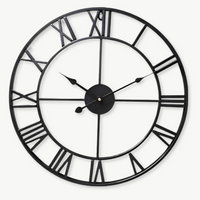
For anyone drawn to the industrial aesthetic and wanting something with mechanical character but no bird, the industrial wall clock range covers exposed-gear designs, aged iron frames, and factory-style dials that bring a similar sense of mechanism and materiality to a room.
Caring for a Modern Cuckoo Clock Over Time
The most common reason a cuckoo clock stops working correctly isn't age or wear: it's being hung on a wall that isn't plumb, which throws the pendulum off beat and stresses the movement unevenly. That's a five-second fix with a spirit level before you drive the nail, and it prevents most of the problems people bring to a clockmaker.
Setting the Beat on a Mechanical Movement
When a mechanical cuckoo clock is hung correctly and running in beat, the tick-tock sound is even: the intervals between tick and tock are equal. If the sound is uneven (tick...tock, with one interval longer than the other), the clock needs minor adjustment. Most modern cuckoo clocks allow this by gently moving the pendulum wire slightly left or right until the beat evens out. It takes about two minutes and makes a substantial difference to both timekeeping accuracy and the life of the movement.
Quartz Model Maintenance
Quartz cuckoo clocks need very little attention. Replace the batteries before they fully deplete: a dying battery can sometimes cause the clock to run slow, and in rare cases a leaking battery can damage the movement housing. Remove batteries if the clock is going into storage for more than a few weeks. Keep the clock level (most quartz models will work off-level, but it's still the best starting position).
Dust and the Bird Mechanism
The bird door and the bird figure itself are the most mechanically vulnerable parts of a cuckoo clock. A light dusting with a dry soft brush (a makeup brush works well) keeps the door pivot points clear. Never use spray cleaners or damp cloths on the case or mechanism: moisture and clock movements don't get along, traditional or modern.
💡 Did you know?
The Kuckucksuhr (the German word for cuckoo clock) uses a live bird sound as its call model: the common cuckoo (Cuculus canorus), whose two-note descending call, a perfect descending minor third, is instantly recognizable. Clock makers in the Black Forest chose this bird specifically because the interval is so clean and consistent that it could be mechanically reproduced with just two wooden whistles and a bellows. The acoustic simplicity of the call is what made the mechanical cuckoo possible at scale.
Frequently asked questions
Where should a cuckoo clock be placed in a living room?+
For a mechanical cuckoo clock with hanging weights, the clock needs to be mounted high enough that the weights have room to descend: typically at least 90 to 100 cm of clear wall below the clock body. For a quartz battery model, eye level (around 150 to 160 cm from floor to clock center) is a solid starting point. Either way, make sure the wall directly in front of the bird door is clear: the bird needs about 15 cm of unobstructed horizontal space to emerge cleanly. Above a console table, on a chimney breast, or centered on an alcove wall are all strong positions in a living room.
What are the main types of modern cuckoo clock?+
Modern cuckoo clocks fall into a few broad categories: Scandinavian minimalist (pale wood, clean lines, simplified case), contemporary Black Forest (genuine German craftsmanship updated with modern finishes like smoked oak or matte paint), industrial or urban (metal cases, geometric frames, exposed hardware), and sculptural art objects (Japanese and European designer pieces where the case becomes the main event). Within those aesthetics, the most practical distinction is mechanical movement (weight-driven, ticking, acoustic call) versus quartz battery (silent between calls, automatic night silence, easier maintenance).
Who makes the best cuckoo clocks?+
The most respected makers are based in Germany's Black Forest region (Baden-Württemberg). Names like Hubert Herr, Hekas, and Anton Schneider have made mechanical cuckoo clocks for generations and their movements are regarded as the standard. For contemporary design-first pieces, the Dutch brand Karlsson has done the most consistent work in updating the cuckoo aesthetic for modern interiors. Italian maker Pirondini produces well-regarded quartz models in MDF and non-toxic materials at accessible price points. For genuine Black Forest origin, look for the VDS certification mark.
Can a modern cuckoo clock work without the cuckoo sound?+
Yes. Most quartz battery cuckoo clocks include a manual on/off switch for the call, and many have an automatic night silence mode that uses a light sensor to disable the call in dark conditions. On mechanical models, there's usually a small latch wire that you can push to prevent the call mechanism from engaging. So you can have the visual of a cuckoo clock, the case, the pendulum, the bird waiting behind its door, without the hourly announcement. Some people run the clock silently during the week and only activate the call at weekends. It's a reasonable way to live with one.
How is a modern cuckoo clock different from a traditional one?+
The core mechanism, a bird that emerges on the hour and calls, is the same. What changes in a modern cuckoo clock is the visual design of the case. Traditional cuckoo clocks (particularly the chalet and hunter styles popularized from the early 20th century onward) feature heavily carved wood, forest motifs, waterwheels, and decorative figures. Modern versions simplify the case to geometric or architectural forms, use contemporary finishes like matte paint or pale wood, and often abstract the bird itself. Some modern versions also swap the mechanical movement for a quartz battery, which makes the clock easier to maintain and quieter between calls.
How much does a good modern cuckoo clock cost?+
A reliable quartz battery cuckoo clock with a modern case starts around 80 to 150 euros. A genuine Black Forest mechanical movement with a contemporary design sits between 250 and 600 euros for a 1-day movement, and 400 to over 1,000 euros for an 8-day movement with hand-carved details. VDS-certified pieces at the top of the range are investments in the full sense: they're made to last 50 years or more with proper care. If budget is a constraint, a mid-range quartz model from a reputable brand like Karlsson or Pirondini gives you most of the aesthetic value without the mechanical complexity.