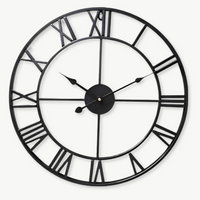

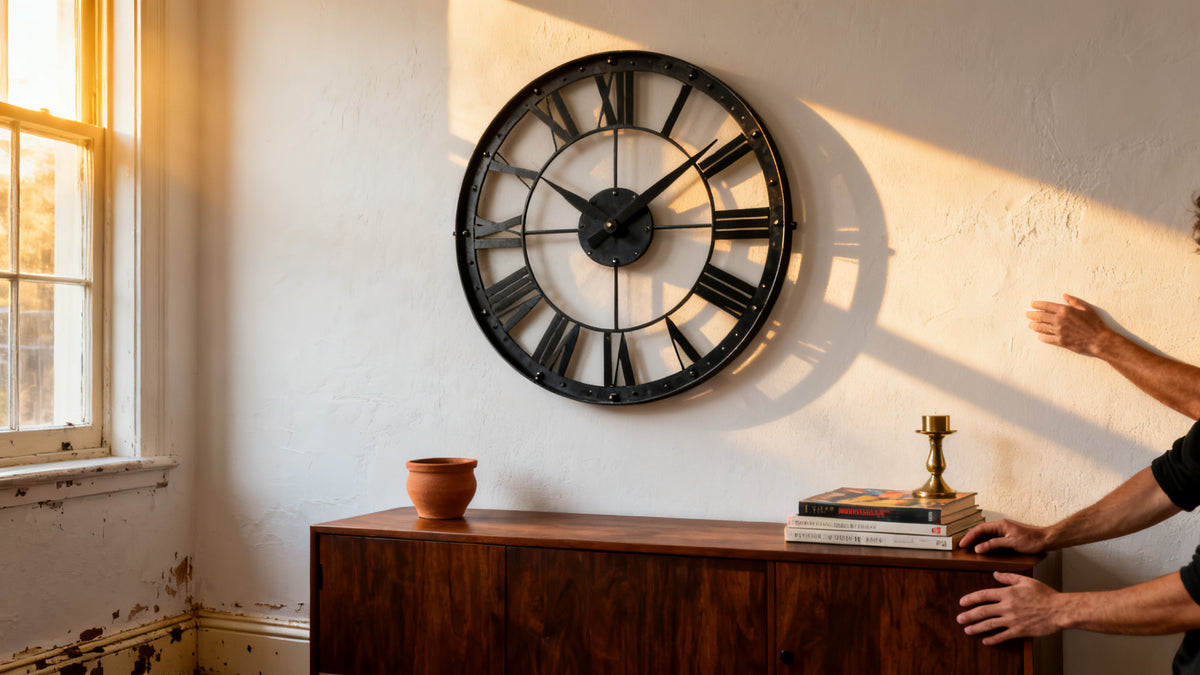
An oversized wall clock in the living room stops being a clock the moment you hang it right. It becomes the piece people notice first, the thing that anchors the furniture around it, the detail guests ask about. Getting there is less about buying the biggest dial you can find and more about reading your room: wall width, ceiling height, what sits below, and which style speaks to the rest of your space.
What follows is a room-by-room, layout-by-layout breakdown of what actually works, based on real living rooms rather than showroom staging. Each idea comes with specific placement notes so you can picture it on your own wall before committing.
⭐ Key takeaways
- An oversized clock needs at least 60 cm (24 in) of clear wall on each side to read as a focal point, not a crammed afterthought.
- Hanging height matters more than most people expect: center the clock face at roughly 155-165 cm from the floor in a standard room.
- The furniture below an oversized clock should be lower than the clock's bottom edge by at least 20-30 cm - this breathing room is what gives the piece presence.
- Style coherence beats size alone: a 60 cm industrial metal clock in a maximalist room disappears; the same clock on a plain white wall in a minimalist space commands the whole room.
- Silent quartz movements are non-negotiable in living rooms where you actually sit and talk.
Why the Living Room Is the Right Room for an Oversized Clock
The living room works for an oversized wall clock because it has the wall real estate and the sightlines that a bedroom or hallway rarely offers. You spend time here. You look up. The wall behind the sofa or above the fireplace is often the largest uninterrupted surface in the whole flat, and in most homes it sits directly in the eyeline of anyone seated across from it.
Kitchens and bedrooms call for smaller, task-oriented clocks. The living room is where a large-format piece, anything from 50 cm (20 in) upward, actually gets the space it needs to breathe. A clock with a 70 or 80 cm diameter needs at least 1.5 m of wall width to avoid feeling crowded. Most living rooms have that. Most bedrooms don't.
There's also the light factor. Living rooms typically get the best natural light in a home. Good light reveals what makes an oversized wall clock worth the investment: the texture of a hand-welded metal frame, the warmth of real wood grain, the subtle shadow a raised numeral throws at noon. A clock that looks flat in a dim hallway becomes something else entirely in afternoon window light.
It's worth noting that large decorative clocks weren't always a living-room staple. The Art Déco movement of the 1920s and 1930s was arguably the first time oversized, geometrically bold clock faces moved from public buildings into private homes, with designers like Émile-Jacques Ruhlmann treating the wall clock as furniture-scale sculpture. Before that, the clock on a domestic wall was almost always a modest, functional object. The shift toward bold, room-defining dial sizes is genuinely a 20th-century idea, and it's one that hasn't stopped evolving.

The Sofa Wall: Your Most Reliable Canvas
The wall behind the sofa is where most oversized living room clocks find their home, because it offers scale, neutrality, and a natural visual anchor for the whole seating arrangement. The sofa defines the bottom boundary; the clock defines the top. Together they read as a composed unit rather than two separate pieces.
How to position it above the sofa
Leave a gap of at least 20-30 cm between the sofa back and the bottom of the clock. Any closer and it looks squeezed. Any further and the two pieces stop relating to each other. For a standard 90 cm sofa height, that puts your clock bottom edge at roughly 110-120 cm from the floor, which works comfortably for a 60-80 cm diameter piece.
Width matters here too. The clock should be no wider than two thirds of the sofa length. A 200 cm sofa pairs well with a clock up to about 65-70 cm across. Go wider than that and you tip from statement piece into overwhelming centerpiece, which is a different thing entirely.
What to put on the wall around it
Restraint pays off. Honestly, I think one strong piece of art placed off-center on one side, with nothing on the other, is the composition I return to again and again in my own home. It creates asymmetry that feels deliberately chosen rather than accidental. Two matching prints flanking the clock looks corporate. Bare wall on both sides, with the clock as the only element, works beautifully if the clock has enough visual weight. Industrial metal pieces, in particular, can hold a large blank wall solo without any supporting cast.

Above the Fireplace: Drama Done Right
A large wall clock above a fireplace works when it replaces the mirror, not when it competes with one. The chimney breast is often the visual centerpiece of a living room by default; it already has everyone's attention. Put the right oversized clock there and you transform a traditional setup into something genuinely considered.
Proportion is strict here. The clock should be narrower than the fireplace surround, typically no more than 70-75% of the mantel width. Too wide and the composition looks top-heavy. The ideal gap between mantel top and clock bottom is 15-25 cm: enough to let the mantel accessories breathe, not so much that the clock floats disconnected above.
Style pairings that actually work
A vintage or steampunk-style clock above a Victorian or Edwardian fireplace leans into the history of the room without being a costume party. The textures rhyme: aged metal, cast iron, dark wood. For a modern fireplace with a clean stone or plaster surround, a minimal black metal dial at 60-70 cm keeps the room from tipping into industrial cliché.
One pairing worth avoiding: ornate carved-wood clocks above a sleek flat-surround gas fireplace. The styles fight rather than talk.
💡 Did you know?
The tradition of placing a clock on a fireplace mantel dates to 18th-century France, when pendules de cheminée (mantel clocks) were status symbols in aristocratic interiors. The clock above the fire wasn't just decorative: it used the warmth rising from below to keep the mechanism running smoothly in cold rooms. By the late 19th century, British and American households had adopted the practice widely, and the mantel clock became the definitive domestic timepiece until wristwatches arrived. Modern oversized wall clocks above fireplaces carry that same visual authority, without needing the heat.

The Empty Accent Wall: When You Want the Clock to Stand Alone
Putting an oversized clock on a bare accent wall, with nothing else around it, is the highest-commitment approach and often the most rewarding one. No gallery wall to hide behind, no sideboard to prop it up: just the clock, the wall, and the question of whether the piece is good enough to hold the room on its own.
The walls that suit this approach best are painted in a mid-tone that contrasts with the clock material. Dark charcoal or forest green behind a brass or warm gold clock. White or off-white behind matte black metal. Sage or warm grey behind raw wood. The contrast does the work that furniture would otherwise do.
Sizing up for a solo wall
For a true solo statement, go large: 70 cm minimum, ideally 80 cm or more. A 50 cm clock on a bare wall looks like it got lost. The piece needs enough visual mass to claim the wall rather than decorate a corner of it.
Hanging height shifts slightly here. Without furniture anchoring the bottom, center the clock at approximately 150-160 cm from floor to clock center, which puts it at natural eye level when standing. When seated across the room, it reads slightly elevated, which is exactly right.
Opposite the Entryway: The First Impression Wall
The wall directly visible from your front door or main entryway is prime real estate for an oversized clock, because it creates an immediate sense of welcome the moment anyone walks in. You want something with enough presence to register from 4-5 meters away and enough character to make someone stop.
This placement works particularly well in open-plan living rooms where the entryway and the lounge share a sightline. The clock doesn't need to be the largest piece in the room; it needs to be the most immediately readable one. Clear Roman numerals or large Arabic markers on a 60-70 cm dial read well from a distance in a way that abstract or minimalist designs don't.
Keep furniture below it relatively low and uncluttered. A slim console table or a narrow bench, one or two thoughtful accessories, nothing above knee height when seated. The idea is to let the eye travel straight to the clock.

Corner Walls and Awkward Angles: Making Them Work
Corner walls and narrow side walls are where most people give up and hang a print, but an oversized clock can actually solve these tricky spots better than a rectangular frame. A circular clock has no orientation to get wrong, no vertical-or-horizontal decision, no portrait-versus-landscape debate. It just works.
For a narrow wall between a window and a bookshelf, a 50-55 cm clock can fill the vertical space without crowding the width. Keep the bottom edge above the top of any furniture nearby. On a corner wall with an asymmetric return, center the clock on the available flat plane rather than trying to split the difference.
The rule for window-adjacent walls
Hanging an oversized clock on the wall directly beside a window opens up a nice effect: at certain times of day, raking light from the window catches the texture of the clock face, the hands, and any raised numerals. Metal and wood clocks reward this treatment particularly well. The shadow play makes the piece look alive rather than static.
The practical note: avoid hanging any clock where direct sunlight hits the face for more than a couple of hours a day. UV exposure over years can fade certain finishes and weaken the adhesive on some acrylic components.

Matching Clock Style to Your Living Room's Existing Aesthetic
The most common mistake with oversized living room clocks isn't scale: it's style clash. A beautiful industrial piece in a room full of linen sofas and rattan accents looks like a mistake. A delicate metal filigree clock in a raw concrete loft looks tentative. The scale is right; the conversation between clock and room is off.
| Room Style | Clock Material and Finish | What to Avoid |
|---|---|---|
| Scandinavian / minimalist | Slim black or white metal, pale wood, clean numerals | Ornate frames, heavy gear mechanisms, gilded finishes |
| Industrial / loft | Matte black or aged steel, exposed gears, factory-style dials | Pastel colors, light wood, contemporary acrylic |
| Rustic / farmhouse | Raw or reclaimed wood, forged iron, Roman numerals | Chrome, ultra-modern geometry, LED displays |
| Mid-century modern | Warm wood tones, brass accents, starburst or geometric shapes | Heavy industrial black metal, over-ornate carving |
| Contemporary / eclectic | Mixed materials (metal + acrylic, metal + wood), sculptural frames | Matching the clock too closely to one item in the room |
The table simplifies things, but the underlying principle is consistent: find a clock that shares at least one material or finish with your room's dominant surfaces. This is what creates cohesion without forcing a match. Personally, the Scandinavian minimalist style is the one I find most forgiving for first-time buyers: a slim white or pale-wood clock against a white wall is almost impossible to get wrong, and it leaves room to evolve the rest of the decor around it.

Decorating Around an Oversized Clock: What Goes Below
The furniture and objects below an oversized clock transform it from a piece on a wall into a composed vignette. This is where living rooms can look genuinely designed rather than furnished.
The sideboard setup
A low sideboard or credenza below the clock is probably the most versatile base. It gives you a horizontal anchor and a surface for accessories without blocking the clock. Keep the top sparse: one or two objects with height variation (a tall plant, a short stack of books), nothing that fights for attention. The clock should be the loudest element in the grouping.
The floating-shelf option
For rental spaces or rooms where a large piece of furniture would crowd the floor plan, a single long floating shelf at around 90-100 cm height does similar work. It grounds the clock visually without blocking floor space. This works particularly well with smaller oversized clocks in the 50-60 cm range, where the shelf keeps the piece from feeling isolated on the wall.
Plants as framing elements
A floor-standing plant on one side of a clock grouping adds life and asymmetry without adding clutter. The organic shape of branches or large leaves contrasts nicely against the precision of a clock face. A fiddle-leaf fig, an olive tree, or a large-leaf monstera all work in this role. The plant height should reach roughly the bottom third of the clock, not the top.

The Size Question: Finding the Right Diameter for Your Wall
Getting the diameter right is the single most practical decision in this whole process, and the one most guides skip over in favour of vague advice like "go bigger than you think." Here's what that actually means in numbers.
Measure the width of the wall section where the clock will hang. For a solo statement piece, the clock diameter should sit between 40% and 60% of that width. On a 150 cm wide wall section: 60-90 cm clock. On a 200 cm section: 80-120 cm clock. On a narrow 100 cm alcove: 40-55 cm.
Ceiling height shifts this slightly. A 240 cm ceiling (standard) suits clocks up to about 80 cm without feeling vertically oversized. A 300 cm ceiling, common in older buildings and converted spaces, can carry a 90-100 cm piece comfortably. If you have high ceilings and a wide wall, that's the specific situation where truly large-format clocks look purposeful rather than excessive.
"The wall doesn't lie. If you have to explain why the clock is there, it probably isn't the right size."
Elena Rossi, on sizing oversized clocks
The Steampunk and Statement Styles: When You Want More Than a Dial
Some oversized wall clocks aren't really about telling the time at all: they're sculptural objects that happen to have hands, and the living room is the right room for them. Steampunk clocks with visible spinning gears, skeleton dials with exposed movements, and geometric abstract frames all fall into this category.
These pieces ask for simpler surroundings. Put a steampunk gear clock on a wall with a gallery of prints and the room reads as busy. Put it on a plain dark wall with nothing else around it and it becomes something a guest will stand in front of for ten minutes. The more complex the clock face, the simpler the wall needs to be.
One practical note specific to gear-driven or kinetic clocks: check the mechanism before you hang it in a main seating area. Many silent quartz movements produce no audible tick whatsoever, which matters in a room where you spend evenings reading or talking. Any clock with moving mechanical parts deserves a listen in a quiet moment before it goes on a wall you sit beside for hours.
Frequently asked questions
Where is the best place to hang a clock in your living room?+
The wall behind the sofa and the wall above a fireplace are the two most reliable spots. Both offer a natural visual anchor and a clear sightline from the main seating. For open-plan rooms, the wall directly visible from the entryway is a strong third option, as an oversized clock there creates an immediate focal point from the moment you walk in. Avoid walls that run perpendicular to your seating - a clock you have to turn your head to see loses its purpose as a room piece.
What size wall clock is considered oversized for a living room?+
Generally, any clock with a diameter of 50 cm (20 inches) or more reads as a statement piece in a living room rather than a standard wall accessory. The sweet spot for most living rooms with standard 240 cm ceilings is 60-80 cm. Rooms with high ceilings (280 cm and above) or very wide feature walls can carry 90 cm and larger comfortably. Under 50 cm tends to disappear on a living room wall unless it's placed in a tight alcove or grouped with other elements.
How do you decorate around a large wall clock?+
Less is more. The clock should be the loudest visual element in its grouping. Below it, a low sideboard or console table with two or three well-chosen accessories (a plant, a candle, a sculptural object) grounds the piece without crowding it. On the wall alongside it, restraint is key: one piece of art on one side maximum, or nothing at all. The mistake most people make is treating the area around a large clock like a gallery wall - but the clock needs breathing room to register as a focal point, not a contribution to a collage.
Why should I center a wall clock at 155-165 cm exactly?+
155-165 cm from the floor to the center of the clock corresponds to natural standing eye level for most adults (average eye height while standing is around 155-160 cm). At this height, the clock reads comfortably when you walk into the room, and sits slightly elevated when you're seated, which gives it a natural authority without floating toward the ceiling. If you hang it lower, it competes with furniture; higher, and it disappears into the upper third of the wall where the eye rarely rests. This range is a starting point, not a rule: adjust by up to 10 cm depending on your specific furniture height and ceiling.
How high should an oversized wall clock be hung?+
The standard guidance is to center the clock face at around 155-165 cm from the floor in a room with standard ceiling height, which puts it at natural eye level when standing. When hung above furniture like a sofa or sideboard, the bottom edge of the clock should sit at least 20-25 cm above the top of the furniture, with the clock centered over the width of the piece below it. The main thing to avoid is hanging it so high that it disappears toward the ceiling, or so low that it competes directly with what's on the furniture surface beneath it.
Can I hang a 60 cm clock on a 2.5 m ceiling wall?+
Yes, a 60 cm clock works well on a wall with a 2.5 m (250 cm) ceiling, provided the wall section is at least 100-120 cm wide. The 60 cm diameter sits comfortably within the proportions of a standard room without overwhelming the vertical space. If the wall section is narrower than 100 cm, consider dropping to a 50 cm piece instead. The key check: once hung at the correct center height (155-160 cm from floor), there should be at least 50 cm of clear wall above the top edge of the clock before the ceiling line. If that gap closes below 40 cm, the clock will read as crowded upward and the room will feel lower than it is.
Do oversized clocks work in small living rooms?+
Yes, with the right approach. In a small living room, one large piece often reads better than many small ones because it creates a clear visual hierarchy and prevents the room from looking cluttered. A 55-65 cm clock on the main wall, with nothing else around it, can make a compact room feel more intentional and spacious. The key is to keep the rest of the wall decor minimal. Clutter around a large clock in a small room amplifies the feeling of smallness; a clean wall with a single strong piece does the opposite.