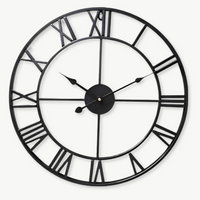


It started with a gift. My partner brought home a beautiful vintage mechanical clock for our bedroom and we both loved the look. Then 2 a.m. happened. That small, relentless tick in the dark. We lasted four nights before it went into the living room. A large silent wall clock for the bedroom solves that exact problem: no ticking, real presence on the wall, and a dial you can actually read from bed. But picking the right one takes more thought than most people give it.
Size, movement type, material, and placement all interact. Get one wrong and the clock either disappears on the wall or turns your calm room into something that feels more like a hotel lobby. Here's what I've learned works, and what doesn't.
⭐ Key takeaways
- Silent quartz sweep movements eliminate ticking entirely - standard quartz still clicks once per second
- For bedrooms, 40-60 cm (16-24 in) hits the sweet spot between readable and room-appropriate
- Wood and resin absorb sound slightly better than bare metal, making them smarter choices acoustically
- Wall placement matters as much as the clock itself: center above the headboard or anchor a blank lateral wall
- Battery-powered models are better for bedrooms than plugin - no cord, no interference
Why "Silent" Doesn't Mean the Same Thing on Every Clock
Not all silent wall clocks are equally quiet. The difference comes down to whether the movement uses a sweep mechanism or a standard step quartz. Standard quartz movements advance the second hand once per second with a small mechanical click. That's the tick you hear. A sweep quartz movement (also called continuous movement) glides the hand in a smooth, near-continuous arc. No click, no pause, no sound detectable in a quiet room.
This matters more in a bedroom than anywhere else in the house. In a kitchen or hallway, ambient noise swallows a soft tick without effort. In a bedroom at night, your hearing sharpens considerably. A clock that's whisper-quiet at noon can feel surprisingly loud at midnight.
When you see "silent quartz" on a product listing, check whether the description specifies sweep movement. Some manufacturers label standard quartz clocks as "quiet" because the tick is softer than a mechanical movement, but it's still there. True sweep movements are listed as "sweep second hand," "continuous movement," or "no-tick quartz" in the specs. If those exact words aren't there, keep looking.
One more thing worth knowing: the first miniaturized sweep motors were developed in the 1970s for broadcasting studios and recording environments, where even a standard quartz tick was picked up by sensitive microphones. Home designers borrowed the technology once production costs dropped enough for consumer clocks. That origin is part of why sweep movements are still considered the professional-grade choice.

💡 Did you know?
The sweep quartz mechanism was first developed in the 1970s, partly in response to complaints from broadcasters and recording studios where even a soft tick was picked up by microphones. Home designers borrowed the tech later, once miniaturized motors became affordable enough for consumer clocks.
How Big Should a Bedroom Wall Clock Actually Be?
The most common mistake is choosing a clock that's too small: a 25 cm dial on a standard bedroom wall looks like a decoration that forgot to commit, and you end up squinting from bed. Interior designers generally recommend a wall clock occupy roughly one-third to one-half of the wall width it anchors (a principle you'll find in most professional staging guides). For a typical headboard wall, that translates to 40-60 cm (16-24 inches) in diameter.
Reading Distance and Dial Legibility
Think about where you'll actually read the clock from. From a bed positioned 2-3 meters from the wall, a 40 cm clock is comfortable. Push that distance past 3.5 meters and 50-60 cm becomes the more practical choice. Numerals matter here: Roman numerals read slightly less quickly than Arabic at a glance, especially at night. If you rely on the clock before your eyes fully adjust to the dark, clean Arabic numerals or high-contrast hands are more functional.
People notice this more than they expect. A common pattern: someone buys a beautiful 35 cm clock, loves it from across the room during the day, then realizes at 6 a.m. they have to lean forward to read it. Going up to 50 cm makes a real difference in morning readability.
Ceiling Height Changes the Equation
Low ceilings (under 250 cm) call for rounder, more compact silhouettes even at larger diameters. Tall ceilings above 280 cm can carry elongated formats like oval vertical designs that measure 57 cm tall but only 24 cm wide. These read as imposing statement pieces in high rooms without overwhelming the wall horizontally.

Material Choices and How They Shape the Mood
The material of a bedroom clock affects how it interacts with light at different times of day and how the room feels at night, when texture matters more than color. This isn't just aesthetics. Porous materials like wood and bamboo absorb ambient sound rather than reflecting it, which contributes to a quieter acoustic environment overall. Dense metal, especially with a polished finish, behaves as a minor reflective surface. Here's how the main material families behave in bedroom conditions.
| Material | Bedroom strength | Watch out for |
|---|---|---|
| Natural wood | Warm, organic, absorbs rather than reflects light; slight acoustic dampening from grain texture | Can look heavy on very small walls |
| Bamboo | Lightweight, sustainable, very calm visual texture; tighter grain than oak or pine | Grain variation means no two are identical (usually a plus) |
| Metal (brushed/matte) | Sleek, works in modern and industrial rooms; matte iron reads warmer than chrome | Reflective finishes bounce light at night and can create glare |
| Resin (wood-look) | Moisture-resistant, consistent finish, very quiet acoustic profile | Less premium feel up close than real wood |
| Acrylic / transparent | Visually light, good for small rooms; hands appear to float on the wall | Shows dust easily, needs regular wiping |
For most bedrooms, natural wood and bamboo are the safest bets. They bring warmth without demanding visual attention the way a polished metal dial does. If your room skews more urban or contemporary, a matte metal with no reflective finish works well, particularly in darker colorways like charcoal iron or aged black steel.

Where to Hang It: Placement That Actually Works
A large bedroom clock placed wrong will dominate the room in a way that feels anxious rather than calm, the opposite of what a bedroom needs. There are four spots that consistently work, and a couple that almost never do.
Above the Headboard
This is the classic position, and it works because the headboard already anchors the wall visually. The clock adds a vertical layer without competing. Keep at least 20-30 cm of clear wall between the top of the headboard and the bottom of the clock. Anything closer looks crowded, even with a slim frame.
On the Lateral Wall (Visible from the Bed)
This placement gets underused. A large clock on the wall to the side of the bed, positioned at eye level when you're sitting up, reads naturally without requiring you to crane your neck. It also frees up the headboard wall for artwork or nothing at all. In a bedroom with an accent wall, this is often the stronger choice.
Opposite the Bed
Works well in larger rooms where the opposite wall is far enough away (3 m or more) to make a 50-60 cm clock readable. This placement benefits from a clock with high-contrast hands and clear numerals. In smaller rooms, it can feel like the clock is staring at you, which is its own kind of unsettling.
Spots to Avoid
- Directly above a window: backlighting makes the dial hard to read
- Inside a built-in alcove: sound reflects differently and even a silent clock can hum faintly against an enclosed wall
- Behind the bed (not visible from a sleeping position): purely decorative at that point, which undercuts the functional purpose
The Best Clock Styles for a Quiet Bedroom
Style and silence aren't in tension: most design families that work well in bedrooms use silent sweep quartz movements as standard, and the aesthetic logic of each style has a functional reason behind it. Here are the styles worth knowing, with an honest take on where each one actually lands in a real bedroom.
Scandinavian Minimalist
Clean faces, natural oak or birch frames, either no numerals or sparse hour markers. This style reads as restful because there's genuinely not much to look at. Fewer visual elements mean less mental stimulation, which is exactly what a bedroom wall should offer. The spare aesthetic isn't just fashionable; it's functional for sleep environments. Works best with neutral palettes, linen textiles, and low visual noise. The wooden wall clock collection covers the full range from slim birch dials to carved bamboo pieces.
Japanese-Inspired Wood
Similar philosophy to Scandinavian but with even more restraint. Often 30 cm (12 in), so smaller by large-clock standards, but the craftsmanship at close range compensates for scale. Wabi-sabi sensibility, that Japanese appreciation for imperfection and natural texture, shows up in the visible grain and the hand-finished edges. Handcrafted Japanese-style clocks with sculpted faces are among the quietest aesthetically and acoustically. They suit rooms where you want a single intentional object rather than a gallery wall moment. Honest opinion: if your bedroom already has a lot going on, this is the style I'd choose to bring it back down.
Industrial Metal
Better suited to bedrooms with exposed brick, dark walls, or a more urban, loft-style aesthetic. The functional logic here is contrast: a matte iron or brushed steel frame reads as deliberately raw against a clean painted wall, giving the room an intentional edge rather than an accidental one. Look for matte or brushed finishes rather than polished chrome, and choose a model where the frame is heavier than the dial to avoid the "cheap" look. The industrial wall clock collection runs from 30 cm compact dials to 60 cm oversized statements, all in iron or brushed steel finishes.

Contemporary Sculptural
Oval formats, geometric acrylic frames, ring-shaped metal constructions: these are clocks that do double duty as wall sculpture. They work best as the only decorative object on that wall. Pair one with bare plaster or a single-color painted wall and let the form speak for itself.


Battery Life, Hanging, and the Practical Side Nobody Mentions
A beautiful clock that needs constant maintenance or requires moving furniture to change the battery is a clock you'll start resenting by spring. Here's what's worth checking before you buy.
Battery Access and Frequency
Most silent quartz wall clocks run on a single AA battery. A well-made sweep movement in a 40-60 cm clock typically lasts 12-18 months on one AA cell (this is consistent with battery performance data published by major movement manufacturers including Seiko and Ronda). Larger clocks with heavier metal hands can drain faster because the motor works harder to move the weight. Check whether the battery compartment is on the back of the movement (standard, easy to access) or buried behind a decorative panel that requires removing the clock from the wall entirely. That second option is annoying every single time.
Wall Anchoring for Large Clocks
A 50-60 cm clock in metal can weigh anywhere from 800 g to over 2 kg. That's not a job for an adhesive strip. Use a proper wall anchor and screw rated for at least twice the clock's weight. Most clocks in this size range come with a single central keyhole mount on the back. The screw head sits in the wide end of the keyhole and locks into the narrow end when you slide the clock down. It's secure when done right, but only if the screw is driven into a wall plug rather than just the plaster.
Glass vs. Open Face
Open-face clocks (no glass cover over the dial) gather dust faster but avoid the glare problem: glass covers can catch ceiling light or morning sun at an angle and create a reflective flash. In a bedroom where light conditions vary a lot, an open face is usually the better call. In dustier homes or homes with pets, a glass cover is easier to wipe clean than dusting around hands and hour markers.
"The clock is not a watch. It doesn't belong to your wrist, it belongs to the room."
Common observation among interior stylists, often repeated in the context of scale and placement
That shift in thinking, from functional object to architectural element, is what separates a bedroom that feels considered from one that feels assembled. The bedroom clock collection covers 168 models built around exactly that principle: silence first, then presence, then style.
Sizing Up Your Bedroom: A Practical Decision Framework
Rather than a generic size chart, here is how to think through the decision based on what your specific bedroom actually has to work with.
Start with the wall you have in mind. Measure the usable width (between any furniture, windows, or art). A clock should occupy between 30% and 50% of that width to read as intentional rather than accidental. On a 120 cm wide wall section above a headboard, that means 36-60 cm. On a full 200 cm lateral wall, you can go up to 90 cm without it feeling overwhelming, particularly with a sculptural open-frame design that reads as lighter than a solid dial.
Then think about viewing distance. From the bed, measure roughly how far your eyes are from the wall. Under 2.5 m: 40 cm is fine. Between 2.5 and 3.5 m: 50 cm is the comfortable minimum. Over 3.5 m: go 60 cm or larger, and prioritize high-contrast hands and numerals. Legibility at distance is underrated as a buying criterion, but it's the one you notice every morning for years.
Finally, think about what else is on the wall. A clock competing with gallery frames, mirrors, and sconces is fighting a losing battle. The cleaner the wall, the smaller you can go and still have impact. The busier the wall, the larger the clock needs to be to hold its own.

Frequently asked questions
What size wall clock works best for a bedroom?+
For most standard bedrooms, 40-60 cm (16-24 inches) in diameter is the practical range. A 40 cm clock works well when viewed from under 2.5 meters. Larger rooms with longer viewing distances benefit from 50-60 cm. The clock should cover roughly a third to half the usable wall width it anchors, which is the proportion interior designers use to judge whether a piece reads as intentional or too small.
What makes a wall clock truly silent?+
True silence comes from a sweep quartz movement (also called continuous quartz), where the second hand glides smoothly instead of clicking once per second. Standard quartz movements are quieter than mechanical clocks but still tick audibly in a quiet room. When buying, look specifically for "sweep second hand" or "no-tick sweep movement" in the product specs. If those words aren't there, the clock almost certainly has a standard step movement.
Is a wood or metal clock better for a bedroom?+
Wood and bamboo tend to read as warmer and more restful, and their porous surface absorbs light rather than reflecting it, which matters when morning sun hits the wall. Natural materials are also acoustically softer. Metal works well in contemporary or urban bedrooms, particularly in matte or brushed finishes that don't create glare. The honest answer: if you're not sure, go wood. It suits more bedrooms in more lighting conditions than any other material.
Where is the best place to hang a wall clock in a bedroom?+
Above the headboard (with at least 20-30 cm clearance from the top of the headboard) is the most reliable position. A lateral wall visible from the bed also works well and leaves the headboard wall free for art or mirrors. Avoid hanging a clock directly above a window, where backlighting makes the dial hard to read, and avoid enclosed alcoves where even a silent movement can hum faintly against a hard surface.
How long does the battery last in a large silent wall clock?+
Most silent sweep quartz movements in 40-60 cm bedroom clocks run for 12-18 months on a single AA battery, consistent with published specs from major movement manufacturers like Seiko and Ronda. Larger clocks with heavier metal hands may run shorter because the motor works harder. Always check whether the battery compartment is accessible from the back without removing the clock from the wall. It's a small detail that matters every time you change the battery.
Can a silent wall clock work in a very small bedroom?+
Yes, and the material and format choice matters more in a small bedroom than a large one. An open-frame or acrylic design reads as visually lighter than a solid-face wood clock, which makes the room feel less crowded. Stick to 40 cm or below for walls under 100 cm wide. A single clock on a clean wall will always feel more intentional than a small clock competing with other objects for the same space.