
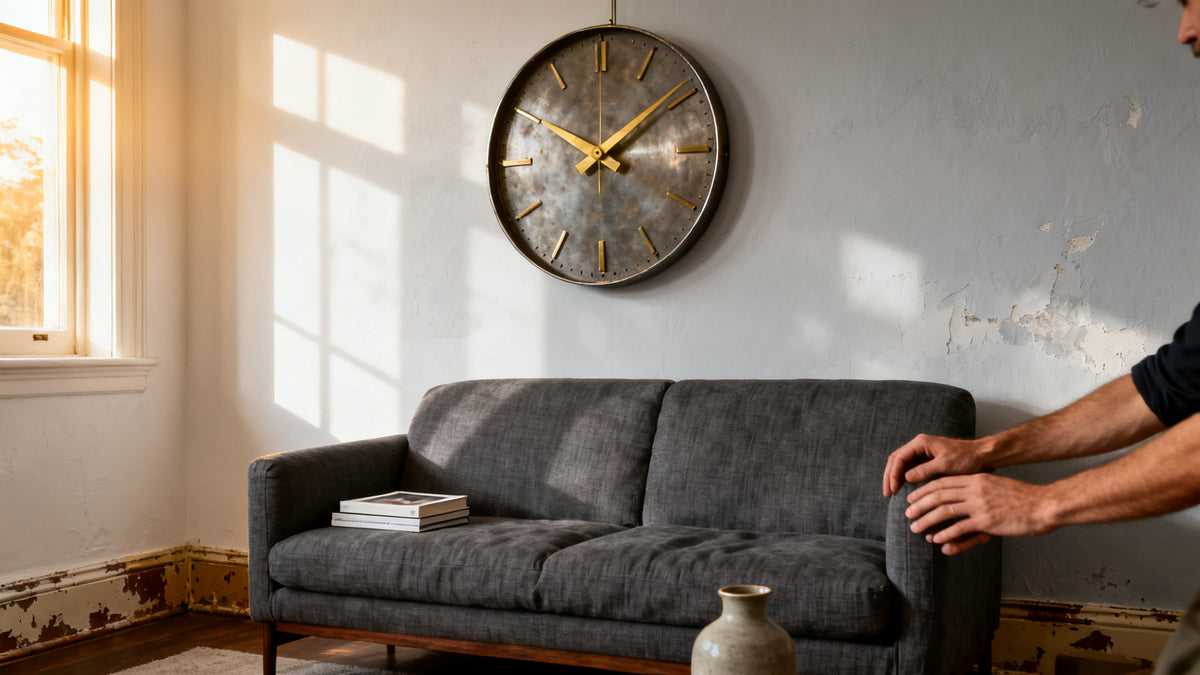
You hang the clock. You step back. Something is off, but you can't say exactly what. The clock looks too high, or the sofa seems to have drifted toward the floor, or the whole wall feels slightly wrong. Getting a large wall clock above a sofa to look intentional comes down to three numbers: the gap, the centering, and the diameter relative to the sofa's length. Nail those three, and the rest is just style choices.
⭐ Key takeaways
- Hang the clock's bottom edge 8 to 12 inches above the sofa's back for a tight, intentional relationship between the two.
- The clock's diameter should be between 50% and 75% of the sofa's width - no wider, no narrower.
- Center the clock over the sofa, not over the wall, unless the sofa is centered on the wall too.
- Pairing with art works best when the clock is the anchor and artwork flanks it at the same visual weight.
- A silent quartz movement matters more than you think in a living room - constant ticking kills relaxed conversation.
The Height Rule That Designers Actually Use
The most reliable rule for hanging a large wall clock above a sofa: place the bottom edge 8 to 12 inches (20 to 30 cm) above the sofa's highest point. That gap keeps the clock visually connected to the sofa without sitting so close it looks like it could fall on someone's head. The American Society of Interior Designers references this same 8-to-12-inch zone for artwork hung above seating, and clocks follow identical logic.
Why 8 to 12 inches specifically? Below 8 inches, the clock and sofa start to merge into one visual blob. The space between them disappears, and the clock loses its independence as a decor piece. Above 12 inches, the connection breaks. The clock floats. It stops reading as part of the seating arrangement and starts looking like it landed on the wrong wall.
There's a second check worth doing: eye level from standing. Walk to the center of the room and look at the wall. The center of the clock face should sit between 57 and 65 inches from the floor - the standard art-hanging zone, and clocks follow the same logic. If your sofa is unusually tall (some high-back Chesterfields reach 36 inches), the clock will naturally sit higher. That's fine. The 8-to-12-inch gap from the sofa still takes priority over the absolute floor measurement.
We hear this confirmed constantly in customer notes. One buyer who hung our Orbital clock above an 88-inch velvet sofa wrote: "I was skeptical about the 10-inch gap but it's exactly right. Any closer and it would have looked cramped." That kind of feedback makes the rule easier to trust when you're standing on a step stool second-guessing yourself.

Centering Over the Sofa vs. Centering Over the Wall
Center the clock over the sofa, not over the wall, unless the sofa sits perfectly centered on that wall. The sofa is the visual anchor. The clock's job is to relate to it, not to the architecture behind it.
This trips people up constantly. Say your sofa is pushed slightly left of center on a long living room wall because of a doorway on the right. If you center the clock over the wall, it will look displaced from the sofa - off to one side with dead space on the other. If you center it over the sofa, the two pieces form a unit. The wall asymmetry becomes invisible.
How to find your center line
Measure the sofa's total width. Find the halfway point. Use a plumb line or a level app on your phone to mark a vertical line on the wall above that midpoint. That's your center. The clock's hanging hook goes on that line - simple, but it's the step most people skip.
One exception: if you have a sectional sofa with an L-shape, the longest section is typically the reference. Center the clock over the long seat, not the chaise portion. The chaise tends to read as secondary.
💡 Did you know?
The "rule of three" in interior design says odd numbers feel more natural to the eye than even ones. When you're grouping a clock with objects on a console table or a shelf below the sofa, three objects (clock + two flanking pieces) tend to look more resolved than two or four. It's not a law, but it shows up in room layouts so reliably that furniture brands use it in their catalog photography.
What Size Clock Actually Works Above a Sofa
A clock above a standard 84-inch (213 cm) sofa typically falls between 18 and 24 inches (45 to 60 cm) in diameter: large enough to register as a focal point, small enough not to overwhelm.
The proportional guide many designers rely on: the clock's diameter should cover roughly 50% to 75% of the sofa's width. So a 72-inch sofa calls for a clock between 36 and 54 inches wide. A 90-inch sofa can carry a 45 to 68-inch piece.
Those numbers sound large. That's the point. The most common mistake isn't going too big above a sofa - it's going too small. A 12-inch clock above a three-seater looks like a forgotten afterthought. It gets lost. A 20-inch clock starts to read. A 24-inch clock above an 84-inch sofa is a statement.
Customers confirm this repeatedly. "I ordered the 50 cm version thinking I'd return it for the 40 cm - it looked huge in the box. On the wall above our sofa it was exactly right. The 40 cm would have disappeared." Interior designers on platforms like Houzz echo the same note: clients almost always size up when they see the result in situ.

When a clock is too big
There is a ceiling. A clock that approaches or exceeds the sofa's width feels aggressive rather than anchoring. It compresses the room and draws so much attention to itself that nothing else on the wall can breathe. If the sofa is 84 inches, a 72-inch clock is too wide - the sofa needs visual air above it, not coverage.

Pairing a Large Clock with Art and Other Objects
Treat the clock as the anchor piece and let art play a supporting role: hang smaller frames at the same visual height on either side rather than stacking above or below. That horizontal band of interest across the wall doesn't compete with the clock's focal weight.
Think of it as a horizon line. The clock sits at the center. Two prints or photographs, each roughly half the clock's diameter, flank it at the same midpoint height. The spacing between the clock and each flanking piece should mirror the sofa-to-clock gap - consistent breathing room signals intention. Interior stylists who blog about Scandinavian and Japandi aesthetics describe this "floating horizon" technique as the single most reliable way to avoid a wall feeling decorated-by-committee.
Mixed media combinations that hold up
- Clock plus woven textile or macrame: works especially well with a wood or bamboo clock face. The textile adds texture without the rigidity of a frame.
- Clock plus two identically framed prints: the symmetry is reassuring. This is the safest combination for rooms that already have a lot going on (patterned rugs, exposed brick, busy shelving).
- Clock plus a single large-format photograph: asymmetric but intentional. The photo goes to one side and slightly lower. The clock stays centered above the sofa. This works when the photo's subject echoes the clock's material - a black-and-white architectural photo beside an industrial metal clock, for instance.
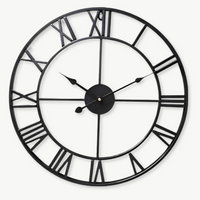
- Clock alone on a clean wall: often underestimated. A 24-inch designer clock on a white or light plaster wall, with nothing else, is a confident move. It only works if the clock has genuine visual complexity: an open frame, a sculptural dial, visible handwork.
What doesn't work
Stacking art vertically below a clock is almost always a problem. It creates a tower effect that draws the eye down rather than letting it settle on the sofa arrangement. Similarly, placing a clock inside a gallery wall as one piece among fifteen makes the clock invisible. A large clock wants prominence, not competition.

Matching Clock Style to Your Sofa and Room
The clock's material and finish should either match something already present in the room or provide a deliberate counterpoint: never land somewhere in between with no clear relationship to anything else.
A few combinations worth knowing:
| Room style | Sofa type | Clock that holds the wall |
|---|---|---|
| Scandinavian / minimalist | Low-profile linen or boucle | Open-frame metal or bamboo, 50-60 cm, neutral finish |
| Industrial / loft | Leather or dark velvet | Iron or brushed steel, exposed gear details, 40-60 cm |
| Traditional / classic | Rolled-arm fabric or Chesterfield | Roman numeral dial, brass or aged gold, 45-55 cm |
| Japandi / organic | Low seat, natural cotton or linen | Sculpted wood or bamboo face, minimal markings, 30-40 cm |
| Contemporary / eclectic | Bold color or mixed materials | Geometric metal or mirrored face, 50 cm, can take a finish risk |
The counterpoint move deserves a note. If every element in your room is soft - linen sofa, wool rug, cotton cushions - a hard metal clock with a bare iron finish creates a tension that makes the room feel considered rather than decorated-by-committee. That contrast only works when the clock is quality enough to carry it. A flimsy metal clock trying to punch above its weight reads as cheap, not intentional.

Pendulum Clocks Above a Sofa: A Specific Case
A pendulum clock above a sofa needs more vertical clearance than a standard round clock, because the pendulum's swing adds visual depth below the dial. Hang the clock body at least 14 to 16 inches above the sofa's back, not the standard 8 to 12, to give the pendulum room to read without appearing to hover over people's heads.
The upside of a pendulum above a sofa is genuine. The swing adds movement to a space that is otherwise still. It gives guests something to notice. It makes the wall feel alive in a way that a static round clock doesn't. The trick is choosing a pendulum length that doesn't bring the bottom of the swing too close to sofa height - a pendulum swinging within a few inches of cushion level looks precarious, even if it isn't.
For this placement, a pendulum clock with a compact, modern profile tends to work better than a large traditional grandfather-style case. You want the movement and the elegance without the architectural bulk.

The Ticking Problem: Why Silence Matters in a Living Room
A ticking clock above a sofa is something you don't notice in the shop and can't stop noticing at home, especially during a quiet evening or a conversation that drifts into a pause. A silent quartz sweep movement is worth paying for in any clock that will live above your primary seating area.
Mechanical clocks tick. Cheap quartz movements tick. A sweep movement, by contrast, turns the second hand continuously rather than in step increments, and it produces no audible click. The room stays as quiet as you want it. This is less of a concern in a kitchen or hallway, where background noise masks a tick. In a living room, with a sofa directly below, silence is a feature.
Most quality designer wall clocks at 45 cm and above now ship with sweep movements as standard. It's worth confirming in the product specs before buying. The living room wall clock collection has filters by movement type if you want to narrow your options quickly.
This is one of the things buyers mention most in reviews: "I didn't realise my old clock was ticking until I replaced it with a sweep movement. My whole living room feels calmer." Small upgrade, big difference in daily comfort.
Before You Drill: A Three-Step Check
Three checks before committing to a hole: wall weight capacity, stud or anchor placement, and the hook-to-top-of-clock measurement. Miss any one of them and the final height won't match your plan.
- Weight check: most metal wall clocks between 45 and 60 cm weigh between 1 and 3 kg. A single screw into a stud handles that easily. If you're hitting drywall between studs, use a wall anchor rated for at least double the clock's weight.
- Stud location vs. center line: studs don't always fall where you need them. If the stud is 2 inches off your center mark, a good wall anchor at the exact center is a better option than a stud at the wrong position.
- Hook-to-top measurement: every clock has a different distance between the hanging hardware and the top of the frame. Measure it. If the hook sits 3 inches below the top of the clock and you want the top at 72 inches from the floor, you drill at 69 inches, not 72. Missing this step is how clocks end up 3 inches too high.
"A well-placed clock doesn't just tell the time. It tells you something about the room."
Interior design maxim
Making a Large Clock Work When the Sofa Isn't Against the Wall
When a sofa floats in the middle of a room, a large wall clock can still anchor the visual zone, but the wall behind needs more than just the clock to create a backdrop that reads as intentional from both sides.
Float arrangements ask for a stronger approach to the wall. A single clock on an otherwise bare wall works when the sofa is pushed against it - the sofa acts as a visual base. When the sofa floats, that base disappears. Here's what fills it: a console table pushed against the wall below the clock (even if the sofa is several feet in front), a gallery wall that includes the clock as a centerpiece, or flanking floor lamps that frame the clock and draw the eye upward from the floor.
The clock itself can go slightly larger in a float arrangement. Because there's no sofa back immediately below it to define the lower boundary, you have more freedom to scale up to 60 cm or beyond. The extra size helps the clock hold the wall from a distance. Several customers with open-plan layouts have told us they went up a full size after seeing how far the sofa actually sits from the wall.
Frequently asked questions
What to put on a big wall above a couch besides a clock?+
A large-format photograph or print (at least 24 by 30 inches) works well as a single statement piece. A gallery wall of 5 to 9 mixed frames is another strong option. Textile art - woven wall hangings, tapestry panels, or even a large macrame piece - adds texture that flat prints don't. Mirrors are popular for their light-reflecting quality, though a clock and a mirror above the same sofa can feel redundant if the mirror is also round. Choose based on what the room lacks: light, texture, color, or visual depth.
Are big clocks still in style in 2026?+
Yes, and for a specific reason: as phones took over timekeeping, wall clocks shifted fully into decor territory. A large clock is now chosen for how it looks before how it functions. That shift actually extended the style's longevity, because a piece bought for aesthetic reasons doesn't go out of style the way a trend piece does. Open-frame metal, sculptural wood, and geometric designs have replaced the oversized distressed-farmhouse look that dominated a few years ago - but the principle of a single large piece above a sofa remains as solid as ever.
What is the 3-5-7 rule in decorating and does it apply to clock placement?+
The 3-5-7 rule suggests grouping decorative objects in odd numbers - three, five, or seven - because asymmetric groupings feel more natural and dynamic than pairs or even sets. Applied to a sofa wall, it means: if you're building a composition around a clock, aim for a total of three, five, or seven distinct visual elements (the clock plus flanking prints, a small shelf, a plant, sconces). It's a guideline, not a formula. A single oversized clock with nothing else can be just as effective if the clock itself has enough visual interest.
How do I hang a clock above a sofa without a stud in the right spot?+
Use a toggle bolt or a heavy-duty drywall anchor rated for at least twice the clock's weight. For a 2 kg clock, a 10 kg-rated anchor is a comfortable margin. Toggle bolts are more secure than standard plastic anchors because the toggle spreads the load across the back of the drywall. Pre-drill to the anchor's specified diameter, insert, and tighten until snug but not over-torqued. One properly placed anchor is more reliable than two poorly placed screws.
Can a large wall clock above a sofa also work as a focal point in a room with a fireplace?+
It can, but a room rarely supports two focal points without one winning and one looking like an accident. If the sofa faces the fireplace, the fireplace is usually the natural focal point and the sofa wall becomes secondary. A large clock above the sofa in that configuration works as a strong secondary statement - something interesting to look at from the seating area - rather than competing with the fireplace. If the sofa is against a wall with no fireplace in view, the clock above it can be the room's primary focal point without compromise.
What's the difference between a decorative wall clock and a statement clock?+
A decorative clock fills space without commanding it - think small, simple dials that sit quietly on a shelf. A statement clock, by contrast, is sized and designed to be the first thing your eye lands on when you enter the room. Above a sofa, you almost always want a statement clock: one with enough diameter (45 cm minimum), enough material presence (open frame, textured metal, sculpted wood), and enough visual complexity to justify its position at the center of the wall. If you find yourself thinking "will anyone notice it?", it's probably a decorative clock trying to do a statement clock's job. Size up.