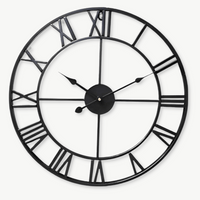


You've got about three seconds. That's how long it takes a guest to form their first impression of your home the moment they step through your front door. The entryway sets the emotional temperature for every room that follows, and yet it's the space most people treat as an afterthought, a place to drop keys and shed coats rather than a deliberate design moment.
A wall clock for entryway decor changes that entirely. Not because a clock is magical, but because a well-chosen one does two things at once: it tells time (practical, always appreciated), and it tells something about you (the part that actually matters). Think of it as your home's opening line. Here's what works, and why.
⭐ À retenir
- The entryway is the only room every visitor sees, making it your most valuable design real estate.
- Clock size should reflect wall width: aim for a diameter that covers roughly one-third to one-half of the available wall span.
- Silent quartz or sweep movements are non-negotiable in hallways where ticking echoes off hard floors.
- Style alignment matters more than trend: pick a clock that previews the rest of your interior, not one that contradicts it.
- Feng Shui and spatial psychology both support placing a clock where it's visible but not directly facing the main door.
Why the Entryway Deserves More Attention Than a Coat Hook
The entryway deserves more design attention than any other room because it's the only space every visitor sees, and a single well-chosen wall clock can transform a blank hallway into a deliberate, welcoming focal point. Think about how you experience your own home. You walk in, you glance around, and within seconds your nervous system either relaxes or tightens slightly based on what you see. Order, warmth, a sense of intention: those signals come from objects, not square footage. A narrow hallway with one well-placed piece of decor feels more welcoming than a spacious one that's been left blank.
The entryway also functions differently from every other room. It has no sofa to anchor it, no dining table, no bed. Its furniture is minimal by nature: a console table, a coat rack, maybe a small bench. That openness means a single wall object carries enormous visual weight. Hang the wrong thing and the space feels random. Hang nothing and it feels unfinished. Hang a wall clock for entryway styling that actually fits the mood of your home, and suddenly the space has a focal point, a rhythm, a personality.
Designers working on high-end residential projects consistently cite the entryway as the room where budget is best spent per square foot. A well-chosen clock costs a fraction of a renovation and delivers the same sense of considered design. It carries real visual authority precisely because it's one of the oldest domestic objects we know.

Choosing the Right Size: The Rule Most People Get Wrong
Most people choose an entryway clock that is far too small: a clock face should span one-third to one-half of the available wall width, putting most hallways in the 40-60 cm diameter range. The most common mistake in entryway styling isn't choosing the wrong style. It's choosing the wrong size, almost always too small. A 20 cm clock that would look charming on a bedroom nightstand disappears completely on a hallway wall. It reads as shy, tentative, easily missed.
Here's a more reliable approach. Measure the width of your available wall space. A clock face should span roughly one-third to one-half of that width. On a standard 120 cm wide wall section, that puts you in the 40-60 cm diameter range. On a wide, open entryway wall, you can push to 70 cm or beyond without it feeling overwhelming.
Scale also depends on ceiling height. Higher ceilings read better with taller or larger clocks because there's more vertical space to fill. A 40 cm clock under a 3-metre ceiling will look lost. The same clock under a standard 2.4-metre ceiling feels perfectly proportioned.
💡 Did you know?
The tradition of placing a clock near a home's entrance dates back to 18th-century European bourgeois households, where a prominent hallway clock signalled both wealth and punctuality. It was a status symbol before it was a decor choice, which is part of why it still carries such visual authority today.
Style Matching: Your Clock Should Whisper What's Coming Next
Your entryway clock should preview the design language of the rooms beyond it: a consistent material, finish, or visual tone tells visitors what kind of home they've walked into before they see a single other room. The entryway is a trailer for the rest of your home. When someone walks in and sees a clean-lined Scandinavian wooden clock, they expect the living room to carry that same quiet restraint. When they see a bold industrial metal-and-wood piece with exposed gear detailing, they're primed for something with more edge. Consistency between your entryway and interior doesn't mean everything has to match exactly. It means the visual conversation makes sense.
A few style pairings that work reliably well:
- Minimalist interiors: Lean toward clocks with clean dials, thin metal or light wood frames, and no unnecessary ornamentation. White or natural birch tones read as calm and intentional, especially in Japandi-inspired spaces where every object earns its keep.
- Warm, eclectic spaces: A vintage wooden clock with Roman numerals or a piece with hand-painted details adds character without cluttering. The aged quality of the materials signals "collected over time," which feels personal rather than staged.
- Industrial or loft aesthetics: Oversized metal-framed clocks with bold numerals, exposed mechanisms, or dark finishes complement the rawness of exposed brick, concrete, and dark ironwork. Think matte black or oxidised bronze rather than polished chrome.
- Coastal or nature-inspired homes: Wooden clocks with organic shapes, compass motifs, or neutral grain textures echo the unhurried feeling of natural materials throughout.
- Classic European interiors: Glass-faced clocks with ornate hands, porcelain details, or a French-countryside aesthetic fit beautifully in spaces with mouldings, herringbone floors, or antique furniture.

Placement That Actually Works: Height, Position, and What to Avoid
Hang your entryway clock so its visual centre sits at eye level, between 150 and 165 cm from the floor, on a side wall rather than directly opposite the entrance, with 20 to 30 cm of breathing room above any console furniture below. Knowing where to hang your entryway clock matters as much as knowing which clock to pick. Get the placement wrong and even the most beautiful piece looks awkward.
The Ideal Height
The visual centre of a wall clock should sit at approximately eye level, which for most people falls between 150 and 165 cm from the floor. This feels natural when you're standing and reading the time. If the clock hangs too high, it reads as a ceiling feature rather than a wall feature, and if it hangs too low, it competes awkwardly with any console furniture beneath it.
When placing a clock above a console table or bench, leave a gap of 20 to 30 cm between the top of the furniture piece and the bottom of the clock. This breathing room lets both objects exist independently without one crushing the other.
Centering vs. Off-Center
Symmetry works well in traditional or formal entryways, especially when flanked by matching sconces or framed prints. But off-center placement can feel more dynamic and modern. A clock positioned slightly to one side with a vertical row of hooks or a narrow gallery arrangement to the other side creates tension and movement without looking cluttered.
What to Avoid
- Hanging a clock directly above a door frame, where it's impossible to read at normal eye level.
- Placing it in a dark corner or behind a door swing, where it's hidden from view the moment someone enters.
- Positioning it where direct sunlight hits the face for hours daily, which fades certain dials and strains the eyes.
- Crowding it with too many competing objects. The clock needs some clear wall space around it to breathe and register as a focal point.

The Noise Problem Nobody Talks About Enough
Entryways and hallways amplify sound because of their hard floors and bare walls, making a silent sweep movement an absolute requirement for any wall clock in this space. Hallways and entryways are acoustically unforgiving spaces. Hard floors, bare walls, and minimal soft furnishings mean sound bounces. A ticking clock in a bedroom is mildly distracting. A ticking clock in an entryway can be audible from the living room, the kitchen, and halfway up the stairs.
This is why silent sweep movement isn't a luxury feature for a wall clock for entryway use, it's a baseline requirement. Sweep movements advance the second hand in a smooth, continuous motion instead of a step-by-step tick. The result: zero mechanical noise, absolute calm. You notice the clock visually. You don't hear it.
Quartz silent movements are also extremely reliable and low-maintenance. They run on a single AA or AAA battery and keep accurate time for 12 to 24 months between changes. No winding, no servicing. For a space you interact with multiple times a day, that practicality is genuinely valuable.

Building a Composition: The Clock as Part of a Larger Entryway Story
The clock should serve as the visual anchor of your entryway composition, with every other object, console table, mirror, print, and plant, orbiting it rather than competing with it. A clock on a blank wall is a good start. A clock within a thoughtfully assembled entryway composition is a great one. Here's the key distinction: the clock should be the anchor, not just one item among many competing for attention.
The Console Table Layer
Pairing your entryway clock with a console table below creates a visual column that draws the eye from floor to ceiling. On the table: one tray (for keys and small items), one plant or sculptural object (for organic texture), and nothing else. Clutter under a beautiful clock immediately undermines it. I learned this the hard way after leaving a small stack of mail under a walnut-framed piece for a week. The clock was invisible. The mail was all anyone saw.
The Gallery Wall Approach
If you have a wider hallway wall, placing the clock as the centrepiece of a gallery arrangement works beautifully, particularly for larger-format clocks. Surround it with a mix of framed prints and a small round mirror. The mirror serves a secondary purpose: it bounces light in a space that's often darker than the rest of the home.
Keep the gallery asymmetrical. Three pieces in a perfectly symmetrical row reads as corporate rather than residential. Let the clock be the dominant element and let everything else orbit it loosely. In a Japandi or Scandinavian hallway, even one framed botanical print and a small ceramic vessel on the console can complete the composition without overcrowding it.
The Minimalist Single-Object Statement
Some entryways are too narrow for anything but one object. In that case, a single large, beautifully designed clock on an otherwise clean wall is not sparse. It's confident. This approach works especially well with oversized pieces, anything above 50 cm in diameter. The white space around the clock becomes part of the composition.

A Comparison of Entryway Clock Materials and What They Communicate
| Material | Visual Feel | Best Style Match |
|---|---|---|
| Walnut / Dark Wood | Warm, grounded, premium | Scandinavian, mid-century modern, organic minimalism |
| Metal (black/bronze) | Graphic, bold, industrial | Loft, industrial, contemporary |
| Glass / Acrylic | Light, airy, refined | European classic, Art Deco, formal spaces |
| Light birch / White wood | Fresh, calm, understated | Scandinavian, Japandi, minimalist |
| Wood + Metal hybrid | Textured, layered, versatile | Transitional, eclectic, farmhouse-modern |
What Feng Shui Actually Says (and What to Take From It)
Feng Shui advises against placing a clock directly facing the front door because it creates a sense of rushing energy upon entry; hanging it on a side wall preserves both the calm atmosphere and full readability from within the hallway. Feng Shui principles around clocks are more nuanced than the internet tends to suggest. The short version that gets circulated everywhere: "don't put a clock facing the front door." The fuller picture is more useful, and honestly, more interesting.
In classical Feng Shui, a clock facing the main entrance is considered to create rushing energy, a sense that time is running out as you walk in, which isn't exactly the welcoming atmosphere you're going for. The concern isn't about clocks being bad near entrances. It's about whether the sightline creates anxiety or calm. I'd add a completely non-mystical layer to that: walking into a hallway where a clock stares you down just feels like arriving at a dentist's office. The energy is waiting-room, not welcome-home.
Practically speaking: hang the clock on a side wall rather than directly opposite the entrance. This way it's visible from within the entryway and hallway, readable at a glance, but it doesn't confront you the moment the door swings open. That slight angle also makes the space feel less like a corridor and more like a room.
Whether or not you subscribe to Feng Shui philosophy, the spatial logic holds independently. A clock on a perpendicular wall to the entrance reads as a design choice. A clock staring you down the moment you walk in reads as a waiting room.
"The home should greet you the way a good host does: with warmth, a sense of order, and something beautiful to look at."
Interior design principle, widely cited in residential styling practice
Large-Format Entryway Clocks: When Going Big Pays Off
A clock of 60 cm or larger stops functioning as an accessory and becomes architectural: it anchors the entire wall and works especially well in entryways with high ceilings, dark accent walls, or very minimal furniture. There's a tipping point in entryway design where a larger clock doesn't just fill more wall space. It changes the room's personality entirely. A 60 cm or 70 cm clock in a hallway reads as architecture rather than accessory. It becomes part of the room's structure, something you see and feel rather than notice and move past.
Large-format clocks work particularly well in entryways with high ceilings, dark accent walls, or very minimal furniture. They also travel well across different aesthetic registers. A large wall clock with bold numerals can anchor an industrial space or, with the right frame material, sit comfortably in a warmer, more traditional interior. A 70 cm walnut-framed piece, for example, reads completely differently from a 70 cm matte black metal skeleton clock, even at identical scale.
The practical constraint: weight. Clocks above 50 cm in diameter can be heavier than you expect, particularly metal-framed ones. Always check the mounting hardware included and verify that your wall type (plasterboard, brick, plaster over brick) can support the weight at a single hanging point. Most quality clocks above this size come with reinforced hanging mechanisms, but it's worth confirming before you buy.

Renter-Friendly Approaches: When You Can't Put Holes in the Wall
Renters can hang a lightweight wooden or acrylic entryway clock of 30-40 cm using weight-rated Command strips, which remove cleanly from most painted surfaces and won't cost you your deposit. Renters face a real constraint: most leases either prohibit wall anchors entirely or allow only small-gauge picture hooks that won't support a heavy clock. Here's what actually works without risking your deposit.
Lighter clocks, those with wooden or acrylic frames rather than heavy cast metal, typically weigh between 600 g and 1.2 kg. Command strips rated for that weight capacity are a legitimate solution and remove cleanly from most painted surfaces. A 30-40 cm clock in this weight range fits the bill perfectly and still reads clearly from across a hallway.
Alternatively: a shelf bracket mounted with adhesive strips can support a lighter clock that leans rather than hangs. This creates a more casual, layered look that suits eclectic and Scandinavian interiors particularly well. Pair it with a few small objects on the same shelf and it looks entirely intentional.
If you're working with a rental entryway, also consider a Scandinavian-style wall clock with a slim profile: lighter, easier to mount, and designed to make an impact at smaller diameters. Many of the best-designed entryway clocks in this category land between 30 and 40 cm, which is genuinely enough for a hallway of standard width.
From Threshold to Living Room: Carrying the Clock Aesthetic Through Your Home
The entryway clock works best as the introduction to a recurring design motif, a material, palette, or formal quality that reappears in the living room and beyond, making the whole home feel authored rather than assembled. One thing worth thinking about before you buy: where does the visual story go after the entryway? If your hallway opens directly into a living room, the clock you choose for the entrance should at minimum not clash with your living room decor. It doesn't need to be matchy, but it shouldn't contradict.
The most elegant approach is to treat the entryway clock as the introduction to a recurring design motif: a material (walnut wood, matte black metal, natural stone), a palette (warm neutrals, cool greys, forest greens), or a formal quality (handcrafted, geometric, organic). When that motif appears again in the living room, the bedroom, or the kitchen, the home feels authored rather than assembled from different shopping carts.
If you're looking to build that cohesion from scratch, browsing a designer wall clock range gives you a sense of which aesthetic threads run consistently across different pieces. Finding two or three clocks that share a visual DNA, even if they're different sizes and intended for different rooms, is one of those quietly powerful moves that makes a home feel genuinely considered.
Your wall clock for entryway use isn't just a timekeeper. It's the first sentence of a longer story your home tells, and the best first sentences make you want to keep reading. Get that opening line right, and everything else has room to follow naturally. Browse the full collection and find the piece that starts your story the way you actually want it told.

FAQ
What should you hang on an entryway wall?+
A wall clock is one of the most effective entryway pieces because it combines function and visual impact. Beyond that, a narrow console table with a small tray for keys, a mirror to bounce light, and one piece of art or a plant work well. The goal is purposeful simplicity: each object should earn its place. Avoid hanging too many small pieces that compete for attention instead of creating a clear focal point.
Where should you not hang a wall clock?+
Avoid placing a clock in direct, sustained sunlight, which can bleach certain dials and warp wooden frames over time. Don't hang a clock where it will be hidden behind a door when it swings open. In kitchens and bathrooms, keep clocks away from steam sources, which can compromise the movement mechanism. And in any room where you need quiet, a ticking clock above a hardwood floor is a poor choice: always opt for a silent sweep movement.
Can you put a clock in the hallway?+
Absolutely, and it's one of the best uses of a hallway wall. Hallways and entryways often have wall space that sits blank because people aren't sure what to put there. A clock solves the visual gap, serves a practical purpose, and creates a moment of design intention. The main considerations are size (proportional to the wall width), mounting (heavier clocks need proper anchors), and movement type (silent sweep for echoing hard-floored spaces).
Is it bad Feng Shui to have a wall clock facing the main door?+
Traditional Feng Shui advises against placing a clock so that it directly faces the front door, as this is thought to create a sense of rushing or depleting energy upon entry. The practical interpretation: a clock staring you down as you walk in can feel subtly unwelcoming, like a waiting room. Placing it on a perpendicular or side wall gives you all the functionality and visual appeal without that frontal confrontation. It's an easy adjustment that most people find makes the space feel noticeably more relaxed.
How large should a wall clock for entryway use actually be?+
A reliable guideline is to choose a clock with a diameter that spans one-third to one-half of your available wall width. For a standard hallway wall section of around 100-120 cm, that puts you in the 35-60 cm range. In taller spaces or on wider walls, a clock of 60-80 cm creates an even stronger focal point. If you're unsure, cut a paper circle matching the diameter you're considering, tape it to the wall, and step back: you'll see immediately if it's the right scale.
What clock style works best for a Scandinavian or minimalist entryway?+
For Scandinavian and minimalist entryways, look for clocks with light birch or whitewashed wood frames, simple dial markings (no excessive numerals or ornamentation), and a silent quartz movement. The Japandi aesthetic, which blends Japanese restraint with Scandinavian warmth, pairs especially well with walnut-toned pieces that have a single clean ring frame and no second hand. The goal is quiet confidence: the clock should feel inevitable in the space, not decorative in an obvious way.