
There's a specific moment that happens when you hang the right clock in a modern farmhouse room. The whole wall exhales. Everything that felt slightly unfinished suddenly clicks into place. That's not an accident, it's what happens when a wall clock for modern farmhouse interior actually fits the space instead of just filling it.
The challenge? Modern farmhouse is a hybrid style. It asks for the warmth and texture of rural living but refuses to look dated or cluttered. Getting the clock wrong means it either reads too country-craft or too cold and clinical. Getting it right means you've found something that bridges both, and that's exactly what we're working through here.
⭐ À retenir
- Modern farmhouse interiors need clocks that carry natural texture without heavy ornamentation.
- Wood, metal, and mixed-material dials hit the sweet spot between rustic and contemporary.
- Scale matters as much as style: a too-small clock disappears on shiplap walls.
- Silent quartz movement is non-negotiable in open-plan farmhouse living spaces.
- Roman numerals, distressed finishes, and clean round silhouettes are the three most reliable design choices.
What "Modern Farmhouse" Actually Means for Clock Design
Modern farmhouse clock design calls for natural materials like wood and aged metal, matte finishes, simple numeral systems, and round silhouettes that bridge rural warmth with clean contemporary lines, while avoiding glossy finishes and ornate frames that tip the balance into country kitsch. Modern farmhouse as an interior style grew out of a real tension: people wanted the warmth of their grandparents' kitchens but also clean walls, neutral palettes, and uncluttered surfaces. The result is a style that layers natural materials, reclaimed wood, raw linen, aged metal, against white or off-white backdrops with minimal fuss.
A clock in this context isn't decorative trim. It's a structural accent. On a shiplap wall or a smooth plaster surface painted in warm white, the clock becomes one of the few objects with visual weight. That weight needs to feel intentional.
Here's what works: natural grain woods (oak, walnut, pine), matte or aged metal finishes (black, brushed bronze, raw iron), simple numeral systems (Roman numerals or clean Arabic), and round or slightly oval silhouettes. Here's what tends to kill the vibe: glossy lacquered finishes, overly ornate frames with baroque flourishes, bright chrome, or pastel color washes that push the clock into "country kitsch" territory.

The Three Clock Styles That Nail the Modern Farmhouse Look
1. Distressed Wood with a Neutral Dial
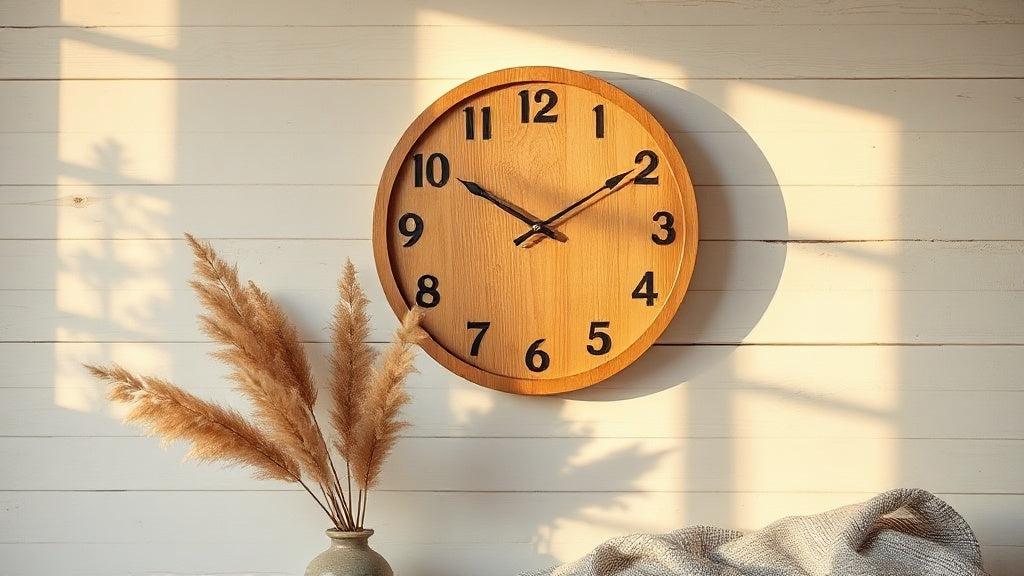
The three clock styles that best suit modern farmhouse rooms are distressed wood with a neutral dial, wood-and-metal hybrids with Roman numerals, and clean white wood for bright airy spaces, each balancing organic texture with contemporary restraint. This is the backbone of farmhouse clock design, and for good reason. A clock face built from crackled, aged, or naturally grained wood carries an honest material quality that fits right in with reclaimed shelving, linen cushions, and jute rugs. The key word is "distressed" rather than "painted", the texture has to feel organic, not manufactured.
Sizes between 30 cm and 50 cm work for standard walls. On a large blank shiplap feature wall, you can push to 60 cm without it feeling overwhelming. The dial itself should stay neutral: cream, off-white, or the natural wood tone without additional color treatment.
One thing most people overlook with wood-dial clocks: the hands. Black matte hands on a light wood face create the crisp contrast that keeps the design feeling modern rather than purely antique. Gold or brass hands drift slightly toward vintage, which isn't wrong, it just depends whether your space leans warmer or cooler.

2. Wood and Metal Combinations with Roman Numerals
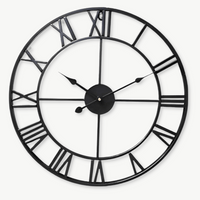
If distressed wood feels too casual for your space, the wood-and-metal hybrid is where modern farmhouse gets sophisticated. A wooden case or backing paired with a metal ring, metal hands, or metal numeral markers brings an industrial edge that grounds the softness of the natural grain.
Roman numerals do a specific job here: they read as timeless rather than nostalgic. Arabic numbers can tip toward either direction depending on font; Roman numerals stay neutral across style contexts. On a 40 cm clock, they're bold enough to read from across a room. On anything larger, they become genuinely architectural.
The color pairing that keeps appearing in well-designed farmhouse interiors: warm walnut wood with matte black metal. It avoids the overly rustic brown-on-brown issue and gives the clock a sharper, more contemporary silhouette.

3. Clean White Wood for Bright, Airy Farmhouse Rooms
Not all modern farmhouse interiors go dark and moody. A lot of them lean into light: white walls, bleached oak floors, pale linen, ceramic vessels in cream and chalk. In that kind of space, a white or off-white wood clock disappears in the best way possible, it blends into the palette while still providing that material warmth that makes the room feel collected rather than stark.
The 30 cm size is surprisingly versatile here. It's large enough to read as intentional decor, small enough to layer with other wall elements (a simple macramé piece, a floating shelf) without competing. This is the clock style customers often describe as "exactly what I was looking for", because it solves the problem of wanting a clock that doesn't announce itself.

💡 Did you know?
The modern farmhouse aesthetic owes much of its visual language to the Shaker movement, an 18th-century American religious community who believed that functional objects should be made with the same care as anything else. Their philosophy: "Do not make something unless it is both necessary and useful; but if it is both necessary and useful, do not hesitate to make it beautiful." That's basically the brief for every farmhouse clock today.
Where to Place a Farmhouse Clock (and Where Not To)
The strongest farmhouse clock placements are solid unbroken walls where the piece can breathe: a living room anchor wall, above kitchen cabinetry for readability, or beside the bed in a bedroom with a mandatory silent sweep movement. Placement is where most farmhouse clock decisions go sideways. The clock style can be perfect but hang in the wrong spot and it reads as an afterthought. Here's what actually works, room by room.
Living Room: The Anchor Wall
In a modern farmhouse living room, the clock tends to work best as the sole statement on a large blank wall rather than grouped with other pieces. This is especially true on shiplap. The horizontal lines of shiplap create a strong visual texture, adding too many objects fragments it. One large clock, centered at eye level (roughly 57-60 inches from floor to center), gives the wall a clear focal point.
Over a fireplace mantel is a classic position, but be precise about scale. The clock's diameter should be between one-third and one-half the width of the mantel. Smaller looks lost; larger looks top-heavy.
Browse the full living room wall clock collection to compare scale options side by side before committing to a size.
Kitchen: Functional First, But Still Thoughtful
The farmhouse kitchen clock has a different job than its living room counterpart. It needs to be readable from across the room while someone's cooking, which means high contrast between hands and face is critical. A dark-faced clock with white or cream numerals, or a light wood face with black hands, both solve the readability problem without sacrificing the aesthetic.
Position it high on the wall, above cabinet level if possible, so it stays visible even when the kitchen is busy. A 30-40 cm clock works in most kitchens; anything smaller gets lost above cabinetry.
The kitchen clock collection focuses specifically on clocks that handle both style and legibility, worth a look if your kitchen is the main space you're decorating.
Bedroom: The Quiet Requirement
This is non-negotiable: a farmhouse bedroom clock must have a silent movement. The rhythmic tick of a standard quartz clock is the number-one complaint in clock reviews, and in a quiet bedroom it becomes genuinely disruptive. Silent sweep mechanisms run without any audible sound, the seconds hand glides rather than clicks.
Scale down in the bedroom. A 25-35 cm clock on a wall beside the bed or above a dresser is plenty. The bedroom is about calm, not statement-making, so opt for softer finishes: white wood, pale oak, muted tones.
If you're specifically shopping for bedroom clocks, filtering by silent movement first will save you from returning a beautiful piece that keeps you awake.
Size Guide: Getting the Scale Right for Farmhouse Walls
For most farmhouse rooms, a clock between 30 and 60 cm delivers the right visual weight: under 30 cm for small intimate spaces, 45-60 cm for open-plan living areas and feature walls, with a paper template test being the most reliable way to confirm scale before ordering. Scale is the variable most people underestimate when shopping online. A clock that looks substantial in a product photo can arrive and feel surprisingly modest in a real room. Here's a practical breakdown.
| Clock Diameter | Best Placement | Wall Size It Suits |
|---|---|---|
| Under 30 cm (12 in) | Bedside wall, small kitchen nook, bathroom | Walls under 2 m wide |
| 30-45 cm (12-18 in) | Kitchen, bedroom, hallway | Standard residential walls |
| 45-60 cm (18-24 in) | Living room feature wall, above sofa or fireplace | Open-plan spaces, tall ceilings |
| Over 60 cm (24 in+) | Large living rooms, entryways, barn-style spaces | Double-height walls, very wide feature walls |
One practical test before ordering: cut a circle from brown paper or newspaper to the exact diameter you're considering, tape it to the wall, and live with it for a day. This sounds low-tech, but it's genuinely the most reliable way to judge whether a size feels right in your specific room before you commit.

Materials and Finishes: What Reads as Farmhouse vs. What Reads as Rustic
Farmhouse finishes differ from purely rustic ones in degree of refinement: oak and walnut with matte surfaces and aged metal accents read as modern farmhouse, while heavily knotted pine with rough-hewn frames and visible oxidation tips into rustic territory. The line between farmhouse and purely rustic is thinner than most people realize, and the finish is usually where the distinction lives. Rustic leans heavily into imperfection: rough-hewn surfaces, heavy staining, knotty wood with obvious grain, iron hardware with visible oxidation. Farmhouse takes those same materials and refines them slightly, the texture is still there, but it's been edited.
For a modern farmhouse wall clock with wooden construction, here's what to look for:
- Oak and walnut read more contemporary than pine. The grain is tighter, the tone more sophisticated.
- Matte finishes always outperform gloss in farmhouse contexts. Gloss tips toward French country or vintage; matte stays modern.
- Brushed or aged metal accents (not polished chrome) bridge the industrial and rustic registers without landing too hard in either.
- Crackled or weathered wood dials carry natural aging without requiring the full distressed frame treatment, they're a more restrained way to get that lived-in quality.
The one material pairing that consistently divides people: white-painted wood frames. Some find them clean and versatile; others find them a bit "catalog." If your walls are already predominantly white, a white clock frame can feel redundant. In that case, lean into the natural grain or go with a contrasting matte black metal to give the clock its own presence.
Rustic Wall Clock Collection
If you're drawn to the weathered, warm side of farmhouse style, this collection covers the full range from refined to character-heavy textures.
14 références
Découvrir la catégorie →The Silent Movement Question: Why It Matters More in Open-Plan Homes
In open-plan farmhouse homes where sound travels freely across vaulted ceilings and connected living spaces, a silent sweep quartz movement is essential: it produces no audible tick at normal listening distance, unlike standard quartz which clicks once per second. Modern farmhouse design loves open-plan living. Kitchens that open into dining areas, living spaces without doors, vaulted ceilings that let sound travel freely. In these layouts, a ticking clock isn't a minor background detail, it fills the room.
Silent sweep quartz movement uses a continuous gliding mechanism instead of the step-by-step click of a standard quartz. The difference in sound is total. Where a standard movement produces a consistent tick roughly once per second, a silent sweep produces nothing audible at a normal listening distance.
If you're browsing the broader silent wall clock range, look for clocks explicitly labeled with "silent quartz" or "sweep movement" rather than simply "quiet", those marketing terms don't always mean the mechanism is fully silent, just slightly muffled.
"The right clock doesn't just tell you the time. It tells you something about the room it's in."
Observed in reviews by customers who replaced standard clocks with silent-movement farmhouse pieces.
What Style Is Moving Beyond Classic Farmhouse (and What That Means for Your Clock)
As modern farmhouse evolves toward "organic modern" with richer earth tones and fewer stark white surfaces, the safest clock investment is warm natural wood tones like walnut or amber oak paired with aged bronze, which sit comfortably in both current and emerging residential aesthetics. Modern farmhouse has been the dominant residential aesthetic for about a decade, and its visual language has become so familiar that some designers are starting to evolve away from it. The direction isn't a clean break, it's a gradual shift toward what people are calling "organic modern" or "new naturalism": richer earth tones (terracotta, deep sage, warm ochre), more tactile materials, and fewer stark white surfaces.
What does this mean practically for clock shopping? If you're decorating a space now and want longevity, choose a clock with warm natural wood tones rather than stark white or gray finishes. Walnut, amber-toned oak, and aged bronze all sit comfortably in both current farmhouse interiors and wherever residential design moves next. White-painted wood and cool gray finishes are more trend-specific.
The clocks that tend to outlast style cycles share a few traits: natural materials, simple geometry (round or oval), minimal ornamentation, and neutral color values. A handcrafted walnut clock purchased today will still read as intentional and well-chosen in ten years. A clock that leans heavily on trend-specific styling, heavily distressed gray, barnwood with very rough edges, may feel more dated sooner.
Explore the wooden wall clock collection for pieces that carry natural material quality across multiple style contexts.

Common Mistakes That Make Farmhouse Clocks Look Off
The most common farmhouse clock mistakes are going too small on a large wall, matching the frame too closely to existing wood tones, hanging too high, choosing ornate frames that fight the room's architecture, and ignoring how the backing wall color affects the clock's visibility. A few patterns come up consistently when people describe clocks that didn't work out the way they hoped.
- Going too small on a large wall. A 25 cm clock on a 3-meter shiplap wall looks like a lost button. The rule of thumb: the clock's diameter should be at least one-sixth the width of the wall it's on.
- Matching the clock frame too closely to existing wood tones. If your floating shelf, coffee table, and clock all share the same medium oak finish, the clock disappears. A slight contrast in tone or material keeps it readable as a distinct piece.
- Hanging the clock too high. This is the most common installation mistake. Clocks hung at picture-frame height (eye level) read as purposeful decor. Clocks hung near the ceiling read as an afterthought that ran out of wall space.
- Choosing a frame style that fights the room's architecture. Heavy ornamental frames compete with detailed moldings and built-ins. In rooms with strong architectural character, simpler clock profiles win.
- Ignoring the backing wall color. A warm cream wood clock on a warm white wall disappears. The same clock on a sage green or slate blue accent wall becomes a proper focal point.
Frequently Asked Questions
What decor style is replacing farmhouse in modern interiors?+
The shift is happening gradually rather than all at once. "Organic modern" is the term most designers are using: it keeps the natural material warmth of farmhouse but moves away from shiplap, mason jar aesthetics, and stark white palettes toward richer earth tones (terracotta, warm ochre, deep sage), curved forms, and more tactile surfaces like boucle, rattan, and unglazed ceramics. The good news for clock choices: natural wood and aged metal finishes translate seamlessly into this direction, so a well-chosen farmhouse clock won't look out of place as your space evolves.
Where should you not put a wall clock in a farmhouse interior?+
Three spots that consistently produce disappointing results: directly above a television (competing visual focal points), in very narrow hallways where scale becomes impossible to get right, and on walls that already carry significant architectural detail (intricate moldings, exposed brick, heavy built-ins). Clocks also tend to look lost on walls shared with large windows, since the natural light draws the eye away from the clock rather than toward it. The strongest placements are solid, unbroken wall surfaces where the clock has room to breathe.
What are the best clock choices for a modern farmhouse bedroom?+
Silent sweep movement is the non-negotiable starting point, a bedroom clock that ticks will affect sleep quality regardless of how beautiful it looks. Beyond that, 30-40 cm is the sweet spot for most bedrooms: substantial enough to read intentionally but not so dominant that it disrupts the room's calm. White wood, pale oak, or soft cream finishes work well in bedrooms that lean lighter; walnut or dark-framed clocks suit moodier, richer bedroom palettes. Avoid highly reflective finishes that might catch light from windows or lamps during the night.
How do you decorate a modern farmhouse interior without it looking dated?+
The trick is choosing pieces that carry genuine material quality rather than surface-level farmhouse signifiers. A clock made from actual walnut or oak will always read differently from one made from printed MDF with a wood effect. The same applies to textiles, ceramics, and hardware. Restraint helps too: one well-chosen farmhouse clock on a large wall reads as intentional design; four farmhouse-themed accessories in the same corner read as a themed room. Natural materials, simple forms, and one or two real statement pieces tend to age far better than spaces built entirely around aesthetic trends.
Is a large wall clock better for farmhouse style, or does size depend on the room?+
Size always depends on the specific wall and room, not the style. Modern farmhouse interiors often feature large open walls, shiplap, board-and-batten, wide plaster surfaces, that genuinely suit larger clocks (45-60 cm). But the same style in a small city apartment with standard 2.5-meter ceilings calls for something considerably more modest. The paper template trick is genuinely useful: cut the diameter from craft paper, tape it to the wall, and assess it over a day before ordering. Proportion between the clock and the wall matters far more than any style rule about "farmhouse clocks should be big."