
Kids change everything about how you choose things for your home. The sofa needs to survive juice spills. The rug has to hide crumbs. And that beautiful wall clock you've been eyeing? It suddenly needs to clear a whole new checklist before it earns a spot on your wall. Finding the best wall clock for a home with children isn't just about picking something that tells the time, it's about finding a piece that holds up to real family life while still looking like you actually care about your interior.
Here's what nobody tells you upfront: the kids' clock section and the grown-up clock section don't have to be mutually exclusive. A clock that works beautifully in a family home looks great, reads clearly, ticks quietly (or not at all), and doesn't shatter the moment a foam ball grazes the wall. That sweet spot exists. This guide will show you exactly where to find it.
⭐ À retenir
- Silent quartz movement is the single most important feature for family homes, especially near bedrooms and nurseries.
- Analog clocks with clear, high-contrast numerals actively help children aged 5-8 learn to read time.
- Material matters: wood and metal outlast plastic in the long run, and they look far better doing it.
- Placement height (above the 6-foot mark) eliminates reach risk without sacrificing readability.
- A clock doesn't need a "kids' design" to be kid-friendly - it just needs the right specs.
Why "Kid-Friendly" Doesn't Mean What Most People Think
Walk into any big-box store and the "kids' clock" section is full of cartoons, bright plastics, and chunky numerals. Nothing wrong with that for a child's bedroom. But the family living room, the kitchen, the hallway? Those spaces don't need a clock that looks like it belongs in a preschool classroom. They need a clock that functions well in a household with children.
The real criteria are simpler than you'd expect. A family-friendly clock is one that won't shatter if it vibrates off a wall from slamming doors. It reads clearly at a glance, from across the room, for eyes of all ages. It doesn't tick loudly enough to disrupt nap time or concentrate-sensitive homework hours. And it attaches to the wall securely, with hardware that doesn't give way over time.
Wooden clocks, for instance, tend to be far more forgiving than glass-faced designs in high-traffic areas. A crack in glass is a safety hazard. A scuff on wood is barely noticeable, and in some rustic or Scandinavian styles, it actually adds character. That's the kind of quiet resilience that makes a best wall clock for a home with children genuinely worth the investment.

The Noise Question: Why Silent Clocks Are Non-Negotiable in Family Spaces
Ask any parent what they didn't anticipate about decorating with a clock, and the ticking comes up almost every time. It's one of those things that sounds perfectly fine in a quiet showroom but becomes surprisingly intrusive in a child's bedroom at 10 PM, or in the living room during a baby's afternoon nap.
Silent quartz movement, sometimes called sweep movement, means the second hand glides continuously rather than clicking forward in one-second intervals. The result is near-total silence. No tick, no tock, no unconscious tension while you're trying to get a toddler to sleep.
This isn't a premium feature anymore. Many beautifully designed wall clocks now come standard with silent movement, from minimalist Scandinavian-style pieces to ornate vintage designs. The key is checking the product description specifically for "silent quartz" or "sweep movement" before purchasing. If the listing doesn't use either phrase, assume it ticks.
🕰 Elena's tip
When clients ask me about clocks for rooms where their kids sleep or study, I always steer them toward silent quartz first, style second. Here's the thing though: once you start looking, you'll find silent movement in some genuinely stunning designs, from raw-edged walnut rounds to slim industrial iron faces. It stopped being a compromise years ago. Start with the silence requirement and let the aesthetics fall into place from there.
Readability That Grows with Your Kids: What to Look For on the Dial
Children between ages 4 and 8 are actively learning to read analog time. That process is genuinely faster and more intuitive when the clock face supports it. High contrast between the dial background and the numerals matters. Arabic numerals (1, 2, 3...) are easier for young children to recognize than Roman numerals. Minute markers, even simple lines, give kids a visual scaffold for counting minutes.
A 12-inch (30 cm) diameter is generally the minimum for clear readability from across a kitchen or living room. Go larger in open-plan spaces: a 40 cm clock reads comfortably at 4-5 meters. The hands need genuine contrast with the dial face, which is why a white dial with dark hands outperforms a dark dial with dark hands every single time for legibility.
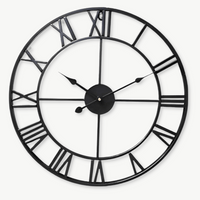
For older kids, 9 and up, Roman numerals become a learning opportunity rather than a barrier. Some parents specifically choose a clock with Roman numerals in the kitchen or living room as a way to introduce classical notation casually, without it feeling like homework. It's one of those small design choices that earns its keep long after the kids have grown up.
💡 Did you know?
Research in early childhood education consistently shows that analog clocks help children develop a more intuitive understanding of time as a continuous flow, rather than the segmented, digit-by-digit reading that digital clocks encourage. Several European school systems actually mandate analog clocks in classrooms specifically for this reason.

Room by Room: Placing Clocks Thoughtfully in a Family Home
The Kitchen
The kitchen is where time pressure actually lives in a family home. School run at 8:15. Dinner at 6:30. The clock here needs to be readable from the stove and the table simultaneously. A 30-40 cm clock at eye level when standing works well. Avoid highly decorative frames with open cutouts near cooking areas, where grease and steam can accumulate. A clean wooden frame in a light oak or beech finish, or a sealed matte-black metal case, cleans more easily and handles the occasional steam cloud without warping.
The Living Room
This is the room where you have the most design freedom, and where a clock genuinely becomes part of your interior story. Larger formats, 50-60 cm, read beautifully on feature walls without feeling overwhelming. Wooden or mixed-material designs hold up well here because they're away from direct physical contact. Mount above the 150 cm height mark to keep it out of reach of the most ambitious small climbers. A minimalist round wood clock or an industrial iron-rimmed piece both work well in this context, depending on your overall palette.
Children's Bedrooms
This is where silence becomes absolutely critical. A silent wall clock in a child's bedroom eliminates the "I can hear the clock" bedtime excuse (yes, it's a real one). Keep the dial simple and high-contrast. A 25-30 cm clock is plenty for a bedroom. Position it where it's visible from the bed and the desk, typically on the wall facing the window so natural light illuminates the face during the day.
The Hallway
Hallways are transition spaces where a quick glance at the time determines whether everyone gets to school on time. A clock here doubles as decor in a space that often gets neglected. Because hallways typically have less wall space, a 30 cm clock in a slim profile works better than a statement piece. This is also where a wooden wall clock shines: the warm tones make a narrow hallway feel more welcoming without crowding it visually.

Materials That Hold Up: Wood vs. Metal vs. Plastic in a Family Home
| Material | Durability in Family Spaces | Aesthetic Range | Safety if Dropped |
|---|---|---|---|
| Solid Wood | Excellent: resists vibration, ages gracefully | Rustic, Scandinavian, minimalist, boho | Dents or scratches, no shatter risk |
| Metal (Iron/Aluminum) | Very good: heavy enough to stay put, strong mounting | Industrial, vintage, contemporary | Can bend; no shatter, but edges may be sharp |
| Glass-faced | Moderate: beautiful but vulnerable to impact | European, art deco, designer | Shatters: not ideal for low placement near kids |
| Plastic / ABS | Good resistance but may feel flimsy over time | Colorful, children's designs, novelty | Won't shatter, but can crack and yellow with age |
| Acrylic | Good: shatter-resistant alternative to glass | Modern, Japanese, minimalist | Cracks rather than shatters; safer than glass |
The takeaway from this comparison: solid wood and sealed metal are the most practical choices for family living spaces. They're durable, they look better over time rather than worse, and neither presents the shattering hazard that glass-faced clocks carry when placed in rooms where balls, toys, and general chaos occasionally reach the walls. If you're still weighing your options, a Scandinavian-style solid oak or beech clock is usually the safest bet for blending durability with everyday good looks.

The Case for Letting Kids Actually Use the Clock
There's a school of thought that says keep nice things away from children until they're old enough to respect them. Here's a different take: a clock in a shared family space that kids can see and read every single day becomes a genuine learning tool. The child who checks the kitchen clock before school, who learns to calculate "15 more minutes until dinner," is developing a relationship with time that serves them for decades.
This is one reason why placing a clearly readable analog clock in the kitchen or living room, rather than tucking a digital clock in a corner, actually matters for development. It's passive learning. Nobody has to "teach" anything. The clock just has to be there, readable, and consistent.
The cuckoo clock tradition in Central European homes is a good example of this. Generations of children grew up not just reading time from those clocks, but anticipating the hour, counting the cuckoos, understanding the relationship between the mechanism and the numbers on the dial. It made time tangible in a way a blinking LED display never does. A well-chosen analog clock does the same thing, quietly, every single day.
"A clock on the wall teaches without saying a word." Common reflection among Montessori educators on the value of analog timekeeping in the home environment

Mounting Height and Safety: The Detail Most Guides Skip
Mounting height is one of those practical details that rarely comes up in decor conversations but makes a real difference in family homes. The standard advice is to hang a wall clock at eye level, roughly 150-165 cm from the floor to the center of the clock. That's good guidance for adults in a room without children.
In a family home, especially with toddlers and young children who climb, the safer approach is to mount clocks at 170-180 cm minimum. The clock remains perfectly readable from across the room, adults can still check it at a comfortable angle, and it's simply out of reach for anyone under about 4 feet tall.
For the hardware itself: always use the anchor and screw weight rating that exceeds your clock's actual weight by at least 50%. A 1.5 kg wooden clock should be hung with hardware rated for 2.5 kg or more. Slamming doors, vibrations from nearby play, and the general dynamics of a family home put more stress on wall fixings than a quiet adult home does.

When the Bedroom Clock Doubles as a Learning Tool
The child's bedroom clock gets a category of its own, because the criteria shift slightly. Here you're not decorating for visitors. You're creating an environment that supports a child's independence and routine. A clock they can read when they wake up means they don't come padding down the hallway at 5:30 AM asking if it's morning yet. That alone might be the best argument for a good bedroom clock you'll ever hear.
For children under 6, a clock with color-coded sections (a green zone for "wake up" time, for instance) works better than pure analog. These are typically standalone products in the kids' clock category. For children 6 and older, a clean analog clock with Arabic numerals and a second hand is enough, and switching to a "grown-up" clock at this age often gives kids a small sense of pride.
The bedroom clock should be positioned where it's visible from the bed without needing to sit up fully. This means roughly opposite the head of the bed, or on the side wall at the foot-end. A 25-30 cm clock is right for most standard bedrooms. Anything larger in a small room starts to feel like the clock is watching you.
Wooden Clocks as a Long-Term Investment for Family Homes
Solid wood ages in ways that plastic and cheap MDF simply don't. A well-made wooden wall clock purchased today can still look right in your home when your kids are teenagers, and then when they have their own homes. The grain doesn't fade the way printed surfaces do. The finish can be maintained. The mechanism can be serviced or replaced without replacing the whole clock.
This matters more than it sounds in a family home context, because you're not buying decor just for right now. You're choosing things that will share space with your kids through their whole childhood. A clock with some actual material quality to it becomes part of the home's story in a way that a $15 plastic piece never will. That's the case for the best wall clock for a home with children being a genuine, materials-first decision rather than an afterthought.
Walnut and bamboo are particularly resilient choices. Walnut develops a richer patina over years of natural light exposure. Bamboo, one of the most sustainable hardwoods available, is harder than most softwoods and resists humidity well, which makes it practical in kitchens and bathrooms where moisture levels fluctuate. Both pair naturally with the kind of warm-neutral palette that's popular in Scandinavian and minimalist interiors right now.
A Practical Buying Checklist Before You Commit
Rather than a vague "here's what to consider," here's exactly what to verify before buying any wall clock for a family home:
- Movement type: Does the listing explicitly say "silent quartz" or "sweep movement"? If it doesn't say silent, it probably isn't.
- Dial readability: High contrast between dial background and numerals. Arabic numerals for any clock going in a child's bedroom or common learning space.
- Frame material: Wood or metal for shared spaces. Save glass-faced designs for rooms that children don't regularly use.
- Diameter: 30 cm minimum for kitchens and living rooms. 25-30 cm for bedrooms. Scale up to 50-60 cm for large open-plan walls.
- Mounting hardware: Check what's included and verify the weight rating. Buy extra anchors if needed.
- Battery type: AA batteries are far easier to replace on a ladder at 2 m height than specialty batteries. Check before buying.
- Return policy: Colors and sizes often read differently in person than online. A good return window protects you.
Frequently Asked Questions
Should kids have a clock in their room?+
Yes, and it's one of the more underrated things you can do for a child's sense of independence. A clock in a child's room helps them build an internal sense of time structure: knowing when it's okay to get up, when school starts, how long until dinner. For children learning to tell time (typically ages 5-8), an analog clock with clear Arabic numerals in their bedroom provides daily passive practice without any deliberate teaching effort. The one non-negotiable: it must have silent movement. A ticking clock in a child's bedroom is a genuine sleep disruptor.
What are the best wall clocks for children?+
The best clocks for households with children combine a few specific features: silent quartz movement (no ticking), a high-contrast dial that's easy to read from across the room, a durable wooden or metal frame that won't shatter if knocked, and a size appropriate to the room (25-30 cm for bedrooms, 30-40 cm for kitchens and living rooms). Cartoon designs are fine for a young child's private bedroom, but shared family spaces work better with proper analog clocks that pull their weight as both a functional timepiece and an actual decor piece.
What clock features actually help kids learn to read time?+
The most effective clocks for time-learning have Arabic numerals (1-12) rather than Roman, clear minute markers or a divided outer ring, and a second hand that makes the movement of time visible. High contrast between the dial and the hands helps enormously: a white dial with black hands is the most readable combination. Color-coded hour zones (green for morning wake-up time, for example) work well for children under 6 who aren't yet reading numbers reliably. For children 6 and older, a clean standard analog clock is both sufficient and preferable.
Is silent movement really worth the extra cost?+
Absolutely, especially in a family home. Silent quartz (sweep) movement clocks produce no audible ticking at all. The price difference between a ticking clock and a silent one has narrowed significantly over the past decade: many beautifully designed clocks now include sweep movement as standard, at no meaningful premium. In a child's bedroom or a nursery, silent movement isn't optional. In a living room or kitchen, it's simply a better experience for everyone. The question isn't really whether it's worth it; it's whether you want to notice the ticking every quiet moment you're in the room.
Is a ticking clock bad for children's sleep?+
It can be. The audible tick of a standard quartz movement is around 30-40 decibels in a quiet room, which is noticeable in silence, particularly for lighter sleepers. Children's bedrooms are typically quiet at night, which makes any repetitive sound more intrusive than it would seem during the day. Silent quartz (sweep) movement clocks produce no audible ticking at all. They're the straightforward solution, and they're widely available across all styles and price points. If you're buying a clock for a child's bedroom or a nursery, make silent movement a firm requirement rather than a nice-to-have.
At what height should a wall clock be hung in a family home?+
Standard decor advice places the center of the clock at around 150-165 cm from the floor, roughly eye level for adults. In a family home with young children, bumping that up to 170-180 cm is a practical adjustment that puts the clock out of reach of small hands while remaining fully readable from across the room. The clock doesn't need to be at perfect eye level to be legible; most people read wall clocks at a slight upward angle anyway. The priority is stable mounting at a height that keeps it safe from contact while remaining clearly visible to all ages in the household.
What size clock is best for a child's bedroom?+
For most standard children's bedrooms, a 25-30 cm (10-12 inch) diameter clock hits the sweet spot. It's large enough to read clearly from the bed without dominating the wall. Go smaller than 25 cm and the numerals become difficult to read at a distance; go larger than 35 cm in a small room and it starts to feel imposing. If the bedroom is part of an open-plan studio or a particularly large space, a 35-40 cm clock may be more appropriate. The most important factor, though, isn't size: it's contrast. A 25 cm clock with a high-contrast white dial and bold black hands will outperform a 35 cm clock with a pale grey-on-grey design every single time.