
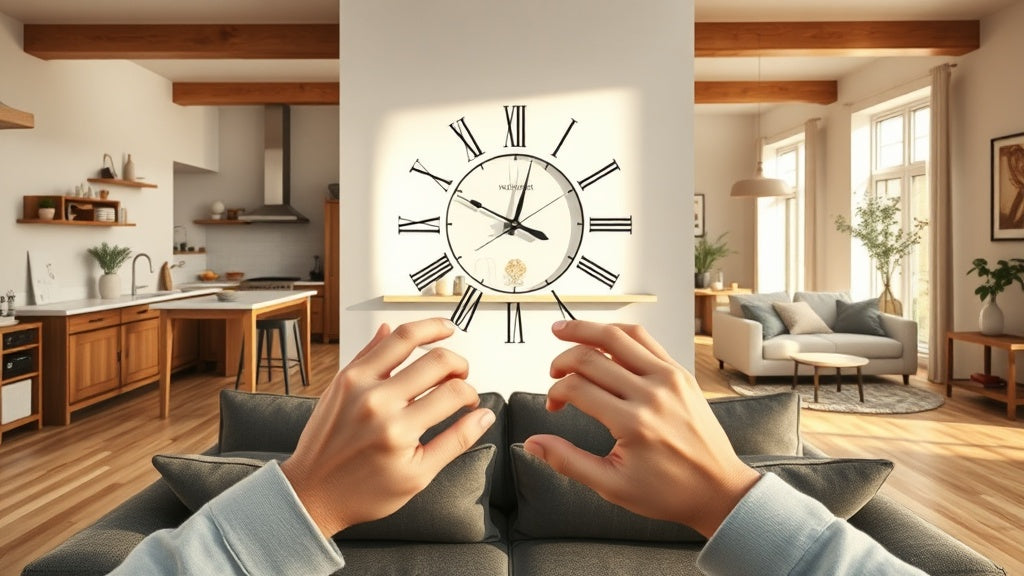
Open-concept homes are beautiful. They're airy, social, and full of light. But they present a real decorating puzzle that most people don't think about until they're standing in the middle of their living-kitchen-dining space, holding a clock, wondering where on earth to put it. The best wall clock for an open concept home isn't just about looks. It has to read clearly from 20 feet away, hold its visual weight across a broad sightline, and feel at home in a space that serves three or four functions at once.
That's a tall order. A clock that looks perfect in a cozy, single-purpose room can completely disappear in an open floor plan. Or worse, it can feel out of place when the living zone bleeds visually into the kitchen. Here's what actually works, and why.
⭐ À retenir
- In open-concept spaces, size matters more than in any other room: go 18 to 24 inches minimum for a wall clock.
- Silent quartz movement is non-negotiable when a clock is near both the sofa and the dining table.
- The clock's style should bridge your zones, not belong exclusively to one of them.
- Placement height and wall color dramatically affect legibility from distance.
- One strong clock beats a gallery of small ones in wide-open spaces.
Why Open-Plan Spaces Break the Normal Rules of Clock Shopping
Most clock-buying advice assumes a single room with four defined walls and a fixed viewing distance. An open-concept home throws all of that out. You might be reading the time from your kitchen island, your sofa, your home office nook, and your dining chair, all from different distances and angles. The clock has to perform for all of them.
There's also the matter of visual weight. In a smaller room, a 12-inch clock on the wall feels substantial. In a large open plan with 18-foot ceilings and a 40-foot sightline, that same clock becomes a small disc that nobody notices. The space demands something bolder.
Then there's the style challenge. Open-concept living means your clock is visible from the cooking zone, the lounging zone, and the dining zone simultaneously. A heavily themed piece, say a farmhouse shiplap clock, might clash with the clean-lined kitchen cabinets it's visible next to. You need a design that reads well across styles, or one that actively ties the zones together. This is why choosing the best wall clock for an open concept home really is a different brief from shopping for any other room in the house.

The Size Question: What Actually Reads Well from 15 to 25 Feet
Here's the honest answer: for most open-concept main floors, you want a clock with a diameter between 18 and 24 inches (45 to 60 cm). That's the range where the numerals and hands remain legible at a full room's distance without the clock becoming a mural.
For very large open plans, loft-style apartments, or rooms with double-height ceilings, going up to 30 inches (75 cm) is entirely reasonable. A clock at that scale becomes a proper focal point, the kind of piece that anchors the wall the way a painting would.
What doesn't work? Anything under 14 inches. Those clocks are made for hallways, home offices, and bedrooms where you're typically within 8 feet. In an open plan, they get lost. Customers consistently report the same thing: "It looked great in photos but disappeared on my wall." The space ate it.
| Room Size | Max Viewing Distance | Recommended Clock Size |
|---|---|---|
| Compact open plan (under 400 sq ft) | 10 to 15 feet | 16 to 18 inches |
| Standard open plan (400 to 700 sq ft) | 15 to 22 feet | 18 to 24 inches |
| Large open plan / loft (700+ sq ft) | 22 to 30+ feet | 24 to 36 inches |
One practical trick: before buying, cut a circle of newspaper or kraft paper to the exact diameter you're considering and tape it to the wall. Step back to your kitchen island or sofa. If it looks like the right visual weight from every vantage point you use daily, you've got your size.
Placement Strategy: Where to Hang a Clock in an Open Concept Space
This is where most people go wrong. They pick a good clock and hang it in the wrong spot, then wonder why the room still feels off.
In an open-concept home, the best wall for a clock is almost always a transitional wall: one that faces multiple zones at once. Think the wall at the end of a kitchen that faces both the dining area and the living room. Or the wall behind a kitchen island that's visible from the sofa. These transitional walls let the clock do double duty, keeping time for cooking and lounging simultaneously.
Avoid putting the clock deep inside one zone where it's only visible from that zone. A clock tucked into a corner of the living room, only readable from the sofa, misses the point entirely in an open plan.
Height matters too. The standard "eye level" advice breaks down in open-concept spaces because eye level for a seated dining guest is different from eye level for someone standing at the kitchen counter. A good rule: center the clock at around 60 to 66 inches from the floor. That splits the difference between seated and standing viewing heights and keeps the clock readable without craning your neck.
The Style Problem: Choosing a Design That Works Across Multiple Zones
A clock in an open-concept home is always visible from the kitchen and the living space at the same time. That means it has to feel at home in both contexts, which is a harder brief than it sounds.
Here's what tends to work well across zones:
- Natural wood with clean lines: Wood is warm enough for a living room and unpretentious enough for a kitchen. Scandinavian-style wooden clocks with minimal numerals hit this balance almost perfectly. They don't belong aggressively to any one aesthetic.
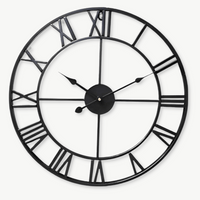
- Metal with an open frame design: Industrial-style clocks with visible gear work or skeleton frames read as both functional and decorative. They're at home in a modern kitchen and a styled living room simultaneously.
- Neutral dial colors: White, cream, walnut, or matte black dials integrate more easily across zones than bold colors. A bright red clock might look great in isolation but feel jarring when you see it from the kitchen while the living room has warm neutrals.
- Roman numerals or large Arabic numerals: Both read better at distance than minimalist marker-only designs. If legibility across 20 feet is a priority (and it should be), make sure the time is actually readable at that range.
What doesn't work as well in open plans: ultra-themed clocks (heavy rustic wood with barn elements, hyper-nautical designs) that belong strongly to one aesthetic. They can look incredible in a single-purpose room and completely out of place when seen next to a modern kitchen backsplash.


Silent Movement: Not Optional When Your Clock Is Near a Dining Table and a Sofa
In a single-purpose room, a softly ticking clock can feel charming, almost nostalgic. In an open-concept space, that same tick echoes. You hear it from the sofa during quiet evenings. You hear it during dinner. You hear it when you're working at the kitchen island. What felt quaint in a study becomes irritating in a space you spend 80% of your home time in.
Silent quartz movement, sometimes called "sweep movement," uses a continuous rotor mechanism rather than the step-by-step ticking of a standard quartz. The hands move in a smooth, continuous sweep with no audible click. For open-plan living, this isn't a luxury feature. It's the baseline.
If you're already sensitive to ambient sound, or if you work from home near your living space, it's worth specifically filtering for sweep movement when shopping. The difference in day-to-day comfort is real, and many customers describe it as one of the things they wish they'd paid attention to the first time around.
The good news is that silent movement is now standard across a wide range of price points and styles, from minimalist Scandinavian oak discs to large-scale industrial skeleton frames. You really don't have to sacrifice design to get the quiet you need. Looking for a specific starting point? The best wall clock for an open concept home in most households turns out to be a 20-inch-plus silent sweep model placed on the transitional wall. It's almost always the combination that customers come back to report actually worked.
Silent Wall Clock
Every clock here uses sweep or silent quartz movement, making them ideal for open-plan spaces where sound travels freely across zones.
179 références
Découvrir la catégorie →
Materials That Hold Up in High-Traffic Open Spaces
Open-concept spaces see more steam, cooking odors, and humidity fluctuation than enclosed rooms. The kitchen connection means your clock may be exposed to grease vapor over time, especially if it hangs on the kitchen-facing wall. Material choice matters more than it would in a bedroom or hallway.
Here's a practical breakdown:
- Solid wood or bamboo: Beautiful and warm, but keep them away from direct steam exposure (directly above the stovetop, for example). On a living room-adjacent wall, they're excellent choices that age gracefully. A lacquered light oak frame in a Scandinavian-minimalist style is particularly forgiving in mixed-use spaces.
- Metal frames with powder coating: Durable, easy to wipe down, and available in styles from industrial to minimalist. Matte black and brushed brass finishes both work in contemporary open plans.
- Glass-faced dials: Easy to clean if cooking residue settles on the face, and they reflect light in ways that add depth to a large wall. A glass or mirror face can actually amplify perceived space, useful in open plans that feel slightly cramped.
- Acrylic/resin components: Lightweight and resistant to humidity, making them practical for kitchen-adjacent placements.
Avoid unfinished or lightly finished wood pieces in kitchens or cooking-adjacent positions. They'll absorb humidity and oils over time. If you love the natural wood look, choose a clock with a sealed or lacquered finish.
💡 Le savais-tu ?
The open-plan kitchen-living design became popular in North America and Western Europe during the 1950s, partly influenced by postwar housing design and the idea that cooking shouldn't isolate the home's caretaker from family life. That social architecture is exactly why a clock placed in the shared sightline of both zones carries more meaning than one tucked into a corner: it's literally designed to be seen by everyone in the space at once.
Using a Clock as the Focal Point of an Open-Plan Wall
One of the most common mistakes in large open spaces is treating a clock as a supporting player when it has the potential to anchor the entire wall. In an open-concept home, a well-chosen clock on a transitional wall can function the way a fireplace or a large painting does: it gives the eye a place to land.
To make a clock work as a focal point, a few things have to be true:
- It needs sufficient scale. As noted above, 20 inches or larger for most open plans.
- The wall around it should be relatively clear. A clock fighting for attention against gallery walls, shelving, or floating cabinets loses every time.
- The clock's finish should either contrast or harmoniously complement the wall color. A walnut wood clock on a warm white wall creates a clean, readable contrast. The same clock against a dark terracotta wall blends too much and loses its presence.
If you want the clock to anchor the space rather than just occupy it, think of it the way a designer thinks about a hero piece: everything else on that wall should support it, not compete with it.


Matching Clock Style to Your Open Plan's Dominant Aesthetic
Most open-concept homes fall loosely into one of several aesthetic families. Here's how to match the clock to each, with real style reasoning rather than vague advice.
Modern Minimalist (clean lines, white or grey palette, handleless cabinetry)
Go for a clock with a simple round form, an uncluttered dial, and a restrained material palette. Matte white with slim hands, natural bamboo with no numerals, or a barely-there glass face all work. Avoid ornate frames, Roman numerals with serifs, or anything that reads as decorative for its own sake. The clock should feel like it was designed at the same drafting table as your furniture.
Warm Contemporary (wood tones, linen textures, natural light, earthy palette)
This is the sweet spot for walnut, oak, and natural wood clocks. A handcrafted wooden wall clock in warm-toned timber fits this aesthetic the way a well-worn leather chair does: it belongs there without trying. Roman numerals in a matching wood tone add character without shouting.
Industrial Loft (exposed concrete, steel, reclaimed wood, black metal accents)
Oversized is your friend here. A clock with an exposed metal frame, visible gear work, or a combination of dark wood and black metal reads correctly in an industrial space. The large wall clock category is worth browsing if this is your aesthetic; the scale options there are purpose-built for tall ceilings and wide walls.
Scandinavian (white walls, light oak, functional simplicity, soft textiles)
Scandinavian design principles, rooted in the Nordic tradition of *hygge* and purposeful simplicity, apply directly to clock selection: nothing superfluous, high-quality materials, quiet elegance. A light oak clock with minimal markers, clean hands, and a silent movement is the Scandinavian ideal. The form should be circular and unadorned, the hands slender and high-contrast, the material either solid light oak or lacquered birch. No decorative surround, no Roman flourish, no color accent that doesn't earn its place. Scandinavian wall clocks designed specifically in this tradition handle the brief perfectly, and in an open-concept home with white walls and linen soft furnishings, the right piece genuinely disappears into the design while remaining completely legible from the kitchen island. That's the Scandinavian clock ideal: present without demanding attention.
Eclectic / Maximalist (mix of eras, colors, textures, global influences)
Here you have the most freedom, but the clock still needs to be large enough to compete visually with the richness around it. A globe-themed design, an ornate vintage clock, or something with a strong personality can work beautifully. Just make sure it doesn't get swallowed by the surrounding visual noise; scale up and choose a clock with strong contrast against your wall color.
"The clock is the only piece of decor in your home that every guest reads, every single day. That makes it worth choosing carefully."
Interior design principle, often cited in Scandinavian home styling tradition
The One-Clock Rule vs. the Clock Cluster: What Works in Open Plans
You've probably seen the trend: a cluster of three to five small clocks grouped together, set to different time zones or just styled as a composition. In a small room or a single hallway, it's charming. In an open-concept space, clusters rarely work. Here's why.
An open plan needs visual anchors that read clearly from a distance. A cluster of small clocks looks like a single busy spot of decoration from 20 feet away. The individual pieces can't be appreciated at that range, and the grouping doesn't provide the clean focal point the space needs. You end up with visual noise, not an anchor.
One strong, properly scaled clock almost always beats a grouping in a wide-open space. Save the cluster approach for a bedroom reading nook or a home office where you're within 6 feet of the wall. In the open plan, commit to one piece that can hold the space on its own.
Lighting, Wall Color, and the Legibility Factor Most People Overlook
A clock that's perfectly legible in the store can become nearly unreadable at home if the wall color and lighting conditions aren't considered. Open-concept spaces are especially vulnerable to this because light levels shift throughout the day as the angle of natural light changes across a large floor plate.
A few things to factor in:
- Dark walls need high-contrast clocks. A dark walnut clock on a charcoal or navy wall disappears. On those walls, choose a clock with a light dial, white hands, or a metal finish that catches light.
- Recessed lighting directly above a clock can wash out the dial. If your open plan has recessed LED downlights, avoid placing the clock in a spot where a light is aimed directly at it. Oblique lighting from the side creates better shadow definition and makes the hands pop.
- Glossy vs. matte dials: In rooms with lots of natural light, a glossy glass face can create glare at certain times of day. A matte or brushed face stays consistently readable throughout the day without reflection issues.
- The sightline test at night: Walk your space at night with normal ambient lighting (not the harsh overhead fixture, your actual evening lighting). Is the clock still readable from your sofa? From the kitchen? If not, it may need a dedicated accent light nearby, or a change of position.
Most people test their clock placement during the day, when light is plentiful. The evening test is just as important in a space you use heavily during those hours.
When the Clock Also Needs to Be a Conversation Piece
An open-concept home is a social space by design. It's where you host, where family gathers, where guests see everything at once. That context gives the clock an additional role that a bedroom or office clock never has: it can be a genuine conversation starter.
A world map clock on the wall above your dining area. A clock with exposed gear mechanisms that guests ask about. A vintage-inspired piece with a street name from a city that means something to your family. These objects carry stories, and in a social space, that matters.
This is where the unique wall clock collection becomes genuinely useful. When you're looking for something that functions perfectly at scale and also says something specific about who you are as a household, a distinctive design beats a generic round clock every single time.
The best wall clock for an open concept home isn't the one that blends in. It's the one that holds the wall with confidence, reads from every seat in the room, and makes the space feel more like yours every time you glance at it.
Ready to find yours?
Not sure which size or style suits your specific floor plan? Elena personally answers questions sent through our contact page. Drop her a photo of your space and she'll point you in the right direction, no purchase required.
Ask Elena a question →Frequently Asked Questions
What size wall clock works best in an open concept home?+
For most open-concept main floors with a viewing distance of 15 to 22 feet, an 18-to-24-inch (45 to 60 cm) clock hits the right balance between visual weight and legibility. Larger loft-style spaces with ceiling heights above 10 feet can go up to 30 inches or more. Anything under 14 inches tends to get visually swallowed in a wide-open space.
Can I use a small clock in an open plan if I position it carefully?+
In short: not really, at least not as the primary clock. A clock under 14 inches simply doesn't carry enough visual weight to read clearly from 15 or more feet. You can use a smaller clock inside a dedicated zone (a home office nook, a reading corner) where you're within 6 feet of the wall, but for the shared sightline of kitchen, dining, and living together, you need the scale to match the space. Save the smaller pieces for rooms where they can shine up close.
What type of wall clock is best for a home?+
It depends on the room, but across most living spaces, an analog clock with a silent quartz sweep movement is the most practical choice: no ticking noise, readable hands, and a design that integrates naturally with interior decor. For open-concept spaces specifically, prioritize size first (large enough to read from a distance), then style, then material.
Where should I hang a wall clock in an open-plan living area?+
The best spot is a transitional wall that faces multiple zones, such as the wall at the end of the kitchen visible from the dining and living area, or the wall behind a kitchen island that reads from the sofa. Hang it with the center at 60 to 66 inches from the floor to split the difference between seated and standing eye levels. Avoid corners or walls only visible from one zone.
What is the best design wall clock for a modern open plan?+
In a modern open plan, clocks with clean geometric forms, natural materials (walnut, bamboo, light oak), or minimal metal frames tend to integrate best across kitchen and living zones. Avoid heavily themed designs that belong exclusively to one aesthetic. The goal is a clock that feels at home in the cooking zone and the lounging zone simultaneously, which usually means neutral tones, clear numerals or hands, and a design that doesn't demand to be explained.
Does clock movement noise matter in an open-concept space?+
Yes, significantly more than in a closed room. Open-concept spaces amplify ambient sound because there are fewer walls to absorb it. A standard ticking quartz clock that seems quiet in a bedroom can become noticeably audible in an open living area during quiet evenings or while working from home. Silent quartz sweep movement (where the hands rotate continuously with no click) is the right choice for any clock placed in a shared open-plan space.