
You're three rounds deep into a HIIT circuit. Sweat in your eyes, heart pounding, and you need to know exactly how much time is left. You glance at the wall. The clock face is small, the hands are thin, and from eight feet away you can barely tell if it's 4:38 or 4:58. That's not a clock for your gym. That's a decoration that wandered into the wrong room.
Picking a wall clock for a home gym easy to read sounds simple, but it's one of those decisions that catches people off guard. Most clock-buying guides focus on living rooms and bedrooms. A workout space has completely different demands: distance readability, humidity tolerance, functional timing features, and yes, it still needs to look intentional on your wall. Here's what actually works.
⭐ À retenir
- Minimum 12 inches (30 cm) in diameter for a home gym; 18+ inches reads better from across the room.
- High-contrast dials (black on white, or white on black) cut through visual fatigue faster than stylized faces.
- Humidity and vibration from heavy equipment affect clock mechanisms; choose sealed or quartz-movement models.
- Analog clocks give you instant time-elapsed awareness; digital timers are better for precise interval tracking.
- Placement height matters as much as size: eye level or just above it, never above head height.
Why Readability Is a Non-Negotiable for a Wall Clock for Home Gym Use
In a living room, you glance at a clock from a couch, usually from about six to eight feet away, at rest. In a home gym, you're reading that clock mid-squat, from the far end of a garage, with sweat obscuring your vision and your brain at partial capacity. The cognitive load is real. A clock that requires two seconds of focused attention to read is two seconds you don't have.
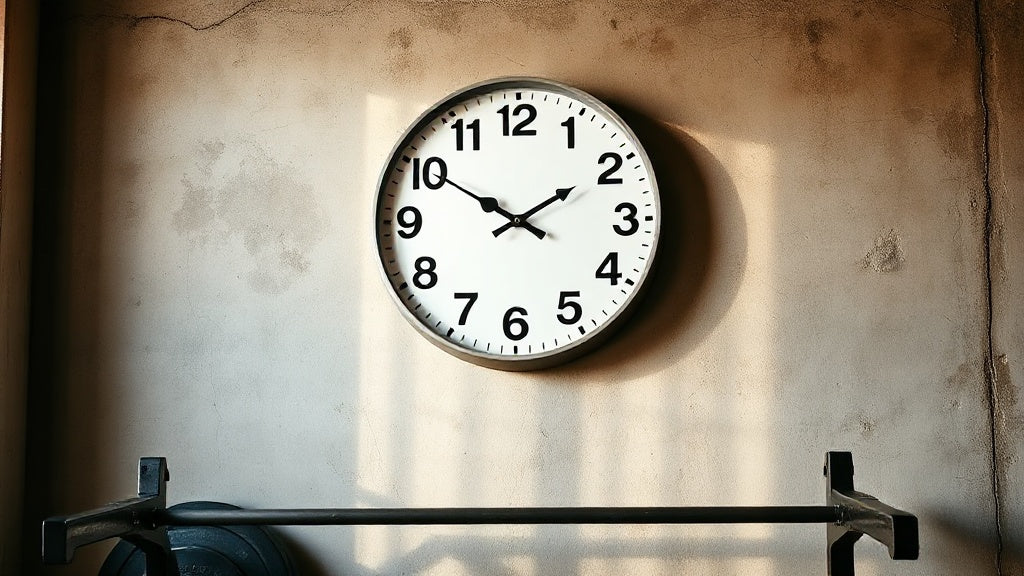
Research on visual ergonomics in industrial workplaces (a closer analog to a gym than a living room) consistently shows that high-contrast, large numerals with thick hands reduce reading time and errors under physical or cognitive stress. The same principle applies to your garage setup. Bold Arabic numerals or large sans-serif digits, a clean uncluttered dial, and hands or numbers that contrast sharply with the background are not aesthetic preferences here. They're functional requirements.

The secondary issue is distance. Most home gyms range from 10 to 20 feet in depth. At 15 feet, a standard 10-inch clock face becomes genuinely difficult to read precisely. The rule of thumb used in commercial fitness facilities is one inch of clock diameter per foot of maximum viewing distance. So a 15-foot garage gym needs a wall clock for home gym easy to read that measures at least 15 inches across. That's a starting point, not a ceiling.
Analog vs. Digital: They're Not Competing, They're Complementary
This debate comes up constantly in home gym forums, and people tend to pick a side firmly. Here's a more practical read: they do different things well, and a lot of serious home gym setups use both.
| Feature | Analog Wall Clock | Digital Gym Timer |
|---|---|---|
| Time-elapsed awareness | Excellent (sweep of the hand gives instant sense of elapsed time) | Requires reading digits consciously |
| Interval timing precision | Approximate (seconds hard to track at a glance) | Excellent (countdown/countup, HIIT modes, alerts) |
| Readability from 15+ ft | Good if 16+ inches and high-contrast | Excellent with bright LED display |
| Aesthetic in home gym decor | Much stronger - blends with decor style | Functional/industrial look only |
| Noise (tick) | Silent quartz = zero tick; sweep movement = silent | Beep alerts only |
| Best for | General time awareness, decor integration | CrossFit, HIIT, boxing, strict interval training |
The practical conclusion: if your training is mostly strength work, steady-state cardio, or yoga, a large analog clock does the job beautifully and looks intentional in the space. If you're doing structured intervals with precise rest periods, a dedicated digital timer (mounted separately or used alongside the analog clock) removes the guesswork entirely.
The Size Question: Bigger Than You Think You Need for Easy Reading
Go bigger. Almost every home gym owner who has gone through two or three clocks says the same thing: they wish they'd bought the larger size first. A 12-inch clock that looks proportional in a home goods store photo feels tiny once it's mounted in a garage with 10-foot ceilings and rubber flooring. If you want a wall clock for home gym easy to read from every corner of the room, size is where you start.
Here's a practical sizing guide based on room depth:
- Up to 10 feet: 12 inches (30 cm) minimum, high-contrast face required
- 10-15 feet: 16-18 inches (40-45 cm) is the sweet spot
- 15-20 feet: 20-24 inches (50-60 cm) or a large LED digital display
- 20+ feet (converted barn, large garage): 24+ inches or a commercial LED timer
Beyond raw diameter, think about hand thickness. A clock with thin decorative hands disappears visually against a busy dial. You want hands that are at least 6-8% of the clock's diameter in width, ideally with a contrasting color to the face. On a white dial, black hands. On a dark industrial-style face, white or brushed metal hands.

Materials That Actually Hold Up in a Gym Environment
Gyms are humid. If you're training hard, temperature swings between a cold morning and a heated workout session create condensation. Over time, this damages paper dials, warps wooden frames not treated for moisture, and corrodes exposed metal components. It's worth thinking about this before you mount something.
Here's how common clock materials perform in a home gym context:
- Powder-coated metal frames: Ideal. Resistant to moisture, won't warp, easy to wipe down. Industrial and Scandinavian styles often use this.
- Sealed hardwood (walnut, oak with finish): Good, provided the finish is intact. Unfinished or lightly oiled wood will absorb moisture over time in a heavily used space.
- Acrylic or tempered glass face covers: Better than paper dials in humid environments, since moisture can't reach the mechanism through the face. Also easier to clean after a spray-bottle wipe-down.
- Plastic housing (most digital timers): Generally fine for humidity, but check that the battery compartment seals well.
- Exposed paper or cardboard dials without glass cover: Avoid in any space that gets humid. The dial warps, the print fades, and it looks rough within a year.
💡 Le savais-tu ?
The quartz movement mechanism inside most wall clocks was originally developed for precision instrumentation in the 1960s before being miniaturized for consumer watches and clocks. A quartz oscillator vibrates exactly 32,768 times per second, making it dramatically more accurate than older mechanical movements - and it's also what makes modern silent sweep movements possible, since there's no gear-click needed to advance the second hand.
Placement That Works When You're Actually Moving
Wall position is underrated in most gym clock guides. Here's what matters in practice:
Mount it at or just above eye level. Not up near the ceiling where you'd need to crane your neck mid-deadlift. If you're 5'10" and your eyes are at about 5'6", aim for the clock center at 5'0" to 5'6" on the wall. This keeps it readable in a neutral head position during most exercises.
Position it on the wall you face most often during training. For most people that's the mirror wall. If you don't have a mirror, it's the wall you face during cardio or floor work. Avoid placing it behind you or on a side wall you'd need to turn completely to read.
Lighting matters more than most people expect. A gym lit primarily by overhead fluorescent strips can create glare on glass-covered clock faces. Matte or anti-glare glass reduces this significantly. If your gym has directional spotlights, angle them so they don't create a direct reflection on the clock face from your main workout position. Getting placement right is often the difference between a clock you check naturally every few minutes and one you forget is even there. For more ideas on how clock position transforms a room, the large wall clock collection includes placement notes for each size range.

Dial Design: What Makes a Clock Face Actually Readable Mid-Workout
Not all high-contrast dials are created equal. Here's what separates a genuinely readable gym clock from one that just looks bold on a product page:
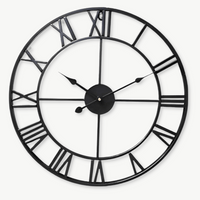
Arabic numerals outperform Roman numerals for speed reading. Roman numerals are beautiful in a living room or bedroom where you have time to appreciate them. In a gym, parsing "VIII" takes a fraction of a second longer than "8" - and that adds up when you're checking the clock thirty times a workout. If you love the aesthetic of Roman numerals, reserve them for the rest of your home and keep the gym clock clean and Arabic.
Minute markers on the outer ring are more useful than most people realize. They let you track seconds and partial minutes at a glance, without needing to count or estimate from hand position alone. Look for clock faces where the minute track is clearly printed or raised, not faint or decorative.
Index-style dials (lines instead of numbers) are the worst option for gym use. They look sleek in Scandinavian minimalist interiors and work beautifully in a calm living room or home office. But when you need to know the exact minute quickly and you're breathing hard, lines are slower to interpret than numbers. Same goes for clocks with numerals printed in very light or thin fonts, regardless of color contrast.

A Note on Silent Clocks in the Gym
Ticking clocks aren't usually a problem in a gym because the ambient noise of a workout covers the sound entirely. But if you train early in the morning in a shared home, or your gym is adjacent to a bedroom, a silent sweep movement clock eliminates that background ticking between sets when the room goes quiet.
Silent quartz movements use a continuous sweep of the second hand rather than a step-by-step advance. They're now standard in most quality wall clocks, and the mechanism itself is generally more accurate and longer-lasting than older step-movement designs. If you're choosing between two otherwise equivalent clocks, the silent version is simply the better pick for any home environment. You can explore the full range in the silent wall clock collection if that's a priority for your setup.

Styling the Clock Into Your Gym Without It Looking Like an Afterthought
A home gym doesn't have to look like a commercial facility with white walls and a clock bolted wherever it fits. If you've put care into your flooring, your equipment layout, or your lighting, the clock deserves the same attention. It's often the first thing people notice when they walk into a well-designed home gym.
For industrial-style setups with black equipment, rubber flooring, and exposed concrete or brick, a clock with a powder-coated metal frame and a clean white or off-white dial reads as intentional and cohesive. The modern wall clock range covers this aesthetic well, with several options in 40-60 cm diameters that work at distance.
For gym spaces that open onto a living area, or dedicated rooms that pull double duty as a training space and a hobby room, an analog clock with warm sealed-wood tones or a minimalist designer finish blends the two functions without either one dominating. The goal is a clock that looks like it belongs, not like it was grabbed off a grocery store shelf because you needed to know the time.
"The gym is the one room where function and form have to earn equal status. A clock that you can't read mid-rep has failed at its job. A clock that makes the room look like a storage facility has failed at the other half."
Elena Rossi, on designing workout spaces that actually motivate

The Checklist Before You Buy
Before committing, run through these five questions. They're not a checklist for its own sake; each one filters out a real failure mode that shows up repeatedly in home gym clock decisions.
- What's the maximum distance from clock to training position? If it's over 12 feet, you need at least 16 inches in diameter.
- Does the dial have high-contrast numerals (not indexes, not Roman numerals as a first choice) with thick hands? If not, readability under fatigue will disappoint you.
- Is the frame and face material suitable for a humid environment? Powder-coated metal or sealed wood with glass or acrylic face protection performs best.
- Is the movement silent? If you train early or late, or the gym is near a bedroom, this matters between sets.
- Does the clock scale with your wall? A small clock on a large blank gym wall looks like an oversight. When in doubt, go one size up.
The right wall clock for a home gym easy to read isn't the most expensive one or the one with the most features. It's the one you can read in a half-second, mid-movement, without breaking focus. Get that part right, and everything else is a bonus. For a broader look at statement-making pieces that work across multiple rooms in your home, the unique wall clocks collection is worth a browse once you've nailed the gym first.
FAQ: Wall Clock for Home Gym Easy to Read
What size wall clock is best for a home gym?+
For most home gyms in the 12-20 foot range, a clock between 16 and 24 inches (40-60 cm) is the practical target. Smaller clocks are genuinely difficult to read at distance under physical fatigue. The common mistake is sizing by what looks proportional on the wall when the room is empty, rather than by what reads clearly from your furthest training position. If your gym is around 15 feet deep, a 16-18 inch clock is the minimum you should consider.
What size clock do I need for a 15-foot home gym?+
For a gym that's roughly 15 feet deep, aim for a clock with at least a 16-inch (40 cm) diameter and a high-contrast Arabic numeral face. The commercial fitness standard is one inch of clock diameter per foot of viewing distance, which puts a 15-foot space right at the 15-16 inch mark as a floor, not a ceiling. Going up to 18 or 20 inches gives you real comfort margin, especially if the lighting isn't perfect or you train at speed. A clock that's borderline readable when you're fresh becomes genuinely hard to read mid-set.
Can I use a digital timer instead of a wall clock in my gym?+
Absolutely, and for structured interval training (HIIT, CrossFit, boxing rounds) a digital countdown timer is actually the better tool for precise rest periods. Where analog wall clocks win is general time awareness during a session: a single glance at a clock face gives you an intuitive sense of how long you've been training, which a scrolling digit display doesn't replicate as naturally. Many serious home gym setups use both: a large analog clock for time of day and session length, a digital timer clipped to the rack or mirror for interval precision. You don't have to choose one or the other.
Are digital clocks easier to read during workouts?+
LED digital displays are easier to read from very long distances and in variable lighting, especially large bright-digit models. They're the best option for precise interval timing (HIIT, CrossFit, boxing). However, for general time awareness during a session, a well-designed large analog clock with a high-contrast dial is just as fast to read and integrates much better with home decor. The answer depends on how you train, not a universal rule.
What is the best type of clock for a home gym?+
For general training (strength work, cardio, yoga, mixed), a large analog wall clock with Arabic numerals, high-contrast face, silent quartz movement, and a frame suited to humidity is the most versatile choice. It keeps time accurately, reads well at distance, and actually looks good in the space. For structured interval training specifically, pairing it with a separate digital countdown timer gives you the best of both without compromise.
Is there a wall clock that doesn't tick for a gym?+
Yes. Silent quartz wall clocks use a continuous sweep movement that produces no audible tick. They're widely available and have become the standard in quality clock design. In a gym context, ticking is rarely audible during a workout because of ambient noise, but between sets in a quiet space it can be noticeable. A silent movement clock removes that entirely and is generally the right pick for any home environment, gym or otherwise. Browse the silent wall clock collection for options across a range of sizes and styles.
Where should a wall clock be placed in a home gym?+
Mount the clock at or just below eye level on the wall you face most during your main exercises. For most home gyms that's the mirror wall or the wall at the far end of a cardio run. Avoid placing it above head height (requires neck extension to read) or on a side wall that requires you to rotate fully. Also check for glare: direct light reflecting off a glass clock face from overhead fixtures can make it unreadable from certain positions.