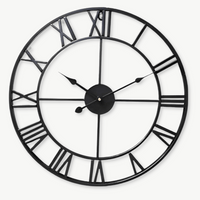

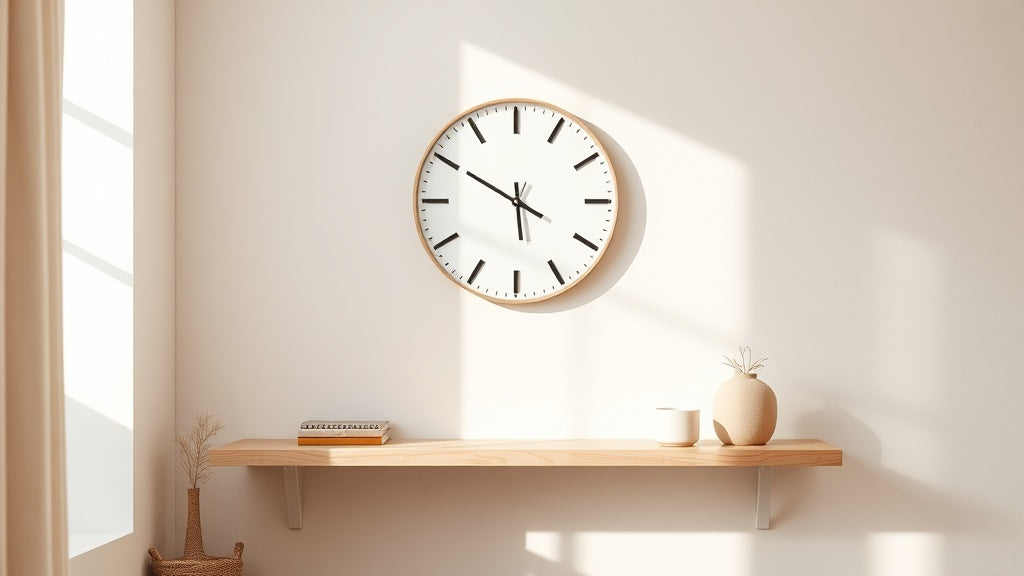
A minimalist wall clock under $50 sounds like a compromise waiting to happen. Thin plastic that warps in humidity. A dial that looked sleek in the product photo but arrives looking like a budget office supply. We've all been there. The good news: the category has genuinely improved. Brands are catching on that the people buying sub-$50 clocks aren't looking for "cheap." They're looking for restrained. And restrained, done right, is actually hard to fake.
This guide is for anyone who wants their wall to feel intentional, not cluttered, without spending triple digits to get there. Here's what actually works.
⭐ Key takeaways
- Minimalist clocks work best when the dial, hands, and case share a consistent material story.
- Silent quartz movement is non-negotiable for bedrooms and home offices, even at this price point.
- 12-inch diameter (30 cm) is the sweet spot for most walls: readable from 10 feet, never overwhelming.
- Under $50 doesn't mean plastic. Wood and powder-coated metal options exist in this range.
- Placement matters as much as the clock itself: hang it at eye level, not too high.
What "Minimalist" Actually Means on a Clock Face
Minimalism in clock design isn't just about removing numbers. It's about every element earning its place. A truly minimalist wall clock under $50 has a clear reading order: you read the hands first, the dial second, and the case third. If anything interrupts that sequence, it's not minimalist, it's just sparse.
In practice, that means looking for a few specific things. The hands should be proportionally thin but long enough to reach close to the outer ring of the dial. The dial should be matte, not glossy, since gloss catches light and creates visual noise. And the case? It should disappear into the wall, not compete with it. Think of the restraint you see in classic Scandinavian furniture design: nothing decorative that isn't also structural.
There's a useful shortcut here borrowed from Scandinavian minimalist clock design tradition: if you can describe the clock in one sentence without using the word "nice," you're on the right track. "White matte dial, black hands, natural bamboo rim" is a clock. "It's nice and simple" is not a clock you should buy.
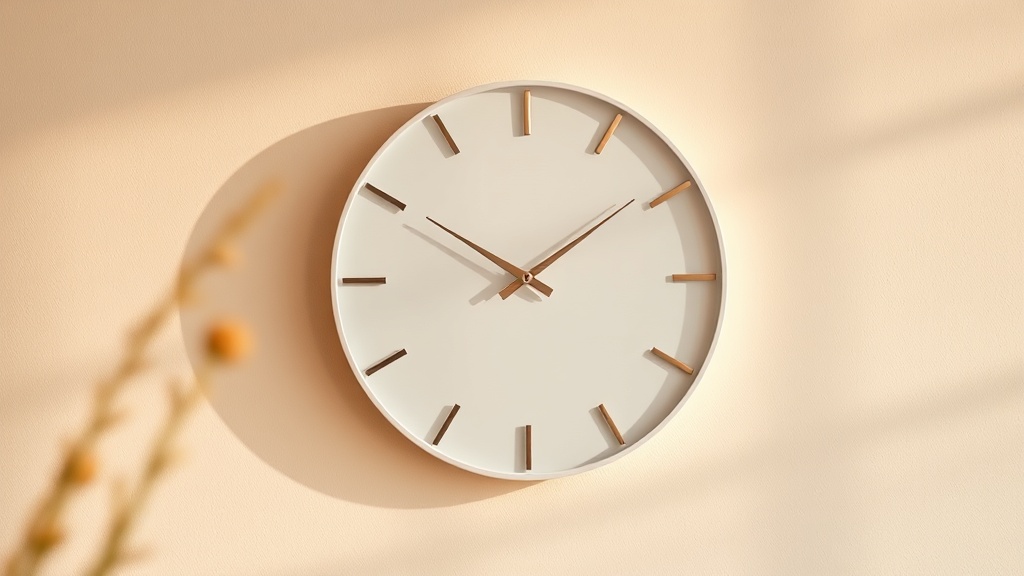
Color theory matters here too. A pure white clock on an off-white wall reads as one piece, which is exactly the effect you want in a Scandinavian-leaning interior. A black clock on a white wall makes a stronger graphic statement, closer to industrial minimalism. Neither is wrong. But knowing the difference saves you from returning the clock three days after hanging it.
💡 Did you know?
The Bauhaus movement, which started in Weimar Germany in 1919, is the philosophical ancestor of every minimalist clock you'll see today. Its core principle: "form follows function." Designers like Marianne Brandt applied it to everyday objects, including timepieces, stripping them down to only what the object needs to do its job beautifully. Over a century later, that same discipline is exactly what separates a $45 clock that looks designed from one that just looks cheap.
The $50 Budget: Where It Limits You (and Where It Doesn't)
At $50, you won't get hand-finished walnut or Swiss-made movement. That's honest. But you can absolutely get a clock with a genuine silent quartz mechanism, a powder-coated steel or bamboo case, and a dial that holds its proportions. The budget mostly limits case thickness and finishing details, not the overall design logic.
What to watch for in this price range:
- Movement quality: Look specifically for "silent sweep" or "step-free sweep" quartz movement. A ticking clock in a bedroom is a slow form of torture. Most clocks in this range still use cheap step-movement; silent sweep is rarer but findable. If the listing says "quiet" without specifying sweep, keep scrolling.
- Case material: ABS plastic is the default. It's not inherently bad, but it reads as plastic from close up. MDF with a wood-look veneer is a step up. Actual bamboo or thin-gauge metal is the best you'll find at $50, and it exists if you know where to look.
- Hand finish: Matte black or brushed brass hands photograph better and age better than chrome-plated ones that cloud over time.
- Dial printing: Markers should be crisp, not fuzzy at the edges. If the product photo shows slightly blurred indices, the real thing will be worse. Zoom in on the listing photos before you buy.
Best Rooms for a Scandinavian Minimalist Clock Under $50
The bedroom is the easiest win for a silent minimalist wall clock in this budget. A 12-inch silent clock in white or natural wood works with almost every bedroom palette, and nobody examines your bedroom clock from six inches away. Distance is forgiving. The clock does its job visually from the doorway and functionally from the bed. A quiet Scandinavian minimalist clock under $50 with a pale wood rim and no numerals is genuinely hard to distinguish from something that costs three times as much, especially in softer bedroom lighting.
The home office is the second best room for this budget. You want something that reads at a glance, doesn't distract during video calls, and sits quietly in the background. A simple black-on-white or white-on-white dial is ideal. It says "I thought about this" without screaming for attention. If you spend long hours at your desk, a silent wall clock isn't a luxury, it's genuinely restful.
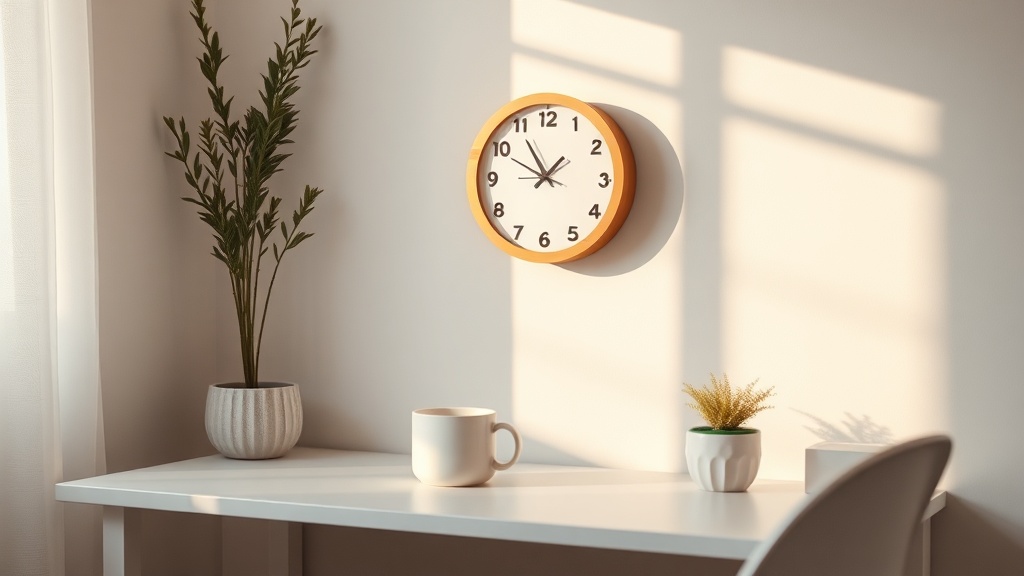
The living room is trickier. Here, people actually look at the clock, pick up on the material, notice if the hands feel thin and cheap. If you're planning to hang a minimalist wall clock under $50 in a living room, keep it to a secondary wall, not the focal feature wall. Let it complement rather than anchor the room. For a living room statement piece, you'll generally want to invest a bit more.
Kitchens are underrated for affordable minimalist clocks. High humidity isn't as much of an issue with a small clock near the window as it would be with a large wooden piece. A clean 10- or 12-inch clock above the coffee station or near the doorframe gives the kitchen a bistro feel that reads as deliberate rather than accidental. It's one of those small moves that makes a kitchen look genuinely put-together.
Material Guide: What You're Actually Getting at This Price
| Material | Pros at $50 | Watch out for |
|---|---|---|
| ABS Plastic | Light, affordable, wide color range | Can yellow over time, looks cheap close-up |
| Bamboo / Light Wood | Warm texture, eco-friendly, genuinely natural | Thinner cases may warp in high humidity |
| MDF + Veneer | Stable, takes finishes well, heavier feel | Edge quality varies; check corners in photos |
| Thin Metal (powder-coated) | Clean lines, durable, premium feel | Harder to find in this budget; check for stamped vs. formed edges |
The One Clock in Our Range That Hits the $50 Sweet Spot
If you want to understand what's actually possible at this price, the Sun and Moon wooden clock at $45 is the honest benchmark. It uses a silent quartz sweep movement, comes in a lightweight wood construction that reads as natural rather than manufactured, and the celestial motif is restrained enough to stay on the right side of decorative without tipping into busy. Finding a minimalist wall clock under $50 with both real wood and a genuine silent movement is genuinely uncommon in this price band. This one sits in the sweet spot.
What makes it work as a room piece rather than just a functional object? The wood grain does the visual work that paint or print can't. It introduces warmth without pattern, texture without noise. Hang it on a white wall in a Scandinavian-styled bedroom and it disappears in the best possible way: present enough to be useful, quiet enough that you stop noticing it after a week. That's the goal.

When to Stretch the Budget (and When Not To)
There's a real argument for staying at $50 and there's a real argument for going to $55-$75. Here's how to think about it honestly.
Stay at $50 if: the clock goes in a room where it's functional rather than focal. Bedroom, small home office, kitchen side wall. You're looking for quiet reliability, not a conversation piece. A good silent minimalist wall clock at this price does exactly that job without asking for anything in return.
Consider stretching if: the clock will be the first thing people see when they walk into a room. Or if you're renting and this is one of the only things you can do to the walls. In that case, the clock is carrying design weight that justifies a few more dollars. The White Wood Wall Clock at $55 is the natural next step up, with a cleaner bamboo dial and a 12-inch format that hits the right balance between readable and subtle. The white-on-natural-wood combination works across minimalist, Scandinavian, and even transitional interiors without looking like it's trying too hard.
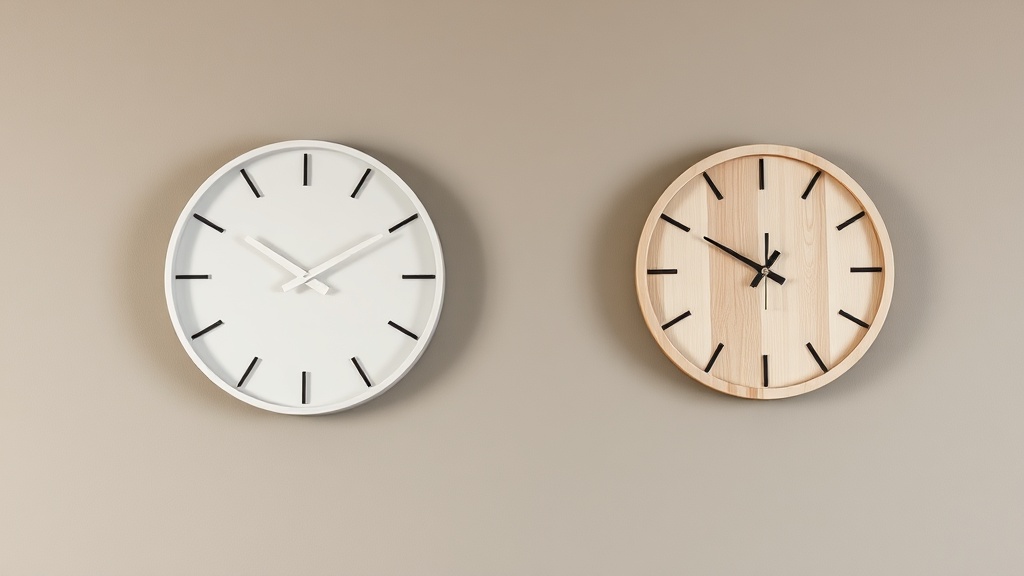
And if you're furnishing a living room or want something that genuinely anchors a wall, the Scandinavian wall clock collection has options that stay true to the same clean-line philosophy at various price points. Some of the pieces there are genuinely striking in ways that a sub-$50 clock can't quite reach, but they share the same design DNA.
Five Placement Rules That Make Any Clock Look Better
- Eye level, not "high on the wall." Most people hang clocks too high. The center of the clock should sit at roughly 57-60 inches from the floor. That's gallery height, and it works for clocks too.
- Give it breathing room. A minimalist clock needs at least 6-8 inches of clear wall on all sides. Crowding it with frames or shelves destroys the effect.
- Match the undertone. Warm-toned walls (cream, sand, terracotta) pair with natural wood or brass-handed clocks. Cool walls (grey, blue-grey, white with blue undertone) suit matte black or white cases.
- Consider the light source. A clock directly opposite a window will sometimes catch glare on its face. Side-lighting is almost always more flattering for any wall object. If you're working with a glossy dial, this matters even more.
- One clock per room. This sounds obvious but gets broken constantly. Two clocks in the same room read as an accident, not a design choice.
"Simplicity is not the absence of clutter. It is the presence of what matters."
Adapted from Dieter Rams, industrial designer and originator of the "less but better" design philosophy
Beyond Minimalist: Exploring the Full Clock Range
Once you've nailed the under-$50 minimalist look in one room, the natural instinct is to think about what a silent wall clock with a stronger design presence could do elsewhere. The silent wall clock collection spans a wide range of aesthetics, from Scandi clean-line pieces to more textured wooden designs, all sharing that absence of tick that makes a room feel genuinely calm. Whether you're after something more dramatically industrial (think raw metal with exposed hardware) or something softer and more organic (pale ash with a linen-colored dial), the underlying principle is the same: the clock should serve the room, not compete with it.
Silent Wall Clocks
Every clock here shares the one feature that matters most in a bedroom or home office: no tick, no intrusion, just clean timekeeping.
179 references
Browse silent clocks →FAQ
Can a wall clock under $50 actually look high-end?+
Yes, with the right conditions. A clock with a matte finish, proportionally correct hands, and a natural material like bamboo or thin-gauge metal reads as quality from normal viewing distances. The key is placement: give it space, hang it at eye level, and keep the surrounding wall clear. Clutter around a budget clock exposes it. White space protects it.
Is a silent quartz movement available in a minimalist wall clock under $50?+
It is, but you have to look for it specifically. Product listings often say "quiet" when they mean "standard step quartz with a slightly lighter tick." The term to search for is "sweep movement" or "silent sweep," which means the second hand moves in a continuous glide rather than clicking each second. At $45-$50, a handful of options genuinely deliver this, including the Sun and Moon wooden clock mentioned above.
What size minimalist clock works best for a small room?+
12 inches (30 cm) is the reliable answer for rooms under 120 square feet. It reads from across the room without dominating the wall. For very small spaces like a bathroom or narrow hallway, 10 inches is cleaner. Going below that risks making the clock illegible at normal viewing distance, which defeats the functional purpose entirely.
Should a minimalist clock have numbers or just markers?+
It depends on how you use the room. In a bedroom or living space where you glance at the clock casually, line markers or no markers at all work fine. Your brain learns the positions quickly. In a kitchen or office where you're checking exact times repeatedly, printed numerals (especially at 12, 3, 6, and 9) actually reduce friction. Neither is "more minimalist." One is more practical for certain uses.
What is the difference between a Scandinavian minimalist clock and a regular minimalist clock?+
In practice, the difference is mostly about material warmth. A Scandinavian minimalist clock typically uses natural or light-toned wood (ash, beech, birch), pale dials, and matte finishes. The overall effect is soft rather than stark. A standard minimalist clock might go further toward white, black, or metal with no organic texture at all, which reads as more industrial or Bauhaus-influenced. Both are restrained; the Scandi version just feels a bit more livable.
How do I keep a minimalist clock looking good long-term?+
Replace the battery before it fully drains. A dying battery causes the hands to move unevenly before stopping, which can leave the hands in awkward positions that stress the movement mechanism. For wooden or bamboo cases, avoid hanging directly above a radiator or in direct sunlight, both of which cause warping and fading over time. A light dust with a dry microfiber cloth every few weeks keeps the dial face looking sharp.