
There's a moment every decorator knows well: you've arranged the furniture, picked the paint, sourced the throw pillows, and still something feels unfinished. The wall is bare in the wrong way. Not empty-minimalist, just... incomplete. More often than not, that missing piece is a modern wall clock with geometric design. Not because you need to know the time, but because that one object does something no cushion or plant can: it gives the wall a focal point with actual structural presence.
Geometric clocks sit at the intersection of functional object and wall sculpture. They work in spaces where art feels too precious and mirrors feel too obvious. Here's what actually makes them worth thinking about carefully before you buy.
Key points to know before you shop
- Geometric clock designs range from minimalist Scandinavian circles to layered industrial ring constructions - material and scale matter as much as shape.
- Silent quartz movements are non-negotiable for bedrooms and open-plan living areas; ticking becomes noise pollution fast.
- The "right size" rule: your clock face should span roughly one-third of the wall width it occupies.
- Finishes (gold, matte black, copper, raw metal) create the visual temperature of a room - warm or cool, bold or restrained.
- Geometric clocks mix best with two or three complementary textures: wood, concrete, linen, leather.
What Makes a Clock "Geometric" - and Why It Reads Differently on a Wall
The word geometric gets thrown around loosely in interior design. For wall clocks specifically, it means something precise: the clock's visual identity comes from deliberate angular or curved forms that go beyond a plain round face. Think concentric rings at different depths, crossed circle frames, hexagonal cases, starburst spokes, or overlapping arcs in contrasting finishes.
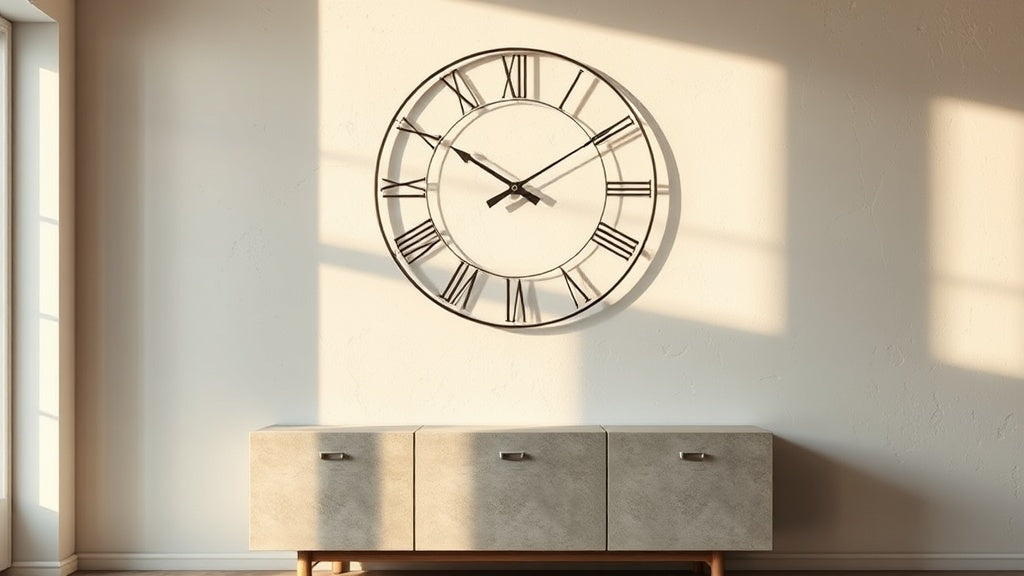
What sets these apart from standard round or square clocks is that the geometry creates shadow play. A flat dial hangs on a wall. A clock built from three-dimensional intersecting rings or sculpted metal frames casts actual shadows as daylight moves, changing its appearance throughout the day. That's the functional difference between a decorative object and one that earns its place on the wall.

The other thing geometric designs do well is scale without weight. A 50 cm crossed-circle metal clock visually fills a wall the way a large canvas would, but because the frame is open metal rather than solid material, it doesn't visually compress the space. That's why they work particularly well in smaller rooms where a solid oversized piece would feel oppressive.
Did you know?
The Bauhaus movement of the 1920s is widely credited with making geometric form a legitimate design language for everyday objects - clocks included. Walter Gropius and his colleagues argued that a functional object stripped to its geometric essence was more honest than one dressed in ornament. A century later, that philosophy is still driving the best contemporary clock design.
The Five Geometric Families: Picking the Shape That Fits Your Space
Not all geometric clocks speak the same design language. The shape you choose sends a specific visual signal, and matching it to your existing decor is where people most often go wrong. Here's a practical breakdown of what each family does best.
Concentric Rings and Spherical Structures
These are the most architecturally dramatic option. A clock built from overlapping spherical rings or layered circles in metal reads like a 3D diagram of planetary motion. In a living room with high ceilings, exposed concrete, or dark hardwood floors, this style anchors the space without competing with furniture. The depth of the construction, typically 8-15 cm off the wall, creates that shadow play mentioned earlier.
The retro design language of spherical ring clocks also bridges the gap between mid-century modern and contemporary interiors - useful if you've mixed pieces from different eras and want one object to tie them together.
Crossed Circle and Open Frame Designs
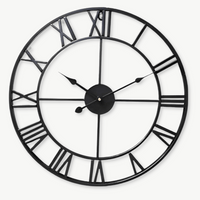
A crossed circle clock takes a standard round silhouette and subdivides it: horizontal and vertical bars cross through the face, or the outer ring is intersected by geometric elements that break its continuity. At 50 cm, this format sits confidently above a sofa or sideboard without needing a gallery wall around it. It's a single object with enough internal complexity to hold attention on its own.
This category works particularly well in kitchens and dining areas, where you want a design statement but not something so precious that cooking splatter feels like a crime. Metal finishes - matte black, brushed steel, aged bronze - are easy to wipe down and don't show the gradual patina of daily life.
Gold Circle and Layered Ring Constructions
Warm metallic tones change the entire emotional register. A 60 cm gold circle construction in metal brings softness that matte black or raw steel doesn't. It reads as luxurious without being ostentatious, which is a harder balance to strike than it sounds. These work best in rooms with warm neutrals: cream walls, terracotta accents, natural linen, aged oak furniture.
The size matters here. At 60 cm, a gold circle design clock becomes the undisputed focal point of a living room wall. Below 40 cm, the same finish reads as decorative accessory rather than statement piece. If you're hanging it above a fireplace or over a large sofa, go bigger than your instinct tells you to.

3D Sticker and Acrylic Geometric Formats
This is the category that surprises people. 3D wall clock stickers in metal or acrylic use individually applied hour markers that project off the wall surface, creating the illusion of a clock face that floats in space rather than hanging as a unified object. The geometry comes from the precision of the layout and the material's reflective quality.
They suit renters particularly well: installation is minimal, the visual impact is high, and removal doesn't involve repainting. In a bedroom with light walls, mirrored or brushed-metal 3D markers catch morning light in a way that feels considered rather than accidental.
Industrial Gear and Steampunk Constructions
Exposed gear mechanisms are geometric in a different sense: the circle of each cog, the precise teeth spacing, the deliberate arrangement of moving parts. A wooden steampunk clock with visible 3D gears reads as both mechanical diagram and decorative object. This style suits loft apartments, home offices with brick or concrete walls, and any space that values craft and process over polish.
Matching Geometric Clock Finishes to Your Interior Style
The shape gets the clock on your shortlist. The finish is what makes it actually work in your room. Here's a direct comparison of the four most common finishes in geometric clock design, mapped against interior styles.
| Finish | Best Interior Match | Wall Color Sweet Spot | Avoid With |
|---|---|---|---|
| Matte Black | Minimalist, Scandinavian, industrial | White, light grey, sage green | Very dark walls, overloaded gallery walls |
| Brushed Gold | Contemporary glam, eclectic, transitional | Cream, warm white, terracotta, navy | Cool grey palettes, stark industrial spaces |
| Copper / Copper-Red | Industrial, mid-century modern, bohemian | Exposed brick, dark charcoal, warm white | All-white Scandinavian, pastel palettes |
| Raw / Brushed Steel | Loft, contemporary, minimalist | Concrete tones, light grey, white | Rustic-heavy or very ornate traditional rooms |
Where to Hang a Geometric Wall Clock: Placement That Actually Works
Placement is the detail that separates a well-designed room from a room that has nice individual pieces which somehow don't cohere. A geometric designer wall clock placed wrong becomes background noise. Placed right, it becomes the first thing you notice and the last thing you photograph before leaving.
The Living Room: Above the Sofa vs. Opposite the Entrance
Two positions dominate living room clock placement. Above the sofa works when the clock is large enough, typically 45-65 cm, to visually balance the sofa's horizontal mass. The clock face should be centered on the sofa's width, not the full wall. Leave 25-30 cm between the sofa back and the clock's bottom edge - enough for the eye to read them as related but distinct.
The wall opposite the entrance works for a different reason: that's the first thing you see when you walk in. A geometric clock placed there sets the design tone of the entire space in two seconds. For this position, a sculptural piece, something with real three-dimensional presence, makes more impact than a flat dial even at the same size.
The Kitchen: Functional Geometry Above the Counter
Kitchen clocks get dismissed as purely functional, which is exactly why a geometric piece there is such a sharp choice. Most people put a basic round clock on the kitchen wall and move on. A crossed-circle design or an industrial copper-finish geometric clock in a 30-40 cm diameter sits at the intersection of practical and considered, especially in kitchens that lean toward modern or open-plan designs.
Height matters more in kitchens than in other rooms. You're reading the time from a distance while your hands are occupied. Aim for eye level or just above, where the clock is readable without a neck crane. For wall clocks in kitchen settings, silent quartz movement is worth prioritizing: the ambient noise of cooking makes a ticking mechanism genuinely distracting.
The Bedroom: Restraint as a Design Strategy
Bedrooms reward restraint. A geometric clock that's too visually busy competes with the rest and fragments the room's calm. Here, a clean-lined circular design with minimal hour markers, or a matte black 3D sticker format, gives you the geometric interest without the visual weight. Position it where it's readable from the bed but not directly in the sightline when you're lying down. Scandinavian-style geometric clocks tend to hit this balance most reliably: geometric precision without decorative overload.

The Home Office: Geometry as Creative Reference
A home office wall benefits from something that makes the space feel intentionally designed rather than improvised. A geometric clock with a gear mechanism or a layered ring construction on the wall behind your desk shows up in video calls as a deliberate design choice, which matters more than it probably should in 2026. It also does the practical job of keeping time visible without requiring you to check a phone screen.
The Silent Movement Question: Why It Matters More Than People Think
Most decorating conversations about clocks focus entirely on appearance. The movement mechanism gets maybe one sentence. This is backwards. A clock's acoustic footprint is the difference between a piece you love and one you eventually take down because you can't focus with it on the wall.
Standard quartz movements produce a distinct tick-tock at roughly 40-45 decibels at 1 meter. In a quiet room, that's noticeable. In a bedroom at night or a home office during focused work, it becomes maddening surprisingly quickly. Silent quartz movements, also called "sweep" movements, use a continuous gliding sweep of the second hand rather than one-second jumps. The mechanical difference is small; the acoustic result is dramatic.
For any industrial or designer wall clock placed in a living area, bedroom, or workspace, silent movement isn't a premium feature. It's the baseline worth insisting on.
One thing to check
Very large geometric metal clocks (60 cm and above) can occasionally transmit subtle vibration to hollow walls, especially in apartments with plasterboard construction. Use the mounting hardware specified by the manufacturer, and if vibration is a concern, a felt or rubber wall pad behind the mounting point eliminates it entirely.
Sizing a Geometric Clock: The One-Third Rule and When to Break It
The one-third rule is the most reliable starting point: the clock's diameter or widest dimension should be approximately one-third of the wall section it occupies. A sofa 210 cm wide reads best with a clock in the 60-75 cm range. A narrow kitchen wall of 90 cm suits a 30-35 cm piece.
The rule breaks intentionally in two situations. First, when you want the clock to be the single focal point of a large wall with no other objects: here, go bigger than the formula suggests, because the empty wall around it is part of the composition. Second, when the clock's geometric complexity is high, a densely layered ring construction or a gear mechanism with many moving parts, you can go slightly smaller because the visual density reads as larger than the physical dimensions.
"A clock is the only object in a room that tells you exactly what it is while pretending to be something else entirely."
Common observation among interior designers working with statement timepieces
Mixing a Geometric Clock into an Existing Decor - Without Starting Over
The most common fear: "I love this clock but I don't know how it fits with what I already have." Here's what actually works.
Start with the finish, not the shape. If your existing hardware, fixtures, and frames are warm metal (brass, gold, bronze), a geometric clock in the same metal family integrates immediately. If you're working with cool tones (silver, chrome, brushed steel), a matte black or raw steel geometric clock fits without effort. Mixing warm and cool metal finishes deliberately can work, but it takes confidence and usually one dominant and one accent.
The shape question is simpler than people make it. Geometric clocks in metal are neutral enough to coexist with organic shapes, soft textiles, and natural materials. A spherical ring metal clock above a linen sofa next to a rattan lamp? That's a considered contrast, not a clash. Geometric rigor plus organic softness is a combination that works across nearly every style of interior.
For rooms that already have significant visual complexity, a cleaner geometric format, a single circle with minimal internal geometry, a flat ring in one finish, holds its presence without adding to the chaos. For rooms that feel bare or under-decorated, the more complex constructions, layered rings, 3D gear mechanisms, earn their place by doing a lot of visual heavy lifting at once.
Browse the full wall clock collection if you're weighing multiple formats side by side. And if the geometric direction feels right but you want to explore the industrial metal segment more specifically, the industrial wall clock category covers the widest range of geometric metal constructions available.
Five Questions Worth Asking Before You Commit to a Geometric Clock
Not every striking object belongs on your specific wall. Before you order, run through these quickly.
- What's the wall material? Plasterboard, brick, and concrete require different mounting hardware. Confirm the clock ships with appropriate fixings or that you can source them locally.
- How does natural light hit that wall? South or west-facing walls get strong afternoon light, which will dramatically affect how a metallic finish reads at different times of day. This can be a feature, not a problem, but it's worth visualizing.
- Is silence a genuine requirement? If the clock is going anywhere near a sleeping space or a quiet workspace, confirm the movement is silent sweep, not standard quartz tick.
- What's the dominant finish in the room's hardware? Door handles, light fixtures, cabinet pulls: matching or deliberately contrasting these with the clock finish is a choice you should make consciously rather than accidentally.
- Will you move? Renters: how easy is this to take down and rehang elsewhere? Open-frame metal geometric clocks are usually one or two hanging points and very manageable to relocate.
When all five answers point toward a single piece, that's usually the right piece. And if you're still choosing between a few finalists, the Scandinavian wall clock collection is a reliable tiebreaker: clean lines, considered proportions, and finishes that work across a wide range of interiors.
FAQ
What size geometric wall clock works best in a living room?+
For most living rooms, a modern wall clock with geometric design between 45 and 65 cm in diameter works well above a sofa or console table. The clock face should span roughly one-third of the wall width it occupies. If your wall is very large or mostly empty, go bigger: a 60-70 cm piece will have more presence and won't look like it's floating in space.
Are metal geometric wall clocks heavy to hang?+
Open-frame geometric clocks in metal are often lighter than they look because the construction uses hollow tubing or laser-cut sheet metal rather than solid material. Most pieces in the 45-60 cm range weigh between 1.5 and 4 kg. Standard wall anchors handle this range comfortably. For very large or three-dimensional constructions above 5 kg, use a stud anchor or masonry screw directly into a wall stud or solid brick.
Do geometric wall clocks work in small rooms?+
Yes, and often better than people expect. Open-frame geometric designs - crossed circles, ring constructions, spoke formats - fill visual space without the heaviness of a solid object. In a small room, a 35-45 cm open geometric clock on an empty wall creates a focal point that makes the room feel more intentionally designed rather than cramped. Avoid very deep three-dimensional constructions (more than 15 cm off the wall) in tight spaces.
Can a geometric clock work alongside a gallery wall?+
It can, but positioning matters. A geometric clock works best as the anchor piece at the center of a gallery wall, with smaller frames arranged around it, rather than as one element among equals. Treat it as the composition's focal point. Choose a clock finish that pulls from one of the frame colors - a gold or black clock ties together a mixed gallery wall far more effectively than a clock that introduces a new finish family.
What's the difference between a silent quartz movement and a standard quartz in practical terms?+
A standard quartz movement advances the second hand one step per second, producing an audible tick. At arm's length in a quiet room, this registers at roughly 40-45 decibels. A silent (or sweep) quartz movement drives the second hand in a continuous glide with no discrete steps, producing no audible tick. The timekeeping accuracy is identical. For any room where ambient noise drops significantly at night or during focused work, the silent movement is the practical choice.
Which geometric clock style suits a Scandinavian or minimalist interior best?+
For Scandinavian or minimalist interiors, look for a modern wall clock with geometric design that prioritizes negative space over complexity: a single matte black or brushed steel ring, a clean crossed-circle frame with no numerals, or a simple concentric circle in one finish. The Bauhaus principle applies here directly - strip the form to its essence and let the proportions do the work. Avoid multi-layered or gear-heavy constructions, which read as too busy against pared-back Scandinavian walls. Browse the Scandinavian wall clock collection for options calibrated to exactly this aesthetic.
Choosing the right modern wall clock with geometric design comes down to three things working together: a shape that complements your architecture, a finish that speaks the same temperature as your room's existing materials, and a size that earns its place rather than disappearing into the wall. Get those three right and you won't just have a clock. You'll have the piece that makes the room feel complete.