
You've measured the wall, picked the paint color, arranged the furniture twice. Then you look up and realize: the clock is the thing that's going to make or break the whole room. Not because it's the biggest piece, but because it lands right at eye level and everyone sees it the moment they walk in. The question isn't just aesthetic. It's about how a piece lives with you day to day, what it says about the space, and whether it still feels right six months from now.
So: minimalist wall clock vs decorative wall clock. These aren't just two product categories. They represent two genuinely different philosophies about what a clock is supposed to do on your wall. Here's what works, what doesn't, and how to figure out which one belongs in your home.
⭐ Key takeaways
- Minimalist clocks recede into a room and support an existing design; decorative clocks lead it.
- Room size, wall color, and existing furniture style all affect which type reads well in person.
- The "right" choice depends less on trend and more on whether your room already has a focal point.
- Silent quartz movements matter in both categories: noise is a dealbreaker in bedrooms and offices.
- Budget and materials aren't the same as style: you can find refined minimalism at $45 and ornate pieces at $380.
What We Actually Mean by "Minimalist" vs "Decorative"
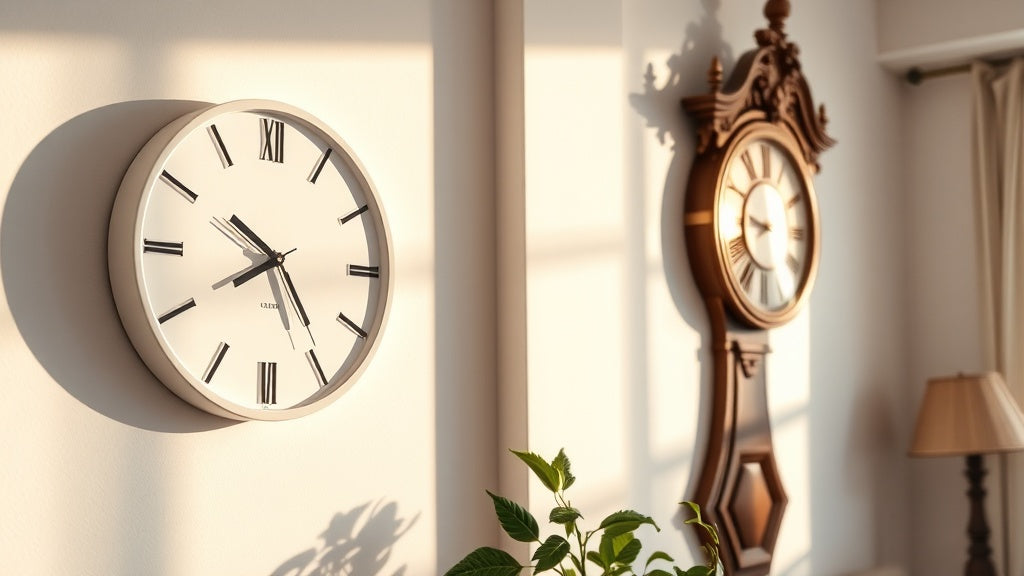
These terms get thrown around loosely in home decor, so let's pin them down. A minimalist wall clock strips away everything that isn't necessary. No Roman numerals crowding the dial, no sculpted frame, no color contrast begging for attention. The hands move, the time is readable, and the clock almost disappears into the wall. Scandinavian design is the obvious reference point: clean geometry, neutral tones, negative space used with intention.
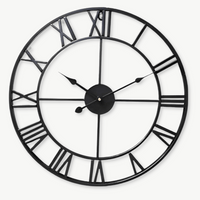
A decorative wall clock does the opposite. It arrives with personality attached. Carved woodwork, exposed gear mechanisms, painted dials, sculptural hands, layered materials, cuckoo birds. The clock is not trying to blend in. It's trying to start a conversation. Antique-inspired European styles, industrial gear designs, botanical carvings, celestial motifs, these are all decorative clocks, even when they're made with quiet movements.
The distinction matters because it changes how the clock interacts with everything else in the room. One fades back; the other steps forward.

Visual Impact: How Each Style Reads on the Wall
Here's something worth knowing: minimalist clocks don't actually disappear. They create a different kind of visual weight. A 30 cm white-on-white clock on a pale wall produces a calm, floating quality. The eye finds it without being grabbed. That restraint is doing real work, it keeps the wall from feeling busy while still anchoring the space.
Decorative clocks, by contrast, create a focal point. A 60 cm gear clock in dark wood and gold anchors a wall so thoroughly that it almost functions as art. You don't need a gallery arrangement around it. You don't need much else on that wall at all. The clock carries the visual weight for the entire section of the room.
This is why scale matters differently for each type. A small decorative clock on a large wall can look lost and cluttered simultaneously, too small to anchor, but too detailed to blend. A large minimalist clock on a small wall can feel overwhelming in a different way: too much empty geometry. The proportional sweet spot shifts depending on which category you're working with.
💡 Did you know?
The Bauhaus movement in 1920s Germany was one of the first design schools to argue that a clock should prioritize legibility above all else. Their timekeepers used bold, geometric numerals and no decorative framing whatsoever. That principle directly shapes what we now call "minimalist" clock design, nearly a century later.
Room by Room: Which Style Fits Where
There's no universal answer here, but there are strong patterns that hold across most homes.
Living rooms: where decorative clocks shine
The living room is usually your largest, most socially visible space. It's also the room where design choices are most consciously made, you've probably already thought about the sofa, the rug, the cushions. A decorative clock in this context functions as a statement piece rather than a supporting player. A large-scale gear clock or an ornate Roman numeral piece can anchor a feature wall above a console or fireplace without needing additional decor around it.
That said, if your living room already has a lot going on visually (patterned textiles, gallery walls, bold color), a minimalist clock can be exactly what the space needs. It provides a point of rest for the eye. You're not adding complexity, you're resolving it.
Bedrooms: the case for quiet restraint
Most people getting this decision wrong in bedrooms go too ornate. A heavily carved clock above the bed adds visual noise to a space that's supposed to feel calm. The bedroom rewards restraint, not because decorative clocks are wrong per se, but because you're looking at this wall as you fall asleep and wake up. Simplicity wears better over time.
A bedroom clock works best when it reads clearly in low light, sits quietly (silent quartz is non-negotiable here), and doesn't compete with the bed as the room's natural focal point. White wood, pale birch, or muted tones all work. A 30 cm round clock with slim hands and no numerals can be genuinely beautiful in this context.
Kitchens: practicality first, personality second
Kitchens are the room where function genuinely leads. You're checking the time while cooking, not admiring the dial work. That pushes most kitchen clock choices toward legibility, bold numerals, strong contrast between hands and face, a size that's readable across the room. Both minimalist and decorative clocks can meet that bar, but the kitchen tends to favor designs with clear numeral markers over abstract, marker-free minimalism.
A farmhouse-style clock with printed text detailing or a vintage French bistro dial reads easily and adds warmth to what can be a clinically functional room. A stark, numeral-free minimalist piece may look clean but becomes frustrating when you're trying to time the pasta.
Home offices: don't underestimate this space
Office environments benefit from clocks that are precise without being distracting. A heavily decorative clock in a workspace can feel slightly incongruous, your eye keeps going back to the carved detail when it should be on the task. A clean, modern office clock with strong hand contrast and no tick keeps you on schedule without pulling focus. It's one room where the minimalist category has a practical advantage beyond aesthetics.

Materials and Craftsmanship: Where the Two Styles Overlap
One assumption worth challenging: that minimalist clocks are cheaper or less considered than decorative ones. That's not true. A handcrafted walnut clock with a clean dial and no numerals can require more precision joinery than a mass-produced ornate frame. The absence of decoration doesn't mean the absence of craft.
What differs is where the craft is expressed. In a minimalist clock, it's in the wood grain, the precision of the hands, the quality of the quartz movement, the finish consistency. In a decorative clock, it's in the carving depth, the material layering, the painted dial details, the mechanical or sculptural animation.
Both categories include genuinely well-made pieces and genuinely low-quality ones. The way to tell the difference: look at the movement (silent sweep quartz beats loud tick mechanisms in most home contexts), check the material description (solid wood vs MDF veneer matters for longevity), and examine the hands (too thin or too light and they won't read from across the room).
The Style Compatibility Question: Matching Clock to Interior
Here's the practical framework that actually works. Think of your room as already having a "register", either it's busy or it's calm, either it has a focal point or it needs one.
- Busy room with lots of visual elements: minimalist clock. It gives the eye somewhere to rest and doesn't add to the competition.
- Calm, neutral room with few statement pieces: decorative clock. It becomes the reason the room has character rather than feeling sparse.
- Room with a defined style (Scandinavian, industrial, Japanese): pick the clock that speaks that language explicitly. A Japanese-style wood and acrylic clock in a japandi living room; a gear-and-metal clock in an industrial loft.
- Eclectic mix without a clear style direction: a single strong decorative clock actually works better here than a minimalist one, because it gives the room a visual anchor rather than floating ambiguously.
| Criteria | Minimalist Clock | Decorative Clock |
|---|---|---|
| Visual role | Supports existing decor, recedes into room | Creates focal point, leads visual attention |
| Best room fit | Bedroom, office, already-busy living spaces | Living room, dining room, entry hall |
| Interior style match | Scandinavian, japandi, modern, Bauhaus | Rustic, industrial, European, bohemian, vintage |
| Scale flexibility | Works well at 30-40 cm; larger sizes need strong walls | Benefits from larger scale (45-60 cm) to show detail |
| Longevity of feel | Very high; simplicity doesn't date | High if style-matched; lower if trend-driven |
| Price range | $45 - $150 for quality pieces | $75 - $385+ depending on complexity |
| Timekeeping readability | Excellent (high contrast, clean hands) | Good to excellent depending on numeral type |
Three Clocks That Represent Each Style Well
It's one thing to talk about categories in the abstract. Here are specific pieces that show what these styles actually look like in practice.
For the minimalist side, the White Wood Wall Clock in 30 cm is a clean example: bamboo construction, no numerals, slim hands, silent quartz. It fits a bedroom or a Scandinavian living room without demanding anything from the surrounding decor. Similarly, the Wood and Acrylic Wall Clock in Japanese style takes minimalism in a slightly different direction, the acrylic element adds a translucent quality that works particularly well in rooms with good natural light.
On the decorative end, the Wood and Metal Wall Clock with Roman Numerals sits squarely in an industrial-meets-heritage register: the combination of raw wood and metal gives it material depth, while the Roman numerals add a classical character that reads well in both traditional and contemporary interiors.


The Noise Factor: Why Silent Movement Changes Everything
Here's a practical point that doesn't always make it into style discussions. Whether you choose a minimalist or decorative clock, the movement type shapes how you experience it every single day. A loud tick-tock isn't just annoying at night, it subtly changes the feel of a room, making it feel slightly more restless and less settled.
Silent sweep quartz movements have become the standard in quality clocks across both style categories. Instead of the stepping motion that creates the tick (one jump per second), a sweep movement rotates continuously and nearly silently. For bedrooms, offices, and any room where you spend time reading or resting, it's not optional, it's the baseline.
Both the minimalist and decorative pieces worth buying in 2026 will carry silent quartz as standard. If a clock description doesn't mention it, ask or check the return policy before committing. One customer review I come across repeatedly: "Perfect clock, but I had to return it because of the ticking." Don't be that person. Browse the full silent wall clock collection if this is a priority for your space.
What Customers Actually Say: Patterns Worth Noting
Across reviews for minimalist styles, the most common phrase is some version of "exactly what I was looking for", which tells you something. People buying minimalist clocks often have a specific gap in mind: a wall that needs something without needing everything. The satisfaction comes from restraint working as intended.
For decorative clocks, the language shifts. Reviews tend to highlight reactions from other people: "everyone asks where I got it," "it completely transformed the wall," "my guests think it cost much more than it did." The satisfaction is relational, the clock performs for the room and for the people in it.
Neither outcome is better. They're just different jobs the clock is doing. Knowing which job you need is the whole decision.
Designer Wall Clocks
Browse 139 pieces that span both minimalist refinement and bold decorative design, curated for rooms where the clock is meant to say something.
139 references
Browse the collection →Making the Call Without Second-Guessing Yourself
Two questions that cut through most of the indecision. First: does this room already have a focal point? If yes, a minimalist clock won't compete with it and will probably serve the space better. If no, a decorative clock can become that focal point. Second: how often do you redecorate? If you rearrange rooms every couple of years, a minimalist clock travels better, it adapts to new contexts more easily. A distinctive decorative piece is perfectly matched to a room where you've committed to a specific aesthetic for the long term.
The minimalist wall clock vs decorative wall clock comparison ultimately comes down to whether your wall needs a whisper or a statement. Both are legitimate design choices. Both can be executed beautifully. The mistake is choosing one when your room is clearly asking for the other, putting a visually quiet clock in a room that has nothing else to anchor it, or hanging a heavily detailed piece in a space that's already working hard.
Get that part right, and the rest of the decision, wood or metal, 30 cm or 60 cm, Roman numerals or bare hands, becomes much easier to work through. Your wall is waiting.
Frequently asked questions
Can a minimalist clock work in a traditional or rustic interior?+
Yes, but the material needs to bridge the gap. A minimalist clock in warm walnut or light bamboo reads differently than a stark white plastic one. The clean silhouette can actually provide a pleasant contrast in a rustic room without clashing, as long as the material palette connects to the existing warmth of the space.
What size minimalist clock looks proportional in a large living room?+
For large walls (above 3 meters wide), a minimalist clock needs to be at least 40-50 cm to avoid looking lost. If you're attached to a smaller diameter, consider grouping three clocks in a loose cluster at different heights, this creates visual mass without sacrificing the clean aesthetic.
Is a decorative clock too much for a small apartment?+
Not at all, if the scale is right. A small apartment actually benefits from a single strong decorative piece because it creates the impression of a curated space rather than a furnished one. Keep it to one wall, choose a clock in the 35-45 cm range, and let it do the work without layering other art around it.
Do decorative wall clocks require more maintenance than minimalist ones?+
Carved or multi-material decorative clocks accumulate dust in crevices faster than smooth-faced minimalist designs. A soft brush or compressed air every few months keeps them looking sharp. The quartz movement in both types is battery-powered and essentially maintenance-free beyond an annual battery swap.
Can I hang a decorative clock in a bedroom without it feeling heavy?+
Yes, with two conditions: choose a decorative style in lighter colors (white, cream, pale wood) rather than dark metals, and make sure the movement is genuinely silent. A white cuckoo clock with botanical or nature motifs, for instance, adds personality to a bedroom without the visual heaviness of a large dark-framed piece. Placement matters too: on a side wall rather than directly above the bed keeps it from feeling oppressive.