
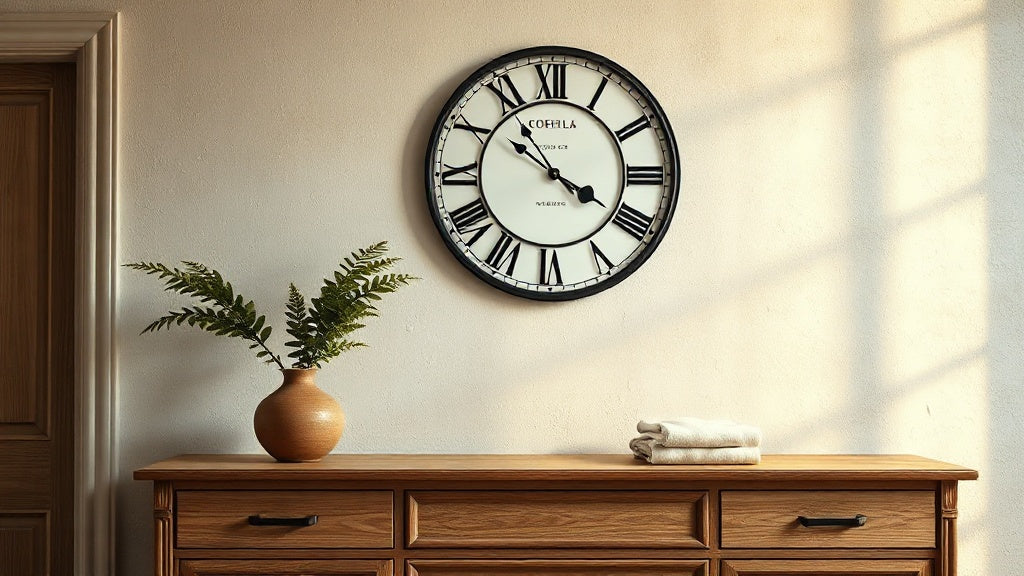
You know that feeling when you walk into a room and something just holds your attention? Not a sofa. Not the rug. A clock. It's hanging there, quietly doing its job, but it's also anchoring the entire wall. That's the thing about a premium wall clock worth the investment: it doesn't ask for attention. It earns it.
Here's the honest question most people don't ask before buying: are you paying for the name, or are you paying for something that actually performs and looks better over the years? The answer matters. Because the gap between a $30 clock and a $200 clock isn't always what you expect, and sometimes it's much more significant than you'd think.
Key Takeaways
- A high-quality movement is the single biggest predictor of long-term reliability.
- Material quality determines how a clock ages: gracefully or badly.
- Design impact compounds over time: a well-chosen piece improves as your space matures around it.
- Silent quartz mechanisms are a non-negotiable feature in bedroom and living room clocks.
- The price per year of use on a premium clock is often lower than on budget pieces that need replacing.
What You're Actually Paying For at the Higher Price Point
At a higher price point, you are paying for a precision-grade movement that lasts 10 to 15 years, a solid metal or bamboo housing that holds up over time, and a level of material quality that a $25 clock simply cannot deliver. Budget clocks do one thing: they tell time. Sometimes accurately, sometimes not. The movement inside a $25 clock is usually a generic, mass-produced quartz module with minimal quality control. It runs fine for a year or two, then starts losing minutes, ticking irregularly, or simply stopping.
A genuine designer wall clock at a higher price point typically uses a precision-grade quartz or mechanical movement. Precision quartz movements (often labeled "silent sweep") have fewer vibrations per cycle, which translates to less noise and longer motor life. Some premium movements carry rated lifespans of 10 to 15 years on standard AA batteries. That's not marketing copy; it's an engineering specification.
Then there's the housing. Budget clocks use plastic frames with foil-printed dials. Premium wall clocks worth the investment use spun metal, cast resin, hand-finished bamboo, or tempered glass. Those materials don't just look better on day one. They hold up. A brushed steel frame doesn't yellow. A solid bamboo case doesn't warp the same way plywood does in humid kitchens. The difference is most visible two years after purchase, not two weeks.

The Design Impact Argument: Why a Clock Is Never Just Decorative
A well-chosen wall clock solves two problems at once: it fills underused vertical space intentionally and adds a functional layer that decorative art alone cannot provide, making it one of the highest-impact single purchases in a room. Here's what interior designers have known for a long time: vertical space is the most underused dimension in most homes. Walls above console tables, above sofas, in entryways, these are prime real estate that most people either ignore or fill with generic prints. A well-chosen wall clock solves two problems at once. It fills the space intentionally and it adds a functional layer that art alone can't provide.
The size relationship matters enormously. A 30 cm clock on a large living room wall reads as shy, almost apologetic. A 50 to 60 cm statement piece on that same wall creates a focal point that organizes the entire composition around it. Customers who've made the switch to a larger, higher-quality piece consistently say the same thing: "I didn't realize how much the room was missing something until I hung it up."
Did you know?
The tradition of placing a large clock at the center of a room's main wall dates back to 18th-century French bourgeois interiors, where the *pendule de cheminée* (mantel clock) was a deliberate status symbol. The logic hasn't changed much: a beautiful clock signals that the person who chose it cares about time, craft, and space in equal measure.
Style specificity also plays a role here. A Scandinavian bamboo clock in a warm, minimalist bedroom does something a generic round clock simply can't: it reinforces a design language. It says "this room was thought through." The same logic applies to an industrial copper-finish clock in a loft kitchen, or a large Roman numeral metal piece in a traditional living room. The clock isn't decorating the space; it's completing it.

Editor's Pick
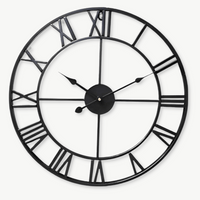
Large Roman Numeral Wall Clock - Metal, Silent Quartz
When you need a piece that genuinely commands a large wall, this metal Roman numeral clock delivers the scale and presence that smaller clocks simply can't match.
219.00 USD
View Product →Movement Quality vs. Price: A Practical Comparison
The core difference between a budget and a premium clock movement comes down to the stepping motor: budget clocks tick audibly every second, while premium silent-sweep movements glide continuously and are essentially inaudible, which matters enormously in bedrooms and home offices. Not all quartz movements are created equal. The core difference sits in two places: the stepping motor and the gear train. Budget movements use basic stepping motors that produce the characteristic "tick-tick" sound every second. Premium silent-sweep movements use a continuous-rotation motor that glides the second hand smoothly, eliminating audible ticking entirely. For a bedroom or home office, that distinction isn't minor. It's the difference between a clock you notice and one you forget about (in the best way).
| Feature | Budget Clock (under $60) | Premium Clock ($100+) |
|---|---|---|
| Movement type | Basic quartz stepping motor | Precision silent-sweep quartz |
| Noise level | Audible tick every second | Near-silent continuous sweep |
| Frame material | Plastic or thin stamped metal | Solid metal, bamboo, or cast resin |
| Expected lifespan | 2-4 years typical | 8-15 years with basic maintenance |
| Design aging | Yellows, warps, looks dated fast | Develops patina, retains presence |
| Cost per year (est.) | $10-15/year | $10-20/year |
That last row is the one people don't expect. When you spread a $180 clock over 12 years of reliable use, the annual cost lands around $15. A $45 clock that gets replaced every three years costs roughly the same, but you've also spent time shopping twice more, made two wall-patching decisions, and lived with something that didn't fully satisfy you. The math isn't even the most compelling part: it's the intangible cost of settling.

Which Styles Actually Hold Their Value Over Time
The wall clock styles that hold their visual relevance longest share three traits: they reference a clear design tradition, use materials that age gracefully, and avoid over-decoration, Scandinavian minimalism and industrial metal are the most proven examples. Trend-chasing in home decor is expensive. The clock that felt cutting-edge in 2022 can feel tired by 2025. The styles that genuinely hold their visual relevance share a few common characteristics: they reference a clear design tradition, they use materials that age gracefully, and they avoid over-decoration.
Scandinavian minimalism has proven itself. Bamboo and light wood clocks with clean dials and minimal numerals fit as naturally into a 2026 interior as they did in 2015. The aesthetic is grounded in restraint, and restraint doesn't go out of style. Scandinavian wall clocks consistently rank among the easiest pieces to integrate into evolving interiors precisely because they don't compete with anything around them.
Industrial designs, particularly those using raw or powder-coated metal in copper, black, or aged iron finishes, also age well. They carry a visual weight that reads as intentional even as surrounding decor shifts. A copper-finish clock that looked bold in 2020 has genuine staying power because metal patinas subtly with age, making the piece feel more considered as time passes, not less.
What doesn't hold: oversized decorative plastic frames in trendy colorways, clocks with novelty shapes tied to a specific moment (the hexagonal craze, the ultra-maximalist sunburst that peaked and then abruptly didn't), and anything where the visual weight is carried by a painted finish rather than the material itself.

Editor's Pick
Natural Bamboo Wood Wall Clock - Silent Quartz Movement
Solid bamboo construction that genuinely improves with age, paired with a silent sweep movement that won't disrupt your bedroom or reading nook.
99.00 USD
View Product →Room-by-Room: Where a Premium Clock Pays Off Most
The rooms where a high-quality wall clock pays off most are the living room, bedroom, and kitchen, spaces you use every day where movement quality, material durability, and design presence each deliver a measurable return. Not every room rewards the same level of investment equally. Here's what actually holds up from a design-impact perspective.
Living Room
The highest-return placement in most homes. The living room wall clock is seen by guests, photographed in every wide shot, and acts as the visual anchor for your primary social space. A piece at $150 to $300 here is genuinely justified because the design ROI is disproportionately high. Go large. Go material-forward. This is not the room for subtlety. If you want a starting point, the luxury wall clock collection is built precisely for this kind of statement placement.

Editor's Pick
Luxury Designer Wall Clock - Gold and Black Metal, 22 x 17 in
Gold and black metal construction that reads as genuinely luxurious in person, ideal for living rooms where the clock needs to hold its own against high-contrast decor.
250.00 USD
View Product →Bedroom
Silent movement is non-negotiable here. A ticking clock at 2 a.m. is a sleep-quality issue, not just an aesthetic one. A silent-sweep mechanism at $80 to $120 is worth every cent over a ticking clock at $35. The size should be readable from bed without being dominating. Somewhere between 30 and 40 cm tends to work well for most standard bedrooms.
Kitchen
Kitchens are harder on clocks. Steam, grease, and temperature fluctuations age cheap plastic frames quickly. A metal-cased or powder-coated clock holds up far better. It also tends to read more intentionally against tile backsplashes and open shelving, where every object gets scrutinized. Industrial wall clocks in copper or raw metal tones are a reliable match for most kitchen aesthetics.
Home Office
Functional priority: silent movement and legible dial. Aesthetic priority: something that doesn't look like it was picked up at a gas station. A clean, minimalist clock in the $60 to $100 range works perfectly here. It's a space where the clock is used constantly, so quality of movement matters more than dramatic scale.

The Price Brackets: What to Expect at Each Level
Each price bracket delivers a distinct jump in material and movement quality: under $60 gets you basic utility, $60, $120 genuine materials and silent movement, $120, $250 statement-level design, and $250-plus artisan or collector pieces. This is where a lot of buying guides go vague. Here's what's actually realistic at different price points in 2026.
- Under $60: Basic stepping-motor quartz, plastic or thin stamped-metal housing, limited size options, generic dial printing. Fine for a utility space or a temporary solution.
- $60 to $120: Entry-level premium territory. You'll find genuine materials (bamboo, solid metal), improved movement quality, and real design specificity. This is the sweet spot for bedrooms and home offices.
- $120 to $250: Genuine statement pieces. Larger formats, designer-grade metal finishing, architectural presence. This is where living room clocks live. The best high-quality wall clocks for long-term value cluster in this bracket.
- $250 and above: Artisan and collector territory. Resin sculpture clocks, hand-finished metal, mechanical movements, pieces that function as wall sculpture as much as timekeepers. The Deer Head resin sculpture ($429) and the Vintage Pendule ($297) live here. These aren't just clocks; they're conversation pieces that happen to tell time.
"A clock is the only object in a room that tells you something every single time you look at it. That ought to count for something in how you choose it."
Design philosophy, factoclock.com
Red Flags When Shopping for a Premium Wall Clock
A high price tag alone does not guarantee quality: watch for missing movement specifications, vague material descriptions, unusually low weight, no warranty, and renders-only photography, any one of these signals a clock that won't justify its cost. A high price doesn't automatically mean high quality. Here's what to watch for when assessing whether a clock is actually worth its price tag.
- No movement specification: If the product description doesn't mention the movement type, that's usually because it's a generic stepping-motor module. Legitimate premium pieces always name the movement.
- Vague material descriptions: "Metal-look finish" or "wood-effect" means plastic. Look for "solid bamboo," "spun steel," "cast resin," or "powder-coated iron."
- Unusually light weight for size: A 50 cm clock that weighs under 500g is almost certainly plastic housing. Solid materials have mass.
- No return policy or warranty: Premium clock makers stand behind their movements. A 1-year minimum warranty on the mechanism is standard at this price level.
- Renders-only product photography: If every image is a digital rendering placed on a staged wall, you can't assess real finish quality. Look for actual product photography.
Making the Decision: What Actually Tips the Scale
If you're furnishing a space you plan to stay in for more than three years, investing in a quality wall clock almost always makes financial and aesthetic sense, especially in the rooms you use every single day. Here's the real framework: if you're furnishing a space you plan to stay in for more than three years, a premium wall clock worth the investment almost always makes financial and aesthetic sense. The calculus changes in a rental you're leaving next year, or a room you're actively redesigning. But for a settled space, where you've already invested in a quality sofa and decent lighting, a budget clock is the weak link that people notice even if they can't name it.
The rooms where people spend the most time, living rooms, home offices, primary bedrooms, are exactly the rooms where design quality compounds. You see these spaces every day. The right clock on the right wall becomes part of how you feel about your home, and that's genuinely hard to put a number on. What's easier to quantify: you won't be shopping for another one in two years.
Browse the full luxury wall clock collection if you're ready to commit to a statement piece, or spend some time in the best sellers collection if you want to see what other buyers have settled on after asking the same questions you're asking now.
FAQ
What makes a wall clock "premium" versus just expensive?+
The key markers are movement quality (precision quartz or mechanical, not basic stepping motor), material construction (solid metal, bamboo, or quality resin rather than plastic), and finishing detail (clean dial printing, solid hands, proper weight). A high price without these features is just branding. A clock with all three is a genuinely premium wall clock worth the investment.
How long should a quality wall clock last?+
A precision quartz movement in a well-made clock realistically lasts 8 to 15 years with occasional battery changes. The housing material is often the more limiting factor: solid metal and bamboo frames can outlast two or three movement replacements. Mechanical clocks, properly serviced, can last decades. Budget clocks with plastic-housed basic motors typically need replacing within 3 to 5 years.
Where should I place a statement clock for maximum impact?+
The living room wall above the sofa or opposite the main seating area is the highest-impact position in most homes. It's the wall guests face, the wall that anchors your social space, and the one most likely to appear in any photo of the room. For a statement clock to truly land, aim for a size that fills one-third to two-thirds of that wall's width. Entryways are a close second: they set the tone for the entire home before anyone sees another room.
How do I know what size clock to buy for my wall?+
A useful starting rule: the clock should occupy between one-third and two-thirds of the wall width it's placed on. For a sofa wall, that often means 50 to 70 cm. For a narrow entryway, 30 to 40 cm is usually right. The tape trick (cutting paper to size and taping it on the wall for a day) is genuinely the most reliable method before committing.
Is a silent wall clock worth it for a bedroom?+
Absolutely, and it's not a close call. A standard stepping-motor clock produces around 40 decibels of ticking in a quiet room, which is enough to interfere with light sleepers. A silent sweep movement is essentially inaudible at normal distances. The price premium for a silent movement is usually $20 to $40. That's a straightforward trade-off.
Which wall clock styles age the best in home decor?+
Scandinavian minimalism, classic industrial metal, and traditional Roman numeral designs consistently hold up well across shifting interior trends. They're rooted in clear design traditions rather than micro-trends. Styles to be cautious with: anything where the shape or colorway is tied to a specific 2 to 3 year trend cycle, like ultra-bold color blocking or novelty silhouettes.