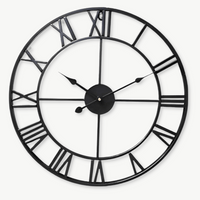

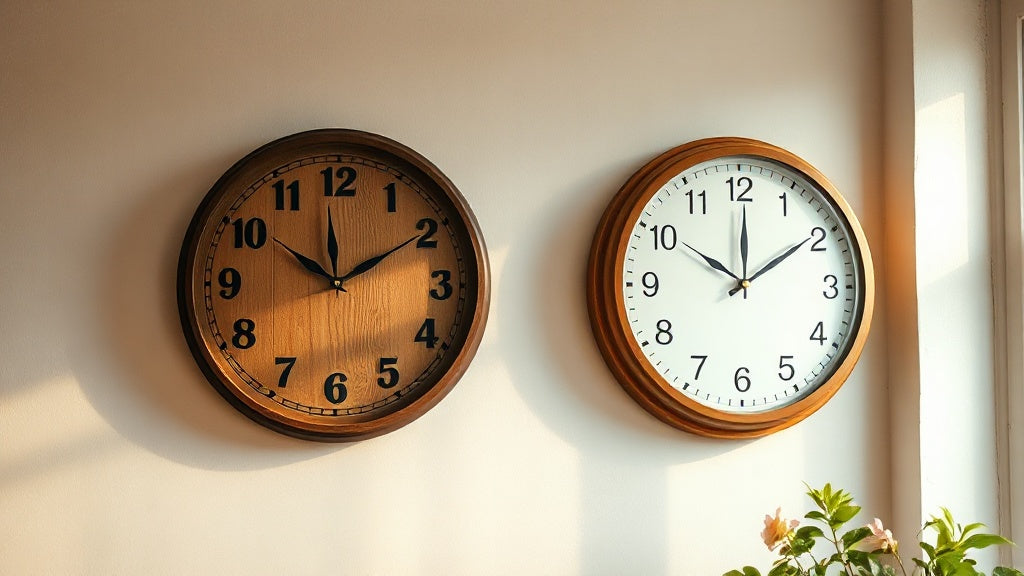
You finally found the perfect spot on the wall. The light hits it just right, the proportions work, and you've already pictured how it'll look. Then comes the question nobody warns you about: silent wall clock vs ticking wall clock. Two completely different objects. Same face, but a totally different relationship with your home.
It's not just about noise. It's about the energy a clock brings into a room, the way it behaves at 2am, and whether it works with the way you actually live. Here's what actually matters when you're choosing between them.
Key takeaways
- Silent (sweep) movements use a continuous motor - zero audible tick, ideal for bedrooms and offices.
- Ticking clocks use a quartz step movement - that classic sound is a deliberate sensory choice, not a flaw.
- Room acoustics matter more than most people expect: hard surfaces amplify ticking dramatically.
- Neither is objectively better. The right answer depends on your room, your sleep habits, and what kind of atmosphere you want to create.
- Mechanism quality varies hugely within both categories - budget movements perform poorly regardless of type.
How Each Mechanism Actually Works
Before picking sides, it helps to understand what's happening inside the clock. The difference isn't cosmetic - it goes right down to the gears.
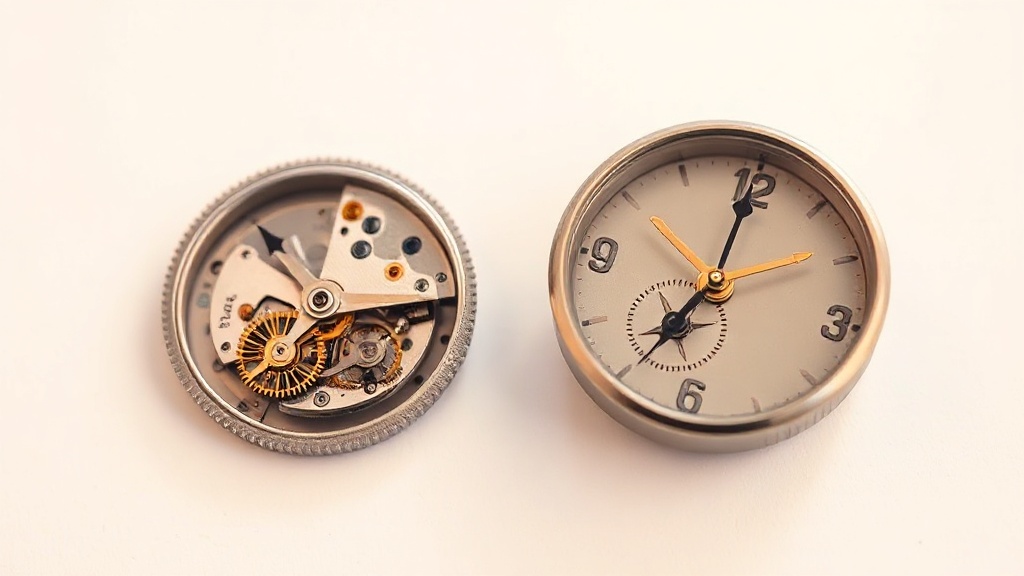
A ticking wall clock runs on a quartz step movement. A tiny quartz crystal oscillates at 32,768 Hz when electricity passes through it. The movement converts those oscillations into discrete steps - one per second. Each step is a physical click of the escapement wheel, and that click is the tick you hear. The sound is a direct mechanical byproduct of how time is measured.
A silent wall clock (often sold as a "sweep movement" clock) still uses quartz technology, but the motor drives the second hand in a continuous glide rather than discrete jumps. There's no escapement click. The hand moves in an unbroken arc, which is why you'll also see these described as "sweep second hand" clocks. The result: near-complete silence, typically under 20 decibels - roughly the ambient noise level of a quiet library. So when you're weighing the silent wall clock vs ticking wall clock decision, you're really choosing between two distinct motor philosophies, not just two sound levels.
You might not realize this...
The sweep movement was actually developed first for high-end Swiss watches in the early 20th century, where a gliding second hand was considered a mark of superior watchmaking. It only migrated to affordable wall clocks decades later, once micro-motor technology became cheap enough to manufacture at scale. That "luxury" detail is now available in a $40 clock for your hallway.
The Sound Question: What "Ticking" Really Feels Like in a Room
Here's something people consistently underestimate: room acoustics transform a clock's sound profile completely. A clock that produces a gentle, almost imperceptible tick in a soft-furnished living room - think rugs, upholstered sofas, curtains - can sound like a metronome in a kitchen with tile floors and bare walls.
Hard surfaces reflect sound. A ticking clock at 30-35 decibels in a reverberant space reads as significantly louder than that number suggests. This is why so many people report that the same clock they tested quietly in a showroom sounds intrusive once it's on their bedroom wall at home.
That said, the tick isn't always the villain. Some people find it genuinely reassuring - a rhythmic, steady pulse that reads as calm rather than intrusive. Interior designers working in traditional, rustic, or farmhouse-style spaces often deliberately choose ticking clocks because that sound is part of the atmosphere. It signals "lived-in" and "warm" in a way that silence sometimes doesn't.
Room-by-Room: Where Each Clock Type Genuinely Works Best
The honest answer isn't "silent is always better." It depends on what that room is for and who's in it.
Bedroom
Silent sweep movement. Full stop. Light sleepers especially - and really anyone who wakes during the night - will notice a ticking clock far more at 3am than during the day. The brain doesn't tune out sound the same way during light sleep phases. If you share a room with a partner whose sleep is fragile, a ticking clock becomes a household negotiation you don't need. Browse our Scandinavian wall clock collection for silent pieces that look as calm as they sound.
Home Office or Study
Also strongly in favor of silent. Deep work requires sustained focus, and rhythmic sounds - even ones people claim to "not notice" - register in working memory. The steady tick of a clock is exactly the kind of low-level distraction that fragments concentration without being obvious enough to prompt you to fix it. Sweep movement clocks let the room stay acoustically neutral.

Living Room
This is where ticking clocks can genuinely shine. Living rooms tend to be larger, more furnished, and rarely silent - conversation, television, music, and the ambient sounds of a household naturally absorb a clock's tick. A beautifully crafted ticking wall clock in a traditional or industrial-style living room adds warmth and character. The sound becomes part of the room's texture rather than an intrusion.
Kitchen
Either works, with a caveat. Kitchens are typically noisy enough during cooking that a ticking clock is inaudible. The question is whether you spend quiet time in your kitchen - morning coffee, slow weekend breakfasts. If so, a silent movement is the safer call. If your kitchen is purely functional and always busy, the distinction barely matters.
Children's Rooms and Nurseries
Silent, without hesitation. Both for nap times and for the simple fact that children are light sleepers and highly sensitive to auditory stimuli during sleep cycles.
Hallways and Entryways
Ticking clocks work well here. Hallways are transitional spaces - nobody lingers long enough for the sound to become oppressive, and the audible tick of a vintage-style or classic pendulum clock in an entry hall reads as welcoming and characterful. It's the right place to let a clock make some noise. Check the vintage wall clock range for pieces that own their tick with confidence.
| Room | Silent Sweep | Ticking Quartz |
|---|---|---|
| Bedroom | Ideal | Risky for light sleepers |
| Home office / Study | Ideal | Can fragment focus |
| Living room | Works great | Adds warmth and character |
| Kitchen | Safe choice | Usually fine (busy room) |
| Nursery / Child's room | Only option | Avoid |
| Hallway / Entry | Works fine | Often preferred for atmosphere |
The Aesthetic Angle: Style and Movement Type Don't Always Match
Here's a misconception worth clearing up: a clock's visual style doesn't dictate its mechanism type. You can find silent sweep movements inside vintage wooden cases, industrial iron frames, and ornate gold finishes. The movement is hidden. The style is entirely separate.
That said, there are some natural pairings that tend to make sense aesthetically and functionally.
Scandinavian minimalist clocks - clean dials, thin hands, light ash or bleached oak frames - pair almost instinctively with silent movements. The whole point of that aesthetic is calm and restraint. A ticking sound would work against the visual quiet those pieces are designed to create. Think of brands like Karlsson or Lemnos: the silence is baked into the design brief.
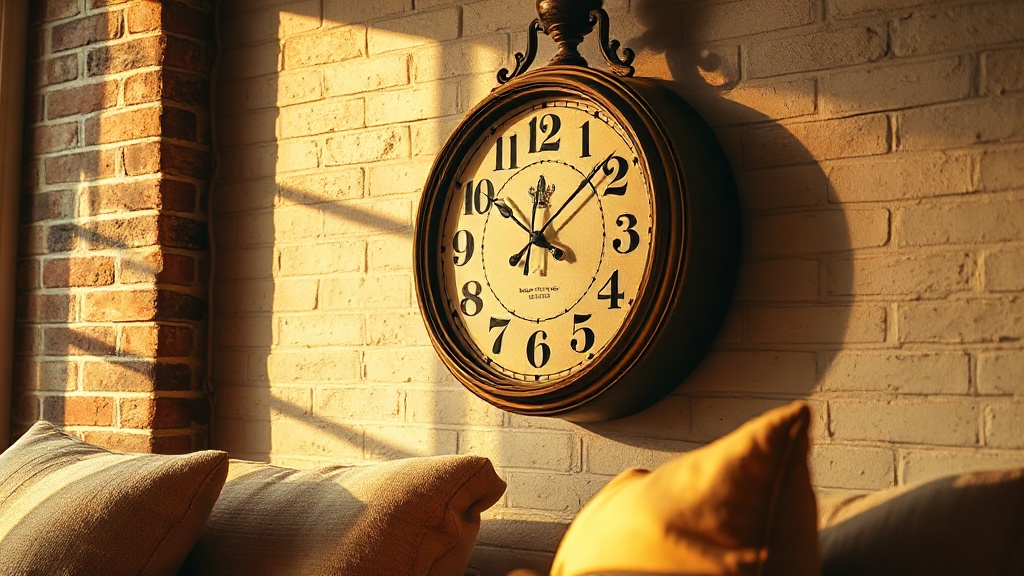
Industrial-style clocks, on the other hand - exposed metal, bold oversized numerals, raw iron or aged brass finishes - often suit a ticking mechanism because they're already making a visual statement. They belong in lofts, kitchens with brick-feature walls, and open-plan spaces where some noise is ambient and expected. The tick feels at home there.
Vintage and farmhouse styles sit in interesting territory. A genuine antique clock mechanism will tick. Reproduction vintage pieces sometimes come in either movement type. If authenticity of sound matters to you, a ticking mechanism reinforces the nostalgic quality of the piece. If you love the look but need the silence, a sweep movement in a vintage-style case is a perfectly reasonable compromise - and honestly, nobody visiting your home will know the difference.
Voir la collection
Wall Clocks
Browse 166 wall clocks across every style - silent, ticking, minimalist, vintage - to find the one your wall has been waiting for. Filter by mechanism type to zero in on exactly what your room needs.
166 références
Découvrir la catégorie →Accuracy, Longevity, and the Practical Side Nobody Talks About
Both movement types use quartz oscillators, so accuracy is broadly equivalent at the consumer level - typically within 15-30 seconds per month for standard quartz, and better for higher-grade movements. The mechanism type (sweep vs step) doesn't meaningfully affect timekeeping precision.
Where they do differ is in motor wear. Sweep movements run their motor continuously rather than in discrete pulses. In theory, this means more operating hours on the motor. In practice, a quality sweep movement will run for years on a single AA battery without issue. The real variable is movement quality, not mechanism type. A cheap sweep motor can fail in 18 months. A well-engineered ticking movement can outlast the clock's decorative life. Always look at the manufacturer's movement specification rather than the price of the clock itself - many beautiful-looking pieces house mediocre movements regardless of type.
Battery consumption is slightly higher for sweep movements because the motor runs continuously. The difference in practice is small - maybe a few extra weeks per battery - but worth knowing if you're mounting a clock somewhere awkward to reach.
What Customers Actually Say (And What That Tells Us)
Spend enough time reading clock reviews and a clear picture emerges. People who buy silent sweep clocks for bedrooms almost never regret it - the most common phrasing is some variation of "I didn't realize how much a ticking clock was affecting my sleep until I switched." Light sleepers especially report real differences in sleep quality after making the switch.
The more nuanced picture comes from living room buyers. A meaningful share of customers who specifically sought out a silent clock for their main living space report that the room felt "too quiet" or "a bit flat" afterward - they missed the sensory layer that a ticking clock provides. Several went back to a ticking model. That's not a product failure. It's a reminder that the tick isn't always the enemy; sometimes it's exactly the atmosphere you want.
Home office users are almost unanimously in favor of silent mechanisms, particularly among people who work in focused, document-heavy roles. Writers, designers, and people who spend long hours reading consistently prefer the acoustic neutrality of a sweep movement.
"A clock should keep time and hold space - not demand attention."
On the philosophy of choosing a clock for a quiet home
Three Scenarios to Help You Decide Right Now
Still unsure? Here's what works for three common situations.
You're furnishing a primary bedroom and you're a light sleeper: Silent sweep, no debate needed. Don't test it out and see - just start there. You can always add a ticking clock elsewhere in the home if you miss the sound. A Scandinavian minimalist piece in pale oak or white will look stunning above a bedside console and stay whisper-quiet all night.
You want a statement piece for a traditional or industrial-style living room: A ticking clock with a quality movement adds genuine character. Look for a movement with a softer tick (some manufacturers spec "soft tick" movements that produce a quieter, lower-frequency click). Pair it with soft furnishings to absorb the sound and you'll hit that warm, lived-in atmosphere perfectly. The industrial wall clock collection has several pieces built exactly for this scenario - raw iron cases, bold Roman numerals, movements that sound as solid as they look.
You work from home and your office doubles as a creative space: A silent wall clock in a home office isn't just about concentration - it's about building an environment that feels deliberate and curated. A well-chosen piece in a workspace communicates that the space was designed with intention, which has real psychological effects on how you perform in it. Think a slim Scandinavian-style piece in matte white or brushed aluminum: minimal on the wall, maximum on the focus.
Voir la collection
Scandinavian Wall Clocks
Clean lines, silent sweep movements, and timeless Nordic design. If you've decided quiet is the right call, this is your shortlist - every piece ships ready to hang.
18 références
Découvrir la catégorie →Beyond the Bedroom: Clocks That Earn Their Place on Every Wall
The silent wall clock vs ticking wall clock debate only matters if you treat it as a binary. The smarter approach is to think room by room and let each space tell you what it needs. A ticking pendulum clock in the hallway. A silent Scandinavian piece in the bedroom. A bold industrial number in the kitchen. Each one chosen for its context, not just its looks.
A clock is the one piece of decor that interacts with you through two senses simultaneously - what you see and what you hear. That's unusual. Most art just sits there. A clock has a presence. Getting that presence right is worth the few extra minutes of thought before you commit.
Browse the full wall clock collection to filter by style and mechanism type. If you're drawn to classic craftsmanship, the vintage wall clock range has pieces that work beautifully in either movement type. For industrial-style spaces, the industrial wall clock selection covers everything from raw iron to aged brass. And if you've already decided you want the absolute quiet, the Scandinavian wall clock collection is the most focused place to start.
Voir la collection
Industrial Wall Clocks
Raw iron, aged brass, oversized numerals. These are the clocks that own a room - and in an open-plan loft or a kitchen with exposed brickwork, a confident tick makes perfect sense.
Voir toute la sélection
Découvrir la catégorie →FAQ
Can you convert a ticking clock to a silent one?+
Yes - clock movements are standardized components and many are interchangeable. If your clock uses a standard quartz movement (the majority of wall clocks do), you can purchase a replacement sweep movement for around $5-$15 and swap it out yourself in under 10 minutes. You'll need to match the shaft length to your clock's dial thickness. Search for "replacement sweep quartz movement" with your clock's hand-shaft specifications.
Are silent clocks less accurate than ticking clocks?+
No. Both types use quartz oscillators as their timekeeping reference, so accuracy is determined by the quality of the quartz crystal and the electronic circuit, not by whether the movement is sweep or step. A premium silent clock will outperform a budget ticking clock, and vice versa. The mechanism type has no bearing on precision.
Do silent wall clocks have a second hand?+
Many do, and it's the smoothly gliding second hand that most visually distinguishes a sweep movement clock - instead of jumping second by second, it moves in one continuous arc. Some silent clocks omit the second hand entirely for a cleaner dial. If you want to confirm you're getting a sweep movement, check whether the product listing specifically mentions "silent sweep" or "continuous sweep movement," or look for a smooth-gliding second hand in product videos.
Are there any downsides to sweep movement clocks?+
Two minor ones worth knowing. First, the continuous motor draws slightly more power than a step movement, so battery life is marginally shorter - think a few weeks less per battery, not months. Second, very cheap sweep motors can produce a faint electrical hum under certain conditions. This is rare with quality movements and only audible in completely silent rooms with your ear close to the clock. Reading reviews on the specific model before buying is always a good call.
Is the tick of a pendulum clock louder than a standard wall clock?+
Generally, yes. Pendulum clocks use a mechanical escapement that produces a more pronounced "tick-tock" than a basic quartz step movement, and the pendulum case often amplifies resonance. Traditional mechanical pendulum clocks are particularly resonant. If you love the look but need a quieter option, some manufacturers now produce pendulum-style cases with silent quartz movements where the pendulum swings purely as a decorative element without driving the mechanism.
Which is better for a silent wall clock vs ticking wall clock decision in an open-plan home?+
Open-plan homes are actually the ideal case for ticking clocks in the shared living area, since ambient noise from cooking, conversation, and background audio naturally absorbs the tick. Where it gets complicated is if your open-plan space flows directly into a sleeping area or a home office nook. In those hybrid spaces, a silent sweep movement is the safer, more versatile choice - it works everywhere rather than just in the noisy parts.