
Roman Numerals on a Wall Clock: A Design Choice That Asks Something of You
A wall clock with Roman numerals is a deliberate design statement: it trades a small amount of at-a-glance speed for significant decorative authority, working best in traditional, transitional, or vintage-leaning rooms where presence matters more than split-second readability. You've spotted it. That clock with the I, IV, VIII, XII circling the dial. It looks confident on the wall, a little classical, a little authoritative. But then the question creeps in: will I actually be able to read it at a glance across the room? And will it clash with the rest of my space, or pull it all together?
Understanding the real wall clock with Roman numerals pros and cons matters far more than any product photo can show you. A wall clock with Roman numerals isn't just a timekeeping device; it's a design statement that changes the personality of a room. That's precisely why the decision deserves more thought than a quick scroll. Here's what works, what doesn't, and how to figure out which side you're on before you put a nail in the wall.
Key takeaways
- Roman numeral clocks excel as statement pieces in traditional, vintage, and transitional interiors.
- Readability at a glance is slower than Arabic numerals; distance and dial size matter more here.
- The material pairing (metal, wood, resin) shapes how formal or relaxed the Roman dial reads.
- Minimalist or highly contemporary rooms can find the style clash jarring rather than charming.
- Larger diameters (40 cm and above) tend to resolve most legibility concerns naturally.
The Case For: Why Roman Numeral Wall Clocks Keep Winning Rooms

They carry genuine historical weight
Roman numeral wall clocks keep winning rooms because they bring centuries of visual history into a space, making any interior feel established and considered without the cost of genuine antiques. Roman numerals have been used to mark hours since at least the 4th century. Sundials, tower clocks, pocket watches handed down through families: this numeral system is deeply embedded in the visual language of timekeeping. When you hang a wall clock with Roman numerals, you're borrowing that entire lineage. The room feels like it has a story, even if you moved in two years ago.
That's not sentimental fluff. Interior designers frequently point to this quality when clients want a space to feel "established" or "lived-in" without resorting to actual antiques. A Roman numeral dial does some of that work quietly, and it does it for a fraction of what a genuine heirloom piece would cost.
Did you know?
The Roman numeral IIII (four) appears on most clock faces instead of IV. This convention, called the "clockmaker's four," dates back to the 14th century and is thought to have been kept for visual balance: IIII mirrors the VIII on the opposite side of the dial far more symmetrically than IV would.
They function as wall art without trying too hard
A standard Arabic numeral clock tells the time. A Roman numeral clock does that and also invites you to look at it. The characters have visual complexity; the angles of I, V, and X create rhythm around the dial in a way that plain digits rarely achieve. In rooms where you want the clock to earn its place on the wall rather than just occupy space, that distinction matters.
Customers who've gone this route often describe it the same way: "I wasn't just looking for a clock, I wanted something that looked intentional." That's the Roman numeral sweet spot. It signals thoughtfulness without requiring a gallery-level budget.
They work across a surprising range of styles
This is where most people underestimate them. Yes, Roman numerals feel at home in traditional French country kitchens and Victorian-inspired parlors. But pair them with raw metal hands on an industrial-style clock, and suddenly they read edgy rather than stuffy. Mount a large Roman numeral dial on a Scandinavian white wall with simple birch or ash furniture, and the contrast actually works in the minimalist's favor: one warm, classical element against a clean field.
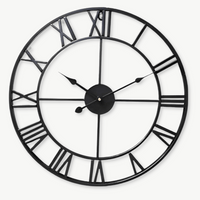
The secret is the surrounding material. A wall clock with Roman numerals cast in aged brass feels formal and salon-ready. The same numerals laser-cut into black powder-coated steel feels loft-industrial, the kind of thing that looks at home alongside exposed brick and bare Edison bulbs. In bamboo with fine brushed hands, it reads organic and Japanese-adjacent. The numerals are almost a canvas; the material applies the style.

Elena's pick
Large Roman Numeral Wall Clock - Metal, Silent Quartz
A large metal dial where the Roman numerals get the breathing room they need to read clearly from across the room. The powder-coated finish keeps it feeling contemporary rather than fussy.
219.00 USD
See the product →The Case Against: Where Roman Numerals Create Real Problems

Readability at speed is genuinely slower
Roman numerals create real problems in fast-moving rooms like kitchens and home offices, where the extra mental translation step adds up across a busy day and smaller dials under 35 cm make the issue noticeably worse. Let's be straightforward about this. If you're moving through a busy kitchen and need to clock the time in half a second, Roman numerals require a small extra translation step. Your brain reads "VIII" and converts; with "8" there's no conversion. Over the course of a day, that's barely noticeable. But in a kitchen where you're mid-recipe with flour on your hands, or a home office where you're watching a deadline, it adds up.
This isn't a dealbreaker for most people, but it's worth being honest about which rooms in your home are "I'm always rushing" zones. Kitchens and home offices fall into that category for many households. Living rooms, bedrooms, and hallways rarely do. Know your room before you commit.
Small dial sizes amplify the legibility problem
Roman numerals need space. On a 25 cm clock, the characters crowd together and the fine lines of I, V, and X blur at reading distance. Arabic numerals stay distinct down to much smaller sizes because each digit is compact and familiar. If you're considering a Roman numeral clock for a small bathroom or a narrow hallway, the dial size becomes a practical concern, not just a styling one. Aim for at least 35-40 cm in diameter if readability matters to you.
They can pull a modern or ultra-minimalist room backward
In a room built entirely around clean geometry, sans-serif fonts, and zero ornament, a Roman numeral clock introduces a historical reference that works against the intent. That classical character, the very thing that makes it beautiful in a transitional space, reads as a stylistic inconsistency in a strictly contemporary interior. The room starts to feel like it can't decide what it wants to be.
If your walls are polished concrete or white-lacquer and your furniture is all clean-lined steel or matte resin, an Arabic numeral clock with a bold graphic dial will sit better. Check out the full wall clock collection to compare both dial types side by side and get a feel for which reads more naturally in your space.
Roman vs. Arabic Numerals: Quick Decision Matrix
Not sure which numeral style fits your room? Map the wall clock with Roman numerals pros and cons against real criteria rather than gut feel. Not sure which way to go? Run your room through this comparison before you decide. The wall clock with Roman numerals pros and cons become much clearer when you map them directly against real criteria rather than gut feel.
| Criteria | Roman Numerals | Arabic Numerals |
|---|---|---|
| At-a-glance readability | Slower (requires mental conversion) | Faster (instant recognition) |
| Decorative impact | High; functions as wall art | Varies; depends on design |
| Style compatibility | Traditional, vintage, transitional, industrial | Contemporary, Scandinavian, minimalist |
| Minimum recommended size | 35-40 cm for comfortable reading | Works from 25 cm upward |
| Best rooms | Living room, bedroom, hallway, dining room | Kitchen, home office, any room |
| Timelessness | Very high; rarely feels dated | Depends on graphic treatment |
| Best pick if torn | Choose a hybrid format: Roman numerals at 12, 3, 6, 9 only; lines for the rest. Best of both worlds. | |
If you find yourself leaning Arabic after that table, browsing a clock with clean bold digits alongside your Roman shortlist is genuinely worth the five minutes. Seeing them as physical objects side by side on screen often breaks the deadlock faster than any written guide can.
Where Roman Numeral Wall Clocks Actually Shine: Room by Room

Living rooms: the natural habitat
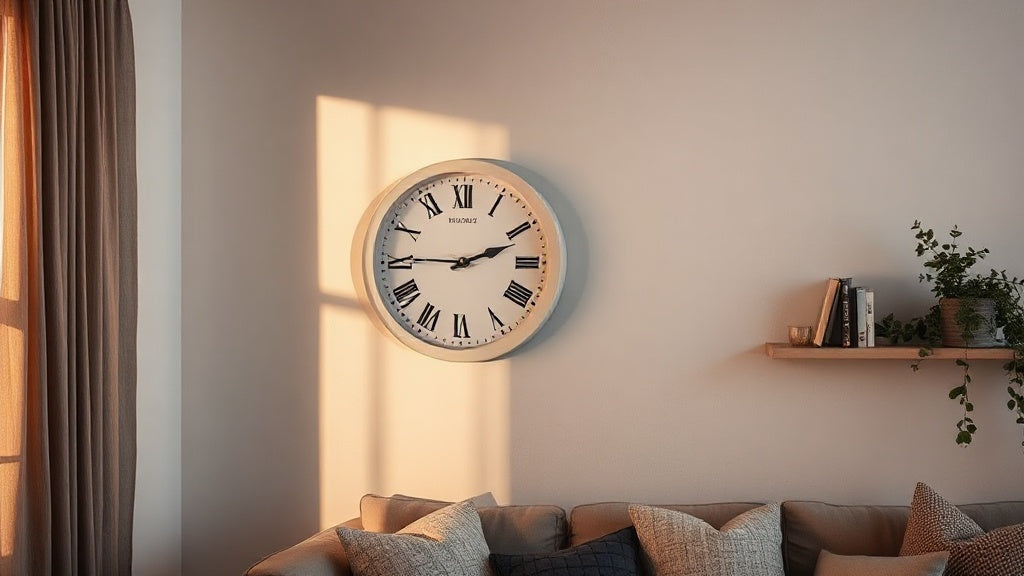
Roman numeral wall clocks shine brightest in living rooms, bedrooms, hallways, and dining rooms where decorative presence outweighs the need for instant readability, and where a larger dial of 50 cm or more becomes genuinely architectural. A large Roman numeral wall clock in a living room operates the way a focal-point painting does: it anchors the wall and gives visitors' eyes somewhere to land. The living room is also one of the few spaces where you rarely need to read the time urgently. You glance at it during conversation, while settling into the sofa. The slightly slower read of Roman numerals? Completely irrelevant here. What matters is presence, and Roman numerals deliver.
Above a fireplace, behind a sofa, flanked by shelving: these positions all benefit from a clock that has visual authority. Go large (50 cm or more) and the effect becomes genuinely architectural; the clock stops being furniture and starts being structure.
Bedrooms: quiet elegance at eye level
In a bedroom, a Roman numeral clock on the wall across from the bed creates a kind of gentle formality. It's not demanding attention the way a smart device would. It just sits there, steady. Vintage wall clocks with Roman dials particularly suit bedrooms decorated with layered textiles, warm woods, and muted palettes. Think warm whites, oatmeal linens, and walnut nightstands; a Roman numeral dial in aged gold or matte black sits naturally in that context.
One thing to check: movement noise. Many people overlook this and end up with a ticking clock that keeps them awake. Silent quartz mechanisms are the practical standard for bedrooms regardless of the numeral style you choose.
Hallways and entryways: first impressions that stick
An entryway Roman numeral clock is one of those quiet power moves in interior design. Guests see it immediately and it sets a tone before they've taken their coat off. The clock says: this home pays attention. It's considered. In a narrow hallway, keep the profile slim and the diameter proportional to the wall height. A 35-40 cm clock at roughly eye level works far better than an oversized piece crowding a tight space.
Kitchens: proceed with intention
The kitchen is where the readability trade-off bites hardest. That said, plenty of people use Roman numeral kitchen clocks without frustration, particularly in larger kitchens where the clock is a decorative anchor rather than the primary time reference (phones and oven timers handle the urgency). A vintage cafe-style Roman numeral clock in a farmhouse or French bistro kitchen feels completely right. In a sleek, tech-forward kitchen with handleless slab cabinets and polished quartz counters, it's a tougher sell.

Elena's pick
Steampunk Gear Wall Clock - 3D Wooden Gears Vintage Industrial
If you love the industrial aesthetic but still want Roman numerals, this is the bridge. Exposed wooden gears and a raw mechanical look prove the classical dial can feel completely contemporary in the right material context. It's a strong choice for loft apartments or open-plan spaces with brick or concrete walls.
From 77.00 USD
See the product →Roman Numerals vs. Arabic Numerals: What Actually Drives the Choice
The real driver behind choosing Roman vs. Arabic numerals is whether the clock needs to hold a wall as a decorative piece or simply function as a quick time reference: Roman numerals win on presence, Arabic numerals win on pure practicality. Here's an honest frame for the decision. It's not really about which numeral system is objectively better. It's about what your room is doing and what the clock needs to do inside it.
If the clock is purely functional (you're checking the time constantly, the room is practical and fast-moving, and the clock is small) Arabic numerals win on every practical measure. If the clock is partly decorative, if it needs to hold a wall rather than just sit on it, if you want guests to notice it as a piece rather than an accessory: Roman numerals carry that weight more naturally.
The hybrid question also comes up. Some clocks offer both options on the same design, or use Roman numerals only at the 12, 3, 6, and 9 positions (the cardinal points) with the remaining positions unmarked or shown as lines. This gives you the visual texture of Roman characters without the full legibility challenge. If you're on the fence, this four-numeral format is often the practical middle ground that most buyers don't think to look for.
"A clock with Roman numerals doesn't ask to be read. It asks to be noticed."
Observation shared by several customers who switched from Arabic to Roman numeral dials
What to Check Before You Buy a Roman Numeral Wall Clock
Before buying a Roman numeral wall clock, confirm dial size against viewing distance, movement type for your room, numeral contrast, and hand proportions so the clock performs as well practically as it does aesthetically. Getting the aesthetics right is step one. Getting the practical details right keeps you from returning it a week later. Here's what to confirm before checkout:
- Dial size against room scale: measure the wall space and the viewing distance. Roman numerals on a 30 cm clock read fine from 2 meters; from 5 meters you want 50 cm or more.
- Movement type: silent quartz is the standard for living spaces. Sweep (continuous) hands are quieter than step (tick-tock) hands. Check the product specs before you buy.
- Numeral style within Roman: raised 3D numerals read differently from printed flat ones. Raised characters create shadow and depth, which actually improves legibility in good light.
- Color contrast between numerals and dial face: dark numerals on a light dial read from a distance; engraved same-color numerals look refined up close but struggle across a large room.
- Frame and hand proportions: thin, spindly hands on a large Roman numeral dial get lost. Match hand weight to dial size. A 50 cm dial needs hands with some mass to read confidently from the sofa.

Elena's pick
Vintage Wall Clock - Roman Numeral or Arabic Dial, Silent Quartz
If you're genuinely torn between the two dial types, this clock lets you live with both options before committing to one permanently. It's a rare find and an honest solution for anyone still weighing the wall clock with Roman numerals pros and cons right up until checkout.
297.00 USD
See the product →Why Roman Numeral Clocks Rarely Go Out of Style
Roman numeral clocks rarely go out of style because the characters predate every modern design category, carrying their own era so far removed from contemporary aesthetics that they never age with any particular decade or trend. Trends cycle through interiors quickly. The dominant palette shifts. Furniture silhouettes change. But a well-chosen Roman numeral clock on a living room wall tends to outlast all of it. The reason is simple: the characters predate modern design categories entirely. They don't belong to any particular decade, so they don't age with that decade.
Arabic numeral clocks can be designed to feel timeless too, but their neutral legibility makes them more susceptible to the overall graphic trends of a moment. Roman numerals carry their own era, one that's far enough back that it no longer competes with contemporary aesthetics. It's a bit like how a good Chesterfield sofa or a solid oak dining table never feels "retro" in a bad way; it simply reads as considered and permanent.
That's the quiet argument for the Roman numeral vintage wall clock: it's not trying to be current. And that, paradoxically, keeps it relevant far longer. Browse the full range of wall clocks to find the dial style that genuinely fits how you live in your space.
FAQ
Are Roman numeral wall clocks harder to read than Arabic numeral clocks?+
Yes, slightly. Roman numerals require a small mental translation step that Arabic digits don't. Most people adapt quickly, and in rooms where you're not checking the time urgently, the difference is negligible. The issue becomes more noticeable on smaller dials (under 30 cm) viewed from across a large room. Sizing up generally resolves it.
What interior styles work best with Roman numeral wall clocks?+
Traditional, French country, vintage, industrial, and transitional styles are the most natural fits. Steampunk and rustic farmhouse interiors also pair well, particularly with distressed or raw-metal finishes. Strictly contemporary and ultra-minimalist rooms tend to clash with Roman numerals unless the clock design is deliberately graphic and oversized.
Why do most Roman numeral clocks use IIII instead of IV for the number four?+
This is a centuries-old clockmaker convention. IIII mirrors the VIII on the opposite side of the dial, creating visual symmetry. It also balances the number of I, V, and X characters across the face. A handful of precision timepieces use IV, but IIII is the overwhelming standard in watchmaking and clock design.
What is the minimum dial size I should buy for a Roman numeral wall clock?+
For comfortable reading from a typical room distance of 3-5 meters, 40 cm (roughly 16 inches) is a reliable minimum. Smaller clocks with Roman numerals work fine as accent pieces where you'll view them up close, but they're not practical as the primary timekeeping reference in a room.
Can a Roman numeral clock work in a kitchen?+
Yes, but it depends on the kitchen's style and how you use it. In a farmhouse, bistro, or vintage-inspired kitchen, a Roman numeral clock is a genuinely good fit. In a fast-paced cooking environment where you're constantly checking the time mid-recipe, you may find the readability trade-off frustrating. In those cases, keep a digital timer handy and treat the clock as the decorative element it really is.
Are there wall clocks that combine Roman and Arabic numerals on the same dial?+
Yes, and they're worth knowing about if you're weighing the wall clock with Roman numerals pros and cons closely. Some designs place Roman numerals at the four cardinal positions (12, 3, 6, 9) and use tick marks or lines for the remaining hours. Others offer switchable dials. The Vintage Wall Clock with dual dial option is a good example of a clock that genuinely bridges both worlds without compromising on either aesthetic.