
There's a particular kind of home that's hard to label. It has a tufted sofa but also a sleek concrete coffee table. Warm oak floors, but brushed nickel fixtures. Crown molding upstairs, open shelving in the kitchen. Sound familiar? That's transitional style, and it's genuinely one of the most common aesthetics in real homes today, even if most people don't have a word for it.
Choosing a wall clock for a transitional interior style is where things get interesting. Too rustic and the clock reads as a farmhouse holdover. Too cold and minimal and it clashes with the warmth underneath. The sweet spot exists, and it's more specific than "something neutral." Here's what actually works.
À retenir
- Transitional style blends traditional warmth with contemporary restraint, your clock needs to honor both.
- Metal with warm finishes (bronze, aged brass, copper) bridges the gap better than chrome or raw iron.
- Roman numerals read as classic; a clean, open dial reads as modern. Together, they're transitional.
- Size matters more than style: an undersized clock disappears and breaks the balance of the wall.
- Silent quartz movement is non-negotiable for living spaces where you actually spend time.
What "Transitional" Actually Means for Your Walls
Transitional design isn't a compromise. It's a deliberate conversation between two aesthetics, and the best rooms do it with intention. On a wall, that means avoiding pieces that shout one era too loudly. A highly ornate gilded clock with scrollwork belongs in a traditional room. A plain white circle with no numerals belongs in a Scandinavian minimal space. Neither is wrong on its own, but both would feel out of place in a transitional home.
What works instead: clean geometry combined with material warmth. Think a round clock face with visible Roman numerals in a matte black or antique bronze frame. The shape is modern; the numerals nod to tradition. The finish is warm but not fussy. That tension is exactly what transitional design lives on.
It's also worth thinking about scale. Transitional rooms often have architectural details like paneling, wainscoting, or picture rails alongside contemporary furniture. A clock that's too small gets swallowed. A clock that's 50 to 60 cm wide has real presence without dominating, which is the transitional sweet spot for most living rooms and dining areas.
The Best Materials for a Transitional Clock: What Actually Holds Up
Material choice is probably the single biggest lever you have when picking a wall clock for a transitional interior style. Here's what holds up, and what quietly kills the room's balance:
- Aged or brushed metal (bronze, brass, antique gold): warm enough to feel traditional, sleek enough to read contemporary. This finish shows up in both Victorian revival and modern industrial design, which is why it sits so comfortably in the middle.
- Matte black metal: clean lines and strong contrast without the coldness of chrome. Works particularly well against warm white or greige walls.
- Natural wood: bamboo or walnut with minimal embellishment bridges organic warmth (traditional) with Scandinavian restraint (modern). Avoid distressed finishes with faux aging, which read more farmhouse than transitional.
- Glass with metal framing: the transparency of glass feels contemporary; a metal rim ties it back to something more structured and classic.
Le savais-tu ?
The term "transitional design" was popularized by interior designers in the 1980s as a response to the strict rules of period-authentic traditional decorating. Rather than choosing between Georgian formality and Bauhaus minimalism, transitional spaces deliberately mix both, and have dominated North American home sales statistics ever since. It's the most popular listed interior style in U.S. real estate listings, according to the National Association of Realtors. When Elena redesigned her own living room a few years back, she had a tufted armchair from her grandmother sitting next to a poured-concrete side table she'd found at a design fair. Finding one clock that didn't betray either piece sent her down a six-month rabbit hole, and it's genuinely what shaped the way she thinks about transitional clock placement today.
Chrome and polished stainless are worth avoiding. They read purely contemporary and can make a transitional room feel colder than intended. Similarly, heavily distressed or reclaimed-wood clocks lean too rustic.
| Material | Transitional fit | Why it works (or doesn't) |
|---|---|---|
| Aged bronze / antique brass | Excellent | Warm tone bridges traditional and industrial aesthetics without skewing either |
| Matte black metal | Very good | High contrast, neutral, clean, reads modern but pairs easily with warm textiles |
| Natural bamboo / walnut | Good | Organic warmth with Scandinavian restraint; avoid distressed or painted wood |
| Glass with metal frame | Good | Transparent dial reads light and modern; framing adds structure and tradition |
| Polished chrome / stainless | Poor | Too cold; pushes the room toward purely contemporary, loses the warmth |
| Heavily distressed wood | Poor | Reads as farmhouse or rustic, not transitional |

La reco de Elena
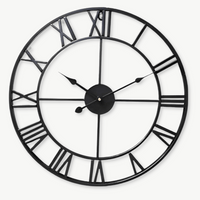
Large Roman Numeral Wall Clock - Metal, Silent Quartz
A large-format metal dial with bold Roman numerals in an aged bronze finish, the exact combination of warm material and clean geometry that holds a transitional room together without picking sides. It's what Elena ended up hanging in her own living room after that six-month search.
219.00 USD
Voir le produit →Roman Numerals vs. Arabic Numerals vs. No Numerals
This isn't just an aesthetic preference; each numeral style carries a specific design signal that affects how the clock lands in a room.
Roman numerals are the most versatile choice for transitional spaces. They carry enough visual tradition to feel grounded without being overly period-specific. A bold Roman numeral face on a clean metal frame doesn't read as "antique," it reads as considered. That's a meaningful distinction. Customers frequently describe this combination as "exactly what I was looking for" because it avoids the extremes on both ends.
Arabic numerals work well when the clock frame itself has enough warmth or structure to anchor it. A clock with clean Arabic numerals in a brushed copper or dark metal frame still feels transitional. The risk comes when both the numerals and the frame are stripped back to the point of abstraction, because that's when you've crossed into purely minimalist territory.
No numerals at all, bare indices or plain markers, works in transitional spaces only if the clock has strong material or sculptural interest. An open-dial clock in plain white with thin metal hands reads as minimalist Scandinavian, which may not bridge both sides of your room's aesthetic. If you do go marker-only, compensate with a frame that has real visual weight: a thick aged-brass ring, a layered industrial border, something that earns its place on the wall.
Sizing a Clock for a Transitional Room: the Real Numbers
The most common mistake isn't style, it's scale. A clock that looks proportionate on a product page can disappear against a real wall, especially in rooms with high ceilings or strong architectural details.
Here's a practical sizing framework that holds up across different transitional spaces, from a compact apartment to a generously proportioned family home:
- 30 cm (12 in) clocks: suited to hallways, kitchens, or small bedrooms. In a living room or above a fireplace, they read as an afterthought.
- 40-50 cm (16-20 in) clocks: the sweet spot for most rooms. Strong enough to register as a statement piece without overwhelming a wall.
- 60 cm (24 in) and above: right for large living rooms, dining rooms with vaulted ceilings, or statement gallery walls. At this size, the clock becomes the room's anchor point, which works beautifully in transitional spaces where you want one clear focal element.
Where to Hang a Clock in a Transitional Home
Placement is half the decision. A well-chosen clock in the wrong spot still falls flat.
In a transitional living room, the most reliable position is centered above a console table, credenza, or fireplace mantel. This creates an implicit vertical axis that the room organizes around. The clock acts as a capstone, not a floating object. If your walls have panel molding, work with the geometry: center the clock within a panel section rather than spanning across seams.
Hallways are underrated. A transitional hallway is often where old-house architecture meets new furniture, and a well-sized clock on the end wall makes the space feel deliberate rather than forgotten. Aim for eye-level center, roughly 57 inches from floor to clock center, the same standard used for hanging framed art.
Kitchens with transitional styling often have shaker-style cabinets alongside modern quartz countertops. A metal wall clock in a warm finish above the refrigerator or on an open end wall reads well here. Keep it practical: a 30 cm diameter is enough for a kitchen where you glance at it while cooking.
Bedrooms deserve more thought than they usually get. The wall above the dresser or opposite the bed (where your eyes land when you wake up) is a real opportunity. Choose something quieter in finish for a bedroom: softer metals, possibly wood, and make absolutely certain the movement is silent. Ticking mechanisms at 3 a.m. in a transitional space is very much not the experience you're after.

La reco de Elena
Luxury Designer Wall Clock - Gold and Black Metal, 22 x 17 in
The black-and-gold pairing holds classic warmth and modern contrast in one frame, a strong anchor above a console or fireplace in any transitional room. If you're looking for a clock that doubles as a conversation piece, this is the one.
250.00 USD
Voir le produit →Mixing Clock Finishes with Other Hardware in the Room
One question that comes up constantly: does the clock finish need to match the rest of the room's metal hardware? Doorknobs, light fixtures, curtain rods, when you're in transitional territory, these are often already mixed.
The short answer: it doesn't need to match exactly, but it needs to be in the same temperature family. Warm metals (brass, bronze, copper, gold) work together even at different sheens. Mixing antique brass with matte black is a classic transitional pairing because both sit on the warm or neutral side of the spectrum. What breaks the room is introducing a cold metal, polished chrome, brushed nickel, silver, against a collection of warm tones.
Think of your clock as part of the room's "metal story." If your light fixture is matte black and your cabinet pulls are aged brass, a clock in either of those finishes reinforces the story. A clock in satin nickel interrupts it. This principle is especially important when you're choosing the best materials for a transitional clock in a space that already has a lot going on visually.
"In a transitional room, nothing should be an accident. Every piece is a choice, and when the choices are coherent, the room feels settled, even when the styles are mixed."
Common thread in how experienced interior designers describe the transitional approach
When a Wooden Clock Is the Right Call
Not every transitional room needs metal. Some spaces lean warmer: more linen, more natural fiber, more visible wood grain in the furniture. In those rooms, a metal clock can feel out of step, even with the right finish.
A wooden wall clock in a transitional context works best when the wood is clean-grained and minimally treated. Bamboo with a dark stain, walnut with a clear seal, or a clock with a wooden frame around a simple open dial all land in that in-between space. The key is restraint: no carved scrollwork, no faux-aging, no country cottage silhouettes. Think of the wood the way a Scandinavian minimalist would, present for its natural beauty, not dressed up to perform.

La reco de Elena
Black Nordic Wooden Wall Clock - Scandinavian Bamboo Design
Bamboo construction with a clean black dial, when your transitional room runs warmer and more natural, this one holds the line without tipping into farmhouse territory. The *wabi-sabi* spirit of the bamboo grain does all the quiet work.
67.00 USD
Voir le produit →The One Feature That's Non-Negotiable Across Every Transitional Clock
Whatever you choose, metal, wood, Roman numerals, open dial, 40 cm or 60 cm, make sure the movement is silent quartz. This isn't a luxury specification; it's basic livability. A ticking clock in a living room or bedroom is the kind of sound that starts as background and ends as the only thing you hear.
Silent quartz (also called "sweep" movement) uses a continuous motor rather than the step-tick mechanism in standard quartz. The hands move in a smooth, unbroken sweep. No click, no tick, no audible reminder that there's a mechanism on your wall. In a transitional interior where the atmosphere is carefully balanced, the last thing you want is an acoustic interruption pulling you out of a room that's supposed to feel effortless.
All the clocks featured here use silent quartz movements. It's one of those things that's hard to overstate until you've lived without it.
Putting It All Together: Your Transitional Clock Checklist
If you take one thing from this guide, let it be this: a wall clock for a transitional interior style isn't about finding something inoffensive and neutral. It's about finding a piece that actively participates in both conversations your room is already having. Warm materials that still feel contemporary. Classic detail that reads as intentional, not nostalgic. The right size to hold its place on the wall without shouting. And a silent movement that respects the atmosphere you've worked hard to build. Get those four things right and the clock stops being a practical afterthought; it becomes part of what makes the room feel settled.
Not sure where to start? Browse the full wall clock collection and filter by finish. Warm metal tones like aged bronze, antique brass, and matte black will surface the strongest candidates for most transitional spaces. If your room leans warmer and more organic, the wooden wall clock range is worth a look too.
FAQ: Wall Clocks for Transitional Interiors
Can a clock with a very ornate frame work in a transitional room?+
It depends on how the rest of the room is anchored. A clock with sculptural metal detail, like layered rings or a gear-like frame, can work if the room's furniture is clean and contemporary. The contrast reads as intentional. However, a clock with classical ornamental carving or floral scrollwork will pull the room firmly toward traditional and is harder to balance against modern elements.
What wall color works best with a metal wall clock in a transitional space?+
Warm whites, off-whites, greige (warm grey-beige), and soft taupe are the most forgiving backgrounds. They let both warm and cool metal tones breathe. Darker accent walls, charcoal, deep navy, forest green, work particularly well with gold or brass-finish clocks, creating strong contrast without coldness. Avoid bright white (cool undertone) behind warm brass, as it creates an undertone conflict.
Is there a "wrong" clock style for a transitional interior?+
A few styles consistently clash. Hyper-rustic clocks (distressed wood, barnwood frames, vintage enamel with chippy paint) lean too country. Clocks that are purely industrial, exposed gears, raw steel without any warmth, can also overpower the traditional side of a transitional space unless the room is already quite contemporary. Ultra-modern clocks with no numerals and bare acrylic dials sit firmly in minimalist territory and may leave a transitional room feeling unresolved.
How far from the ceiling should a wall clock be hung?+
The standard for hanging any wall art applies: center the clock at approximately 57-60 inches from the floor. This corresponds to average eye level and is the industry standard used by galleries. The exception is when the clock is hung above furniture; in that case, leave 8-10 inches between the top of the furniture and the bottom edge of the clock, and adjust height accordingly.
Can I use a large statement clock in a small transitional room?+
Yes, with care. A single oversized clock on a small room's main wall can actually make the space feel more intentional; the clock becomes the room's focal point rather than competing with multiple smaller pieces. The key is to keep the wall otherwise clear, and choose a clock with visual lightness (open frame, minimal detail) rather than a heavy or densely decorated dial that visually compresses the space.
How do I know if a clock is truly silent or just "quiet"?+
Look for the terms "silent quartz" or "sweep movement" in the product description. These indicate a continuous-motor mechanism with no step-tick. If the listing only says "quartz movement" without those qualifiers, assume it ticks. All clocks featured on this site use verified silent quartz movements, so you won't need to guess.