
That Tick Is Louder Than You Think
You hang a new clock in the bedroom. The first night, you barely notice it. The second night, the tick lands right in the silence between thoughts. By the third night, you're wondering whether the clock or you needs to leave the room. Sound familiar? It's one of the most common complaints about analog wall clocks, and the fix is simpler than most people realise.
A wall clock with a silent sweep second hand runs its second hand in one smooth, near-continuous rotation rather than the familiar step-step-step of a standard quartz movement. No click. No tick. Just time, moving quietly past.
Below, we dig into how sweep movements actually work at a mechanical level, why they differ from stepping movements, which rooms benefit most, and what to check before you buy. Think of it as everything your retailer's product listing probably skipped.
Key takeaways
- A sweep second hand moves continuously, powered by a high-frequency motor rather than a 1-pulse-per-second stepping motor.
- Standard quartz clocks tick because their motors fire one impulse per second, snapping the hand to each new position with an audible click.
- Sweep movements are not inherently more accurate. Precision depends on the quality of the quartz oscillator, not the sweep action.
- The best environments for sweep clocks: bedrooms, nurseries, home offices, libraries, therapy rooms, and anywhere concentration matters.
- Not every clock labelled "silent" uses a true sweep motor. Always check whether the movement is a continuous sweep or simply a stepped movement with a rubber-dampened gear.
Stepping vs. Sweep: What Actually Happens Inside the Clock
Most quartz wall clocks use what's called a stepping motor, or a "1-step-per-second" movement. The quartz crystal oscillates at 32,768 Hz. A frequency divider chip counts those oscillations and fires a single electrical pulse to the motor every second. That pulse makes the motor rotate exactly one step, which advances the second hand one position on the dial. It's efficient, cheap to manufacture, and accurate enough for everyday use. The downside is that each pulse produces a small mechanical impact. That's your tick.
A wall clock with a silent sweep second hand works differently. Instead of firing one pulse per second, the motor receives multiple smaller pulses each second, often between 6 and 300 micro-steps per second depending on the quality of the movement. The second hand rotates almost continuously, covering the same 360 degrees over 60 seconds but spreading the motion across many tiny increments instead of 60 hard snaps. Because no single impulse carries enough force to produce an audible click, the hand glides rather than jumps.

Higher-end sweep movements use what engineers call a quartz continuous sweep or velvety sweep motor. These divide each second into finer steps, producing a smoother visual arc and reducing any residual mechanical sound to near zero. A mid-range sweep clock might run at 12 or 24 steps per second. A premium movement can reach 100 or more. At 100 steps per second, the naked eye sees zero stepping, and the ear hears nothing.
Did you know?
The stepping quartz movement was introduced commercially in the late 1960s, popularised by Seiko's Astron in 1969 and rapidly adopted because it was far cheaper to produce than mechanical clockwork. The sweep quartz movement came later, originally developed to replicate the visual elegance of traditional mechanical watches, where the escape mechanism naturally produces a smooth second-hand sweep. So the "sweep" in modern quartz clocks is essentially borrowing the visual language of 17th-century horology. There's something quietly poetic about that.
Why Quiet Rooms Amplify the Tick More Than You Expect
Human hearing is not linear. We're wired to notice repetitive sounds, particularly at frequencies and rhythms that pattern well. A clock ticking at exactly 1 Hz (once per second) sits at a tempo the brain locks onto almost involuntarily, especially in the absence of other ambient noise. In a busy open-plan kitchen with background chatter and coffee machines running, a ticking clock is invisible. Put the same clock in a bedroom at midnight and it becomes the loudest thing in the room.
This is the core reason a silent sweep second hand clock matters so much in specific rooms. The issue isn't the absolute decibel level. A stepping quartz movement produces roughly 25 to 35 dB at close range, which is quieter than a whisper. The problem is the pattern. Rhythmic, isolated sounds at a fixed interval are exactly what the auditory system is built to track. A sweep movement removes the pattern entirely, not just the volume.
People who work from home notice this intensely. A home office needs a clock for time management. It also needs focus. A ticking clock during deep work is a constant micro-interruption: not loud enough to consciously disturb, but repetitive enough to cost concentration over a long session. A sweep clock solves both needs without compromise. It's the kind of small upgrade that feels almost embarrassingly impactful once you've lived with it for a week.

The Five Rooms That Benefit Most from a Sweep Clock
1. The Bedroom
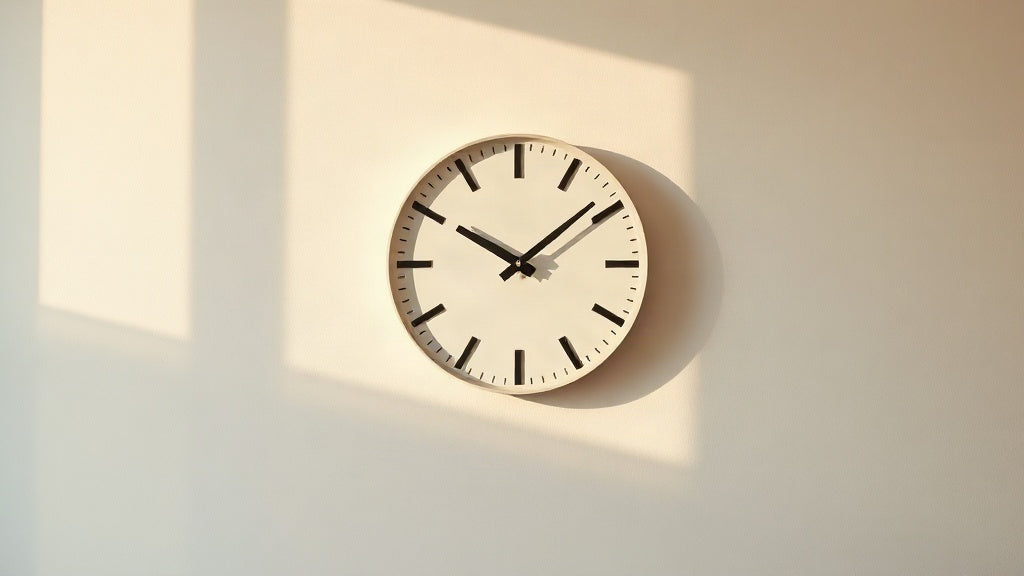
The most obvious case. Sleep onset requires a drop in alertness, and a ticking clock keeps a background alertness signal running. People who are light sleepers or who struggle with sleep latency often report a measurable difference after switching to a sweep movement. Beyond sleep, a bedroom clock is one of the first things you see in the morning. It deserves to look intentional. A sweep clock pairs especially well with Scandinavian or minimalist bedroom design precisely because both prioritise calm over noise. Thin hands on a clean white or pale ash dial, no numerals, no fuss. That's the brief.
2. The Nursery
Babies and toddlers are particularly sensitive to repetitive background sounds during sleep cycles. Parents who've spent 40 minutes settling a baby know exactly how much a single mis-timed tick can cost. A sweep movement on a nursery clock removes that variable entirely. And honestly, anything that buys you an extra 20 minutes of quiet at 2 a.m. is worth it.
3. The Home Office
Deep work, video calls, reading, and creative sessions all benefit from auditory calm. A clock in a home office serves a practical function: it keeps you off your phone. A sweep clock lets you keep that time-checking habit without the background percussion that undermines focus. It's a small thing, but the silent wall clock collection is full of options that work just as hard aesthetically as they do acoustically.
4. The Living Room
This one is more about context. During a film, a conversation, or quiet reading, a ticking clock competes with the atmosphere you're trying to create. In a living room where the clock is also a statement piece (and it should be, given how much wall space it occupies), a sweep movement means the clock contributes visually without imposing sonically. Industrial iron case, raw concrete finish, or clean Scandinavian lines: all of them carry sweep movements beautifully.
5. Therapy, Meditation, or Study Spaces
Any space designed for concentration or inner quiet is a natural fit. Therapists, tutors, and meditation practitioners have been recommending sweep movements to clients for years precisely because the brain registers the tick as an intrusion even when the person believes they've tuned it out. Out of sight but not, it turns out, out of mind.

How to Tell a True Sweep Movement from a Dampened Tick
Here's where shopping gets genuinely confusing. The word "silent" on a clock listing can mean two very different things, and retailers don't always distinguish between them clearly.
The first type is a true sweep (or continuous sweep) movement: the motor physically fires multiple times per second, producing genuine smooth rotation. The second type is a dampened stepping movement: the standard 1-step-per-second motor is paired with rubber dampening on the gear train to absorb the mechanical click. The hand still steps once per second, but the noise is reduced. The visual effect looks like stepping, not sweeping. Up close or in a very quiet room, you can sometimes still hear a faint click.
| Feature | True Sweep Movement | Dampened Stepping Movement |
|---|---|---|
| How the hand moves | Continuous fluid arc | Still steps once per second |
| Sound level | Effectively zero at normal distances | Reduced but may click faintly |
| Battery life | Slightly higher consumption (more pulses) | Similar to standard quartz |
| Visual effect | Smooth, watch-like sweep | Visible stepping at 1-second intervals |
| Typical price premium | Moderate to significant | Minimal over standard quartz |
| Best for | Bedrooms, nurseries, studios | Living rooms, kitchens where some noise is ambient |
When reading a product listing, look for the specific phrase "continuous sweep" or "sweep movement" in the specifications. "Whisper quiet" and "silent" often describe dampened stepping movements. If the listing includes a close-up photo of the second hand, check whether it appears to be mid-position between two minute markers. That's a reliable visual indicator of a true sweep motor.

Does a Sweep Movement Affect Accuracy?
This is one of the most persistent myths around sweep clocks. Many buyers assume that because the hand moves more smoothly, the timekeeping must be more precise. It isn't, at least not because of the sweep itself.
Both stepping and sweep quartz movements regulate time from the same 32,768 Hz quartz crystal. Accuracy depends on the quality of the crystal and the temperature compensation of the circuit, not on how many pulses per second the motor fires. A standard stepping movement with a high-grade crystal can be more accurate than a budget sweep motor. What varies is the motor's job: in a stepping movement, the motor's only task is delivering one reliable impulse per second. In a sweep movement, it's managing dozens of micro-impulses per second, which demands a more precisely engineered motor.
The net result: both types typically achieve plus or minus 15 to 30 seconds per month under normal home conditions. High-quality movements from recognised manufacturers like Seiko (Japan), Ronda (Switzerland), or Hermle (Germany) narrow that to plus or minus 5 to 10 seconds per month. Radio-controlled or GPS-synchronised clocks can hold to within fractions of a second indefinitely, regardless of whether they use a sweep or stepping display.
Sweep Movements Across Different Clock Styles
One thing worth knowing: sweep motors are not exclusive to minimalist or Scandinavian wall clocks. They're available across a wide range of styles, which means you don't have to sacrifice your aesthetic to get quiet timekeeping.
Minimalist and Scandinavian Wall Clocks
This is where silent sweep second hand wall clocks appear most often, partly because the design ethos (calm, uncluttered, purposeful) maps naturally onto the acoustic goal. A clean white dial with thin black hands and no numerals is the genre's flagship. The sweep hand reads as effortless because there's nothing on the face to distract from its motion. If you're building a living room wall clock arrangement around Scandinavian principles, a sweep movement isn't optional, it's the logical conclusion.
Wooden Wall Clocks
Natural wood dials, bamboo frames, and walnut cases can all house sweep movements. The warmth of the material pairs beautifully with the quiet of the movement. A handcrafted walnut sweep clock in a bedroom or reading nook doesn't just look good; it holds a certain honesty. The grain is real, the silence is real, and the whole object feels like it belongs somewhere considered rather than just decorated. Wood and silence genuinely belong together.

Vintage and Industrial Clocks
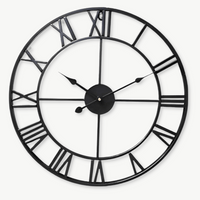
Roman numeral dials, iron cases, and aged finishes can absolutely carry sweep movements. The aesthetic contrast of a raw industrial look with a whisper-quiet movement is actually one of the most satisfying design decisions you can make. The clock looks like it should be noisy and isn't. That gap between expectation and experience is what makes a room interesting, and it's a conversation starter every single time someone notices it.
Large Statement Clocks (45 cm and above)
Scale matters here. A large wall clock with a sweep movement turns the second hand's motion into something genuinely watchable. At 60 cm diameter, the second hand travels a visible arc with every micro-step. It becomes meditative rather than mechanical. This is why large living room clocks often pair especially well with sweep movements: the visual effect rewards the scale in a way a small clock never could.
If you're working with a large statement piece and want a material that reads clearly at distance, glass is worth considering. It catches the light differently across the day, and a silent movement keeps the visual drama undiluted by any acoustic competition.

Practical Things to Check Before You Buy
Getting the right sweep clock isn't just about the movement. A few other factors determine whether you'll still love it in six months.
Battery Type and Lifespan
Most sweep wall clocks run on a single AA or AAA battery. Because sweep motors fire more pulses per second than stepping motors, they draw slightly more current. A good sweep movement should still run for 12 to 18 months on a standard alkaline battery. If a clock claims only 6 months per battery, that's a sign of a lower-efficiency motor. Avoid lithium batteries unless the manufacturer specifically recommends them. They deliver higher voltage that can damage some quartz motors.
Movement Brand vs. Generic
The movement inside matters more than the case around it. Recognised movement manufacturers include Seiko (Japan), Ronda (Switzerland), and Hermle (Germany). Many well-designed wall clocks use generic Chinese movements, which are perfectly adequate for stepped clocks but vary significantly in sweep quality. If the listing doesn't name the movement brand, ask the retailer or check customer reviews for comments about hand smoothness.
Dial Size and Second Hand Visibility
A sweep second hand only reads as smooth when the dial is large enough to show the motion clearly. On a very small clock (under 20 cm), the second hand's arc is too short to appreciate the sweep effect. The sweet spot for appreciating a sweep movement visually is a dial of 30 cm (12 inches) or larger. At 40 to 60 cm, the sweep becomes genuinely elegant.
Glass vs. Open Dial
A clock with a glass cover creates a small enclosed air space that can amplify any residual movement sounds, particularly in very quiet rooms. An open dial (no glass) removes that potential resonance chamber. If near-total silence is your priority, open-dial clocks with sweep movements are the safer choice.
"A clock is the one piece of decor you interact with dozens of times a day without ever touching it. It earns its place on the wall with every silent second it keeps."
Elena Rossi, on why movement quality matters as much as design
Where to Place a Sweep Clock for Maximum Effect
The silence of a sweep movement changes what placement is possible. With a ticking clock, you instinctively avoid quiet rooms. Or you stop noticing the tick, which means it's managing you rather than the other way around. A sweep clock expands your options considerably.
In a bedroom, mount it at eye level when seated on the bed, roughly 140 to 150 cm from the floor. That's the reading angle, which is where you'll actually look at it most. Above the headboard works visually but can feel a little surveilled. Side walls at bed height feel more natural and more human.
In a home office, keep it within your natural peripheral vision zone. You want to check time without turning away from your screen. A 30 to 40 cm clock at roughly monitor height on an adjacent wall is ideal. Avoid placing it directly behind your monitor. The sweep motion in your peripheral vision can become a distraction rather than an aid.
In a living room, the clock can afford to be larger and more architectural. A 50 to 60 cm clock above a sofa or flanking a fireplace reads as a design intention, not just a functional object. The living room wall clock collection covers everything from Scandinavian minimalism to industrial statement pieces, all worth considering if you're planning around a sweep movement.
For a nursery or child's bedroom, keep it out of reach but visible to you when you're in the room. A simple, clearly-marked dial at adult eye height on the wall opposite the cot or bed works well. You'll use it constantly for nap tracking and feeding schedules, and the silence will matter every single time.
Silent Wall Clocks
Every clock in this collection is built around one principle: quiet movement, strong design. A natural starting point if you want to browse sweep and silent options together without wading through stepping-motor listings.
179 références
Découvrir la catégorie →When a Sweep Clock Is Not the Right Choice
There are situations where a stepping clock actually works better, and it's worth being honest about them.
If you use a wall clock as a timer during work sessions (say, the Pomodoro technique), a ticking clock provides an auditory rhythm that some people find grounding rather than distracting. The tick becomes a pacing signal, not noise. In that context, the sweep removes something useful.
Kitchen environments with constant background noise (extractor fans, appliances, ambient sound) make the silence of a sweep movement largely irrelevant. A more affordable stepping clock in a kitchen will perform identically from a practical standpoint.
Children's bedrooms for older children learning to read time often benefit from the visual clarity of a stepping hand that lands crisply on each second marker. The sweep can look ambiguous to a child still learning to associate hand position with specific numbers.
And if you genuinely love the sound of a ticking clock (some people find it cosy, warm, even reassuring), then a sweep movement gives you nothing and costs you something. Personal response to sound is real and valid. There's no objectively correct answer, only what works in your space with your nervous system.
FAQ
What is a sweep second hand on a wall clock?+
A sweep second hand is one that moves in a smooth, continuous arc around the clock face rather than advancing in discrete one-second jumps. It's driven by a multi-pulse motor that fires several times per second, producing fluid motion and eliminating the audible click of a standard stepping quartz movement.
Is a sweep clock more accurate than a ticking clock?+
No. Accuracy in a quartz clock depends on the quality of the quartz crystal oscillator, not on whether the motor produces a sweep or a step. Both types typically maintain accuracy within 15 to 30 seconds per month under normal home conditions. Premium movements from brands like Seiko or Ronda can achieve plus or minus 5 seconds per month regardless of movement type. The sweep is a sonic and visual upgrade, not a precision one.
How can I tell if a clock listed as "silent" has a true sweep movement?+
Look for the specific terms "continuous sweep" or "sweep motor" in the product specifications, rather than just "silent" or "whisper quiet," which can describe rubber-dampened stepping movements. If you already own the clock, hold it face-up and watch the second hand for 10 seconds. A genuine sweep will show fluid motion with no perceptible individual steps. A dampened stepper will still jump once per second, just more quietly.
Do sweep clocks use more battery power than regular ticking clocks?+
Slightly, yes. Because a sweep motor fires multiple pulses per second rather than one, it draws marginally more current. In practice, a quality sweep movement on a single AA battery should still last 12 to 18 months. A budget sweep motor may only manage 8 to 12 months. The difference is minor compared to the acoustic benefit.
Which rooms benefit most from a wall clock with a silent sweep second hand?+
Bedrooms, nurseries, home offices, and any quiet study or reading space benefit most. These are environments where ambient noise is low and the brain is primed to pick up repetitive background sounds. A sweep movement removes the rhythmic tick that standard quartz clocks produce, keeping the auditory environment calm without giving up the utility of an analog clock face.
What clock movement brands make the best sweep motors?+
The most consistently recommended movement manufacturers for true sweep quality are Seiko (Japan), Ronda (Switzerland), and Hermle (Germany). When a product listing names the movement brand, that's usually a good sign the retailer knows what's inside. If no movement brand is listed, ask before buying or check customer reviews specifically for comments about hand smoothness and noise level.