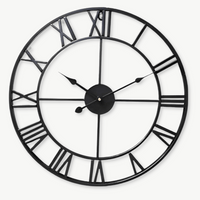


You glance at the wall, check the time, and later realize your phone says something different. By five minutes. Maybe ten. It's one of those small frustrations that shouldn't matter but somehow really does, especially when you're timing a recipe, catching a bus, or trying to make a meeting. Here's the thing: a wall clock that keeps accurate time isn't just about picking an expensive model. There are specific, fixable reasons why clocks drift, and specific habits that keep them honest. Think of this as your complete set of wall clock that keeps accurate time tips, covering everything from battery choices to placement science to knowing when a movement is simply done. Let's work through all of them.
⭐ Key takeaways
- Battery quality and freshness are the single biggest variable in quartz clock accuracy.
- Temperature swings and humidity cause mechanical drift that even good movements can't fully compensate for.
- Placement, not just the movement type, determines how consistently your clock performs over months.
- A basic 10-minute maintenance routine twice a year prevents most common timekeeping problems.
- Silent sweep movements (vs. stepping motors) tend to lose less power per tick, which helps long-term accuracy.
Why Most Wall Clocks Drift in the First Place
Clock drift is almost never dramatic. It creeps in at a rate of a few seconds per day, which compounds to minutes over weeks. Understanding the root cause is the shortest path to fixing it.
Every standard wall clock that keeps accurate time relies on a tiny crystal oscillator that vibrates at 32,768 Hz (oscillations per second). A microchip counts those vibrations and converts them into second-by-second pulses that move the hands. The crystal is remarkably stable, but it's not immune to its environment. Anything that disturbs the crystal's resonance frequency or the electrical signal feeding it will nudge your clock off course.
Here are the main culprits, ranked by how often they actually cause problems in real homes:
- Weak or low-quality batteries: the most common cause by far. As voltage drops, the microchip can't fire consistent pulses.
- Temperature extremes: quartz crystals are calibrated for a narrow temperature range, typically around 25°C (77°F). Kitchens, garages, and rooms with radiators push clocks outside that sweet spot.
- Humidity and condensation: moisture interferes with the electronic components and can cause micro-corrosion on battery contacts.
- Physical vibration: a clock on a wall shared with a washing machine, HVAC unit, or heavy foot traffic absorbs constant micro-shocks.
- Magnetic interference: proximity to speakers, televisions, or large appliances with strong motors can disrupt the movement.
- Movement wear: gears and plastic components in older clocks accumulate friction over years of use.
- Improper hanging angle: a clock not hung flush and level puts uneven stress on the gear train.

The Battery Factor: It's More Than Just "Is It Dead?"
Most people replace a battery only when the clock completely stops. That's too late for accurate timekeeping. A battery at 80% or even 60% charge still powers the clock, but it no longer delivers consistent voltage. The movement stutters at a microscopic level you can't see, and those stutters add up to drift you absolutely can feel after a few weeks.
Here's what actually works: replace the battery on a schedule, not on a failure. For most quartz wall clocks, that means once every 12 months even if the clock is still running. Use alkaline batteries from a reputable brand (Duracell, Energizer, Panasonic), and avoid generic supermarket batteries for any clock you care about.
💡 Did you know?
The quartz oscillator in most wall clocks is accurate to within about 15 seconds per month under ideal conditions. That's roughly 0.0003% error. The battery delivering power to it is typically the variable that degrades that figure in practice.
One more battery tip worth knowing: carbon-zinc batteries (the cheaper kind often sold in bulk packs) have a higher internal resistance than alkaline cells. That means they deliver less stable voltage from the moment you install them. For kitchen clocks or bedroom clocks you rely on daily, alkaline is the only sensible choice. And if you're somewhere with dramatic seasonal temperature swings, look for lithium AA cells: they maintain voltage more consistently than alkaline in both cold and warm conditions, so a clock in a chilly mudroom or a garage workshop will stay on track even in January.
How Temperature and Humidity Silently Undermine Your Clock

Kitchens are the worst room in your home for clock accuracy, and not for the reason most people assume. It's not the steam from cooking (though that doesn't help). It's the temperature cycling: cold in the morning, hot when the oven or stovetop runs, then cooling down again. That constant thermal expansion and contraction affects both the quartz crystal and the gear components around it.
Quartz crystals are cut and calibrated at the factory for a specific "turnover temperature," usually around 25°C. At that temperature, the frequency is at its nominal value. Move significantly above or below that, and the frequency shifts. For most consumer-grade movements, a 10°C swing can introduce a drift of 1 to 2 seconds per day.
Humidity is a slower problem. It doesn't affect timekeeping immediately, but moisture that condenses on battery contacts forms a thin layer of oxidation that increases resistance. More resistance means less consistent current, which means the movement gets slightly irregular power. A clock in a humid bathroom can lose accuracy over months without the owner ever noticing why.
Practical fixes here are simple:
- Keep clocks at least 50 cm (about 20 inches) away from cooking surfaces, ovens, and radiators.
- Avoid hanging clocks on exterior walls in cold climates, where the wall surface can be noticeably cooler than the room.
- In bathrooms, choose a clock rated for humidity, or accept more frequent battery changes.
- If a clock has been in storage, let it acclimate to room temperature for an hour before setting the time.
Quartz vs. Stepping Motor vs. Silent Sweep: Which Movement Stays Most Accurate?
You've probably noticed that some clocks tick audibly, one click per second, while others have a smooth, continuous sweep of the second hand. That difference isn't just about noise. It reflects two fundamentally different ways the motor moves the hands, and it has consequences for accuracy.
| Movement Type | How It Works | Accuracy | Best For |
|---|---|---|---|
| Stepping (ticking) | Motor fires once per second in discrete pulses | ±15 sec/month typical | Living rooms, kitchens, offices |
| Silent sweep | Motor runs continuously, no audible tick | ±10-15 sec/month typical | Bedrooms, offices, nurseries |
| Radio-controlled (atomic-synced) | Receives time signal from atomic reference, auto-corrects | Effectively zero drift | Kitchens, offices, anyone who needs exact time |
| Mechanical (spring-driven) | Wound spring drives gear train via escapement | ±2-5 min/month, varies widely | Collectors, heritage pieces |
For most people reading this, a high-quality silent sweep quartz movement is the sweet spot. It's quiet enough for a bedroom, accurate enough for daily life, and doesn't require the radio signal that atomic clocks need (which can be blocked by thick walls, certain building materials, or distance from transmitters).
One thing the table can't fully capture: not all quartz movements are equal. A movement costing $3 from a budget manufacturer and one costing $15 from a German or Japanese supplier (Hermle, Seiko, UTS) can have meaningfully different real-world accuracy. The crystal grade, the motor coil quality, and the gear tolerances all play a role. When you're investing in a clock you want to keep for a decade or more, the movement inside matters at least as much as the case around it. If you're drawn to a Scandinavian-style birch case or an industrial-look metal dial, it's still worth peeking at the spec sheet to confirm what's ticking inside.

Physical Placement: The Variable Everyone Ignores
Where you hang a clock affects how long it keeps time accurately. The movement isn't the only thing that matters. The wall it sits on, what's behind it, and how level it's mounted all play a role.
A clock hung even slightly off-level puts asymmetric stress on the gear train. In a mechanical clock, this can cause noticeable drift within days. In a quartz clock, the effect is more subtle, but the hands can develop play over months as the gears wear unevenly. Use a spirit level when hanging. It takes 30 seconds and saves real headaches.
Vibration is the other placement factor worth taking seriously. A wall shared with a boiler room, a laundry area, or a street-facing exterior wall will transmit constant micro-vibrations into the movement. Over time, that loosens gear mesh and increases friction. If you're choosing between two walls, always pick the quieter one.
And about height: eye level (roughly 150 to 165 cm from the floor to the clock's center) isn't just an aesthetic preference. It's also the position where temperature and airflow tend to be most stable, away from floor-level cold drafts and ceiling-level heat buildup. As a bonus, it's also where your clock makes the strongest visual statement, particularly true for a minimalist Scandinavian piece or an oversized industrial-style metal dial that deserves to be seen properly.

Choosing a Clock Built for Long-Term Accuracy
If you're shopping specifically for a wall clock that keeps accurate time with minimal fuss, a few design details cut through the noise.
First, look at the movement origin. German movements (UTS, Hermle) and Japanese movements (Seiko, Miyota) have a track record for consistency over years of daily use. A product listing that mentions the movement brand is a good sign the manufacturer actually cares about what's inside the case.
Second, check for a seconds hand. It sounds counterintuitive, but clocks without a seconds hand can be harder to set accurately and harder to spot when they start drifting. A clean sweep second hand lets you verify the clock against your phone in about 10 seconds.
Third, think about silent quartz wall clock accuracy as a specific feature worth requesting. Silent sweep movements fire their motor in much smaller, faster increments than stepping motors. This actually results in slightly lower peak current draw per cycle, which keeps voltage draw more even and can extend battery life by 20 to 30% compared to a stepping motor of similar quality.
For rooms where exact time genuinely matters, like a home office or a kitchen where you're timing things constantly, a radio-controlled clock is worth considering. These sync automatically to an atomic time signal (in the US, the WWVB signal from Fort Collins, Colorado; in Europe, the DCF77 signal from Germany). They don't require any manual time-setting and correct themselves nightly. The only practical limitation is that the radio signal can be blocked by thick concrete walls or reinforced structures, so placement near an exterior wall is usually recommended.

A Twice-a-Year Maintenance Routine That Actually Works
Clocks don't need much. But "not much" is still something, and skipping it entirely is why most clocks start losing minutes after a few years. Here's a practical routine that takes about 10 minutes, twice a year. Pair it with the clock changes for Daylight Saving Time if your region observes them, and you'll always remember.
- Replace the battery. Even if the clock is running fine. A fresh alkaline battery every 12 months costs less than $2 and eliminates the most common cause of drift.
- Clean the battery contacts. Remove the battery and look at the metal contacts inside the compartment. If you see any white or greenish residue, that's oxidation. A quick wipe with a dry cotton swab, or for stubborn buildup a swab lightly dampened with white vinegar, clears it instantly. Let it dry completely before inserting the new battery.
- Dust the movement area. Use a soft, dry brush (a clean makeup brush works perfectly) to remove dust from around the movement and from inside the case. Dust accumulation on gear surfaces increases friction over time.
- Check the hanging hardware. Pull gently on the clock to confirm the hook or nail hasn't shifted. A clock that's slowly sliding down the wall is also slowly going off-level.
- Verify the time against a reliable source. Set it against your phone (which syncs automatically), not another clock in the house that might itself be drifting.
For decorative clocks with glass faces, wipe the glass with a soft microfiber cloth slightly dampened with water. Avoid spray glass cleaners with ammonia: over time, ammonia can cloud the edges of certain glass types and degrade plastic components near the case opening.

Diagnosing Real Movement Issues and Readability Problems
Sometimes a clock is losing time not because of batteries or placement, but because something mechanical is genuinely wrong. And sometimes the clock is technically accurate but impossible to read from across the room, which feels just as broken in daily life. Here's how to untangle both.
If the clock stops completely, then restarts with a fresh battery: the movement is probably fine. The old battery was simply exhausted.
If the clock runs but loses 5 or more minutes per day even with a brand-new battery, the movement itself is failing. Quartz movements are not really serviceable at home. The good news is that replacements cost between $6 and $25 depending on the movement type, and fitting one is a surprisingly simple 20-minute job that requires only a small screwdriver. Search for your clock's movement size (usually stamped on the back of the movement in millimeters, indicating the shaft length) and order the matching replacement. Many clock repair specialists offer this service too, if you'd rather not open the case yourself.
If the second hand stutters or moves backward: that's usually a sign the magnetic rotor inside the motor has degraded, or the coil has partially failed. Again, a movement replacement is the practical fix rather than trying to repair the motor.
For mechanical (spring-driven) clocks, a clock that runs fast usually means the mainspring is overwound or the escapement needs adjustment. Running slow often means the pendulum length needs shortening (for pendulum clocks) or the mainspring is weak. These are genuinely best left to a professional clockmaker for anything you value. A good clockmaker's service on a mechanical wall clock typically costs $50 to $150 and can add decades of reliable life.
"A clock that's slightly wrong is somehow more unsettling than one that's stopped entirely. At least a stopped clock is right twice a day."
Attributed to various clockmakers, origin uncertain
On the readability side: a clock can be keeping perfect time, but if you can't read it clearly from across the room, you'll constantly misread it and feel like it's wrong. This is especially true in low-light hallways, bedrooms at night, and larger living rooms where the clock is 4 or 5 meters away.
High contrast between numerals and dial background is the key readability factor. Black numerals on a white or cream dial, or white numerals on a dark dial, read cleanly at distance. Decorative scripts and overly ornate Arabic numerals that look beautiful up close can become genuinely difficult to read at 3 meters. Roman numerals are a middle ground: classically elegant and reasonably legible when the font weight is bold enough.
Dial size matters too. For a room wider than about 4 meters, a clock with a diameter under 30 cm will feel hard to read. The general rule: add 3 cm of clock diameter for every additional meter of viewing distance beyond 2 meters. A 40 cm clock reads well at about 4 to 5 meters. A 60 cm clock, like a large statement piece, is comfortable at 6 meters or more and doubles as a genuine focal point in open-plan spaces.
For bedrooms, a wall clock with a silent sweep quartz movement and a design that suits your room's palette handles both the accuracy and the readability problems at once. No tick to wake you, no squinting across the room in dim light, no manual syncing required.
Silent Wall Clocks
If accurate, quiet timekeeping is your priority, this collection brings together the best silent-movement options across every style and size.
179 references
Browse silent clocks →Frequently Asked Questions
Is there a wall clock that keeps perfect time?+
Radio-controlled (atomic) wall clocks come closest. They receive a daily time signal from an atomic clock reference, auto-correct any drift, and adjust for Daylight Saving Time automatically. In practice, they're accurate to within a fraction of a second over years of use. For most homes, a high-quality quartz wall clock with fresh batteries kept at stable room temperature will stay within about 15 seconds per month, which is accurate enough for every practical need.
Which wall clocks are the most accurate?+
Radio-controlled clocks top the list, followed by high-grade quartz movements from Japanese or German manufacturers (Seiko, Hermle, UTS). Within the quartz category, silent sweep movements tend to perform slightly better than stepping motors under real-world conditions because they draw more consistent power from the battery. Mechanical clocks are the least accurate for daily home use, typically varying by 1 to 5 minutes per month.
How do you fix a wall clock that won't keep time?+
Start with the battery: replace it with a fresh name-brand alkaline cell and clean the battery contacts with a dry cotton swab. If the clock still drifts significantly after a new battery, check the placement (away from heat sources, vibration, and magnetic appliances) and make sure it's hanging perfectly level. If it continues losing 5 or more minutes per day, the quartz movement itself has likely failed and needs replacing. Replacement movements are inexpensive and widely available.
How often should I replace my wall clock battery?+
Replace it every 12 months with a fresh name-brand alkaline AA cell, even if the clock hasn't stopped. A battery at 60-70% charge still runs the clock but delivers inconsistent voltage, which causes gradual drift you'll notice after a few weeks. Pairing your battery swap with the Daylight Saving Time change is an easy way to never forget. In cold environments (garages, mudrooms), lithium batteries outperform alkaline for voltage stability.
What temperature affects quartz clocks the most?+
Quartz crystals are factory-calibrated at their "turnover temperature," typically around 25°C (77°F). Moving more than 10°C above or below that point can introduce 1 to 2 seconds of drift per day. Kitchens are the most problematic room because of repeated temperature cycling from cooking, not just the overall heat. Keeping your clock on an interior wall away from ovens, stovetops, and radiators is the simplest way to stay in the crystal's sweet spot.
How long should a quality wall clock last?+
A well-maintained quartz wall clock can last 10 to 20 years before the movement needs replacing. The movement itself is the component that wears out, not the case or dial. Since replacement movements cost $6 to $25, it often makes more sense to replace the movement than to replace a clock you genuinely love. Mechanical clocks, when properly serviced every 7 to 10 years by a clockmaker, can last generations.
Does hanging a clock on the wrong wall affect accuracy?+
Yes, in several ways. Walls near heat sources or exterior walls in cold climates create temperature swings that affect quartz crystal frequency. Walls shared with mechanical equipment transmit vibration that wears gear components over time. A clock hung off-level also puts uneven stress on the gear train. The ideal wall is an interior partition at a stable room temperature, away from appliances, with the clock mounted flush and perfectly level.