

A gold starburst catches the late afternoon light, and suddenly a plain wall has a pulse. That's the magic of the retro sunburst wall clock decor trend: one object, radiating outward, turning dead space into a focal point. The design first exploded in the 1950s, vanished for a couple of decades, and now it's back on living room walls, above fireplaces, and inside minimalist apartments where you'd least expect it.
What changed? Not the clock itself. The rays still fan out. The dial is still small. What changed is how people use it. Homeowners in 2026 aren't recreating a period room; they're dropping a single retro piece into an otherwise modern space, and the tension between old and new creates something genuinely interesting.
⭐ Key takeaways
- Sunburst clocks work in both retro and contemporary rooms because the silhouette is sculptural, not busy.
- Size matters more than finish: a clock too small for the wall looks like an afterthought.
- Material (brass, wood, black iron) determines whether the piece reads glamorous, warm, or industrial.
- Placement above a mantel, sofa, or console table gives the rays room to breathe.
- Mixing a sunburst clock into a gallery wall works, but it should be the largest element.

A Short History of the Sunburst Clock (and Why It Keeps Coming Back)
The sunburst clock has roots stretching back to 1700s French aristocratic parlors, peaked in 1950s postwar America, faded in the 1980s, and keeps returning because its radial silhouette works across every era of interior design. The sunburst silhouette predates mid-century modernism by centuries. Louis XIV adopted the sun as his personal emblem, and French clockmakers built elaborate gilt sunburst cases for aristocratic parlors as early as the 1700s. The form carried a clear message: radiance, power, centrality.
The Mid-Century Boom
Fast-forward to postwar America. George Nelson, working with Howard Miller, released the "Spike Clock" in 1948. Its clean, radial spokes stripped the sunburst of royal ornament and gave it an atomic-age edge. Other designers followed quickly. By the mid-1950s, starburst and sunburst clocks appeared in department store catalogs, Sears advertisements, and Hollywood set dressing. The form became shorthand for optimism and modernity.
Production materials reflected the era's love of new synthetics and metals: brushed brass, teak, walnut, even acrylic tips on brass rods. Sizes ranged from modest 10-inch kitchen models to 30-inch living room statements.
💡 Did you know?
George Nelson's original Spike Clock is part of the permanent collection at the Museum of Modern Art in New York. The design has been in continuous production for over 75 years, making it one of the longest-running decorative clock models in American furniture history.
The Quiet Decades and the Revival
Through the 1980s and 1990s, sunburst clocks felt dated. Minimalism reigned; walls went blank. Then the mid-century modern revival of the early 2010s brought them roaring back, first in vintage shops, then in mass-market reproductions. By 2026, the cycle has matured. Buyers aren't chasing nostalgia blindly. They want sunburst wall clocks that play well with Scandinavian neutrals, industrial brick, even maximalist gallery walls. If you're curious how the broader wall clock market evolved alongside this, our guide on choosing the right wall clock for every room has the full picture.

Choosing the Right Sunburst Clock: Material, Finish, and Size
Choosing the right sunburst clock comes down to matching its material and diameter to your room: brass for warm glamour, wood for an organic feel, black metal for industrial spaces, and a diameter large enough that the rays never look like an afterthought. Not all sunburst clocks carry the same visual weight. A brushed gold starburst above a velvet sofa tells a completely different story than a matte black iron version above a reclaimed-wood console. The secret is matching the clock's material language to the room's existing palette.
Brass and Gold Tones
Brass reads warm and slightly glamorous. It pairs well with jewel-toned interiors (deep emerald, navy, burgundy) and with neutral rooms that need a single metallic accent. Polished brass is louder; brushed or antiqued brass is subtler. If your room already has brass hardware on a sideboard or lamp, a brass sunburst ties those details together without introducing a new material to the mix. It's the decorating equivalent of repeating a motif, quiet but intentional.
Wood (Walnut, Teak, Bamboo)
Wooden rays feel organic and grounded. A walnut sunburst clock on a white wall creates a Scandinavian-meets-mid-century effect that's very current. Teak rays reference the original 1950s material vocabulary. Bamboo reads lighter and slightly more casual, suited to bedrooms or sunlit breakfast nooks.
Black Metal and Iron
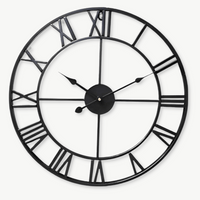
For industrial or monochromatic spaces, black metal sunbursts add graphic punch. They look especially sharp against exposed brick or concrete. The risk: a thin, cheap-looking frame. Look for clocks where the rays have actual dimension, wrought iron, solid steel, or layered metals, not just stamped sheet metal. Run a finger along a ray in-store (or zoom into product photos online) and ask yourself: does this feel like something that belongs on a wall, or something that belongs in a blister pack?
How Big Should It Be?
Measure your wall, then measure again. A sunburst clock's visual diameter includes its rays, and the whole piece needs breathing room on all sides. Here's a practical guide:
| Wall Area | Recommended Clock Diameter | Best Placement |
|---|---|---|
| Small (under 4 ft wide) | 10-16 inches | Above a nightstand, in a hallway niche |
| Medium (4-8 ft wide) | 18-24 inches | Above a console, over a desk, bathroom feature wall |
| Large (8+ ft wide) | 26-36 inches | Above a sofa, over a fireplace mantel, dining room accent |
A clock that's too small for a large wall reads timid. One that's too large for a narrow hallway overwhelms. When in doubt, tape a circle of the clock's outer diameter on the wall with painter's tape and step back. Live with it for a day before committing. It sounds fussy, but you'll thank yourself later.
7 Ways to Style a Sunburst Clock in a Modern Room
You can style a sunburst clock as a solo statement above a sofa, as a gallery wall centerpiece, above a fireplace mantel, paired with a round mirror, in a kitchen, above a bedroom headboard, or on a staircase landing, each placement using the radial form differently. Here's where theory meets practice. These aren't abstract mood boards; they're specific arrangements you can replicate.

1. Solo Statement Above the Sofa
The simplest approach. Center the clock above a sofa, roughly 6 to 8 inches above the top of the backrest. The sunburst becomes the room's anchor. Works best with a large (24-inch+) clock and a relatively undecorated wall. If the wall color is neutral, a gold or brass clock pops. If the wall is dark (charcoal, navy), a lighter metal or natural wood creates contrast.
2. Gallery Wall Centerpiece
Build a gallery wall around the sunburst. Place the clock slightly off-center, then surround it with smaller frames (botanical prints, black-and-white photos, small mirrors). The clock should be the largest single element in the arrangement. Keep frames within a 6-inch radius of the clock's ray tips so the grouping feels unified, not scattered.
3. Above the Fireplace Mantel
A sunburst clock above a fireplace is a classic for good reason. The radial form echoes the warmth spreading from the hearth. Position the clock 4 to 6 inches above the mantel shelf, centered. Add two low objects on the mantel below (candlesticks, a small plant) to ground the composition. Avoid tall objects that compete with the clock's lower rays.


4. Paired with a Round Mirror
Place a round mirror on one side of a wall and a sunburst clock on the other, at the same height. The circular forms create visual rhythm. This works especially well in entryways and dining rooms. Keep the two pieces at least 10 inches apart so neither feels crowded.
5. Kitchen Accent Wall
Kitchens are underrated clock territory. A smaller sunburst (12-16 inches) on the wall between upper cabinets or above a breakfast bar adds personality without competing with backsplash tile. Wood-ray sunbursts feel particularly at home near open shelving and ceramic dishware.
6. Bedroom Feature Wall
Above the headboard, a sunburst clock replaces the typical artwork. And here's the detail that actually makes or breaks this placement: the movement. A ticking mechanism in a bedroom is a deal-breaker for light sleepers, full stop. I learned this firsthand when I hung a beautiful brass sunburst above my own bed and spent three nights counting ticks instead of sleeping. Silent quartz movements exist for exactly this reason. Matte finishes (brushed nickel, matte gold, unfinished wood) also feel calmer than high-gloss options, which can read restless in a space meant for winding down. On the practical side, a clock above the bed lets you check the time without reaching for your phone. That alone is worth it.

7. Staircase Landing or Hallway
Transitional spaces often get ignored. A sunburst clock on a staircase landing wall catches your eye as you move between floors. Hallways benefit too, especially narrow ones where the radial design adds a sense of width. Position the clock at eye level for standing, not sitting.
Mixing Retro and Contemporary: The Design Tension That Works
A sunburst clock does not require a fully retro room: it works precisely because the radial geometry creates productive tension against minimalist, industrial, or maximalist settings that might otherwise lack a visual anchor. The biggest misconception about sunburst clocks is that they require a fully retro room. They don't. In fact, the most visually striking uses right now involve contrast.
Sunburst Clock in a Minimalist Space
Picture a stark white room, Scandinavian furniture with clean lines, a single potted plant. Now add a brass sunburst clock. The clock becomes the only decorative object with complex geometry, and it commands attention precisely because everything else is restrained. The rays give the eye something to follow; the minimal setting gives the rays room to radiate.
Sunburst Clock in an Industrial Loft
Exposed ductwork, concrete floors, metal-frame windows. A black iron sunburst clock on the brick wall between two windows echoes the room's raw materials without adding softness. It reads as architectural hardware, not decoration. For this look, skip anything shiny. Matte black or aged bronze works best.
Sunburst Clock in a Maximalist Room
This is the trickiest application, but it can work. In a room already full of pattern (wallpaper, layered textiles, mixed furniture styles), a metallic sunburst acts like a punctuation mark: a single, organized shape that gives the eye a resting point. Keep the clock's frame relatively simple. Elaborate detailing on the clock plus elaborate wallpaper equals visual noise.
"A clock is not just a timepiece. It is a point of focus, a center from which the room radiates outward."
George Nelson, designer of the original Spike Clock
Placement Pitfalls to Avoid
The most common sunburst clock mistakes are hanging it too high, crowding the rays with nearby objects, placing two sunbursts on the same wall, losing it against a matching wall color, and neglecting angled light that makes the rays come alive. Styling advice usually focuses on what to do. Here's what not to do, based on common mistakes.
- Don't hang it too high. The center of the clock should sit at 57 to 60 inches from the floor when it's a standalone piece. Above furniture, measure from the furniture top, not the floor.
- Don't crowd the rays. If a shelf, sconce, or frame overlaps the outermost ray tips, the starburst silhouette breaks. Leave a clear halo of empty wall around the entire clock.
- Don't pair two sunbursts on the same wall. One is a statement; two is a competition. If you want symmetry, use a matching pair of simpler objects (sconces, prints) flanking the single clock.
- Don't ignore the wall color. A gold clock on a yellow wall disappears. A white clock on a white wall looks intentional only if the textures differ dramatically (glossy clock on matte wall, for instance).
- Don't forget lighting. A sunburst clock comes alive when light hits the rays at an angle. Position a floor lamp, picture light, or track spot to graze across the clock face in the evening. The shadows the rays cast are half the visual appeal.
Caring for a Sunburst Clock: Practical Notes
Caring for a sunburst clock takes under a minute a month: a microfiber cloth along each ray, a light wax coat for brass models, and a fresh battery before the second hand starts stuttering are all it takes to keep the piece looking its best. Here's the honest truth about maintenance: it's easier than you think, and skipping it is how a beautiful piece slowly starts to look neglected. I keep a small microfiber cloth in the drawer of the console below mine and make a habit of running it along each ray while I'm already dusting the rest of the room. Thirty seconds, done.
Metal sunburst clocks collect dust along each ray. A soft microfiber cloth once a month keeps the finish bright. For brass models, a very light coat of clear furniture wax prevents tarnishing without changing the color. Wood-ray clocks benefit from an occasional wipe with a barely damp cloth, followed immediately by a dry one; moisture and wood don't mix well long-term.
Battery life in quartz movements varies, but most AA-powered sunburst clocks run 12 to 18 months on a single battery. If the second hand starts stuttering or pausing at the 12 o'clock position, that's the classic low-battery signal. Replace it promptly. A stopped clock on the wall undermines everything you worked to create. You can keep a spare AA taped to the back of the clock itself, so it's always within arm's reach.
💡 Did you know?
Vintage sunburst clocks from the 1950s and 1960s regularly sell for 100 to 500 USD at auction, depending on the maker and condition. Original George Nelson models can fetch well over 1,000 USD. Collectors have been snapping them up alongside Eames chairs and Noguchi tables for the better part of a decade now, which tells you something about how seriously the design world takes the form.
Do People Still Decorate with Wall Clocks? Absolutely, and Here's Why
Wall clocks are still very much a decorating choice in 2026: they function as sculptural objects that ground a room, add texture and warmth, and offer a tactile analog counterpoint when every other surface competes for digital attention. Smartphones tell the time. Smart speakers announce it out loud. So why hang a clock? Because a wall clock is a piece of decor that also happens to be functional. No one asks, "Do people still hang paintings now that they have screensavers?" The question answers itself.
Wall clocks, sunburst or otherwise, ground a room. They give a wall purpose. They add texture, shape, and often warmth. When every surface is competing for digital attention, an analog object on the wall provides a tactile, human counterpoint. That's not nostalgia; it's a deliberate design choice.
The retro sunburst wall clock takes this a step further. Its radial form is inherently dynamic: it pulls your gaze inward, then pushes it outward along the rays. That visual energy is why the design has survived over seven decades of shifting trends. And honestly? It's why so many people who swore they weren't "clock people" end up with one on their wall within six months of moving into a new space.
Designer Wall Clock
Browse designer wall clocks with bold silhouettes and premium materials, the kind that hold a wall the way a sunburst holds a room.
139 products
Browse the collection →What's Trending in Wall Clock Design for 2026
In 2026, wall clock design trends include oversized minimal dials, mixed-material frames, muted metallics like aged brass, sustainable materials, and 3D sticker clocks, and the sunburst form fits neatly across several of these at once. Sunburst clocks sit within a broader wall clock renaissance. Here's what's happening alongside them this year.
- Oversized minimal dials. Clocks with faces 20 inches or larger, no numerals, just simple tick marks. They read almost like wall sculpture.
- Mixed-material frames. Combining wood and metal, or concrete and brass, in a single clock. These pieces bridge two aesthetics at once.
- Muted metallics. Aged brass, brushed pewter, and satin nickel are replacing high-shine chrome. The effect is warmer and more forgiving of fingerprints.
- Sustainable materials. Bamboo, reclaimed wood, and recycled metals are gaining ground among eco-conscious buyers.
- Statement sticker clocks. 3D adhesive numerals applied directly to the wall, with a small central mechanism. They create a dramatic, borderless look that works on accent walls.
The sunburst form fits neatly into several of these trends. A large, matte-brass sunburst clock with wooden ray tips, for example, hits the oversized, mixed-material, and muted-metallic notes simultaneously. That versatility explains why the design keeps resurfacing, and why it never really feels like a trend at all.
Your Next Wall Deserves More Than a Blank Stare
A retro sunburst wall clock does something rare in home decor: it's a single piece that fills a wall, anchors a room, and sparks a conversation. It references decades of design history without locking you into any single era. Whether your space leans Scandinavian, industrial, or somewhere in between, there's a version of this clock that belongs on your wall.
Pick the material that matches your room's personality. Measure the wall. Give the rays room to breathe. Then step back and watch the room change. It's your chance to create a moment in your home, one that radiates outward in every direction.
Frequently Asked Questions About Sunburst Wall Clock Decor
What are the trending wall clocks for 2026?+
Oversized minimal dials, mixed-material frames (wood and metal together), muted metallic finishes like aged brass, and retro sunburst designs are all strong in 2026. 3D sticker clocks that adhere directly to the wall are also gaining popularity, especially in modern apartments where drilling is limited.
Do people still decorate with wall clocks?+
Yes, and demand has actually grown. Wall clocks serve as sculptural decor that also happens to be functional. When screens dominate every surface, an analog clock on the wall offers a tactile, grounding element. Sunburst and starburst designs, in particular, double as wall art.
What is the coolest clock wall design right now?+
A single large sunburst clock on an otherwise bare wall remains one of the most striking looks. Gallery walls built around a central sunburst clock are also very popular. For a more contemporary feel, oversized frameless sticker clocks with metallic numerals directly on the wall create a dramatic, architectural effect.
Can I put a sunburst clock in a modern minimalist room?+
Absolutely. A sunburst clock actually shines brightest in minimal settings. When everything else is pared back, the clock's radial geometry becomes the room's single focal point. Choose a matte or brushed finish rather than high-gloss to keep the look cohesive with minimalist principles.
How do I clean and maintain a metal sunburst clock?+
Dust each ray with a soft microfiber cloth once a month. For brass models, a thin coat of clear furniture wax prevents tarnish without altering the color. Avoid wet cleaning near the clock mechanism. Replace the battery as soon as the second hand begins to stutter; a stopped clock detracts from the decor rather than enhancing it.
What's the difference between a sunburst clock and a starburst clock?+
The terms are used interchangeably by most retailers, but there's a subtle distinction in design circles. A sunburst clock typically features rays of varying lengths that taper outward, evoking actual solar rays. A starburst clock tends to have more uniform, sharper points, closer to a geometric star shape. Both trace their roots to the same mid-century modern moment and work beautifully in the same room contexts.