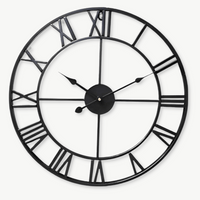


Guests form an opinion about your home before they've even taken their coat off. The hallway, that overlooked corridor most of us treat as a dumping ground for umbrellas and forgotten keys, is actually your home's opening line. A wall clock for your hallway entrance statement does something no mirror or art print can quite replicate: it signals intention. It says someone thought carefully about this space.
It's not about filling wall space. It's about choosing something that earns a second glance. Here's what actually works, and why.
⭐ Key takeaways
- A hallway clock works hardest when it's sized to the wall - too small reads as an afterthought.
- Placement at eye level (roughly 57-60 inches from the floor) is the sweet spot for both function and visual impact.
- The style of your hallway clock sets expectations for the rest of your interior - it's a design promise.
- Silent quartz movement matters here more than in any other room, because sound carries in narrow spaces.
- A clock paired with a console table or mirror creates a composed entrance vignette guests actually remember.
Why the Hallway Is the Hardest Room to Get Right
The hallway is the hardest room to get right because it's narrow and transitional, people pass through without stopping, and every design choice must land instantly or it disappears entirely. Most rooms give you a few seconds of grace. The hallway gives you none. It's narrow, it's transitional, and people pass through it without stopping - which means every design choice either lands immediately or disappears entirely.
That's precisely what makes a well-chosen clock so powerful here. Unlike artwork that requires pause to appreciate, a clock communicates at a glance. The round or geometric shape registers instantly. The material - warm walnut, black metal, aged brass - reads as a texture cue for the rest of the home. And the scale tells guests whether you're someone who decorates deliberately or someone who placed something there because the wall felt bare.
The hallway is also where function and aesthetics have to coexist without compromise. People genuinely check the time when they're leaving the house. A clock that's too decorative to read quickly fails on a basic level. The best hallway entrance statement clocks are legible at a glance - clear numerals, good hand contrast, no over-busy dial - and beautiful enough to hold up on their own as a piece.

Getting the Size Right: What Works in a Hallway
Getting the size right means choosing a clock in the 40-60 cm range for most hallways: large enough to command the wall without overwhelming the corridor's width. This is where most people go wrong. A 12-inch clock in a standard hallway reads as shy. You notice the emptiness around it more than the clock itself. In a narrow corridor with ceiling heights of 8-9 feet, a clock needs presence - something in the 40-60 cm range (roughly 16-24 inches) tends to hit the right note.
Here's a practical way to think about it: tape a piece of paper to the wall in your approximate desired size before you buy anything. Step back to where guests would naturally pause - usually about 6-8 feet from the wall. If the shape commands attention without overwhelming the width of the corridor, you've found your size range.
💡 Did you know?
The concept of the hallway as a dedicated transitional space only became common in European homes from the 18th century onward. Before that, rooms simply connected to each other. The "entrance hall" was originally designed to impress visitors with the host's wealth and taste - which is exactly what a well-chosen clock still does today.
Wider hallways (anything over 5 feet) can carry a large-format clock - 60 cm or more - particularly if the opposite wall is kept deliberately minimal. If your hallway is genuinely narrow, a vertically oriented or elongated clock design reads better than a wide horizontal one. Round clocks with slim frames work in almost every proportion because the shape doesn't fight the architecture.
| Hallway width | Recommended clock diameter | Notes |
|---|---|---|
| Under 4 ft (narrow) | 30-40 cm (12-16 in) | Slim frame, high contrast dial for legibility |
| 4-6 ft (standard) | 40-55 cm (16-22 in) | The sweet spot for most apartments and houses |
| Over 6 ft (generous) | 55-70 cm (22-28 in) | Can carry statement or oversized designs confidently |
Style Matching: The Clock as a Design Promise
Your hallway clock is a design promise: its material, finish, and form set expectations for every room that follows, so it must match the dominant aesthetic of your home. Think of your hallway clock as the opening sentence of a longer story. If the rest of your home leans Scandinavian - clean lines, natural oak, muted palettes - a clock with a stark white face and thin black hands sets exactly the right expectation. A chunky industrial design with exposed hardware would feel like a lie.
That said, contrast is underrated. A raw wood clock against a dark navy or charcoal hallway wall creates a tension that feels deliberately styled, not accidental. It works because the contrast is intentional. What doesn't work is mismatch that looks like two different people decorated the space.
A few pairings that hold up consistently:
- Minimalist Scandinavian entrance: White or light oak clock, thin hands, no second hand, clean Roman or Arabic numerals. Calming and confident.
- Industrial or loft-style corridor: Black metal frame with wood dial, visible hardware, Roman numerals. The wood and metal combination with Roman numerals reads as intentionally crafted, not mass-produced.
- Classic or European-inspired hallway: Aged brass or antique-finish clock with a vintage dial. Pairs well with console tables and traditional mirrors.
- Contemporary or eclectic entrance: Oversized clock with an unusual material mix - glass, acrylic, layered wood. The point is visual surprise rather than blending in.

Want a concrete example of a clock that bridges the industrial and warmth categories? The piece below is one Elena comes back to again and again for hallway recommendations. The combination of powder-coated black metal and natural wood means it reads as crafted rather than manufactured - and that distinction is exactly what makes it work as a standalone wall clock for a hallway entrance statement.

Placement and Height: The Details That Actually Matter
The ideal placement for a hallway clock is center-height at 57-65 inches from the floor, high enough to read clearly as you pass, and never so low it competes with furniture below. The standard rule in interior design is to hang wall art at eye level - center of the piece at roughly 57 to 60 inches from the floor. Clocks follow the same principle, with one adjustment: in a hallway where people are always moving rather than sitting, you can go slightly higher (up to 65 inches center) without it feeling disconnected.
I learned this one the slow way. The first clock I hung in my own hallway looked perfect in photos and completely wrong every morning - it was about four inches too low, which meant it competed visually with the console table below it instead of floating above it. The fix took five minutes, but the difference was immediately obvious. Small adjustments in a narrow space are amplified in a way they simply aren't in a large living room.
What you want to avoid is placing the clock so high it reads as decorative rather than functional, or so low it competes visually with a console table or shoe bench. That middle zone - readable from the front door, visible at eye level as you pass - is where the clock does its best work.
If you have a console table or narrow shelf below the clock, let that anchoring relationship guide your height. The gap between the top of the table and the bottom of the clock should be roughly 6-8 inches - close enough to feel like a composed grouping, far enough apart that neither piece crowds the other. If you're working with a larger format clock, that gap can stretch to 10 inches without losing the visual connection.
Why Silent Movement Is Non-Negotiable in a Hallway
Silent movement is non-negotiable in a hallway because hard surfaces amplify every tick, turning a charming detail into a constant irritation in a space you pass through dozens of times a day. A hallway is acoustically different from a living room or kitchen. It's a narrow, often hard-surfaced corridor - tile, painted plaster, wood floors - where sound bounces rather than absorbs. A ticking clock in this environment doesn't read as charming or nostalgic. It reads as irritating, and it amplifies every time someone pauses near the front door.
A silent quartz wall clock uses a sweep mechanism rather than the standard step-tick movement, which means the second hand glides continuously. There's no audible tick. The mechanism is indistinguishable from a standard quartz in terms of accuracy - it still keeps time to within about 15 seconds per month - but the acoustic difference in a hard-surfaced hallway is significant.
This is one of the few specifications I'd consider genuinely practical rather than just a preference. Get a silent movement for the hallway. The rest of your clock choices are negotiable; this one isn't worth compromising on.


Styling the Space Around Your Clock
Styling the space around your clock works best with a narrow console table below, a mirror alongside, and a single well-chosen object on the surface: the clock leads, everything else supports it. A clock works alone when the wall and the piece are strong enough. But most hallways benefit from a small supporting cast. Here's what holds up:
- Console table below: Creates a natural anchor point and gives the clock a relationship to the room rather than floating in isolation. A narrow console (10-12 inches deep) works in tight corridors without eating floor space.
- Mirror alongside or above: A classic pairing. If the clock is on one wall and a mirror faces it across the corridor, the reflection doubles the visual presence of both pieces. In a tight hallway, a mirror on the same wall as the clock (placed to the side, not overlapping) expands the sense of depth.
- One small plant or object on the console: Not a collection of objects - just one. A ceramic vase, a single trailing plant, a small sculptural piece. The clock is the statement; everything else is context.
What doesn't work: too many competing pieces. A gallery wall next to a statement clock turns the hallway into visual noise. The clock needs some clear wall space around it - roughly 6-10 inches of breathing room on each side - to read as intentional rather than crammed.
"The entrance of a home is its autobiography. Every object placed there is a sentence."
Interior design principle, widely cited in European decorating tradition
Clock Styles That Consistently Work as Hallway Statement Pieces
The clock styles that work best as hallway statement pieces share one quality: a strong, readable silhouette and a clear material personality that registers at a glance without requiring the viewer to stop. Not every clock translates to a hallway context. A highly decorative cuckoo clock, for example, might feel wonderful in a kitchen or living room but create sensory overload in a narrow corridor. What tends to work is a clock with a strong, readable silhouette and a clear material personality.
A few categories that hold up consistently as hallway entrance statement clocks:
- Large wooden clocks with clean dials: Natural warmth, easy on the eye, readable from a distance. Walnut or oak finishes pair with almost any hallway paint color.
- Industrial metal-frame clocks: Black powder-coated frames with wood or metal dials. Strong geometric presence, reads confidently in both modern and transitional interiors.
- Minimalist white or cream-face clocks: Work particularly well in hallways with a lot of natural light. The clean face doesn't compete with the light - it reflects it.
- Vintage or European-style clocks: Aged finishes, Roman numerals, decorative hands. These work best when the hallway has architectural character - coving, dado rails, period flooring.
If you're unsure, lean toward something with a natural material rather than a highly processed finish. Wood and metal age gracefully in a hallway; plastic and cheap chrome tend to look worse over time, not better. You can also browse our wooden wall clock collection if natural materials are your starting point - it's a good anchor for any style direction.
Designer Wall Clocks
If your hallway deserves a piece with genuine design intent behind it, this is the collection to browse - 139 clocks with real material character and visual presence.
139 references
Browse the collection →The One Thing People Get Wrong When Choosing a Hallway Clock
The one thing people get wrong is optimizing for the photo rather than the lived experience: a clock that looks stunning in a styled shoot can feel completely wrong at 7:45 on a Tuesday morning. They optimize for the photo, not the experience. A clock that looks stunning in a styled shoot - surrounded by perfectly placed props, photographed with a wide lens that makes the corridor look twice its actual size - can feel completely wrong in a real hallway at 7:45 on a Tuesday morning.
The practical test is this: can you check the time in two seconds while putting your coat on? Can someone standing at your front door see the clock face without squinting? Does the sound of it - or the silence of it - feel right in that specific space? Those are the questions that matter more than whether the finish matches your door handles.
A statement wall clock for your hallway entrance earns that label not by being the loudest thing in the room, but by being the one piece that makes the whole corridor feel considered. Get that right, and the first impression your home makes will be exactly the one you intended.
Ready to find yours?
Whether you're starting from scratch or replacing something that never quite worked, the right hallway clock is worth taking seriously. Browse our full range of hallway statement clocks or explore the silent movement collection if acoustics are a priority for your space.
Explore hallway clocks →Frequently asked questions about hallway wall clocks
What size clock works best in a hallway?+
For a standard hallway (4-6 feet wide), a clock with a diameter of 40-55 cm (16-22 inches) tends to work best. It's large enough to make a visual statement without overwhelming the wall. Narrow corridors under 4 feet wide suit a 30-40 cm clock with a slim frame, while wider entrance halls can carry 60 cm or more comfortably.
How high should a wall clock be hung in a hallway?+
The center of the clock should sit at roughly 57-65 inches from the floor. In a hallway where people are always moving, you can go toward the higher end of that range (around 63-65 inches center) so the clock reads clearly even as people pass by. The key is that it should be visible from the front door and readable without stopping.
Should a hallway clock have a silent movement?+
Yes, and this matters more in a hallway than almost anywhere else in the home. Hallways are typically hard-surfaced (tile, hardwood, plaster) which amplifies sound. A ticking clock in this environment can quickly feel intrusive. Silent quartz movement - where the second hand sweeps continuously rather than ticking - eliminates the sound entirely without any compromise on timekeeping accuracy.
What style of clock suits a modern minimalist hallway?+
A Scandinavian-influenced clock with a clean white or light wood face, thin metal hands, and minimal numerals works very well in a minimalist hallway. The key is restraint: no overly decorative frames, no cluttered dials. A round form reads as classic and non-intrusive, while maintaining visual presence. Natural materials like oak or bamboo add warmth without visual complexity.
Can a wall clock work as the only decorative piece in a hallway?+
Absolutely - and in narrow or very short hallways, a single well-chosen clock is often the strongest choice. A clock with a distinctive material (solid walnut, layered wood, mixed metal and timber) has enough visual weight to stand alone. The surrounding empty wall actually amplifies the piece rather than diminishing it. The only requirement is that the clock itself is genuinely interesting - not a generic piece you grabbed because the wall felt bare.
How do I match a hallway clock to the rest of my home's style?+
Start with material, not colour. A natural wood clock coordinates with almost any interior because wood is a neutral. From there, the frame treatment is your style signal: a thin powder-coated black frame reads as modern or industrial; an aged brass or patinated finish reads as classic or European; a frameless or floating face reads as minimalist. Pick the one that matches the dominant aesthetic of your living spaces, and the hallway clock will feel like a natural introduction rather than a surprise.