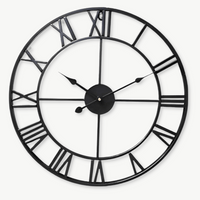


Steam curls up from a hot shower, fogs the mirror, and settles on every surface. Most people don't think about what that does to a wall clock until the hands stop moving, the face clouds over, or the casing starts to crack. A wall clock for bathroom moisture resistance isn't just a nice-to-have spec - it's the reason some clocks are still ticking five years later while others quit before the warranty does.
Here's what actually matters when you're picking a clock for a high-humidity room, broken down into the features that separate a durable purchase from a regrettable one.
⭐ Key takeaways
- Look for a sealed or gasketed case - the housing matters more than the face material.
- IP44 is the minimum rating for a bathroom clock; IP55 or above handles direct splash zones.
- Quartz movements with sealed battery compartments outlast mechanical movements in humid rooms.
- Placement counts: keep at least 60 cm (24 inches) from the shower zone to reduce moisture exposure dramatically.
- Easy-clean faces (glass or acrylic cover, smooth casing) save you from weekly grime battles.
Why Bathrooms Are So Hard on Wall Clocks
Bathrooms are tough on wall clocks because humidity spikes past 90% during a hot shower, then drops sharply when ventilation kicks in, that daily expand-and-contract cycle corrodes internal components, warps casings, and kills movements from the inside out. A bathroom isn't just "a bit damp." It cycles through temperature and humidity extremes multiple times a day. A 10-minute hot shower can push relative humidity past 90%. Then the window opens or the fan kicks in, and everything drops back down. That constant expand-and-contract cycle is what kills clock components from the inside out.
Wood warps. Paper dials bubble. Cheap plastic casings develop micro-cracks that let moisture reach the movement. Battery compartments corrode. Even a clock marketed as "indoor use" can fail within months when it's positioned just a few feet from a steaming shower. The good news: purpose-built bathroom clocks solve these problems with specific material choices and construction details - you just need to know what to read on the label.

IP Ratings Explained: The Number That Tells You the Truth
The IP rating is the single most reliable indicator of whether a bathroom clock will last: IP44 is the minimum for steam and condensation, while IP55 or higher is required near open showers or in wet rooms. IP stands for Ingress Protection. It's a standardized rating (defined under IEC 60529) that tells you exactly how well a device resists solid particles and liquids. For bathroom clocks, the second digit - the one covering water resistance - is what you're checking.
| IP Rating | Water Protection Level | Suitable For |
|---|---|---|
| IPX0 / No rating | No water protection | Dry rooms only - avoid bathrooms |
| IP44 | Protected against splashing water from any direction | Standard bathroom, away from the shower zone |
| IP55 | Protected against low-pressure water jets | Near shower walls, humid wet rooms |
| IP67 / IP68 | Dust-tight, withstands immersion | Wet rooms, outdoor use, poolside |
For most domestic bathrooms, IP44 hits the practical sweet spot - it handles steam and condensation without issue. If you're mounting a clock inside a wet room or directly adjacent to an open shower with no screen, push the requirement to IP55 or higher. Many clock listings skip the IP rating altogether; when that happens, treat the product as unrated and position it accordingly (more on placement below).
💡 Did you know?
The IP rating system was developed by the International Electrotechnical Commission in 1989. The same standard governs everything from bathroom light fixtures to industrial machinery - so when you see IP44 on a clock, it's the identical certification used to rate your bathroom extractor fan.
Case Materials: What Actually Resists Steam Long-Term
The best case materials for a humid bathroom clock are UV-stabilised ABS plastic, 304-grade stainless steel, anodised aluminium, and high-density resin, all chosen because they resist warping, corrosion, and moisture ingress over years of daily steam exposure. The clock's outer shell is its first line of defense. Some materials handle bathroom conditions naturally; others need a specific surface treatment to survive. I've tested a few in my own home over the years, and the difference between a thoughtfully spec'd casing and a cheap one becomes obvious around the six-month mark - not immediately, but gradually, in the form of hairline discolouration, a slightly tacky surface, or, worst of all, a faint mildew smell.
ABS Plastic with UV Stabilization
ABS (acrylonitrile butadiene styrene) is the most common material in purpose-built wall clocks for bathroom moisture resistance for good reason. It's dimensionally stable, resists warping under humidity cycling, and doesn't corrode. UV stabilization stops the casing from yellowing when exposed to sunlight through bathroom windows. My personal preference here is a smooth, lightly textured finish rather than a deep matte porous surface - the latter grips soap scum and mold in a way that makes cleaning genuinely tedious. If you're choosing between two otherwise identical ABS clocks, always go with the one that has a gloss or semi-gloss shell.
Stainless Steel and Brushed Aluminum
Metal cases handle humidity well, provided they use 304-grade stainless steel or anodized aluminum. Lower-grade metals and cheap chrome plating will show rust spots within a year in a humid bathroom - and that rust migrates, staining your tiles in the process. The weight of a metal clock also matters practically: heavier cases need proper wall anchors, especially on tiled walls where the fixings can work loose over time. That said, a brushed stainless bezel in an industrial-style bathroom with matte black hardware looks genuinely considered rather than an afterthought. It earns its place on the wall.
Resin and Composite Shells
High-density resin is worth considering for its near-zero porosity. It doesn't absorb moisture at all, and the surface wipes clean effortlessly. Some resin bathroom clocks mimic stone or ceramic finishes with convincing results, which suits spa-style and Scandinavian interiors particularly well. If you've built a bathroom around a calm, natural palette - think warm whites, raw linen, and pebbled tile - a resin clock in a matte stone effect fits that brief far better than a glossy ABS alternative.
What to Avoid in a Bathroom
- Untreated natural wood (it will warp and crack within months unless sealed with a waterproof lacquer)
- MDF backing (absorbs moisture rapidly, swells, and deforms)
- Open-face designs without a protective cover over the dial
- Fabric or paper clock faces not protected behind sealed glass

The Movement Inside: Quartz is the Practical Choice for Humid Rooms
A sealed quartz movement is the right choice for any bathroom clock: it has far fewer moving parts than a mechanical movement, resists humidity reliably, and paired with a gasketed battery compartment, will outlast any spring-and-gear alternative in a steam-prone room. The internal movement is where moisture does its worst damage, and it's also the part you can't see from the outside. Quartz movements - battery-powered, with a small electronic oscillator - are significantly more resilient than mechanical movements in humid conditions. Here's why: mechanical movements rely on fine metal springs and gears with extremely tight tolerances. Even trace moisture causes micro-corrosion that throws off accuracy. Quartz movements have far fewer moving parts and, when paired with a gasketed battery compartment, resist humidity reliably.
Sweep vs. tick movement is a secondary consideration, but worth mentioning for bathrooms specifically. Sweep (also called "silent quartz") moves the second hand in a smooth, continuous arc with no ticking sound. In an acoustically live space like a tiled bathroom, even a gentle tick echoes. Silent sweep mechanisms also tend to have fewer micro-vibrations, which means slightly less mechanical stress on the movement housing over time - a small but real benefit in a room that already works against your clock.
Dial Face and Cover: Easy-Clean Materials That Don't Cloud Over
For a bathroom clock face that stays clear and legible year after year, sealed mineral glass is the top choice, it won't cloud from steam, cleans with a single wipe, and outperforms acrylic on long-term optical clarity. The clock face you see every morning needs to stay clear and legible - ideally without requiring anything more than a damp cloth. Here's what holds up:
Mineral Glass Covers
Scratch-resistant, optically clear, and completely non-porous. Mineral glass doesn't cloud from steam the way cheaper materials do, and it cleans with a single wipe. It adds weight to the clock but offers the best long-term clarity. Check that the glass is mounted with a sealed bezel rather than just clipped in place - gaps let moisture in behind the face.
High-Clarity Acrylic (Perspex)
Lighter than glass and often used in IP-rated bathroom clocks to keep total weight down. The trade-off: acrylic scratches more easily and can develop a very slight haze over years of wiping. It's a practical choice for family bathrooms where durability and weight matter more than absolute optical perfection. Stick to mild cleaning solutions only - abrasive products will dull the surface faster than steam ever would.
Open Dial Designs
Some minimalist clocks skip the protective cover entirely. These can work in a bathroom only if positioned well away from direct steam - think the far wall opposite the shower, above the door, or in a large bathroom where steam dissipates before reaching the clock. The dial itself should be printed on sealed synthetic material, not paper. If you love the look of an open-faced minimalist clock, our guide on wall clock placement walks through exactly how to position one safely.
The two product picks below are good illustrations of how dial and cover choices translate into real-world bathroom suitability - one optimised for lightweight mounting on tile, the other for maximum optical clarity in a more design-forward space.
Silent Wall Clocks
For a bathroom, a sweep movement isn't optional - it's the difference between a relaxing morning routine and a ticking soundtrack. These silent-movement clocks are built for exactly that kind of peace.
179 references
Browse the collection →Size and Weight: Getting the Scale Right for a Bathroom Wall
For most bathrooms, a clock between 25 cm and 35 cm diameter hits the right balance of readability and proportion, large enough to read from across the room, compact enough not to overwhelm tile-heavy walls or compete with mirrors and fixtures. Bathroom walls are often the most constrained of any room in the home - tiled surfaces, limited flat wall space, fixtures competing for position. A clock between 25 cm (10 in) and 35 cm (14 in) fits most standard bathrooms without dominating the space. Anything larger starts to feel like a statement piece rather than a functional timepiece, which is great for a powder room with high ceilings but awkward in a compact en-suite.
Weight matters more in bathrooms than in other rooms because you're usually mounting into tile, not drywall. Heavy metal clocks need purpose-made tile anchors. Lighter plastic or resin clocks can often go up with adhesive strips rated for bathroom use - just check the weight capacity against the clock's actual weight, not an estimate. If you're unsure about mounting methods on tile, our nail-free hanging guide covers adhesive options in detail.

Where to Position a Bathroom Clock for Maximum Longevity
The single most effective way to extend a bathroom clock's life is placement: keep it at least 60 cm from the shower zone, at eye level on an interior wall, away from the extractor fan's air path and cold exterior walls where condensation pools. Placement is half the battle. Even a well-rated IP44 clock will degrade faster than it should if it's mounted directly in the shower's steam path. The four rules below have genuinely extended the life of every bathroom clock I've recommended.
- The 60 cm rule: Keep any clock at least 60 cm (24 inches) from the shower enclosure or bathtub edge. This puts it outside the "splash zone" as defined by most bathroom wiring regulations, and noticeably reduces the moisture load on the clock over time.
- Height matters: Steam rises and accumulates near the ceiling. Mounting a clock at eye level (roughly 150-165 cm from the floor) keeps it below the worst of the steam layer while remaining easily readable.
- Ventilation awareness: If your bathroom extractor fan is on the same wall you're considering, mount the clock on the adjacent wall instead. The fan draws moist air across whatever's in its path.
- Avoid north-facing exterior walls: In colder climates, exterior walls are cooler than interior ones, which makes them condensation hot spots. An interior partition wall is a better home for a wall clock for bathroom moisture resistance.
Once you've settled on placement, the product below is worth a close look - it's sized and weighted specifically for the constraints described above.

Easy-Clean Finishes: Maintenance That Fits Into Real Life
A moisture-resistant bathroom clock with an easy-clean surface needs a smooth non-porous casing, a sealed glass or acrylic face cover, and minimal joins between parts, those three details mean a 30-second wipe keeps it looking new rather than a frustrating scrub every week. Bathrooms collect soap residue, toothpaste mist, and general grime faster than almost any other room. A moisture-resistant bathroom clock with an easy-clean surface isn't a luxury - it's a practical necessity if you want the clock to look good six months after you hang it.
What makes a clock genuinely easy to clean:
- A smooth, non-porous outer casing (gloss or semi-gloss finishes wipe clean; textured matte surfaces grip grime)
- No exposed screw heads or decorative recesses where soap film accumulates
- A sealed glass or acrylic face cover rather than an open dial
- Minimal joins between the case, bezel, and back plate - each gap is a dirt trap
For routine cleaning, a soft damp cloth does the job. Avoid abrasive cleaners on acrylic faces - they scratch. On glass covers, a small amount of bathroom surface cleaner works fine. Don't spray directly at the clock; spray on the cloth first. It's a 30-second job if the surface design cooperates, and a frustrating one if it doesn't - so this is worth factoring in at the buying stage, not after the fact.
"The best bathroom clock is the one you never have to think about - until you glance at it and it tells you you're running late."
Elena Rossi, on choosing functional decor that quietly earns its place
Style Considerations: Bathroom Clocks That Actually Belong There
The style choices that look best in bathrooms, round minimalist dials, brushed metal finishes, stone-effect resin, also happen to be the material choices that handle humidity best, so you rarely have to sacrifice aesthetics for durability. Functionality doesn't mean settling for a utilitarian look. The bathroom has become one of the most design-forward rooms in the home - people invest in herringbone tile, statement mirrors, and curated shelving. A clock can anchor that aesthetic or undercut it entirely. The good news is that the style choices that work best in bathrooms tend to overlap neatly with the material choices that last longest.
Minimalist Round Clocks
A simple white or off-white dial with a thin metal or ABS bezel and clean numerals reads well in any bathroom from Scandinavian to contemporary. The round shape echoes mirrors, porthole windows, and basin shapes. It's not the most original choice, but it's almost impossible to get wrong - and in a room where you're half-asleep at 7 a.m., legibility is an underrated virtue.
Industrial Metal Finishes
Brushed stainless or matte black metal casings (remember: 304-grade stainless only, if longevity is the goal) work brilliantly in bathrooms with dark grout, matte black fixtures, or exposed concrete finishes. The industrial style is also forgiving of steam marks between cleans - the finish doesn't show watermarks the way high-gloss white does. I'd pair a matte black clock with a matching towel rail and nothing else for a cohesive look that doesn't feel overdone.
Spa and Natural Aesthetics
Resin clocks in stone-effect finishes, or clocks with a simple bamboo-inspired face paired with a sealed composite casing, suit bathrooms designed around a calm, nature-forward palette. The key here is pairing the look with sealed, humidity-safe construction - not buying an actual natural material clock and hoping for the best. The visual warmth of a stone-effect resin clock in a bathroom tiled in warm beige or travertine is genuinely lovely, and the maintenance story is the opposite of difficult.
If your bathroom leans toward a more polished, European-influenced aesthetic, the piece below is worth considering - mineral glass face, silent quartz movement, and a profile that sits comfortably in a design-conscious space.

Battery Life and Access in a Bathroom: Small Detail, Real Inconvenience
Choose a bathroom clock with a front- or side-accessible battery compartment so you never have to dismount it from tile to change the battery, and use lithium cells rather than alkaline ones for 3 to 5 years of reliable service in a temperature-variable room. You'll need to change the battery at some point - and if the clock is mounted on tile two meters up, the easier that process is, the better. Look for clocks where the battery compartment is accessible from the front or side without removing the clock from the wall. Some designs require you to detach the whole unit to reach the battery, which means re-mounting afterward. In a bathroom context, where the fixings might be adhesive into tile, repeated dismounting damages the mounting over time.
AA or AAA alkaline batteries are the standard. A single AA cell in a quality quartz movement lasts 18-24 months on average. Lithium batteries extend that to 3-5 years and handle temperature fluctuation better - genuinely useful if your bathroom gets cold in winter. Worth the small price difference, especially in a room that puts extra stress on the power supply.
⚠️ Note
Never use rechargeable batteries in a bathroom clock unless the product specifically states they're compatible. Rechargeable NiMH cells have a lower nominal voltage (1.2V vs 1.5V for alkaline) that can cause some quartz movements to run slightly slow - and in a humid environment, any fluctuation in power supply stresses the movement further.
A Practical Buying Checklist Before You Order
Before buying a humidity-safe bathroom clock, confirm seven things: an IP44 or higher rating, a named moisture-resistant casing material, a sealed battery compartment, a covered dial, a quartz movement, the right dimensions, and a mounting method that can handle repeated battery changes without failing. Before adding a bathroom clock to your cart, run through this quickly:
- Does the product listing state an IP rating? If yes, is it IP44 or above?
- Is the casing material specified as ABS, stainless steel, aluminum, or resin? If the material isn't named, ask.
- Does the battery compartment have a rubber seal or O-ring visible in the product photos?
- Is the dial covered by sealed glass or acrylic - or is it open-faced?
- Is the movement described as quartz or silent sweep? Mechanical movements are not suitable for humid bathrooms.
- What are the dimensions? Is it proportionate to your available wall space?
- How is it mounted? Does repeated dismounting for battery changes compromise that mounting method?
Seven questions that take about two minutes to answer. The ones that trip people up most often: the IP rating (absent from most listings that don't meet it) and the battery compartment seal (rarely shown clearly in stock photos). If a seller can't confirm those two details, that tells you something useful.
Finding the right wall clock for bathroom use comes down to understanding that humidity is a long game - the materials and construction that seem like minor spec details are the exact things that determine whether your clock is still working perfectly in three years or quietly failed after one rainy season. Get those right, and you're left with the far more enjoyable problem of choosing a design you actually love looking at every morning.
FAQ
Can I use a regular wall clock in a bathroom?+
You can, if you position it carefully - at least 60 cm from the shower or tub and on a wall that doesn't receive direct steam. But a standard indoor clock with no moisture protection will degrade faster in a bathroom than in a dry room, and the timeline depends heavily on how well-ventilated your bathroom is. A purpose-rated clock with an IP44 rating or above is a more reliable long-term choice.
What does IP44 mean on a bathroom clock?+
IP44 means the clock is protected against solid objects larger than 1 mm and against water splashing from any direction. For a bathroom clock, this means it handles steam, condensation, and the occasional splash without the internal components being damaged. It's the standard minimum for bathroom fixtures and covers the conditions in most domestic bathrooms comfortably.
Are wooden wall clocks suitable for bathrooms?+
Untreated or lightly finished wood is not suitable for a humid bathroom - it will warp, crack, or develop mold over time. Some wooden-look clocks use a sealed composite or resin face with a wood-effect finish that performs well in bathrooms, but genuine natural wood needs to be thoroughly lacquered and positioned away from direct steam. When in doubt, check whether the listing specifies a waterproof sealant or moisture-resistant coating.
How do I clean a bathroom wall clock without damaging it?+
Use a soft, slightly damp cloth - nothing abrasive, no solvent-based cleaners. Spray any cleaning product onto the cloth first, not directly onto the clock face. For glass covers, a small amount of glass cleaner works well. For acrylic covers, stick to plain water or a mild soap solution to avoid micro-scratching. Wipe dry immediately after to prevent moisture sitting on any joins or seals.
Where is the best place to hang a clock in a small bathroom?+
The wall opposite the shower or the wall above the door are the two most practical positions in a small bathroom. Both keep the clock away from the highest-humidity zones while keeping it visible from the main areas of the room. Eye level (around 150-165 cm from the floor) is the most comfortable reading height. Avoid the wall directly adjacent to the shower enclosure and any position where steam from hot water would reach the clock directly.
What is the difference between IP44 and IP55 for a bathroom clock?+
IP44 protects against splashing water from any direction, which covers steam, condensation, and incidental splashes in a standard bathroom. IP55 adds protection against low-pressure water jets, making it the right choice if you're mounting a clock inside a wet room, close to an open shower with no enclosure screen, or anywhere that sees heavier direct water exposure. For most family bathrooms with a standard shower tray and enclosure, IP44 is sufficient - IP55 is for edge cases where the steam path is particularly direct or intense.