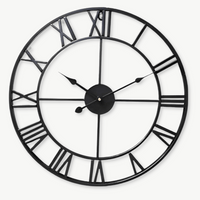


There's a wall in almost every dining room that just sits there. Maybe you've hung a generic print on it, or left it blank and told yourself you'd figure it out eventually. A large decorative dining room wall clock is one of those rare additions that actually solves the problem, not just fills the space. It anchors the room, gives the eye somewhere to land, and pulls the whole aesthetic together without demanding a renovation.
The trick is knowing which clock fits your dining room specifically. Not every oversized timepiece belongs above every sideboard. Scale, finish, wall color, furniture style, and even your dining habits all factor in. Here's what actually works.
⭐ À retenir
- A large decorative clock in a dining room should be at least 18 inches (45 cm) in diameter to hold visual weight against a full-size wall.
- Placement height matters more than most people expect: clock center should sit roughly 57-65 inches from the floor when possible.
- The clock's finish should echo at least one material already present in the room (wood tones, metal hardware, ceramic colors).
- Silent quartz movement is non-negotiable for a dining space where conversation is the point.
- An oversized clock can function as the room's sole statement piece, replacing gallery walls entirely.
Why the Dining Room Is Actually the Best Place for a Large Wall Clock
The dining room is the best place for a large wall clock because it offers a long, uninterrupted wall with no competing furniture, and it's a room people actually inhabit for extended stretches, making the clock a constant, meaningful presence. Most people think living rooms first. But dining rooms have a structural advantage that's easy to overlook: a long, often uninterrupted wall with no windows, no fireplace, and no competing furniture demanding attention. That blank expanse is an invitation.
Dining rooms also have a built-in theatrical quality. People sit facing each other, facing walls. Unlike a hallway where you glance as you walk through, the dining room is a room you inhabit. You spend 30, 60, sometimes 90 minutes there at a stretch. A beautiful clock on the wall becomes part of the meal. It keeps the eye moving, creates a sense of occasion, and quietly signals that someone cared about this room.
There's a practical argument too. Glancing at a clock during dinner is less intrusive than checking your phone. A well-placed timepiece keeps things flowing without interrupting the atmosphere.

Getting the Scale Right: How Large Is Large Enough?
For a dining room, the right clock diameter is roughly one-third to one-half the width of the wall section it occupies, typically 24 to 36 inches for a standard 8-foot wall, and when in doubt, go one size larger than instinct suggests. This is where most people go wrong in both directions. A 12-inch clock on a 10-foot wall looks lost. A 36-inch clock crammed between two small windows looks aggressive. The scale sweet spot for a dining room depends on three measurements you can take in under two minutes.
- Wall width: Your clock diameter should be roughly one-third to one-half the width of the wall section it occupies. For a standard 8-foot dining room wall, that means 24 to 36 inches works well.
- Ceiling height: Higher ceilings (9 feet and above) can carry clocks up to 40-50 cm or more without feeling heavy. Standard 8-foot ceilings work best with 45-60 cm pieces.
- Furniture below: If you're hanging above a sideboard or buffet, leave at least 6-8 inches between the top of the furniture and the bottom of the clock. Less than that and the wall feels compressed.
A reliable rule from interior staging: when in doubt, go one size larger than your instinct suggests. A clock that feels "a bit big" in the shop almost always looks exactly right on the wall at home. One customer who made the jump from a 40 cm clock to a 60 cm piece in her mid-century modern dining room told us she wished she'd done it two years earlier: "The smaller one just disappeared. The 60 cm one actually anchors the whole wall." That experience is more common than you'd think.
💡 Did you know?
The tradition of placing a prominent clock in the dining room dates back to 18th-century French bourgeois interiors, where a mantel clock or wall clock was considered a mark of refinement. The host's ability to keep time, and to serve meals precisely, was a form of social currency. That's why so many classic European dining room designs still feature a clock as the focal wall piece.
Style Matchmaking: Pairing Your Clock with Your Dining Room Aesthetic
Matching your dining room wall clock to your existing aesthetic means reading the room's dominant materials, finishes, and mood, then choosing a clock whose frame, dial, and scale speak the same visual language. A clock that clashes with your dining room furniture isn't just visually awkward. It actively works against the atmosphere you've built. Here's how to read your room and match accordingly.
Farmhouse and Rustic Dining Rooms
Think reclaimed wood tables, linen upholstery, wrought iron chairs, exposed beams. These rooms want a clock with aged character: distressed wood frames, Roman numerals, matte black or antique bronze hands. Diameter in the 24-30 inch range tends to feel proportionally right against the organic textures already present. Avoid anything with a high-gloss chrome finish; it breaks the warmth immediately.
Scandinavian and Minimalist Dining Rooms
Scandinavian dining rooms are built on restraint: light oak furniture, white or greige walls, clean-lined chairs with no fuss. This aesthetic calls for a clock that's precise and calm, with pale birch or white-lacquered frames, simple Arabic or no-numeral dials, and slim hands in contrasting black or natural wood. The clock should feel inevitable in the space, not decorative. Think of it as the room's one deliberate accent rather than an afterthought. A Scandinavian wall clock with a silent sweep movement fits here perfectly, both aesthetically and functionally.
Industrial and Contemporary Dining Rooms
Dark metal frames, concrete accents, leather seating, matte finishes throughout. These rooms can handle a clock with real visual weight: exposed gear mechanisms, mixed wood-and-metal construction, Roman numerals in heavy iron. A 60 cm piece with visible mechanical detail becomes a conversation piece in its own right. The Wood & Gear Wall Clock at 60 cm was practically made for this kind of space.
Classic and Traditional Dining Rooms
Dark wood dining sets, upholstered chairs, crown molding, warm paint tones like burgundy or deep teal. Here you want a clock with a sense of history: ornate frames, pendulum movement if the room can handle the sound, vintage-style dials with Arabic or Roman numerals, gold or brass accents. A large vintage clock with a European silhouette reads as heirloom rather than decoration.


Where Exactly to Hang It: Placement That Actually Works
The most reliable dining room clock placement centers the piece horizontally on its wall, with the clock's midpoint sitting 57 to 65 inches from the floor and at least 6 to 8 inches of clear space above any furniture below it. Placement is the step people rush, and it's the one that makes or breaks the whole effect. Getting it right takes about 10 minutes with painter's tape and two people.
Above a Sideboard or Buffet
This is the classic configuration and it works for a reason. The sideboard anchors the clock visually; the clock gives the sideboard a reason to exist beyond storage. Center the clock horizontally above the furniture, and aim for the gap between them to be 6-8 inches. If the clock is particularly large (36+ inches), you can stretch that gap to 10 inches without losing the relationship between the two pieces.
On the Accent Wall Behind the Head of the Table
If your dining table has a clear head, the wall behind that seat is prime real estate. A large clock here creates a visual frame for the person sitting at the head. It's subtly theatrical. Center the clock at roughly 60 inches from the floor to the clock's center, which keeps it in comfortable eye-level range for both seated and standing guests.
Solo on a Long Bare Wall
Some dining rooms have a long wall with nothing but paint. A single oversized clock, 28 inches or above, hung centered on that wall can be enough. No shelf below it, no gallery arrangement flanking it. Just the clock. This works particularly well in minimalist and Scandinavian interiors where the negative space is intentional, not empty.
What to Avoid
- Hanging too high: a clock whose center sits above 70 inches feels disconnected from the room.
- Competing with a gallery wall on the same surface: one or the other, not both.
- Positioning directly above an air vent or radiator: temperature fluctuations affect quartz mechanisms over time.
- Overcrowding with decorative objects on either side: a large clock needs breathing room to read as a statement.
The Material Question: Wood, Metal, or Something in Between?
Wood frames add warmth and texture, metal frames deliver graphic contrast, and mixed wood-and-metal combinations are the most forgiving choice for real-world dining rooms where multiple styles and finishes already coexist. Material isn't just aesthetics. It affects how the clock reads in different lighting conditions, how it ages, and how it connects to the other surfaces in your room.
Wood Frames
Natural wood brings warmth and texture to a dining room wall, especially in rooms with a lot of hard, reflective surfaces. Walnut reads as sophisticated and slightly masculine. Lighter bamboo or birch reads as casual and airy. Reclaimed or crackled wood finishes add patina and suggest history. A wooden wall clock in a warm dining room creates continuity with the table and chairs below, which is exactly the kind of quiet design coherence that makes a room feel intentional.
Metal Frames
Iron and steel in matte black are the workhorses of industrial and transitional dining rooms. They're graphic, high-contrast, and pair exceptionally well with white or light grey walls. Antique bronze and brushed gold work better in classic and glam dining rooms, where they pick up pendant light fixtures and decorative hardware. Avoid polished chrome in dining rooms with lots of natural wood; it fights rather than complements.
Mixed Materials
Wood-and-metal combinations are the most forgiving option in a real-world dining room. A walnut face with iron hands and hour markers can bridge rustic and industrial aesthetics without committing fully to either. A white wood frame with thin brass hands fits Scandinavian interiors as well as French country ones. If your dining room is a layered mix of influences (and most real rooms are), a mixed-material clock tends to find its footing most naturally because it doesn't demand that the rest of the room conform to a single style.
| Room Style | Recommended Material | Ideal Diameter |
|---|---|---|
| Farmhouse / Rustic | Distressed wood, wrought iron | 60-80 cm |
| Scandinavian / Minimalist | Light wood, white frame | 40-60 cm |
| Industrial / Contemporary | Matte black metal, wood-metal mix | 60-90 cm |
| Classic / Traditional | Dark wood, antique brass | 50-75 cm |
| French Country / Vintage | Painted wood, aged metal | 45-65 cm |
Numeral Style and Dial Design: More Than a Detail
Roman numerals suit formal dining rooms and spaces designed for lingering; Arabic numerals work better in casual settings where quick readability matters; and no-numeral dials project minimalist confidence in rooms that are already visually complex. The dial of a clock is its face, and like any face, it communicates something before you've consciously processed it. Roman numerals suggest formality, heritage, and a certain European gravitas. Arabic numerals feel more casual, contemporary, and immediate. No numerals at all (just markers or hands) reads as minimalist confidence, the design equivalent of saying "you already know what time it is."
For dining rooms specifically, Roman numerals tend to perform well because they add a layer of visual complexity that's appropriate for a space designed for lingering. They give the eye something to read. Arabic numerals work better in casual dining spaces, breakfast nooks, or kitchens where legibility at a glance matters more than atmosphere. And if your dining room already has strong typographic elements (a chalkboard wall, printed art, statement shelving with books), a no-numeral dial can reduce visual noise without sacrificing scale.
The large decorative wall clock for dining rooms with the most lasting appeal tends to have a dial that rewards close looking: layered textures on the face, aged patina on the markers, hands with a subtle taper. These details are what separate a clock that becomes part of the room from one that just tells the time.


Silent Movement: The Non-Negotiable for Any Dining Space
A silent sweep quartz movement is the baseline requirement for any dining room clock: it eliminates the audible tick entirely, so conversation stays at the center of every meal instead of an unwanted background rhythm. A ticking clock at the dinner table is a slow form of psychological torture. Most people don't notice it consciously until someone points it out, and then they can't un-notice it. The tick becomes the loudest thing in the room. We've heard from customers who lived with a stepping-quartz clock for months before they identified it as the reason dinner always felt subtly tense. Once they switched to a silent sweep movement, the difference was immediate.
Modern silent quartz movements, specifically sweep-second mechanisms where the second hand glides continuously rather than stepping, eliminate this entirely. The movement is so quiet that even in a completely silent room, you hear nothing. This isn't a luxury feature. For a dining room, it's the baseline requirement.
The good news: silent quartz movements are now available across every price bracket and style category. There's no trade-off required between aesthetics and silence. When you're browsing, look for the words "silent quartz," "sweep movement," or "non-ticking" in the product description. The silent wall clock collection groups these together if you want to filter by that feature specifically.
Lighting and Readability Across Different Times of Day
High-contrast dials with dark numerals on a pale face perform consistently across all dining room lighting conditions, from bright overhead to low candlelight, making them the safest choice for rooms that host meals at multiple times of day. A dining room clock gets read in candlelight, in the warm glow of a pendant fixture, and in the flat grey light of a Sunday morning brunch. What reads clearly in one condition can become illegible in another.
High-contrast dials (dark numerals on a white or cream face, or white numerals on a black face) perform consistently across all lighting conditions. They're the safe choice for readability. Lower-contrast dials (walnut numerals on a walnut face, aged cream on off-white) look beautiful in good light but can become decorative rather than functional in dim conditions. That's not necessarily a problem if you care more about ambiance than precision timekeeping at dinner, but it's worth knowing going in.
Hand finish matters here too. Glossy or polished metal hands catch light and remain visible in low-light conditions. Matte-finished hands, while more subdued aesthetically, can disappear against a busy dial when the lights are low. If your dining room uses candles or low-wattage pendant lighting regularly, factor this into your choice.
Clocks as Dining Room Focal Points: When One Piece Does the Work of Many
A single well-chosen large decorative dining room wall clock at 60 to 90 cm can replace an entire gallery wall, creating a decisive focal point without requiring curation, arrangement, or any supporting pieces around it. Gallery walls are everywhere. Shelving with curated objects, framed art clusters, macrame panels. All of these work, but they require effort: curation, arrangement, ongoing adjustment as tastes change. A single large decorative dining room wall clock sidesteps all of that.
One well-chosen clock at 60-90 cm can do the visual work of an entire gallery wall. It creates a focal point without requiring anything else. No flanking prints, no shelf below piled with objects. Just the clock, the wall, and the room underneath it. This is particularly valuable in dining rooms that are already visually busy with patterned textiles, statement furniture, or strong paint colors. The clock becomes the full stop at the end of the sentence.
If you're starting a dining room from scratch or restyling, consider placing the clock first and building the rest of the room around it. Choose the table, chairs, pendant light, and textiles to complement the clock's material and finish rather than the reverse. It's a different design direction than most people take, and it consistently produces more cohesive results. Several customers who've tried this approach describe it the same way: once they had the clock on the wall, every subsequent purchase decision became easier because they had a fixed reference point to evaluate against.
Large Wall Clocks
If scale is your priority, this is the right starting point: 83 pieces from 45 cm to well over 90 cm, spanning farmhouse, industrial, vintage, and contemporary styles.
83 references
Browse the category →Five Questions to Ask Before You Buy
Before buying a dining room wall clock, answer five practical questions: dominant room material, available wall width, formality of use, typical dinner lighting, and whether you are building around the clock or fitting it into an existing scheme. These aren't abstract considerations. They're the practical filters that narrow a field of hundreds of clocks down to the two or three that actually belong in your dining room.
- What's the dominant material in my dining room right now? Wood? Metal? Upholstered surfaces? Your clock's primary material should speak to at least one of those.
- What's the largest single wall in my dining room, and how wide is it? Measure it. Then calculate one-third to one-half of that width for your clock diameter target.
- Is my dining room used for formal entertaining, daily family meals, or both? Formal spaces can take more ornate, high-drama clocks. Daily-use rooms often benefit from something slightly calmer that doesn't feel precious.
- What lighting do I use most often at dinner? Bright overhead, low pendant, candles? This affects how readable and how visible the clock will be during its primary use hours.
- Am I building around the clock or fitting it into an existing scheme? Buying the clock first gives you more freedom. Fitting it into an existing room requires more precision in matching finishes and tones.
"The clock is the one object in a dining room that serves everyone at the table simultaneously, yet no one thinks of it as shared furniture."
Interior design principle on functional decor
Living with Your Clock: Care, Batteries, and Long-Term Placement
A quality dining room wall clock needs very little upkeep: replace the AA or AAA battery every 12 to 18 months, keep the frame away from direct sun and temperature swings, and clean with a dry microfiber cloth to preserve the finish for years. A quality decorative wall clock requires very little maintenance, which is part of its appeal. Silent quartz movements run on standard AA or AAA batteries, typically lasting 12-18 months depending on movement type and battery brand. Alkaline batteries outlast carbon-zinc by a significant margin in wall clocks. When the clock starts running slow or the second hand begins stuttering before stopping, the battery is the first thing to check.
Wood and wood-composite frames fare best in rooms with stable humidity. Dining rooms that see significant temperature swings (adjacent to an exterior wall, near a frequently opened door to the outside) can cause wood frames to expand and contract slightly over years. This rarely affects function but can cause minor finish cracking. Keeping the clock away from direct airflow and direct afternoon sun preserves the finish longest.
For cleaning, a dry or very lightly damp microfiber cloth on the frame is all that's needed. Glass or acrylic faces can be cleaned with a lens cloth. Never spray cleaning products directly onto the clock face; liquid near the movement is the only thing that can genuinely damage a wall clock in normal home use.
One last thing: if your dining room wall clock ever gets bumped or knocked askew, re-level it before anything else. A slightly tilted clock disrupts the eye in a way that's hard to identify but immediately sensed. Two minutes with a small level is always worth it.
FAQ
What size wall clock works best in a dining room?+
For most dining rooms, a clock between 45 cm and 75 cm (18 to 30 inches) in diameter strikes the right balance between visual impact and proportion. Larger rooms with high ceilings or long uninterrupted walls can handle 80-90 cm pieces. The practical test: the clock's diameter should equal roughly one-third to one-half of the wall section it occupies. If you're uncertain between two sizes, go with the larger one. It almost always looks better on the wall than it did in your head.
Where should I hang a wall clock in a dining room?+
Aim for the center of the clock to sit between 57 and 65 inches from the floor. This places it in comfortable eye-level range for both seated and standing guests. When hanging above a sideboard, maintain a 6-8 inch gap between the top of the furniture and the bottom edge of the clock. The wall behind the head of the table is another strong option: it frames the space theatrically and makes the clock visible to most of the room at once.
Are ticking clocks a problem in dining rooms?+
Yes, for most people. A clock with a stepping quartz movement produces an audible tick that becomes noticeable during quiet conversation or when the room is otherwise silent. Silent sweep movement clocks are widely available at all price points and are the recommended choice for dining spaces. Look for "silent quartz" or "sweep movement" in the product specifications. Once you've eaten in a room with a silent clock, you won't go back.
Can I use a large clock instead of a gallery wall in my dining room?+
Absolutely, and many interior designers prefer this approach. A single oversized large decorative dining room wall clock (60 cm or larger) creates a stronger focal point than a gallery wall in most dining rooms because it's unified, intentional, and visually decisive. It works particularly well in minimalist, Scandinavian, and industrial dining rooms where the composition benefits from clarity over collection.
How do I match a clock's finish to my existing dining room furniture?+
The clock doesn't need to match exactly, but it should echo at least one material or finish already in the room. If your table is dark walnut, a clock with walnut tones or dark metal hands creates continuity. If your chairs have brass hardware, look for a clock with brass or antique gold accents. The goal is resonance, not matching; the clock should feel like it belongs to the same family as the furniture, not like a twin.
What style of clock suits a Scandinavian dining room?+
A Scandinavian dining room calls for a clock that mirrors its principles: restraint, natural materials, and nothing unnecessary. Look for a light birch or white-lacquered frame, a clean dial with minimal or no numerals, and slim hands in black or natural wood. Silent sweep movement is essential. Diameter in the 40-55 cm range usually reads as intentional rather than decorative in these spaces, where the negative wall space around the clock is part of the composition.