

Small apartments have a way of making every decision feel high-stakes. The sofa either fits or it doesn't. The coffee table is either too big or invisible. And a wall clock for a small apartment? Get that wrong, and it can make the whole room feel cluttered before you've hung a single piece of art. Get it right, and it does something almost magical: it anchors the space, pulls the eye in, and makes the room look finished.
The good news is that picking the right clock for a compact space isn't guesswork. There are clear principles around scale, color, and style that genuinely work. Here's what I've found after spending years thinking about clocks in small spaces, and the specific criteria I'd use to choose the best wall clock for a small apartment today.
⭐ À retenir
- For most small rooms, a clock between 25 cm and 40 cm (10-16 inches) hits the sweet spot.
- Light colors and open-face designs visually expand a tight wall rather than compressing it.
- A silent sweep movement isn't a luxury in a small apartment, it's a necessity for sanity.
- Placement above eye level (roughly 155-170 cm from floor to center) makes a room feel taller.
- One bold clock beats three mediocre ones. Commit to a focal point rather than spreading clocks around.
Choosing the Best Wall Clock for Your Small Apartment: Our Top Criteria
The best wall clock for a small apartment clears three non-negotiables: proportional scale (30-40 cm for most living rooms), low visual weight through open-face or thin-frame design, and a silent sweep movement so it never intrudes on quiet moments. Before we get into room-by-room sizing and style matchmaking, it helps to know the non-negotiables. If a clock doesn't clear these three bars, it probably isn't the right fit regardless of how beautiful it looks on a product page.
Scale first. A clock's diameter should fill roughly one-third to one-half of the visual width of the wall section it occupies. Too small and it reads as an afterthought; too large and it competes with everything else in the room. For most small living rooms, 30 to 40 cm is the reliable sweet spot.
Visual weight second. This is about how much space a clock seems to occupy, not its actual dimensions. An open-face Scandinavian design in pale oak at 40 cm reads as lighter than a solid cast-iron industrial piece at 30 cm. In a compact space, visual weight matters as much as physical size. Thin frames, open dials, and natural materials (bamboo, light oak, acrylic) all reduce visual weight dramatically.
Silent movement third. In a small apartment, you're rarely more than a few meters from any wall. A traditional quartz tick is audible in quiet moments and genuinely intrusive at night. A silent sweep movement is a non-negotiable for small spaces, not an optional upgrade. More on that in its own section below.
Keep those three in mind as you read through the rest. They're the filter everything else runs through when you're hunting for the best wall clock for a small apartment.
Why Scale is the First Decision (Not Style)
Scale trumps style every time in a small apartment: measure your wall section first, then choose a clock whose diameter fills one-third to one-half of that width, typically 28-45 cm, before you even think about finish or color. Most people shop for a clock by style first. They fall for the look, bring it home, and then realize it's either swallowed by the wall or awkwardly oversized for the corner they had in mind. In a small apartment, that sequence needs to flip. Scale comes first, always.
Here's a straightforward framework: measure the wall section where you want to hang the clock. A clock's diameter should fill roughly one-third to one-half of the visual width of that section. So if you're working with a 90 cm stretch of wall between a doorframe and a shelf, you're looking at a clock somewhere between 28 cm and 45 cm across.

For small living rooms, 30 to 40 cm tends to be the reliable range. It reads as a proper decorative object without competing with everything else on the wall. In a kitchen, an entryway, or a narrow hallway, you can go smaller, down to 20-25 cm, because those spaces are read in passing rather than dwelled in. Bedrooms sit somewhere in between: a 25-35 cm clock above a nightstand or on the wall facing the bed feels purposeful without being overbearing.
There's a real temptation to go small in a small space. It feels "safe." But an undersized clock on a large wall just looks like an afterthought, a thing someone stuck up because they had a nail already in the wall. A clock sized properly for its spot, even in a compact apartment, reads as a considered choice.
💡 Did you know?
The average studio apartment in Paris is just 24 square meters, yet Parisian interiors are consistently ranked among the world's most stylish. The secret isn't avoiding big objects, it's choosing fewer, more deliberate ones. A single well-placed clock is a classic Parisian move.
Reading the Room: How to Match Clock Size to Each Space
Each room in a small apartment calls for a different clock diameter: aim for 35-45 cm in the living room, 25-35 cm in the bedroom, 20-30 cm in the kitchen, and 18-25 cm in a hallway or entryway, always hung at roughly 155-170 cm from the floor. Not every room in a small apartment plays by the same rules. Here's how the sizing logic shifts depending on where you're hanging.
Living Room
This is usually the room with the most visual competition: sofas, cushions, plants, a TV, maybe a gallery wall. A clock here needs to hold its own. Aim for 35-45 cm minimum if it's your main focal wall. Anything smaller risks getting visually absorbed. Position it above the sofa or above a console, centered, at roughly 160-170 cm from floor to clock center.
Bedroom
Bedrooms in small apartments are often multi-purpose, sleeping, working, sometimes even dining. The clock has to work in low light (think about legibility from bed) and not feel intrusive. A 25-35 cm clock with a clean, uncluttered face works best. Roman numerals or minimal marker indexes read better at a distance than fine Arabic numerals in poor light.
Kitchen
Kitchens are functional spaces, so a clock there earns its keep through clarity. A 20-30 cm clock, positioned at eye level near the cooking zone, does exactly what it needs to. Avoid ornate designs, steam and cooking odors are not kind to delicate finishes over time. Look for sealed materials: painted metal, sealed wood, or glass-faced options.
Entryway and Hallway
These are the most overlooked spots. A small entryway clock, 18-25 cm, does something practical and beautiful at once: it catches your eye when you're leaving (useful) and sets the tone for the rest of the apartment (aesthetic). Narrow walls in hallways suit vertically elongated formats or very compact round clocks.
| Room | Recommended Size | Best Placement Height |
|---|---|---|
| Living Room | 35-45 cm (14-18 in) | 160-170 cm from floor to center |
| Bedroom | 25-35 cm (10-14 in) | 150-165 cm, visible from bed |
| Kitchen | 20-30 cm (8-12 in) | Eye level near prep zone |
| Hallway / Entryway | 18-25 cm (7-10 in) | 155-165 cm, centered on wall section |
Color Strategy: What Opens a Space vs. What Closes It
The winning rule is contrast without competition: on light walls, choose natural wood, matte black, or charcoal; on dark or saturated walls, go light with cream, white, or pale oak so the clock is clearly visible without fighting everything around it. Color in a small apartment carries disproportionate weight. The wrong color choice on a clock can make a wall feel cluttered; the right one makes the clock feel like it was always meant to be there.
The general principle is contrast without competition. Your clock should be visible, that's the point, but it shouldn't fight with the wall for attention in a way that feels chaotic. Here's how that plays out in practice.
Light Walls (White, Cream, Warm Grey)
The most common small apartment scenario. Here, a clock in natural wood tones (walnut, oak, bamboo), matte black, or soft charcoal will give clean contrast without feeling harsh. White or pale-faced clocks on white walls can work beautifully if the frame has some texture or dimension, like a raised wooden rim or brushed metal edge. Flat white on flat white tends to disappear.
Dark or Saturated Walls (Charcoal, Sage, Deep Blue)
Dark accent walls are increasingly popular in small apartments precisely because they create depth. Against them, a light-colored clock pops dramatically: cream, white, or pale natural wood. A clock with a glass or acrylic face that shows the wall color through it can also look stunning, creating continuity rather than contrast.
Warm Terracotta, Rust, and Earthy Palettes
These tones pair beautifully with natural materials. An unfinished or lightly stained wood clock feels cohesive. Brass or antique gold metal accents complement the warmth without looking too expected. Avoid cool-toned whites here, they'll look slightly sour against warm earthy walls.

Style Choices That Work in Compact Spaces
In a compact space, styles that create visual breathing room consistently outperform busy ones: Scandinavian minimalist and Japanese-inspired designs win because their open dials, thin frames, and natural materials keep visual weight low regardless of diameter. Style is where personality enters. But in a small apartment, some styles are inherently more space-friendly than others. Not because they're "better," but because certain design languages create visual breathing room, which a compact space badly needs.
Scandinavian Minimalism
The go-to for small apartments, and with good reason. Clean lines, minimal ornamentation, natural wood or white finishes, and an open dial design (where you can partially see through to the wall) all reduce visual weight. A Scandinavian-style clock sits on the wall rather than jutting out into the room's visual field, which is exactly the quality you want when every square centimeter counts. If you're unsure where to start, this is the safest, most adaptable choice for rented apartments especially.
The Scandinavian wall clock collection has options specifically designed with this lightweight aesthetic in mind, from 18 cm to 40 cm across. It's worth browsing even if you think your style leans elsewhere because the restraint of Scandinavian design tends to surprise people, it's far from boring.

Minimalist Japanese-Inspired Design
Similar principle to Scandinavian but with a slightly different material palette. Japanese-influenced clocks, often called wabi-sabi in design circles for their celebration of natural imperfection, use bamboo, pale acrylic, or a mix of both, with very spare dial markings. The result is a clock that feels considered rather than busy. At 40 cm, a Japanese-style clock is large enough to anchor a wall without overwhelming it, because its visual complexity is so low.
Vintage and Farmhouse Styles
These work beautifully in small apartments with character: exposed brick, period moldings, wooden floorboards. A vintage-style clock in a modern glass-box apartment, however, can look confused. Context matters. If your space has warmth and history built into it, a Roman numeral wooden clock or a French-café-inspired design will feel like it belongs. If your space is clean and contemporary, it might feel like a costume.
Industrial and Metal Designs
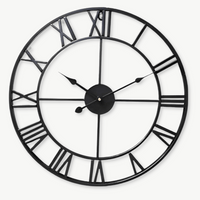
Industrial clocks can work well in small spaces if they're chosen carefully. The key variable is weight: a large, heavily ornamented gear-style clock can feel oppressive in a compact room. A cleaner metal frame with a simple dial, in the 30-38 cm range, brings the industrial edge without the visual heaviness. Black metal frames with a white or cream dial are particularly versatile against most wall colors.
What to Avoid in Small Spaces
- Very thick, three-dimensional cases that protrude significantly from the wall, they catch shadow and feel heavy.
- Highly reflective mirrored faces in narrow hallways, where they can create disorienting reflections rather than the depth effect you'd hope for.
- Roman numerals with very ornate typefaces in small kitchens, they're harder to read quickly in a busy cooking context.
- Multiple clocks in the same room. One intentional clock beats three random ones every time.
The Silent Movement Question (It's Not Optional in a Small Apartment)
A silent sweep movement is the single most important functional specification for any wall clock in a small apartment: it produces genuinely zero audible sound, unlike a standard quartz tick that clicks 60 times per minute and is easily heard from every corner of a compact space. This one matters more than most people realize until they've lived with a ticking clock in a studio for six months. In a small apartment, you're rarely more than a few meters from any wall. A traditional quartz tick mechanism clicking 60 times per minute is audible during quiet moments, and profoundly irritating during sleep, work, or conversation.
A silent sweep movement uses a continuously rotating motor rather than the step-by-step quartz mechanism. No tick. Not quieter ticking, genuinely no audible sound. For anyone working from home, sleeping lightly, or simply sensitive to background noise, this is the single most important functional specification to look for when choosing the best wall clock for a small apartment.
The practical difference: a silent clock costs marginally more in some cases, but the quality-of-life improvement in a compact living situation is significant. It's one of those specs that sounds like a minor detail until you're lying in bed at 2am wishing you'd paid attention to it. Our entire silent wall clock collection uses sweep movements specifically selected for compact living environments.

Placement Principles: Where the Clock Actually Goes
Hang a wall clock so its center sits at 155-170 cm from the floor, always above a key piece of furniture, with 20-30 cm of clear space between the top of the furniture and the bottom of the frame, so the clock anchors rather than floats. Hanging the right clock in the wrong spot undoes all your good decision-making. Placement in a small apartment follows a few straightforward principles, and getting them right is the difference between a clock that looks styled and one that looks stuck up there.
Height
The standard advice is "eye level," but that's imprecise. The ideal center height for a wall clock in a living space is 155-170 cm from the floor, roughly where your gaze lands naturally when standing. In a bedroom, you can drop this slightly to 145-160 cm so the clock reads well when you're lying down. In a hallway, center it at around 160 cm, you'll see it in passing without craning your neck.
Above Key Furniture Pieces
The most reliable placement method: anchor the clock above something. Above a sofa, above a console table, above a bed headboard, above a fireplace mantel. This creates a visual relationship between the clock and the furniture below it, making both look more intentional. Leave 20-30 cm between the top of the furniture (or highest cushion) and the bottom of the clock frame.
Where Not to Hang a Clock
- Directly above a stove or kettle, steam and grease accumulate quickly on clock faces and mechanisms.
- In direct sunlight for prolonged periods, UV exposure fades dials and warps wooden frames over time.
- On the same wall as a large mirror facing it, the doubled reflection creates visual confusion rather than depth.
- In a corner where it can't be seen from the main sitting position in the room.
- Facing the front door in many traditional design philosophies (particularly in feng shui), where a clock visible immediately upon entering is considered unwelcoming, though this is a personal choice.

Solo vs. Gallery Wall Integration
A clock works beautifully as a standalone focal point. It also works within a gallery wall, but only if it's the anchor, not an afterthought. Place the clock first, then build the gallery arrangement around it. When it's treated as an equal to the other frames, it tends to get lost. When it's slightly larger than the surrounding pieces and positioned at the natural center of the arrangement, it becomes the piece that holds everything together.
Renter-Friendly Considerations: Thinking Beyond the Nail
For renters, the lightest compact wall clocks win: bamboo and acrylic designs under 50 cm typically weigh under 600 g and hang safely on a single picture hook or strong adhesive strip, with no anchors, no damage, no lease worries. A significant portion of small apartment dwellers are renters, and that changes the conversation in a genuinely practical way. Large, heavy clocks requiring multiple anchors or specialist fixings aren't always workable (or allowed under your lease). Here's what actually works.
Most clocks under 50 cm and under 2 kg hang happily on a single picture hook or even a strong adhesive strip rated for that weight. For renters prioritizing lightweight options, bamboo and acrylic clocks are the clear winners. A 40 cm bamboo clock typically weighs under 600 g, roughly the same as a picture frame, and it punches well above its weight visually. Heavier materials like cast metal or thick glass require wall anchors and more commitment, which isn't ideal if you're moving in two years.
If you're genuinely hook-averse, a clock on a floating shelf or leaned against a wall on a console can work surprisingly well for smaller diameters (up to about 25 cm). It reads as styled rather than lazy if the shelf has a few other objects at varying heights, a small plant, a stack of books with good spines, a candle. Browse the full living room wall clock range filtered by material to find the weight that suits your wall situation.
Silent Wall Clocks
Every clock here uses a sweep movement, because in a small apartment, silence isn't an upgrade, it's the baseline.
179 references
Browse the collection →When One Clock Is All You Need: Making It the Statement
One well-chosen wall clock for a small apartment, hung at the right height on an otherwise clean wall, always outperforms a room scattered with competing objects: restraint and intentionality are what make a compact space look genuinely considered. There's a version of small apartment decorating that tries to fill every surface and every wall, and there's a version that commits to negative space. The second version almost always looks better. A single, well-chosen wall clock for a small apartment hung on an otherwise bare wall isn't sparse, it's confident.
Think of it the way you'd think of a single piece of statement jewelry. A chunky ring, a beautiful bracelet, a proper necklace. Not all three at once. One clock that you genuinely love, hung at the right height, in the right proportional size for the wall, with the right frame material for the room, that's the move. It creates a moment in the space rather than a list of objects.
When customers share photos of their apartments with us, the ones that consistently look the most pulled-together share this quality: restraint in the number of objects, intentionality in the ones they kept. A clock that was picked because it genuinely spoke to the person, not because it was the most obvious choice, reads that way on the wall.
If you're browsing and feel unsure, start with the unique wall clocks collection, pieces designed to stand on their own rather than as background decoration. You'll know it when you see it.
FAQ: Common Questions About Wall Clocks in Small Apartments
What is the best wall clock for a small apartment?+
The best wall clock for a small apartment combines three things: a proportional size (typically 25-40 cm depending on the room), a silent sweep movement so there's no audible ticking in close quarters, and a visually lightweight design. Open-face, thin frame, natural materials like bamboo or light oak all keep visual weight low. Scandinavian minimalist and Japanese-inspired styles consistently tick all three boxes, literally and figuratively.
Where should you hang a clock in an apartment?+
The most reliable placement is above a key piece of furniture: a sofa, headboard, console table, or dining bench. Center the clock over the piece, leave 20-30 cm between the furniture and the bottom of the clock frame, and aim for the center of the clock to sit at roughly 155-170 cm from the floor. This creates a visual anchor rather than a floating object.
Where should you not put a wall clock in a small space?+
Avoid hanging a clock directly above a stove or kettle (steam and grease damage the mechanism and face over time), in prolonged direct sunlight (fades dials and warps wooden frames), or on a wall where it's not visible from the main seating position. Also avoid corners; a clock tucked into a corner loses its visual impact entirely and can feel like it was hidden rather than placed.
Can a large clock work in a small apartment?+
Yes, with conditions. A larger clock (45-60 cm) can absolutely work in a small apartment if it's on the right wall (the main focal wall of the living room, not a narrow kitchen wall), and if it has an open or visually light design. Think open face with exposed hands rather than a solid, heavily detailed dial. One large clock on a clean wall is far less visually heavy than the same clock surrounded by competing objects.
Do silent wall clocks keep accurate time?+
Yes. A silent sweep movement uses the same quartz accuracy as a standard ticking quartz movement, the difference is purely in how the motor advances the hands (continuously rather than in steps). Time accuracy is identical. The silent mechanism is simply a different motor design, not a compromise on precision.
What clock style suits a minimalist small apartment?+
Scandinavian minimalist and Japanese-inspired designs are the most consistent winners in minimalist spaces. Both lean on natural materials (pale oak, bamboo, acrylic), spare dial markings, and thin profiles that reduce visual bulk. An open-face design where you can partially see the wall behind the clock is especially effective in tight spaces, it keeps the room feeling airy rather than boxed in. If you want something with a bit more personality, a clean industrial-style piece in matte black with a white dial works across most minimalist and contemporary interiors too.