
Antique style wall clocks occupy a strange and wonderful corner of home decor. They carry the weight of history without the fragility of the real thing. No winding keys, no delicate escapements to nurse back to life, no provenance paperwork to chase down at auction. Just a beautifully considered object on your wall that anchors a room in a way a plain modern clock rarely can.
The catch? The market is full of clocks that photograph well and disappoint in person. A finish that looked aged brass online turns out to be spray-painted plastic. Roman numerals that seemed crisp in the listing are barely legible from across the room. It's a frustrating experience, and it's avoidable once you know what to actually look for. This antique style wall clock buying guide walks you through every decision, finish to frame, numeral to movement, room by room.
Here's what works, room by room, decision by decision.
⭐ À retenir
- Finish quality determines how "real" the clock looks at close range - check for layered patina, not flat color.
- Numeral style (Roman vs. Arabic) sets the whole aesthetic tone; match it to your other decorative elements.
- Frame material affects weight, durability, and authenticity - metal and solid wood age better than resin composites.
- Dial texture matters as much as color: embossed or printed details read very differently on the wall.
- Silent quartz movements are non-negotiable in bedrooms and open-plan living spaces.
Why "Antique Style" Is a Broader Category Than You Think
Walk into any interiors shop and you'll see clocks labelled "vintage," "antique style," "retro," and "classic" used almost interchangeably. They're not the same thing, and the distinction matters when you're buying for a specific interior.
True antique clocks are generally understood to be at least 100 years old. Vintage typically refers to pieces from roughly the 1920s to the 1980s. Antique style is different from both: it's a contemporary clock built with design cues borrowed from historical periods. Think French enamel dials, Victorian cast-iron frames, American farmhouse pendulum cases, or the ornate filigree of Belle Époque European mantel clocks, all reproduced with modern quartz movements inside.
This means the buying criteria shift. You're not evaluating authenticity of age. You're evaluating the quality of the design homage. Does the clock feel like it could have come from a Parisian marché aux puces? Or does it feel like a costume? That's the core question this antique style wall clock buying guide is designed to help you answer before you spend a cent.
💡 Le savais-tu ?
The word "clock" comes from the medieval Latin clocca, meaning bell. Early public clocks in 14th-century Europe didn't have dials at all. They simply rang on the hour. The decorative dial face we now consider essential to a clock's design didn't become standard until the 15th century.
Reading the Finish: The Detail That Separates Good from Great

Finish is the first thing your eye lands on when you look at an antique style wall clock, and it's the quickest way to tell a well-made piece from a cheap imitation. Here's the honest breakdown of what you're likely to find at different price points.
Flat single-tone finishes
These are the clocks that look fine in photographs but fall flat the moment you hang them. A single coat of gold or bronze spray, no variation in tone, no depth at edges or relief. From two metres away, they read as plastic even when the underlying material is metal. If the product listing only shows close-up shots of the dial rather than the frame, that's often a deliberate choice by the seller.
Layered patina finishes
This is what you're looking for. A properly finished antique-style frame will have a base coat plus at least one contrasting highlight or shadow layer. Aged brass, for instance, should be darker in the recessed areas (where tarnish accumulates naturally) and brighter on raised edges (where it would catch handling over decades). This two-step process, called "antiquing," can be done well in factory production when the manufacturer invests in it. It makes a $150 clock look like a $500 piece.
Distressed and weathered textures
Some antique-style clocks go further with physical texture: hand-rubbed wax finishes on wood frames, hammered metal effects on iron bezels, or craquelure (a fine crackle pattern mimicking aged paint or glaze) on the dial face. These are harder to fake at low cost, so their presence is usually a reliable signal of quality intent.
| Finish Type | What It Looks Like Up Close | Best For |
|---|---|---|
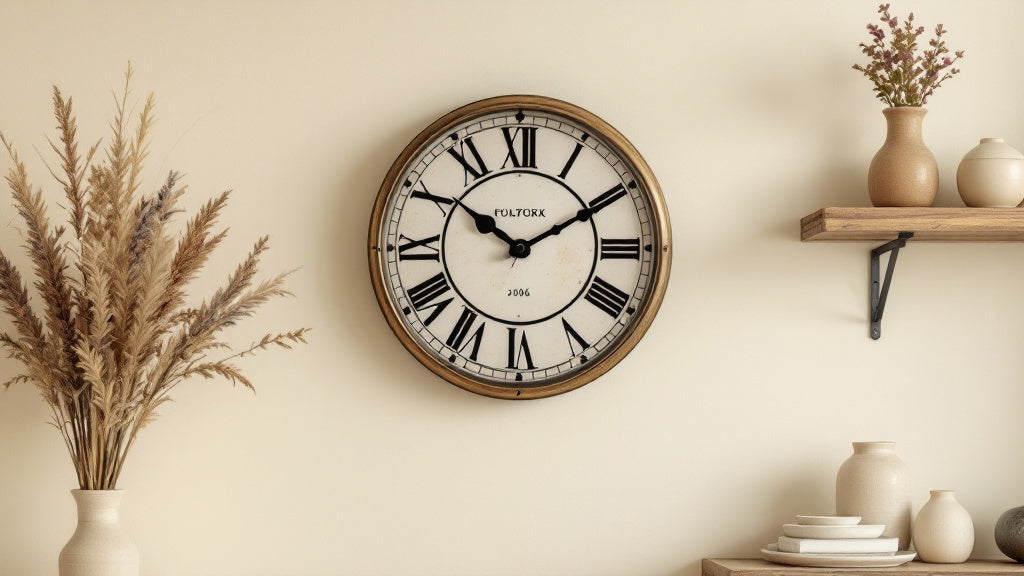
| Aged brass | Warm gold with brown/green shadow in recesses | Victorian, French Empire, traditional interiors |
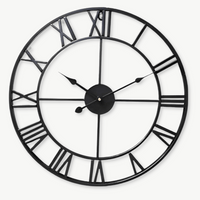
| Matte black iron | Flat, slightly rough surface with no gloss | Industrial, farmhouse, loft spaces |
| Distressed wood | Hand-rubbed stain, visible grain, light wear marks | Rustic, Scandinavian, cottage, kitchen walls |
| Copper patina | Reddish-orange base with verdigris accents | Industrial, steampunk, eclectic lofts |
| White craquelure | Fine hairline crack pattern over off-white dial | French provincial, shabby chic, café interiors |
Roman vs. Arabic Numerals: A Design Choice That Shapes the Whole Room
People underestimate how much numeral style controls the feel of a clock. It's not just about what you prefer to read. The shape of the numbers carries its own historical and aesthetic weight, and getting this wrong can make a beautiful clock feel slightly off in your space.
Roman numerals
Roman numerals signal formality, classicism, and European heritage. They appear on church tower clocks, grandfather clocks, and the faces of luxury Swiss watches for a reason: the vertical lines of I, V, and X create a strong graphic rhythm that reads as "serious" and "traditional." If your home leans toward classic European decor, warm neutrals, antique furniture, or any kind of maximalist richness, Roman numerals are almost always the right call.
One thing worth knowing: most antique-style clock dials use "IIII" rather than "IV" for the number four. This isn't a mistake. It's a convention dating back to at least the 14th century, possibly used to balance the visual weight of the dial against the VIII on the opposite side. Some customers see it and worry the clock is defective. It's not. It's historically accurate.
Arabic numerals
Arabic numerals (1, 2, 3...) are more legible at a glance, especially from a distance. On an antique-style clock, they often appear in a serif typeface that nods to Victorian printing presses or early 20th-century industrial signage. If your interior mixes periods, or if you want a clock that reads a little more casually (a kitchen, a mudroom, a relaxed living space), Arabic numerals can carry vintage character without the full ceremony of Roman.
No numerals at all
A growing segment of antique-style clocks use only hour markers, dots, or simple lines with no numbers. This is a more contemporary interpretation of the vintage aesthetic. It works well in spaces where the clock is meant to be a sculptural piece first, a timekeeper second. Just be honest with yourself about whether you'll actually find it practical day-to-day.

Frame Materials: What They Mean for Longevity and Look

The frame is the bones of the clock. It determines how the piece ages, how heavy it feels on the wall, and whether it reads as a considered purchase or a fast-fashion decoration. Here's an honest look at the main options.
Metal frames (iron, steel, aluminum)
Metal is the most durable frame material for antique-style clocks and, when properly finished, the most convincing. Cast iron in particular has a weight and density that immediately communicates quality. It's cold to the touch, satisfyingly heavy, and its surface takes aged finishes beautifully. Wrought iron and steel are lighter but still rigid, making them good for larger-format clocks where weight on the wall is a concern.
Aluminum is lighter still and cheaper to manufacture. A well-finished aluminum frame can look excellent, but it lacks the thermal mass of iron and can feel hollow if you handle it. For a clock you'll hang and rarely touch, this distinction matters less than it does for, say, furniture.
Solid wood frames
Wood brings warmth that metal simply can't replicate. Walnut, oak, and pine are the most common choices for antique-style wall clocks. Walnut has a natural richness, a deep brown grain that photographs beautifully and ages gracefully. Oak is harder, lighter in color, and carries strong farmhouse and Scandinavian associations. Pine is softer, more prone to dents, but takes paint and stain easily, making it ideal for painted or distressed finishes.
The thing to check: is it solid wood or MDF with a wood-look veneer? MDF frames are cheaper and more dimensionally stable (they don't expand and contract with humidity the way solid wood does), but the edge detail and weight tell the story. A solid walnut frame at 45 cm will feel noticeably heavier than its MDF equivalent.
Resin and composite frames
Resin composites are the most common material at the lower price tiers. They're lightweight, easy to cast into ornate shapes, and take surface finishes well. The problem is longevity: resin can yellow over time under UV exposure, and the finish can chip in ways that expose bright white material underneath rather than a natural substrate. If you want a clock to last a decade on a sunlit wall, resin is a risk worth knowing about.
Dial Details That Actually Matter
The dial is where function and aesthetics meet, and it's surprisingly easy to overlook the details that will bother you six months after hanging the clock.
Dial material: printed vs. embossed
Budget antique-style clocks use a flat printed dial, which is fine for the numerals but gives the surface no physical texture. Higher-quality dials are embossed, meaning the chapter ring (the ring containing the numerals), the hour markers, or decorative borders have actual raised relief. This catches light differently throughout the day and creates a genuinely antique feel that a flat print cannot achieve. It's worth zooming into product images specifically to look for this.
Dial color and aging
Cream and off-white dials read as more authentically aged than pure white. The slight yellowing mimics the aging of enamel or paper, which is what genuine antique dials are usually made from. If a clock is marketed as antique-style but has a bright white dial, the overall effect tends to feel incongruous, like a costume with a modern t-shirt underneath.
Glass vs. open-face dials
Open-face dials (with no protective glass cover) have a more authentically vintage look and make reading the time from an angle easier. They're also one less layer of reflection to contend with in rooms with strong directional lighting. The trade-off is dust accumulation on the dial surface over time. In a kitchen, this matters more than in a hallway.
Glass-covered dials offer protection and are more common on higher-end pieces. Convex glass, which curves outward from the bezel, is a beautiful historical detail borrowed from 18th and 19th century pocket watch and clock design. It catches light in a distinctive way and immediately signals quality to anyone who knows clocks.

Movement Type: Quartz, Mechanical, and Why the Noise Question Really Matters
The movement inside an antique-style clock is where most buyers focus least, and where one specific decision makes a genuine daily difference. If you're using this as a practical antique style wall clock buying guide, don't skip this section. It's the one you'll thank yourself for reading.
Quartz movements: standard ticking vs. silent sweep
Almost all modern antique-style wall clocks use quartz movements. They're battery-powered, accurate to within about 15 seconds per month, and require essentially no maintenance. The main variable is whether the movement is a standard "ticking" quartz or a "sweep" (also called silent) quartz.
A standard quartz movement produces the familiar tick-tock sound: one audible mechanical step per second as the escapement advances the gear train. In a living room with background noise, a television running, or a kitchen with ambient hum, this is completely inaudible. In a quiet bedroom at 2am, it can be genuinely disruptive, measuring around 25 to 30 decibels in a still room, roughly the volume of a soft whisper just a metre away. That's not nothing.
Silent sweep quartz movements work differently: instead of stepping once per second, a microstepping motor advances the gear continuously, so the second hand glides rather than ticks. The result is near-total silence. There's no audible mechanical output at all under normal conditions. The accuracy is identical to a standard quartz. The cost difference is typically $10 to $20 on the retail price. For any clock destined for a bedroom, home office, reading room, or open-plan living space where you spend quiet time, this isn't a luxury upgrade. It's a baseline requirement. The standard ticking movement is perfectly fine in high-traffic zones (hallways, busy kitchens) where ambient noise masks it anyway.
One more practical note: sweep movements also tend to be gentler on the second hand pivot over time, since the gear isn't absorbing thousands of micro-impacts per day. For a clock you expect to last ten-plus years, this is a small but real durability advantage.
Mechanical and pendulum movements
Some antique-style clocks include a decorative pendulum, which swings for aesthetic effect even when the movement itself is quartz. The pendulum doesn't affect accuracy but adds enormously to the visual drama of the piece, particularly with larger statement clocks in entryways or living rooms. True mechanical movements (spring-wound or weight-driven) require winding every 7 to 30 days and are typically found in higher-end reproduction pieces. They produce a genuine mechanical tick and are a pleasure to own if you enjoy the ritual of maintaining them.

Matching Antique Clock Styles to Interior Design Movements
Here's a practical framework. Instead of asking "which clock looks good?", ask "which historical period does my room borrow from?" The answer usually points you straight to the right style.
- French provincial / shabby chic: Look for ornate plaster or resin frames in white or cream with gold highlights, Roman numerals, craquelure or distressed dial surfaces. Oval or arched tops.
- Victorian / traditional English: Dark mahogany or walnut frames, brass bezels, Roman numerals on cream enamel dials. Pendulum or bracket clock shapes.
- Industrial / loft: Raw iron or copper-finish metal frames, minimal or no decorative molding, Arabic numerals in bold sans-serif or stencil-style typography. Exposed gear or mechanism details.
- American farmhouse: Painted wood frames in black, white, or sage. Distressed finishes. Roman or Arabic numerals in a simple serif. Often rectangular or barn-door shaped.
- Mid-century European cafe: Enamel or printed dials with a slightly worn look, thin metal frames, Arabic numerals in a classic serif. These sit particularly well in kitchens and dining rooms.
- Scandinavian modern-vintage: Light wood frames (birch, pine, light oak), minimal markings, clean numeral placement with generous negative space. The antique reference is subtle rather than literal.
You can explore the full range of designer wall clocks organized by style, or narrow it down to the most distinctive statement pieces if you want something that goes beyond a simple period reference.
💡 Le savais-tu ?
The characteristic "Vienna Regulator" style, with its slim rectangular case, long pendulum, and minimalist white enamel dial, was actually designed in the early 19th century as a reaction against the ornate excesses of Baroque clockmaking. What we now read as elegantly antique was, at the time, deliberately radical simplicity. Many Scandinavian clock designs today trace a direct line back to those Vienna workshops of the 1800s.
Size, Placement, and Scale: The Part Most People Get Wrong

Even the most beautifully finished antique-style clock can feel wrong on the wall if it's the wrong scale for the space. This is probably the most common mistake, and it's easy to avoid with a bit of planning before you buy.
The wall-to-clock ratio rule
A clock should occupy roughly one-third to two-thirds of the available wall width above the furniture or surface it's positioned over. A 30 cm clock above a 180 cm sofa will disappear. A 60 cm clock in a narrow hallway will dominate uncomfortably. The sweet spot for most living rooms is 45 to 60 cm. For kitchens and bedrooms, 30 to 40 cm usually works well.
Hanging height
Clocks work best at eye level or slightly above, roughly 150 to 170 cm from floor to center. Above a fireplace mantel or console table, position the clock so its center sits about 15 to 25 cm above the surface beneath it. This prevents the clock from appearing to float disconnected from its surroundings.
Pairing with surrounding decor
Antique-style clocks read best when they're not the only aged element in the room. A beautiful aged brass clock on an otherwise completely minimal Scandinavian wall can look awkward, like one person who misread the dress code. Pair it with at least one other warm, textured element: a rattan frame, a terracotta vase, a linen cushion, aged wood shelving. The clock then feels like part of a considered whole rather than a stylistic outlier.
"The clock is the face of the room. It's the piece that gives a space a sense of time passing, of history held."
Traditional French clockmakers' saying, cited in L'Art de l'Horlogerie, Paris, 1892
Where to Hang Your Antique Style Wall Clock by Room
Different rooms reward different approaches, and a clock that's perfect in one context can feel misplaced in another. Here's where things land in practice.
Living room
The living room can handle the most dramatic antique-style clocks. A large wall clock at 50 to 60 cm, aged brass or iron finish, placed above a fireplace or as a gallery wall centerpiece, becomes a genuine focal point. It's the room where scale works in your favor.
Kitchen
Kitchens benefit from clocks that are readable from across the room while cooking. A 30 to 40 cm piece with clear numerals (Arabic often reads better than Roman at cooking-glance speed), an open face, and a durable finish that won't show steam damage. The kitchen clock range has options specifically proportioned for this context.
Bedroom
Keep it smaller (25 to 35 cm) and always silent sweep quartz. An antique-style bedroom clock in warm wood or aged white works particularly well on a bedside wall or above a low dresser. The bedroom clock collection filters specifically for silent models, which saves you the guesswork.
Entryway and hallway
Narrow spaces reward vertical shapes: an arched-top clock, a small pendulum case, or a slim round clock hung at eye level. These are high-traffic zones where a clock gets noticed every time someone passes. It's worth spending a bit more here for a piece with genuine visual presence.
FAQ: Antique Style Wall Clock Buying Guide
What makes a clock antique versus vintage?+
The standard definition used by most antique dealers and customs authorities is that a true antique must be at least 100 years old. Vintage typically refers to items between roughly 30 and 99 years old, so a clock made in the 1970s would be vintage, not antique. "Antique style" is a modern clock built with design references borrowed from antique periods - it carries no age requirement at all.
How do you identify an antique clock's style period?+
Look at the case shape and material first: ornate gilded bronze cases often indicate French Empire or Second Empire periods (roughly 1800-1870); dark mahogany with brass inlay suggests English Victorian; tall narrow wooden cases with a weight-driven pendulum point to American mantel or Vienna Regulator traditions. The dial typography and numeral style also help - Gothic or Old English lettering is typically Victorian or Arts and Crafts, while clean serif Arabic numerals in red and black usually indicate early 20th century industrial or Bauhausian influence.
How do I choose the right wall clock size for my room?+
The most reliable rule: the clock's width should fill one-third to two-thirds of the wall width available above the furniture piece below it. For a standard sofa (180-200 cm wide), this means a clock between 40 and 60 cm. For a small kitchen shelf or bedside wall, 25-35 cm is usually right. When in doubt, cut out a paper template at the intended size and hold it against the wall before buying.
How do I tell if an antique-style clock is good quality without seeing it in person?+
Check the product weight listed in specs: heavier almost always means better materials. Look at the finish in close-up images - you want to see tonal variation (darker in recesses, lighter on raised edges), not a flat single color. Read the movement type carefully: "silent quartz" or "sweep movement" is a positive signal. Check whether the dial is described as embossed or printed. Finally, look at the number of product images: manufacturers confident in their finish quality show the clock from multiple angles and in real room settings.
Is a silent quartz movement worth paying more for?+
For any room where you spend quiet time - bedroom, home office, reading room, open-plan living - yes, absolutely. The difference between a standard ticking quartz and a sweep quartz is not subtle in a quiet room at night. For a hallway or a busy kitchen where ambient noise masks the tick anyway, the standard movement is perfectly fine and saves money. It's a context decision, not a universal upgrade.
Which frame material is best for an antique-style wall clock that will last?+
Cast iron and solid hardwood (walnut, oak) are the most durable choices and age most authentically. Cast iron takes layered patina finishes beautifully and its weight signals quality immediately. Solid walnut develops a richer tone over years rather than yellowing or chipping. Resin composites are a reasonable budget option in low-light interiors but carry real longevity risks on walls with direct sunlight exposure. If longevity matters to you, check the product weight and ask the seller specifically about the frame substrate before buying.