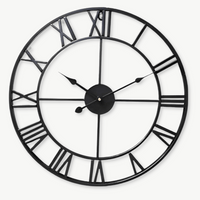


You finally fall asleep. It's 2 a.m. The room is perfectly dark. And then you hear it: tick... tick... tick. A clock on the bedroom wall, doing exactly what it was designed to do, and absolutely ruining your night.
The good news? That problem has a very clean fix. The best silent wall clock for bedroom use runs on what's called a sweep quartz movement, and once you understand how it works, you'll never buy a stepping-movement clock for a sleeping space again. Whether you're a light sleeper who wakes at the slightest sound or simply someone who values a genuinely calm bedroom, here's everything that actually matters when you're choosing one.
⭐ À retenir
- A "silent" clock isn't just marketing: sweep movement physically eliminates the tick by moving the second hand in one fluid rotation instead of 60 discrete steps.
- Quartz accuracy and sweep operation are two different things. Both matter for a bedroom clock.
- Frame material affects sound too: metal frames can resonate; wood and plastic absorb more vibration.
- Size and placement change how much you notice any residual mechanism noise from across a room.
- The best silent wall clock for bedroom spaces combines sweep movement, a readable dial, and a design that actually fits your space.
What "Silent" Really Means: Stepping vs. Sweep Movement
A truly silent bedroom clock uses sweep quartz movement, which runs the second hand in one continuous rotation instead of 60 per-second impulses, eliminating the repetitive tick that keeps light sleepers awake. Most affordable clocks use a stepping quartz movement. Inside, a tiny motor fires once per second, lurching the second hand forward in 60 distinct incremental jumps per minute. Each jump produces a mechanical impulse. That impulse travels through the clock body and into your wall. In a quiet room at night, you hear every single one of them.
A sweep quartz movement works completely differently. The motor runs continuously, turning the second hand in one smooth, uninterrupted rotation. There's no jerk, no impulse, no audible click. The hand glides. The room stays quiet. This is the core reason why a genuine best silent wall clock for bedroom is always built on sweep technology, not just a stepping motor that's been listed as "low noise."
Now, "sweep" and "silent" aren't synonyms used identically across every manufacturer. Some brands label their clocks "silent" when they simply mean the stepping motor is quieter than average, not that they use true sweep operation. The tell is the second hand: watch it for 30 seconds. If it moves in tiny jumps, it's a stepper. If it flows continuously without any visible pause between positions, it's a genuine sweep.

💡 Le savais-tu ?
The stepping quartz movement was developed in the late 1960s as a way to reduce battery consumption. It was never designed with bedroom acoustics in mind. Sweep movements draw slightly more power, which is why they tend to appear in mid-range to premium clocks rather than bargain-bin options. That energy difference is measured in milliwatts, and for most people it translates to replacing one AA battery every 12-18 months instead of every 18-24. Is sweep really silent? In normal bedroom conditions, yes: there's no repetitive per-second impulse for your sleeping brain to lock onto.
The 5 Specs That Actually Separate Good Bedroom Clocks from Great Ones
Beyond sweep movement, four more specs determine whether a silent bedroom clock is merely adequate or genuinely great: movement quality, frame material, dial legibility, size, and battery access all shape real-world bedroom performance. Once you've confirmed sweep movement is on board, there are four other specs worth looking at before committing to a clock for a sleeping space. None of these are complicated.
1. Movement Quality (Not Just "Quartz")
Quartz is a crystal, not a brand. The word tells you the timekeeping standard (accurate to roughly ±15 seconds per month), but it says nothing about build quality or sweep capability. Look for movements from known suppliers like Seiko, Miyota, or UTS if the manufacturer is willing to name their movement source. If they're not, the second-hand test above is your best friend.
2. Frame Material and Construction
A metal frame mounted flush against a hollow drywall section can transmit even the faintest internal vibration straight into the wall, amplifying it. Wooden frames, especially solid rather than MDF, absorb more of those micro-vibrations. Plastic frames are acoustically neutral and often the quietest overall. This isn't a reason to avoid metal clocks entirely, just a factor worth considering if your bedroom walls are thin or your sleeping is light. For Scandinavian minimalist or natural-material bedrooms, solid oak or walnut frames are genuinely the best of both worlds: beautiful and acoustically forgiving.
3. Dial Legibility at Night
High contrast dials with bold hands are easier to read at 3 a.m. without turning on a light. Arabic numerals tend to be faster to read than Roman numerals at a glance. If your bedside lamp has a warm amber bulb (as it should for sleep hygiene), a white or cream dial with dark hands catches that light better than a dark face with light hands.
4. Size Relative to Viewing Distance
A general rule of thumb from interior designers: for every foot (30 cm) of viewing distance, the clock diameter should increase by roughly one inch. A bed that's 12 feet from the wall pairs well with a 12-inch (30 cm) clock. Go too small and you're squinting in the dark. Go too large and the clock dominates the room visually and, in some cases, the motor hum (however faint) carries further.
5. Battery Compartment Access
This sounds trivial until you've wrestled with a clock that requires removing it from the wall, locating a coin, unscrewing a tiny battery cover, and repeating the process every year in the dark. A swing-open battery door on the back, accessible without removing the clock, is a small quality-of-life detail that separates thoughtfully designed pieces from afterthoughts.

Which Clock Styles Work Best in a Bedroom Setting
For a bedroom, minimalist and Scandinavian styles perform best overall: clean dials, wood or plastic frames with low resonance, and a design that disappears into the room rather than competing with it. Silence is the baseline. Style is where you actually get to have fun. Here's how the main aesthetic categories perform in bedroom contexts, beyond just looks.
Minimalist and Scandinavian
Clean dials, no second hand on some models (which removes even the faintest sweep noise entirely), wooden or white frames. These integrate into almost any bedroom palette from warm neutrals to cool grays. The absence of decoration draws the eye to the time rather than the object, which is exactly right for a space built around rest. Scandinavian wall clocks are particularly popular in bedrooms for this reason: no visual noise, no acoustic noise. If you're working with a light oak, white linen, and soft sage color palette, a minimalist round clock in natural beech wood will feel like it was always meant to be there.
Vintage and Classic
Roman numeral dials, aged finishes, bamboo or weathered wood frames. These carry personality and warmth without being loud about it. They work especially well in bedrooms with natural materials: linen bedding, rattan furniture, terracotta tones. The key is checking that the vintage aesthetic hasn't come paired with a vintage-quality (i.e., stepping) movement.
Industrial and Metal
Copper, brushed steel, open-face designs with exposed numerals. Genuinely striking against a textured wall or exposed brick. As mentioned, heavier metal frames need to be hung with care on solid wall sections to avoid any resonance. Done right, an industrial-style silent clock reads as intentional and bold rather than incidental. It's a statement piece that happens to keep time quietly.
Glass-Face and European Designer
A glass cover doesn't affect sweep silence, but it does protect the dial and hands from dust accumulation, which matters in a bedroom where you'll be cleaning less aggressively around it. European-style glass-face clocks often combine refined aesthetics with high-quality movements. They tend to sit at a higher price point, but the longevity is there.

Where to Place a Silent Clock in the Bedroom for Maximum Comfort
The ideal position for a silent wall clock in the bedroom is directly opposite the bed at seated eye level, above a dresser or chest of drawers, away from both the headboard and direct sunlight. Placement matters more than most people realize. It's not just about aesthetics; it's about how much of the room the clock visually and acoustically anchors.
- Opposite the bed, at eye level when seated: You read it without lifting your head. The clock becomes part of your line of sight rather than something you have to search for.
- Above a dresser or chest of drawers: This mirrors a classic interior arrangement and gives the clock a visual base, preventing it from floating in the middle of an empty wall.
- Avoid directly above the headboard: Functionally awkward (you can't see it lying down), and the close proximity to your pillow means even the quietest mechanism may be audible in very deep silence.
- Not adjacent to a window with direct sunlight: UV exposure over years fades dials and can warp plastic frames. A position that catches natural light without direct sun is ideal.

Sweep Movement Clocks by Style: A Quick Comparison
Scandinavian and minimalist sweep clocks offer the lowest resonance for bedrooms; solid walnut and wood frames absorb vibration best; metal-frame clocks need solid-wall mounting to stay truly quiet.
| Style | Best For | Frame Material | Acoustic Note |
|---|---|---|---|
| Scandinavian / Minimalist | Neutral or Nordic bedrooms | Wood, plastic | Lowest resonance |
| Vintage / Classic | Warm, eclectic spaces | Bamboo, wood, resin | Very low resonance |
| Industrial / Metal | Loft, urban, textured walls | Metal, iron | Mount on solid wall to avoid resonance |
| Glass-Face / European | Classic, refined bedrooms | Glass, metal rim | Low; glass adds slight sound dampening |
| Handcrafted Wood | Natural, artisan-focused spaces | Solid walnut, oak | Excellent vibration absorption |
Three Bedroom Clocks Worth Considering in 2026: From Entry-Level to Premium
Three quiet wall clocks cover the full range of bedroom needs in 2026: a 10-inch classic analog at $50 for reliability, a 12-inch European glass-face at $77 for design presence, and a solid walnut handcrafted piece from $99 for maximum acoustic performance. These three sit at different price points and different aesthetics, but all share the characteristics that matter most for a sleeping space: sweep movement, considered design, and materials that won't bounce sound around the room. Think of them as three rungs on the same ladder, each one right for a different bedroom and a different budget.
If you're starting out and want a proven, fuss-free option, the Classic Analog Quartz above is your anchor. For something with a bit more visual presence and design intent, the two below step things up considerably.

For the most acoustically considerate option in the collection, solid walnut is genuinely in a category of its own. The dense grain of real walnut wood absorbs micro-vibrations at the source, so even the faintest motor hum never escapes the case. It's the material choice that justifies the premium price tag, and it shows in a bedroom that values both craft and calm.

Silent Sweep Clocks Beyond the Bedroom: Other Rooms That Benefit
Home offices, nurseries, reading nooks, and open-plan living rooms all benefit from sweep movement clocks for the same reason bedrooms do: removing repetitive ticking improves focus, calm, and sleep in any quiet space. Once you've experienced a genuinely quiet clock in the bedroom, it's hard to go back to stepping movements anywhere in the house. A home office clock on sweep movement makes a real difference during focused work or video calls. The kitchen is another room where background ticking accumulates unnoticed over the course of a day, making a quiet sweep movement wall clock a worthwhile upgrade there too.
Living rooms with open-plan layouts are where a larger silent clock tends to shine. A 50 or 60 cm piece on a statement wall reads as intentional design, not just timekeeping. Living room wall clocks in sweep movement are available in every aesthetic from contemporary to industrial, so the style constraints that once limited silent clocks to basic designs no longer apply.
Nurseries and reading nooks deserve a special mention: a sweep clock in a baby's room removes one more potential disturbance during naps and night settling. It's a small call that parents who've made it tend to mention unprompted. The bedroom logic applies perfectly anywhere silence is a genuine priority rather than just a preference.
"A clock that keeps time is useful. A clock that keeps time without a sound is a gift to the room."
A sentiment shared by most light sleepers who've made the switch
Bedroom Clock Collection
Every clock in this collection is selected with bedroom use in mind: silent movements, legible dials, and designs that feel at home above a nightstand or dresser.
168 références
Découvrir la catégorie →How to Verify a Clock Is Truly Silent Before You Buy It
To verify a clock is truly silent before buying online, look for "sweep movement" explicitly in the specs, read bedroom-specific reviews, check whether the brand names its movement supplier, and confirm the return policy covers noise. Shopping online for a quiet clock has one obvious challenge: you can't hear it before it arrives. Here's what actually helps when you can't do the 30-second second-hand test in person.
- Look for "sweep movement" in the specs, not just "silent." The word silent is used loosely. Sweep is a technical description of how the motor operates.
- Read reviews specifically for bedroom use. Buyers who tested a clock in a quiet room at night are the most reliable source. A review from a home office or kitchen won't tell you much about 3 a.m. performance.
- Check if the brand names the movement. Seiko-movement clocks, for example, have a well-established reputation for true sweep operation and consistent accuracy.
- Ask about the return policy. A brand that's confident in its product's silence will stand behind a return if the clock turns out to produce audible ticking. This is a practical filter for quality.
💡 Le savais-tu ?
The human ear is significantly more sensitive to repetitive sounds than to continuous ones. A 40-decibel ticking clock in a silent bedroom is perceived as louder than a 50-decibel consistent hum. This is why a stepping clock at what measures as "barely any noise" can still keep light sleepers awake, while a slightly louder refrigerator hum across the room doesn't register the same way. The rhythm is the problem, not just the volume. It's also why "is sweep movement really silent?" gets asked so often: yes, because it removes the rhythm entirely, not just reduces the volume.
Caring for a Silent Quartz Clock So It Stays That Way
To keep a silent quartz clock running quietly for years, use fresh alkaline batteries from a reputable brand and replace them annually, dust the interior every six months, and change the battery first if any new sound appears. Sweep movements are durable, but a few habits keep them running quietly for years rather than months.
Battery quality matters more than most people expect. A weak or partially discharged battery causes the motor to work harder, which can introduce subtle irregularities in the sweep motion and, eventually, a faint irregular sound. Use fresh alkaline batteries from a reputable brand and change them annually rather than waiting for the clock to stop.
Dust buildup inside the clock body, particularly around the movement housing, can create faint rattling over time. A quick wipe of the accessible interior surfaces every six months is enough. If the clock has a glass front panel, a soft microfibre cloth keeps it clear without scratching.
If you ever hear a new, faint sound from a clock that was previously silent, the battery is the first thing to change. Nine times out of ten, a fresh battery restores full silent operation without any other intervention. If the sound persists, the movement may need professional servicing, but that's genuinely rare with quality sweep mechanisms.
⭐ À retenir
The best silent wall clock for bedroom use is one you genuinely forget is there. That's the goal: a sweep movement, quality frame, readable dial, and placement that puts it right where your eyes fall naturally. Get those four things right and your bedroom wall gains a statement piece that earns its place every single night.
FAQ
Are silent clocks actually good for bedrooms?+
Yes, genuinely so, but only if they use true sweep quartz movement rather than a stepping motor that's simply been labeled "quiet." A sweep clock has no per-second mechanical impulse, so there's no repetitive ticking sound for a sleeping brain to latch onto. Many people report noticeably better sleep quality after switching from a standard clock to a sweep-movement model, particularly light sleepers and those sensitive to repetitive background noise.
What type of clock is genuinely best for a bedroom?+
An analog wall clock with a sweep quartz movement, a high-contrast dial readable at low light, and a wooden or plastic frame (for minimal vibration resonance) covers the practical requirements well. Size-wise, a 10-12 inch (25-30 cm) clock works for most standard bedrooms. If you prefer a nightstand option, a battery-operated analog clock with sweep movement achieves the same silence at a closer range.
Is sweep movement really silent, or just quieter than a standard clock?+
True sweep movement is genuinely silent in normal bedroom conditions. Because the motor runs continuously rather than firing in 60 per-second pulses, there's no repetitive mechanical impulse and therefore no ticking. You may occasionally detect the faintest hum from the motor in an extremely quiet room if you press your ear close to the case, but at normal bedroom distances (across the room), a quality sweep clock produces no perceptible sound. The distinction matters: sweep removes the rhythm, not just the volume.
How can I tell if a wall clock is truly non-ticking before I buy it?+
In-store: watch the second hand for 30 seconds. Continuous, fluid motion means sweep. Visible per-second jumping means stepping. Online: look for "sweep movement" specifically in the product specifications, not just the word "silent." Reading reviews from customers who tested the clock in a bedroom or quiet office gives you the most honest picture of real-world noise levels.
Do silent sweep clocks require special batteries or maintenance?+
No special batteries needed: a standard alkaline AA or AAA (depending on the model) works fine. Sweep movements draw slightly more power than stepping motors, so expect battery life of roughly 12-18 months rather than 18-24 months. The practical maintenance advice is simple: change the battery annually with a quality alkaline, dust the interior surfaces twice a year, and the movement should stay silent for its entire lifespan.
Can a silent wall clock work in rooms other than the bedroom?+
Absolutely. Home offices, reading rooms, nurseries, and meditation spaces benefit from the same sweep-movement silence. In open-plan living areas, a larger silent wall clock (40-60 cm) provides the visual presence a big room needs while keeping the acoustic environment calm. The bedroom is where silence matters most, but it's not where it matters exclusively.