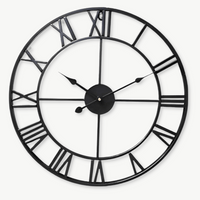


You hang a new clock on the bedroom wall, step back to admire it, and then it starts. That soft, relentless tick-tick-tick. At 2 a.m. it sounds less like timekeeping and more like a tiny metronome set to "annoying." If you've been there, you already understand why silent wall clock mechanisms exist, and why so many people are switching to them.
But what actually happens inside a clock that makes no sound? Is it just better padding? Slower gears? Some kind of sorcery? The answer is genuinely fascinating, and once you understand it, you'll never look at a clock hand the same way again. Here's exactly how the engineering works, what it costs in battery life, and how to choose the right movement for your space.
⭐ À retenir
- The ticking sound in traditional clocks comes from the escapement mechanism, not the motor itself.
- Silent movements use a continuous sweep motor that eliminates the stop-start motion entirely.
- Sweep motors draw more current than stepping motors, which affects battery life.
- Not all "silent" clocks are truly silent; quality of the movement and case construction both matter.
- Silent quartz movements work in virtually any clock style, from minimalist Scandinavian to ornate industrial.
Why Traditional Clocks Tick in the First Place
Traditional clocks tick because a component called the escapement releases energy one step at a time, each catch and release of the escape wheel produces a mechanical click that travels through the case straight to your ears. Before getting into how silent wall clock mechanisms work, it helps to understand what creates that ticking in a conventional clock. The culprit is a component called the escapement. In mechanical clocks, the escapement is a ratcheted wheel and lever system that controls how energy from a wound spring is released, one tiny step at a time. Each "tick" is literally the sound of that lever catching and releasing a tooth on the escape wheel.
Quartz clocks replaced the wound spring with an electronic oscillator, but many kept a version of the stepping logic. A quartz crystal vibrates at 32,768 Hz when voltage is applied. Dividing that frequency down through a series of circuits produces one electrical pulse per second. That pulse drives a stepping motor, which rotates the second hand exactly one step, one degree at a time, 360 steps per full rotation. Each step produces a small mechanical click. That click is your tick.
The tick isn't a flaw. For most of clock history, it was proof the thing was working. But in a quiet bedroom, a home office, or a library reading room, that proof gets old fast.

What Is a Silent Wall Clock Mechanism, Exactly?
A silent wall clock mechanism replaces the stepping motor with a continuous sweep motor that receives a steady low-level current, so the second hand glides around the dial in one unbroken arc with no mechanical impact and no sound. A silent wall clock mechanism, often called a continuous sweep movement or smooth sweep quartz movement, solves the noise problem by replacing the stepping motor with a different type of motor entirely. Instead of receiving one discrete electrical pulse per second, the sweep motor receives a continuous, low-level current that keeps it rotating without interruption.
Think of it this way. A stepping motor moves like someone tapping a steering wheel one beat at a time. A sweep motor moves like someone gently spinning that wheel in a single fluid motion. The second hand doesn't jump from second marker to second marker; it glides around the dial in one unbroken arc. No jump means no mechanical impact. No impact means no sound.
The motor itself is a small synchronous or DC motor paired with a gear train. The gear train reduces the motor's rotation speed down to the correct rate for each hand: the second hand completes one revolution per minute, the minute hand one per hour, the hour hand one per twelve hours. All of that reduction happens through a compact series of plastic or metal gears, most of which are quiet by design because they're made from low-density polymers that absorb rather than transmit vibration.
💡 Did you know?
The 32,768 Hz frequency used in quartz clock oscillators isn't arbitrary. It's 2 to the power of 15, which means it can be divided down to exactly 1 Hz using a simple 15-stage binary counter circuit. That mathematical elegance is why quartz became the universal standard for affordable timekeeping after its commercial debut in the early 1970s.
Sweep vs. Stepping: A Side-by-Side Look at the Mechanics
Both movement types share the same quartz oscillator, but the sweep motor delivers continuous current for fluid, silent hand motion while the stepping motor fires one pulse per second, producing the characteristic tick. Both movement types use a quartz crystal and the same basic circuitry. The difference lives entirely in the motor stage and how power is delivered to it. Here's how they compare across the details that actually matter to someone buying a clock:
| Feature | Stepping (Ticking) Movement | Sweep (Silent) Movement |
|---|---|---|
| Second hand motion | One jump per second (60 steps/min) | Continuous, fluid rotation |
| Sound level | Audible tick in quiet rooms | Near-inaudible in normal conditions |
| Battery consumption | Lower (pulsed power delivery) | Higher (continuous current draw) |
| Typical battery life | 12-24 months on one AA | 6-18 months depending on quality |
| Motor complexity | Simpler pulse motor | More complex continuous motor |
| Visual effect | Staccato hand movement | Smooth, watch-like sweep |
| Best suited for | Kitchens, hallways, living spaces | Bedrooms, offices, libraries, studios |
The Battery Question: Why Sweep Movements Drain Faster
Sweep movements drain batteries faster because the motor runs on constant current rather than short pulses, expect 8 to 14 months from a quality AA battery versus 18 to 24 months in a comparable stepping clock. This is the part that catches people off guard. A stepping motor is efficient precisely because it only draws power in short bursts, one pulse per second, then nothing. A sweep motor runs continuously, which means it pulls a small but constant current from the battery at all times.
The difference in practical terms? A quality stepping movement might keep a standard AA battery alive for 18-24 months. A sweep movement in a similarly sized clock might go through the same battery in 8-14 months. That's a real trade-off. Whether it's worth it depends on where you're putting the clock.
Higher-end sweep movements use more efficient motor designs and lower-friction gear trains to close that gap. Some premium movements are engineered to run for 12+ months even with continuous operation. Budget movements, by contrast, might drain a battery in four to six months. When you see a stark price difference between two "silent" clocks, this is often where that difference hides: the efficiency of the motor and the quality of the gear components.

What "High Torque" Silent Movements Add to the Picture
High torque silent movements deliver extra rotational force so that large, heavy hands on clocks wider than 30 cm keep gliding smoothly, without one, the hands stall or stutter in ways that look worse than a regular tick. Standard sweep movements are built for clocks up to about 12 inches in diameter. Once you go larger, the hands get heavier, and a standard motor simply doesn't have enough rotational force to keep them moving smoothly. That's where high torque silent movements come in.
A high torque sweep movement uses a stronger motor and a different gear ratio to deliver more turning force. This allows the second hand, minute hand, and hour hand to all move continuously even when they're 30 cm or longer. Large statement clocks, 60 cm wall pieces, and oversized industrial-style designs almost all require this type of movement to function correctly with a sweep mechanism.
If you put a standard sweep motor in a 60 cm clock, one of two things happens: either the hands stall completely, or they move inconsistently, pausing and stuttering in a way that's visually worse than a regular tick. The fix is specifying the right movement for the clock's diameter and hand weight, something reputable manufacturers account for in their design process.

The Role of Case Construction in True Silence
Even a perfect sweep movement can be sabotaged by a thin plastic case that amplifies motor vibration, solid wood, rubber-mounted movements, and well-fitted bezels are what separate a truly silent clock from one that merely claims to be. Here's something most clock descriptions skip over: even a perfect sweep movement can produce noise if the clock case around it amplifies vibration. The movement itself might be silent, but a thin plastic back panel acts like a resonance chamber, turning tiny motor vibrations into a faint hum or rattle that's audible in a quiet room.
This is why material and construction quality matter beyond aesthetics. Solid wood cases, for instance, absorb vibration rather than amplifying it. Glass-fronted clocks with well-fitted bezels prevent the cover from buzzing against the frame. Metal cases with rubber-mounted movements isolate motor vibration at the source.
When customers report that a clock marketed as "silent" still makes noise, the culprit is almost always one of three things: a loose battery compartment door rattling, a second hand tip brushing the glass, or a poorly fitted case amplifying the motor. None of those are movement defects; they're assembly and material issues. A good clock solves all three before it leaves the factory.

Quartz Accuracy: Does a Sweep Movement Keep Better Time?
Sweep and stepping movements are equally accurate, both use the same 32,768 Hz quartz oscillator and drift at the same rate of roughly 15 to 30 seconds per month, but the sweep hand makes that drift invisible to the eye. Neither movement type is inherently more accurate than the other. Both use the same quartz oscillator running at 32,768 Hz, and both are subject to the same drift rate, typically plus or minus 15-30 seconds per month for a standard quartz movement. Accuracy lives in the oscillator circuit, not the motor.
What does differ is perceived accuracy. Because a stepping hand snaps to each second marker, any slight inaccuracy in the motor timing is visually obvious. A sweep hand, moving continuously, makes that same drift completely invisible to the eye. The clock isn't more accurate; it just looks more precise because you're not watching it count seconds one by one.
For applications where precise second-level timing matters, neither battery quartz movement is the right answer anyway. Radio-controlled or GPS-synchronized movements correct themselves automatically and are available in both stepping and sweep configurations. But for the vast majority of home and office use, a quality silent sweep quartz movement keeps time well within acceptable tolerances for years.

Where Silent Wall Clock Mechanisms Make the Biggest Difference by Room
Silent clock movements matter most in bedrooms, home offices, nurseries, and reading rooms, spaces where even a moderate background tick competes with sleep, focus, or concentration in ways that accumulate over hours. Not every room needs a silent clock. In a busy kitchen with background noise, a ticking movement is completely masked. In a lively living room, you'd never hear it. But in certain spaces, the movement type makes a genuine difference to how comfortable the room feels.
Bedroom: The strongest case for silence. Studies on sleep hygiene consistently flag irregular background noise as more disruptive than steady noise, and the irregular cadence of a loud tick, particularly if the hands aren't perfectly balanced, is exactly the kind of sound that keeps a light sleeper awake. A bedroom clock with a sweep movement removes that variable entirely.
Home office: Deep work requires sustained attention. A ticking clock in your peripheral awareness competes for cognitive bandwidth in the same way notification sounds do. Moving to a silent wall clock in a work-from-home setup is one of those small changes that feels disproportionately impactful once you've made it.
Nursery or child's room: Same logic as the bedroom, amplified. Young children are sensitive to sound during sleep cycles, and parents are often even more sensitive to anything that might wake a sleeping baby. A sweep movement clock is the obvious call here.
Reading rooms and libraries: Spaces designed for concentration benefit from the same quiet. A ticking clock in a room where you're trying to focus on text is a low-level irritant that accumulates over a long reading session.
Living room: Honestly, it depends. If your living room has rugs, upholstered furniture, and soft furnishings that absorb sound, a moderate-quality stepping clock won't bother you. If it's a hard-surface, high-ceiling space that carries sound well, even a quiet tick can become notable. Here, the choice often comes down to design preference as much as acoustics.
Silent Wall Clock
Every clock in this collection runs on a sweep movement, so you can browse by style and let the silence take care of itself.
179 references
Browse the category →Reading a Clock Spec Sheet: Terms to Know Before You Buy
The only term that guarantees no ticking is "silent movement," "sweep movement," or "continuous sweep", "quartz movement" alone tells you nothing about noise, and "whisper quiet" is marketing copy, not a technical standard. Clock product listings use terminology that isn't always consistent. Here's what the common phrases actually mean, so you're not guessing:
- Silent movement / silent quartz: Uses a sweep motor. No ticking. This is the term you want to see.
- Sweep movement: Same thing. Continuous hand motion, no stepping. Synonymous with silent in most retail contexts.
- Continuous sweep: Clarifies that the sweep is truly continuous, not a very fast stepping motor (some budget movements take 6 steps per second rather than 1, which reduces ticking but doesn't eliminate it).
- Quartz movement: Tells you it uses a quartz oscillator for accuracy, but says nothing about whether it ticks. All modern battery clocks use quartz; it's not a differentiator.
- High torque movement: Built for larger or heavier hands. Important for clocks above 12 inches. Often combined with sweep, labeled "high torque silent" or "high torque sweep."
- Stepping motor / standard movement: The ticking kind. Common in affordable clocks. Perfectly fine for rooms where sound isn't a concern.
- Radio-controlled / atomic: Automatically syncs to a radio time signal for drift-free accuracy. Available in both stepping and sweep versions.
One phrase to treat skeptically: "whisper quiet." It's not a technical standard, just marketing copy. A clock described as whisper quiet might be a true sweep movement, or it might be a stepping movement with foam dampening around the case. Ask specifically whether the second hand moves continuously or in steps, and you'll have your answer.
"A clock should be felt as a presence in a room, not heard as a distraction in it."
A principle worth keeping in mind when choosing between movement types
Can You Replace a Ticking Movement with a Silent One?
Yes, most quartz wall clocks with a removable back can be retrofitted with a sweep movement in about ten minutes, as long as you match the shaft length and choose a high torque version if the hands exceed roughly 15 cm. In many cases, yes. Clock movements are modular by design. The quartz motor sits in a housing that attaches to the clock face through a threaded shaft, and the hands clip onto that shaft. If your clock has a standard shaft diameter (most quartz clocks use an 11 mm or 16 mm shaft thread), you can buy a replacement sweep movement and swap it in without any specialist tools.
The process typically takes about ten minutes: remove the hands, unscrew the nut holding the movement to the face, pull the old movement out from the back, insert the new one, resecure the nut, reattach the hands, and set the time. The main variables to match are shaft length (which depends on dial thickness) and whether you need high torque (determined by hand length and weight).
This makes silent movement upgrades a practical option for anyone with a clock they love aesthetically but can't stand aurally. Replacement sweep movements from reputable suppliers are widely available and genuinely affordable. The clock face, the design, the frame, none of that changes. Only the sound does.
⚠️ Worth noting
Not every clock case is designed for easy movement access. Some sealed or decorative frames require prying open a press-fit back that can crack if forced. Before purchasing a replacement movement, check whether your clock has a removable back panel with accessible mounting hardware. Clocks with a screw-on or clip-on back are the easiest to work with.
Silent Movement Across Different Clock Styles: What Works Where
Sweep mechanisms work across every clock design language, from Scandinavian minimalist dials to heavy industrial statement pieces, because silence is style-agnostic; only the torque specification and shaft length change. One of the quieter facts about sweep mechanisms is how well they translate across design languages. The engineering is the same whether you're looking at a stripped-back Scandinavian minimalist dial or a heavy industrial gear clock. What changes is the torque specification, the shaft length, and the hand weight the movement needs to handle. The silence itself is style-agnostic.
Scandinavian and minimalist designs pair naturally with sweep movements because the clean visual simplicity of a gliding hand fits the aesthetic. There's no visual interruption, no mechanical punctuation. The hand just moves, which suits a clock meant to disappear into a considered interior.
Industrial and statement clocks, often larger, often with heavier metal hands, require high torque versions but deliver the same result. A 60 cm metal wall clock with exposed gear detailing and a sweep movement is functionally a piece of kinetic art: constantly in motion, never announcing itself.
Wooden clocks benefit from the material synergy mentioned earlier. Wood grain, natural finishes, and organic forms feel most at home in a quiet room, and the case's natural vibration absorption works in concert with the sweep movement. It's one of the cleaner examples of form and function reinforcing each other in home design.
If you're browsing wooden wall clocks or anything in the designer wall clock range, checking for silent movement specifications has become almost standard. Most design-conscious pieces in those categories ship with sweep movements by default, because the buyers who care about aesthetics also tend to care about ambient sound.
FAQ: How Do Silent Wall Clock Mechanisms Work?
What is a silent wall clock mechanism and how does it work?+
A silent wall clock mechanism is a quartz movement that uses a continuous sweep motor instead of a stepping motor. A standard quartz clock sends one electrical pulse per second to a stepping motor, which jerks the second hand forward and produces the familiar tick. A silent sweep movement sends a constant low-level current to a continuous motor, so the second hand rotates smoothly and uninterrupted. No jump, no mechanical impact, no sound. The quartz oscillator circuit is identical in both; only the motor stage differs.
Is a silent wall clock completely noiseless?+
A quality sweep movement in a well-constructed case produces no audible ticking. That said, at extremely close range in total silence, you might hear a faint whirr from the motor, particularly in cheaper models. For practical purposes in a home environment, a genuine sweep movement clock is silent. The hand moves, time passes, and you hear nothing.
How do I know if a clock uses a sweep movement before buying?+
Look for the words "silent," "sweep," or "continuous sweep" in the product specifications. If the listing only says "quartz movement," that tells you very little about noise. The most reliable check: watch any available product video and look at whether the second hand jumps once per second or glides continuously. A gliding hand equals sweep, which equals silent.
Do sweep movement clocks keep accurate time?+
Yes, to the same standard as any quartz clock. Both stepping and sweep movements use identical quartz oscillator circuits. The typical drift is 15-30 seconds per month, which most people find perfectly acceptable. If you need atomic accuracy, look for radio-controlled models, available in sweep versions as well.
Why does my silent clock drain batteries faster than expected?+
Continuous sweep motors draw more current than stepping motors because the motor never stops running. This is normal and expected. Using a high-quality alkaline battery from a reliable brand rather than off-brand or old stock batteries makes a meaningful difference. Also, colder ambient temperatures reduce battery output, so a clock in an unheated space will drain faster in winter.
Can I put a silent sweep movement in any wall clock?+
Most standard quartz wall clocks with removable backs can be retrofitted with a replacement sweep movement, provided you match the shaft length to the dial thickness and choose a high torque version if the hands are longer than about 15 cm. The hands clip onto a standard shaft, and the movement housing is usually secured by a single nut. Check that your clock has an accessible back before purchasing a replacement.