
A dog tail that swings like a pendulum. A toddler who has recently discovered the word "throw." Two cats that treat every wall-mounted object as a personal challenge. Sound familiar? Finding the best wall clock for a home with pets and kids is genuinely one of those purchases that sounds simple until you're standing in front of a wall of options with no idea which one will survive the next six months of your actual life.
Here's the thing most buying guides skip: this isn't just about picking something tough. It's about finding a clock that's tough and still looks like you care about your home. Because you do. Your walls deserve more than a cheap plastic circle from a big-box store, even if you have a golden retriever who disagrees.
This guide works through every real consideration, from materials and mounting to placement and cleaning, so you can make a choice that lasts, looks great, and keeps everyone safe, including the dog. If you're also thinking about how clocks fit into a broader decorating scheme, our guide on how to decorate with wall clocks pairs well with this one.
⭐ À retenir
- Material matters more than style: wood, metal, and acrylic each have different durability profiles for active homes.
- Glass-faced clocks are the single biggest risk in rooms where kids and pets play. Silent quartz movements eliminate the noise distraction that can agitate animals.
- Mounting height is your first line of defense. Most clock-related accidents happen when clocks are hung within arm's (or paw's) reach.
- A silent sweep mechanism isn't just a comfort feature; it genuinely reduces stress responses in anxious dogs and light-sleeping children.
- Cleaning frequency goes up dramatically in family homes. Choose finishes that wipe down without warping or fading.
Why "Pet-Friendly" and "Kid-Friendly" Don't Mean the Same Thing
Pet-friendly and kid-friendly wall clocks share some overlap but pull in different directions: kids touch, throw, and climb, while pets jump, wag, and vibrate every surface, so the ideal clock must satisfy a two-column checklist, not just one. It's easy to lump these two requirements together, but they pull in slightly different directions. Kids interact with clocks by touching, throwing, and occasionally using them as step stools. Pets, specifically cats and medium-to-large dogs, create problems through jumping, tail-wagging clearance, and the occasional zoomie that sends vibrations through every surface in the room.
A clock that's great for a household with a toddler might still be vulnerable to a Labrador's wagging tail at counter height. A clock that survives a cat's curiosity might have small decorative parts that a three-year-old could detach and swallow. So the checklist has two columns, and the best wall clock for a home with pets and kids satisfies both.
What works for both groups simultaneously: solid mounting (nothing wobbly), no small detachable parts, no glass front, no loud ticking that disrupts sleep or spooks animals, and a face that stays readable after the inevitable fingerprint smudge situation.

The Materials That Actually Hold Up (and the Ones That Don't)
Solid Wood: The Honest Winner
Solid wood is the most forgiving material for an active household: a light impact that would crack acrylic or shatter glass simply dents wood, and sealed walnut or bamboo finishes resist humidity and wipe clean with a damp cloth. Solid wood wall clocks are the most forgiving material in active households. A light impact that would crack acrylic or shatter glass simply dents wood, and in most cases, that dent is barely visible, especially on darker or textured finishes. Bamboo and walnut are particularly hardwearing. Walnut's natural oils make it resistant to humidity, which matters a lot in kitchens where pets and kids tend to congregate.
The crackled or distressed wood finishes popular in rustic and Scandinavian interiors have an extra advantage: minor scuffs and marks become essentially invisible because the aesthetic already reads as intentionally weathered. That's not a trick; it's just smart material logic.
One thing to check: is the wood finish sealed? An unsealed MDF clock will warp if a wet dog shakes near it regularly. Look for clocks explicitly described as using sealed wood or lacquered surfaces. A quick wipe with a damp cloth should be possible without any damage to the finish.
Metal Dials: Durable but With One Caveat
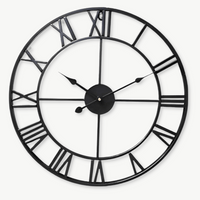
Metal-dialed clocks, typically using powder-coated steel or aluminum, are essentially impervious to impact and moisture. The caveat is edges. Some decorative metal clocks have exposed laser-cut edges that are genuinely sharp. If the clock is within reach of young children, run your finger along any exposed metal perimeter before hanging it. Rounded or rolled edges are the safe standard; raw laser-cut edges are not.
The visual weight of a large metal dial clock also works in your favor in family rooms because it reads as intentional, serious decor. Nobody looks at a 60cm metal-dialed clock and thinks "filler." It commands the wall, which means it likely gets hung high, which is exactly where you want it.
Acrylic: Lightweight but Fragile Under Stress
Acrylic clocks often look stunning in photographs. Clean lines, contemporary feel, sometimes a translucent or smoked effect that reads beautifully in modern minimalist interiors. The problem is impact resistance. Acrylic does not shatter into sharp shards the way glass does, which is one genuine safety advantage over glass, but it does crack, and the cracks tend to propagate across the whole face.
In a room where nothing bounces off the walls, acrylic is fine. In a living room with a two-year-old and a border collie? Probably not your first choice. If you love the look, hang it in a study or adult bedroom where the foot traffic is calmer.
Glass Fronts: The One to Avoid
Full stop: avoid glass-faced clocks in any room where children play or where large pets roam. Even tempered glass fragments into blunt pieces rather than sharp shards, but at the scale of a wall clock falling from height, those pieces are still a real hazard. Beyond safety, glass fronts scratch and smear constantly in family homes, and a clock that looks perpetually dirty is one you'll stop noticing, and then resent.
⚠️ Attention
Clocks with small decorative pendulums, dangling charms, or loose figurine attachments pose a real choking and entanglement hazard for toddlers and for pets with long hair or collars. Always check that every element of a clock is either flush-mounted or securely fixed before hanging it in a family space.
Silent Quartz Movement: Not a Luxury, a Practical Necessity
A silent sweep quartz movement eliminates the repetitive ticking that disrupts light-sleeping toddlers and agitates anxious dogs, replacing the step-by-step click with a continuous smooth rotation that produces no audible sound whatsoever. The ticking of a traditional clock movement might seem like a minor thing until you watch your dog's ear twitch every single second at 2 a.m., or you spend 40 minutes getting a light-sleeping toddler back down because something in the room keeps making a sound. Silent sweep quartz movements eliminate that entirely.
The mechanism works by driving the second hand through a continuous, smooth rotation rather than a step-by-step tick. The result is true silence: no audible click, no vibration through the wall. Multiple customer reviews across family-oriented home decor communities specifically call this out as a deciding factor, particularly in nurseries and open-plan living spaces where a ticking clock amplifies noticeably against hard floors and high ceilings.
Beyond pets and children, silent movement is also the considerate choice for home offices that share walls with bedrooms. Once you've lived with a silent clock, the ticking of a conventional movement becomes genuinely hard to tolerate. If you've been on the fence, consider this your permission slip to just make the switch.

Mounting Height and Placement: The Variable Nobody Talks About Enough
The single most effective protection for a wall clock in a family home is mounting height: hang it at 1.8 to 2.1 meters to the center, above tail-wagging range and out of reach of most children, while remaining fully readable from across the room. The single most effective thing you can do to protect a wall clock in a family home has nothing to do with the clock itself. It's where you put it. A clock hung at 1.5 meters is reachable by a curious five-year-old and absolutely within tail-wagging range of a Labrador. The same clock hung at 2 meters is effectively out of the interaction zone for most households.
The general principle: in rooms where kids and pets actively play, hang clocks at or above eye level for an adult standing up. That's typically 1.8 to 2.1 meters to the clock's center. The clock is still fully readable from anywhere in the room and completely out of casual reach.
Room-by-Room Placement Logic
Living room: The most visited room, the highest risk. Go high, go large. A clock with a diameter of 40cm or more reads comfortably from 3-4 meters away, meaning you don't need to hang it low to see it. A large dial hung at 2 meters is both practical and visually anchoring.
Kitchen: Kids climb onto counters; dogs patrol the floor. The upper cabinet zone, around 50cm above the top of standard upper cabinets, is naturally protected and makes the clock a visual anchor for the whole room. Avoid clocks with fabric, wicker, or unprotected wood in spaces near stovetops where steam and grease accumulate.
Kids' bedroom: Paradoxically, kids' bedrooms can handle slightly lower placement because the room's primary occupant grows into understanding the clock is not a toy. What matters more here is weight: a lightweight clock (under 500g) is far safer if it ever does come off the wall accidentally than a heavy cast-iron piece. MDF and bamboo clocks are the smart pick for kids' rooms specifically.
Hallway: Often overlooked, hallways are actually an excellent clock location in pet and child-heavy homes. Traffic is transitional rather than sustained play, so the interaction risk is lower. A hallway clock can be more decorative and less bombproof than what you'd choose for the living room.

Cleaning Realities: What "Easy to Clean" Actually Means
In a family home, "easy to clean" means sealed or powder-coated surfaces you can wipe with a damp cloth without warping or scratching; unsealed wood and glass fronts consistently underperform and demand far more maintenance than their product descriptions suggest. Every product description says "easy to clean." Here's what that actually means in practice for different materials and finishes.
| Material | Cleaning Method | Family Home Rating |
|---|---|---|
| Sealed / lacquered wood | Damp cloth, no chemicals needed | Excellent |
| Powder-coated metal | Damp cloth or mild soap, dries instantly | Excellent |
| Acrylic | Microfiber only; scratches with paper towels | Moderate |
| Unsealed / raw wood | Dry cloth only; moisture causes warping | Poor |
| Glass front | Glass cleaner, but smears constantly | Poor (safety risk) |
| Open-face (no cover) | Hands and dial exposed; dust collects in mechanism | Moderate (mount higher) |
One detail worth knowing: open-face clocks (where the clock hands are exposed without any front cover) are actually excellent for family rooms from a safety standpoint, because there's no glass to break. The trade-off is that pet hair and dust accumulate on the clock face more quickly. A quick dry dusting every couple of weeks keeps them looking sharp.
Styles That Work in Family Homes Without Feeling "Safe" and Boring
Scandinavian minimalist, industrial metal, and nature-themed laser-cut wooden clocks all deliver genuine style in family homes without sacrificing durability: each format uses materials and construction that hold up to daily contact while looking deliberately chosen rather than merely practical. There's a version of family-friendly that means beige, rounded, and forgettable. That's not what we're going for here. The best clocks for active households are ones you'd choose anyway, if they also happen to be built for real life.
Scandinavian Minimalist
Clean lines, wood or white lacquer, no fussy decorative elements that can break off or attract curious hands. Scandinavian design's philosophy of "nothing unnecessary" is practically a safety specification for family homes. A simple wooden dial with clean numerals and a silent movement checks every box and looks genuinely considered rather than compromised.
The minimalist wood wall clock format, typically 30-40cm in diameter, hangs well at height without looking undersized, reads clearly from across a room, and blends with virtually any paint color or furniture style. It's the format I'd choose for a living room or hallway without a second thought.
Industrial Metal with Roman Numerals
Heavy-gauge metal clocks with Roman numeral dials read as serious, intentional decor. They're visually anchoring enough that they naturally get hung high (where you want them), and the powder-coated metal finish is borderline indestructible for typical household impacts. The Roman numeral detail adds warmth and visual interest without any small moving parts.
The slight visual weight of an industrial clock also means it doesn't get "lost" when hung high on a wall, which is the main risk with small delicate clocks placed high for safety reasons. A 40cm metal-faced Roman numeral clock at 2 meters reads as a deliberate design statement, not as something you stuck up there out of desperation.
Wooden Nature-Themed Designs
Nature-inspired wooden clocks, think sun and moon motifs, tree-of-life cutouts, or compass rose details, bring warmth and a slightly bohemian quality that works especially well in living rooms, nurseries, and playrooms. The key with these is to check that the decorative elements are laser-cut from the same wood panel (so nothing can detach) rather than glued-on appliqués.
A laser-cut wooden clock where the decorative design is integral to the frame is as safe and durable as any plain-faced option. The ornamental quality is built in, not bolted on. That's exactly why I'd reach for this category the moment someone tells me they love the look of decorative clocks but have a toddler at home: the style and the safety spec are the same object.

What About Pendulum Clocks in Family Homes?
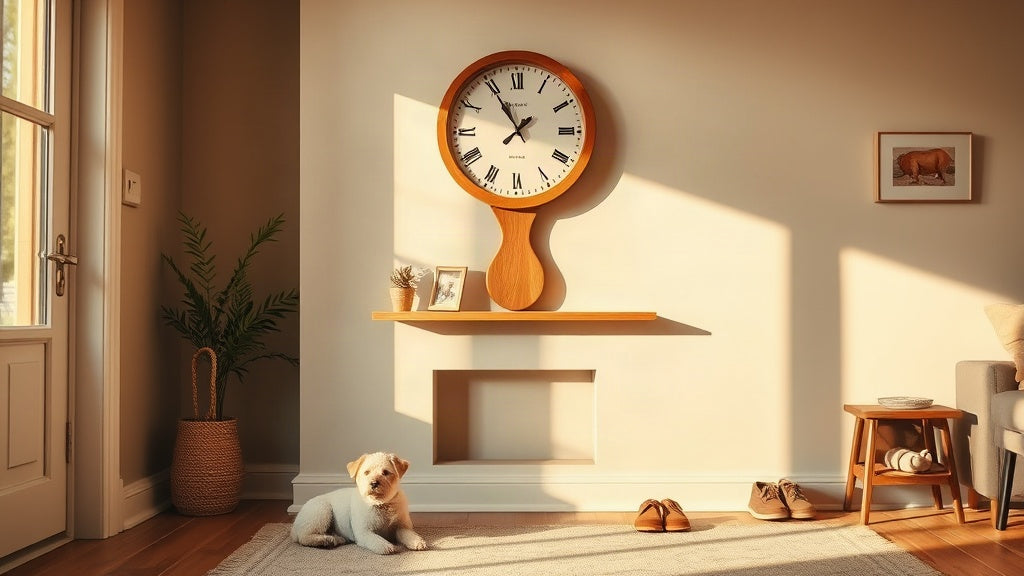
Pendulum clocks can work in family homes when mounted at 2.1 meters or higher, when the pendulum is enclosed in a cabinet case or is a flush decorative element rather than a free-swinging mechanism, and when the room is not a primary play space for cats or young children. Pendulum clocks deserve their own honest conversation because they're genuinely beautiful objects that often come up in searches for decorative wall clocks, and the answer for family homes is nuanced rather than a flat no.
The swinging pendulum is the obvious concern. For cats especially, a moving pendulum is practically an invitation. Dogs with long tails can catch a pendulum mid-swing. And for small children, a pendulum is simply an irresistible thing to grab. All of that is real.
That said, pendulum clocks work in family homes when they're mounted well above reach (2.1 meters or higher), the pendulum is a fixed decorative element rather than a functional mechanical one, or the pendulum is enclosed within a case. Open-pendulum clocks hung at a low or mid-wall height are the specific combination to avoid.
If you love the look, the practical path is a pendulum clock where the pendulum is decorative and flush with the clock body, or one mounted on a high wall in a room with controlled access. The aesthetic is worth preserving if the placement can accommodate it safely. And if the pendulum is enclosed in a proper wooden cabinet-style case, you get the classic look without the hazard.
💡 Le savais-tu ?
The first mechanical pendulum clock was built by Dutch scientist Christiaan Huygens in 1656. His design was accurate to within 15 seconds per day, which was extraordinary for its era. Today's quartz movements are accurate to within a few seconds per month and require zero mechanical maintenance, making them far more practical for households where nobody has time to wind a clock weekly.
Choosing Between Large and Small Format Clocks for Active Rooms
A larger clock mounted high is safer and more readable than a small clock hung low: a 45cm or wider dial at 2 meters stays visible from the entire room while remaining completely out of reach of children and pets. Size affects safety more than most people realize. Here's the core logic: a larger clock hung high is safer and more readable than a small clock hung low. This sounds obvious, but most people default to small-to-medium clocks because they feel less "committed," then hang them at mid-wall height where they're more accessible.
A large format wall clock (45cm and above) at 2 meters of height is visible from the entire room without requiring low mounting. A 30cm clock at 1.5 meters is more accessible to curious hands and less visible from a distance. The safety-readability math actually favors going bigger.
For living rooms in particular, a clock with a diameter of 50-60cm functions as a genuine piece of wall art. It fills the visual space, anchors the room's focal point, and doesn't need to compete with other decor elements for attention. In active family rooms where wall space gets claimed by furniture, art, and the occasional finger-paint masterpiece, a large clock holds its own without requiring perfect conditions.

The Walnut Wood Option: When You Want Heirloom Quality That Survives Real Life
Solid walnut is one of the densest domestic hardwoods: it resists denting, its natural grain variation absorbs small marks visually, and a properly finished walnut surface wipes clean with just a damp cloth, making it the heirloom-quality choice that genuinely holds up to family life. There's a category of family home clock buyer who doesn't want a "practical" clock. They want something genuinely beautiful, something with a sense of craft and permanence, that also holds up. Solid walnut wood clocks occupy exactly that space.
Walnut is one of the densest domestic hardwoods. It doesn't dent easily, its natural grain variation means small marks are absorbed visually, and a properly finished walnut surface can be wiped down without any care products beyond a damp cloth. A well-made walnut clock is the kind of thing you buy once and it's still on the wall fifteen years later, looking better than it did on day one.
The handcrafted quality of a walnut clock also carries a different kind of emotional weight. It's not a replacement item. It's the thing your kids grow up reading the time from. That's not nothing, and it's worth spending a little more to get it right. If you want to see how this kind of piece fits into a considered room, our living room wall clock ideas guide covers scale and placement in detail.

Kids' Rooms Specifically: What Changes When It's Their Space
In a child's bedroom, weight becomes the primary safety factor (under 500g is the right upper limit), large clear Arabic numerals aid learning, and a silent quartz movement consistently helps children settle faster at bedtime by removing one more auditory variable from the room. A clock in a child's bedroom is doing something slightly different from a clock in the living room. It's a learning tool as much as decor, and it takes more direct handling as children learn to tell the time. That shifts the criteria in a few specific ways.
Weight becomes the primary safety factor. A clock that falls in a child's bedroom has the potential to fall on the child. Under 500 grams is a reasonable upper limit for anything hung above sleeping or play height in a child's room. Most lightweight bamboo, MDF, and thin plywood clocks fall well within this range.
Readability matters more here than in other rooms. Large, clear Arabic numerals on a light background are genuinely easier for young children learning to tell the time than Roman numerals, minimalist hour markers, or typography-heavy dials. The design can still be lovely; it just needs to be legible to someone who's still working out the difference between the minute hand and the hour hand.
Noise matters enormously. A ticking clock in a child's bedroom affects sleep quality in a way that's hard to measure but easy to observe. Parents who've switched from a conventional ticking clock to a silent quartz movement in their child's room consistently report faster settling times at bedtime. It removes one variable from an environment where you want as few distracting variables as possible.
Browse the full bedroom clock collection if you're specifically outfitting a child's room or nursery. There are 168 options across formats, sizes, and styles, and every silent-movement clock is flagged clearly.
How to Check Any Clock's Safety Before You Buy
Run seven checks before buying any clock for a family home: glass front, detachable parts, weight, movement type, finish type, edge profile, and mounting hardware quality; a clock that passes all seven is genuinely safe rather than just marketed as such. Whether you're buying from this site or anywhere else, here's the actual checklist to run through for any clock destined for a family home with pets and kids.
- Glass front? If yes, is it tempered? For high-traffic rooms, still better to skip it entirely.
- Detachable parts? Check for decorative pendulums, figurines, number appliqués, or charms that aren't integral to the frame.
- Weight? Under 500g for kids' rooms. Up to 2-3kg is fine for high-mounted living room clocks on proper wall anchors.
- Movement type? Silent sweep quartz is the only format worth considering in bedrooms and shared living spaces.
- Finish type? Sealed, lacquered, or powder-coated. Raw wood and untreated surfaces won't survive regular cleaning.
- Edge profile? No exposed sharp laser-cut metal edges within reach of children.
- Mounting hardware included? A clock that comes with only a single small nail hook is not designed for secure wall mounting. Look for proper wall anchor hardware or a wide keyhole mount that distributes weight across two points.
If a clock passes all seven of these, you've got something that's genuinely safe and durable for a family home, not just marketed as such. That's the difference between a clock that's still on the wall in five years and one that ended up in the donation bin after the first incident.
For a broader look at silent, durable options across all formats, the silent wall clock collection covers 179 pieces specifically filtered by movement type. It's a useful starting point if silence is your non-negotiable first filter.
"The clock on the wall is the first thing children learn to read that isn't a book. Make it worth looking at."
A sentiment shared by many parents who've realized a beautiful, readable clock is one of the most used objects in a family home.
What Real Customers Say About Clocks in Family Homes
The most consistent pattern across family-home clock reviews is this: buyers who skipped silent quartz movement regret it immediately, while those who chose sealed wood are consistently surprised by how much better the real grain looks compared to any product photo. Pattern recognition across customer feedback for family-home clocks points to a few consistent themes that are worth knowing before you buy.
The most common regret: buying something visually appealing without checking the movement type, then discovering the ticking is audible in a quiet room. This is almost universally described as a problem that wasn't anticipated and can't be ignored once noticed. Silent quartz movement is the one feature customers most consistently say they'd require on their next purchase, even when they hadn't prioritized it on the first one.
The most common positive surprise: how much better a clock looks in a real room than in a product photograph, specifically with wooden clocks. The grain, the warmth, the way natural wood responds to different light conditions throughout the day. Multiple reviewers describe being pleasantly surprised by the "aliveness" of a wood-dialed clock compared to printed or painted alternatives.
The most common practical note from pet owners: cats specifically are drawn to clocks with pendulums or any element that moves or reflects light. Wall-mounted clocks without pendulums and without mirrored or high-gloss fronts attract essentially zero feline interest after the first day. That's not an anecdote; it's a pattern across hundreds of reviews from cat-owning households.
Living Room Wall Clocks
154 wall clocks filtered for living room scale, with large-format and silent-movement options that hold up in the most active room of any family home.
154 références
Découvrir la catégorie →Five Habits That Keep Any Wall Clock Looking Good for Years in a Family Home
Five simple habits protect any wall clock in a family home: proper wall anchoring from day one, monthly dusting, annual battery replacement on a fixed schedule, keeping clocks at least a meter from kitchen steam, and wiping paw prints immediately before oils can stain the finish. The clock itself is only part of the equation. How you care for it determines how long it keeps looking intentional rather than incidental.
- Use the right wall anchor from day one. A clock that's properly anchored into a stud or with a proper wall anchor doesn't wobble. A clock that wobbles gets knocked off eventually. Five minutes of proper mounting saves years of problems.
- Dust monthly, not annually. Pet hair accumulates on clock faces faster than on most other surfaces because of mild static charge. A once-a-month dry microfiber wipe takes under a minute and keeps the clock looking sharp.
- Replace batteries before they die. A battery running at low power causes erratic movement on quartz mechanisms and can cause the hands to stick. Replace annually on a fixed schedule (birthday of the clock, first of January, whatever works) rather than waiting for failure.
- Keep clocks away from direct kitchen steam. Even sealed wood clocks will eventually degrade with repeated steam exposure. At least 1 meter horizontal distance from a stovetop or kettle is a reasonable minimum.
- Wipe paw prints immediately. Dog noses and paw pads leave oils that, if left on a wood surface for weeks, can slightly stain light-colored finishes. A quick wipe right after the incident is far easier than a deep clean later.
Follow these five habits and the best wall clock for a home with pets and kids you choose today will genuinely still be the best clock on your wall a decade from now. That's the whole point: buy it once, get it right, and stop thinking about it.
FAQ
What's the safest wall clock material for homes with young children?+
Sealed or lacquered wood, MDF, and bamboo are the safest options for young children. They're lightweight (so less dangerous if they fall), have no sharp edges in typical clock formats, and can't shatter. Avoid glass-fronted clocks entirely in rooms where children play actively. Metal powder-coated clocks are also very safe once you've confirmed there are no sharp exposed edges on the perimeter.
Do silent wall clocks really make a difference for pets?+
Yes, especially for anxious dogs and light-sleeping cats. The repetitive ticking of a conventional clock movement is audible to animals at distances much greater than for humans, since their hearing range is wider. Silent sweep quartz movements produce no audible click whatsoever. Multiple pet owners report noticeably calmer behavior in rooms switched from ticking to silent clocks, particularly at night and during rest periods.
What height should I mount a clock in a family home with kids and pets?+
Aim for the clock's center to sit between 1.8 and 2.1 meters from the floor. This puts it above comfortable reach for most children under 8 years old and well clear of large dog tail height. A clock at this height is still easily readable from anywhere in a standard room, especially if you choose a dial 40cm or larger. The key mistake is hanging small clocks at mid-wall height for visibility: going larger and mounting higher solves both problems at once.
Are glass clocks safe for homes with pets?+
Glass-fronted clocks are generally not recommended for rooms where large pets roam or play. Even tempered glass, which breaks into blunter pieces than standard glass, creates real hazards when a wall clock falls from height. Beyond the breakage risk, glass fronts attract pawprints and nose smudges constantly in pet-heavy homes, making maintenance much more demanding. Open-face wooden or metal clocks are a much better fit for rooms shared with animals.
Are pendulum clocks a bad idea in homes with cats?+
Open pendulum clocks mounted within jumping or reaching height are genuinely problematic with cats. The movement triggers hunting instincts reliably. If you want the look of a pendulum clock, look for designs where the pendulum is either enclosed within a cabinet-style case, decorative and flush to the body (not free-swinging), or mounted at a height where no cat in your household can reach it. A pendulum clock in a high-ceilinged hallway, mounted at 2.2 meters, is usually fine.
How do I clean a wooden wall clock after a dog or child touches the face?+
For sealed or lacquered wood clocks, a slightly damp microfiber cloth is all you need. Wipe gently in the direction of the grain, then immediately follow with a dry cloth to avoid any moisture sitting on the surface. Don't use any spray cleaners, alcohol-based products, or paper towels on wood clock faces: paper towels scratch lacquer over time, and alcohol strips protective finishes. For metal-dialed clocks, a light mist of gentle all-purpose cleaner on the cloth (never directly on the clock) works well.