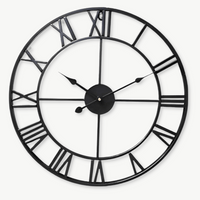


You've spent real time getting your bedroom right. Neutral palette, clean lines, nothing on the walls that doesn't earn its place. Then you hang a clock and the whole thing feels off, somehow too loud visually, or worse, actually loud at 2 a.m. It ticks. You lie there. You notice it. That's the wrong clock.
The best wall clock for a minimalist bedroom isn't just about looks. It's about choosing a piece that reads as intentional, holds the room's calm, and vanishes into the background when you need it to. Here's what that actually looks like in practice.
⭐ Key takeaways
- Silent quartz movement is non-negotiable in a bedroom. No ticking, no disrupted sleep.
- Natural materials (walnut, bamboo, light ash) suit minimalist spaces better than painted plastic.
- Size matters more than people think: 30 cm works for a focused wall, 40 cm for a larger feature wall.
- No numerals or minimal numerals keeps the visual noise low.
- Placement height, roughly at eye level from standing position, makes the clock feel anchored rather than floating.
Why Most Bedroom Clocks Get It Wrong
Most bedroom clocks get it wrong because they're designed for decoration or utility, not for the specific calm a bedroom demands: no ticking, no visual clutter, nothing that competes with rest. Walk into any big-box home store and you'll find two categories of wall clocks: decorative statement pieces with too much going on, and basic functional clocks that look like they belong in a school hallway. Neither fits a bedroom that's been designed with care.
The bedroom is different from every other room. It's where your nervous system actually rests. That changes the brief entirely. A clock that's perfect for a kitchen or living room, maybe oversized, maybe with a bold graphic dial, can feel jarring in a space designed for stillness. The eye picks up on things during winding-down moments that it filters out during the day.
So the question isn't just "what looks good?" It's: what disappears when I need it to, and anchors the room when I'm actually looking at it?

The One Feature You Can't Compromise On: Silent Movement
The single non-negotiable feature for a bedroom wall clock is a silent quartz movement: no ticking, no sound at all, so the clock never becomes the reason you lie awake at 2 a.m. This one's simple but worth saying clearly. A ticking clock in a bedroom is a sleep disruptor. Not dramatically, not for everyone, but for enough people that it's worth treating as a hard requirement rather than a nice-to-have.
Silent quartz movement, sometimes called "sweep movement," replaces the mechanical tick-tock with a continuous glide of the second hand. No sound whatsoever. The technology has been standard in quality clock manufacturing for years, and at this point there's no reason to accept a ticking bedroom clock when silent options exist at every price point.
💡 Did you know?
The "tick" in a traditional clock comes from the escapement mechanism, a series of gears that advance in discrete steps. Silent quartz movements use a stepper motor that moves the hands in a smooth arc instead of incremental jumps. The difference at night, in a quiet room, is immediately noticeable.
When you're browsing options, look for "silent quartz," "sweep movement," or "non-ticking" in the product details. If those terms aren't mentioned, assume the clock ticks. It's that simple.
Materials That Work in a Minimalist Bedroom (and Why)
The right material for a minimalist bedroom clock is one that adds warmth without visual noise: natural wood like walnut, ash, or bamboo, or a matte white finish that reads as quiet rather than decorative. The material of your clock does more than just affect how it looks. It determines how the clock interacts with the light in your room, how it reads against different wall colors, and whether it feels cohesive with your other furniture or slightly off.
Here's a quick materials comparison to help you match your clock to your space before we get into specifics:
| Material | Aesthetic Feel | Pairs Best With | Avoid If... |
|---|---|---|---|
| Walnut | Warm, rich, grounded | White or warm grey walls, dark furniture | Your palette is very cool or industrial |
| Light ash / bamboo | Soft, Scandinavian, airy | Linen, rattan, natural cotton | You want a clock that reads as a bold accent |
| Matte white / off-white | Tonal, architectural, quiet | Any neutral scheme | You want the clock to be a visible feature |
| Brushed metal (accent) | Precise, modern, restrained | Industrial or modern-minimalist spaces | Your bedroom leans warm or Japandi |
Here's what actually works in a minimalist bedroom context, with a bit more texture on each:
- Walnut and dark wood: Rich grain, warm undertone. Works beautifully against white or warm grey walls. The natural variation in the wood means no two clocks look identical, which matters when you're placing something as a considered design choice.
- Light ash or bamboo: Lighter than walnut, almost Scandinavian in feeling. Pairs well with linen, natural cotton, rattan furniture. Reads as soft rather than dramatic.
- Matte white or off-white: The chameleon option. A white-faced clock on a white wall creates a quiet, tonal effect that's genuinely elegant. It's present but not demanding.
- Brushed metal accents: Work when they're minimal, a thin metal frame or slender metal hands rather than an all-metal dial. Too much metal in a bedroom reads as cold.
What to avoid: high-gloss finishes, heavy black frames against light walls (creates too much contrast for a restful space), and plastic that's been treated to look like wood. The latter tends to look convincing in product photos and unconvincing in person.

Size and Placement: The Decisions That Actually Move the Needle
For most minimalist bedrooms, a 30 cm clock suits a focused or narrow wall while a 40 cm clock anchors a larger feature wall; placement at eye level, around 150 to 165 cm from the floor, keeps the clock grounded rather than floating. Getting the size wrong is the most common mistake, and it's hard to undo once you've put a hole in the wall. Here's a practical way to think about it.
A 30 cm (12 inch) clock works well above a bedside table, on a narrow wall between a door and a window, or in any spot where the surrounding space is limited. It reads as deliberate without commanding the room.
A 40 cm (16 inch) clock suits a main bedroom feature wall, typically the wall behind or beside the bed. At that scale, the clock starts to anchor the composition rather than just sitting on it. That's a good thing in minimalist spaces, where one considered piece does more than a gallery of smaller objects.
Anything above 50 cm in a bedroom starts to feel like it belongs in a living room. That's not a strict rule, but it's a reliable instinct for most bedroom proportions.

For height: most designers place bedroom wall clocks at eye level from standing position, which typically lands between 150 and 165 cm from the floor to the clock's center. Above the bed headboard works when the clock is modest in size and the headboard itself is low-profile. Higher than that and the eye has to work too hard to find it.
Dial Design: How Much Detail Is Too Much?
In a minimalist bedroom, the dial should read as a single shape, not a collection of elements: no-numeral or minimal-marker faces keep visual noise low and let the clock's form do the work instead of its decoration. In a minimalist bedroom, the dial is where things can go sideways fast. Here's a quick way to calibrate: stand back from the clock and squint. If the dial reads as a shape (circle, disc, frame), it's probably working. If it reads as a collection of elements, numerals, markers, patterns, it may be pulling too much visual weight.
The most versatile options for minimalist bedroom wall clocks fall into two categories:
- No-numeral dials: Just hands against a clean face. The clock tells time subtly and the form is its own argument. Works best when the clock hands have strong contrast against the dial.
- Minimal marker dials: Short lines or dots at the 12, 3, 6, and 9 positions. Enough structure to read the time quickly, not enough to feel busy.
Roman numerals are a middle ground. They read as more traditional, which fits some minimalist aesthetics (warm, European-inspired) and clashes with others (Scandinavian, Japanese-influenced). Trust your existing furniture on this one.
| Dial Style | Best Fit | Avoid If... |
|---|---|---|
| No numerals, hands only | Ultra-minimal, Japanese-inspired, Scandi spaces | You need to read the time at a glance from across the room |
| Dot or line markers | Most minimalist bedrooms, universally safe | Rarely a bad choice |
| Roman numerals | Warm minimalism, European-style interiors | Your bedroom leans modern/industrial/Scandi |
| Arabic numerals, full set | Farmhouse, retro, or vintage-accented spaces | True minimalist rooms, reads as too decorative |
Three Clock Styles That Genuinely Belong in a Minimalist Bedroom
Three styles reliably work in a minimalist bedroom: the Scandinavian wood disc for warmth, the Japanese-influenced layered clock for depth, and the white-on-white tonal clock for pure architectural quiet. Rather than offering a vague "any minimalist clock works," here are three distinct styles with specific reasoning for each.
1. The Scandinavian Wood Disc
Think: light or medium wood, round, thin profile, no numerals or minimal markers, silent sweep. This is probably the most naturally bedroom-friendly style on the market right now. The warmth of the wood softens the otherwise hard-edged quality of minimalism. It looks good in morning light and fades gracefully at dusk. The 30 cm version is ideal for most bedroom walls. If your room already has a hygge-leaning feel, this style slots in as if it was always there.
2. The Japanese-Influenced Layered Clock
Wood and acrylic combinations that create a quiet sense of depth. The material layering adds texture without visual clutter. Often comes in 40 cm formats. The contrast between organic wood and the precision of acrylic reads as considered rather than busy. This style tends to photograph beautifully for those who document their interiors, but more importantly, it holds up just as well in daily life. Think wabi-sabi in clock form: imperfect materials, precise function.

3. The White-on-White Tonal Clock
A white or off-white clock face against a white wall. The hands are the only real contrast. It's a subtle choice, almost architectural. Some people find it too understated; others find it exactly right. It works particularly well in bedrooms with very soft lighting (warm bulbs under 2700K) where the tonal effect is gently visible rather than completely invisible. The White Wood Wall Clock in 30 cm is a clean example of this approach done right.


What to Pair the Clock With (and What to Leave Off the Wall)
In a minimalist bedroom, a wall clock works best as the sole object on a feature wall, paired only with materials that already exist in the room; adding a second clock or competing pieces almost always breaks the calm. A clock in a minimalist bedroom works best as part of a considered composition, not as a standalone afterthought. Here's what that looks like in practice.
If your bedroom has a single main feature wall, that's where the clock belongs, ideally as the only piece on that wall. One strong object reads as intentional. Two objects on the same wall require a relationship: similar scale, similar material, deliberate spacing. Three is a gallery, and galleries belong in living rooms.
If you're placing the clock near other objects (a shelf, a sconce, a framed print), the key is material cohesion. A walnut clock pairs with walnut furniture. A light ash clock pairs with linen and rattan. A matte white clock pairs with any neutral scheme. The clock shouldn't contrast with the materials around it; it should quietly agree with them.
Resist the impulse to add a second clock for symmetry. It almost never works. The room already has rhythm from its furniture and textiles. A clock is a punctuation mark, not a pattern. If you're curious how this principle extends to other rooms, the guide on choosing clocks by room covers it in detail.
Bedroom Clocks
Every clock in this collection is curated with bedroom use in mind: silent movement, considered scale, and materials that hold their own in a restful space.
168 references
Browse the collection →The Battery Question Nobody Talks About
A quality silent quartz movement runs for 12 to 18 months on a single AA battery; using a reputable alkaline brand and setting an annual reminder to swap it out keeps the clock running without any midnight surprises. Battery-operated clocks are the standard for bedrooms, and they're the right call. No wiring, no proximity to an outlet required, no electrician. A single AA battery typically lasts 12 to 18 months in a quality silent quartz movement. If a clock claims longer, it's usually because the movement draws less power, which is itself a sign of quality engineering.
One practical note: set a reminder to check the battery annually. Clocks that stop during the night and are found at the wrong time in the morning are almost always a battery issue, not a mechanical fault. A dead battery can also cause the second hand to stutter rather than sweep, which is worth catching early.
Worth mentioning: not all AA batteries perform equally in low-draw movements. Alkaline batteries from reputable brands last noticeably longer than budget options in silent clocks. It's a small detail that pays off when you're not fumbling for a replacement at an inconvenient hour.
"The best clock for a bedroom is the one you stop noticing except when you need it."
A useful filter when choosing between two options you genuinely like.
Finding the Clock That Fits Your Room Without Overthinking It
Start with a silent sweep movement, a natural material that agrees with your existing furniture, and a size scaled to your actual wall; everything else is a matter of trusting your eye rather than overthinking it. Here's the short version. You need a silent sweep movement, a natural material that agrees with your existing furniture, a dial that reads as a shape rather than a collection of elements, and a size that suits your specific wall rather than "looks right" in a product photo.
Beyond that, trust your eye. The best wall clock for a minimalist bedroom is the one that makes the room feel more complete, not more decorated. That's a different standard, and it's the right one. If you're looking for a place to start without sifting through hundreds of options, the silent wall clock collection has been edited with exactly this kind of bedroom in mind. And if you already know you want natural wood, the wooden wall clock range narrows things down further.
The right clock is out there. It's quieter than you'd expect, and that's exactly the point.
Frequently asked questions
What size wall clock works best in a minimalist bedroom?+
For most bedrooms, 30 cm (12 inches) works well on a focused wall or above a bedside table. A 40 cm (16 inch) clock suits a larger feature wall, particularly beside or behind the bed. Anything above 50 cm tends to feel more suited to a living room than a bedroom.
Is a silent wall clock actually silent, or just quieter?+
A quality silent quartz (sweep) movement produces no audible ticking. The second hand glides continuously rather than jumping in increments. In a quiet bedroom at night, this makes a real difference. Always check that a clock specifically mentions "silent," "sweep movement," or "non-ticking" before buying for bedroom use.
Where should a wall clock be placed in a minimalist bedroom?+
At eye level from a standing position, roughly 150 to 165 cm from the floor to the clock's center. On the main feature wall (often the wall facing the foot of the bed) it becomes a quiet anchor. Above the headboard works with smaller clocks and a low-profile headboard. Avoid placing it where direct sunlight hits for extended periods, as UV exposure can fade wood and affect adhesive backing over time.
Which materials suit a minimalist bedroom clock best?+
Natural wood (walnut, ash, bamboo) is the most versatile choice. It adds warmth without visual noise and pairs well with linen, cotton, and rattan. Matte white or off-white works for a tonal, architectural effect. Avoid high-gloss finishes and plastic-that-mimics-wood; both look different in person than in product photos.
Can I hang a wall clock above my bed in a minimalist bedroom?+
Yes, with two conditions: keep the clock at 30 cm or smaller so it doesn't overpower the headboard, and mount it securely. A falling clock is a safety concern, so use the correct wall anchor for your wall type (drywall vs. plaster vs. concrete). Lightweight wooden clocks are better suited for above-bed placement than heavier metal-framed ones.
How long does the battery last in a silent quartz bedroom clock?+
Most quality silent quartz movements run for 12 to 18 months on a single AA battery. The lower the movement's power draw, the longer it lasts (and the better-engineered the mechanism tends to be). Set an annual reminder to swap the battery before it gives out, and stick with a reputable alkaline brand for the best performance.