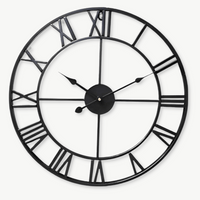


You know that moment when you hang something on the wall and the whole room suddenly makes sense? A round modern wall clock with gold hands does exactly that. Not because it's flashy. Because it's precise. The circle is the most resolved shape in design history, and gold is the one metallic that reads warm rather than cold. Together, they create the kind of quiet confidence that no throw pillow or side table can replicate.
This isn't about buying a clock. It's about placing something on your wall that holds the room together. Here's what actually matters when you're choosing one, and why getting this right is worth your time.
À retenir
- The gold hands do the heavy lifting: hand profile (slim vs. sword) changes the entire visual register of the clock.
- Round clock faces work in virtually every room, but sizing is everything, too small and the gold detail gets lost.
- White or off-white dials amplify gold hands the most; black dials create higher contrast drama.
- Silent quartz movements are non-negotiable in bedrooms and home offices, ticking is a design flaw.
- Gold doesn't mean maximalist: paired with minimalist dials, it reads modern, not ornate.
Why Gold Hands on a Round Clock Hit Different Than Other Combos
Gold hands on a round clock solve a specific design problem: they add warmth to a minimal space without cluttering it, because the circular silhouette floats against any wall surface while brushed gold hands glow rather than glint. There's a reason this pairing keeps showing up on every design account and interior mood board in 2026. It isn't a trend in the fleeting sense. It's a response to a specific aesthetic problem: how do you add warmth to a minimal space without cluttering it?
A round face resolves the geometry. Circles don't compete with rectangular furniture the way square or hexagonal clocks do. They float. The round silhouette reads as organic, almost natural, which is why it works against exposed brick, smooth plaster, and shiplap alike. Then the gold hands do something the dial alone can't: they add a moment of light. Brushed gold in particular catches afternoon sun differently than polished gold. It glows rather than glints. That subtlety is the whole point.
Compare this to silver hands, which read sharper and cooler, great for industrial or ultra-minimalist spaces, but harder to warm up. Black hands are graphic and bold, they shout rather than suggest. Gold hands whisper. And in a well-designed room, a whisper carries further.

Did you know?
The use of gilded hands on clock faces dates back to 17th-century French horology, where gold-leafed hands on enamel dials signaled royalty and precision craftsmanship. Today's brushed gold finish on minimalist round clocks is essentially the same visual language, stripped of the baroque frame.
The Hand Profile That Changes Everything
The hand profile is the single detail most people overlook, and it determines whether a gold-hand clock feels refined or clunky once it's on the wall: slim baton hands read cleanest on modern round faces, while dauphine and spade profiles suit more classical or vintage-leaning styles. Not all gold hands are created equal. This is the detail most people skip over when shopping, and then wonder why their clock looks slightly off once it's on the wall.
The three main profiles you'll encounter are dauphine, spade, and baton (also called stick or straight). Dauphine hands taper elegantly from a wider base to a fine point, they carry a classical European feel and look especially refined on white or cream dials. Spade hands have a leaf-shaped cutout near the tip; they're slightly more ornate and suit clocks that lean vintage-modern. Baton hands are the cleanest: straight lines, uniform width, pure geometry. On a minimalist round clock with gold metallic hands, baton hands are almost always the right choice.
Width matters too. A hand that's too thick relative to the dial reads as clunky. You want the hands to feel like they're drawn onto the face rather than sitting on top of it. As a rule: the larger the clock diameter, the more you can afford a slightly wider hand. On a 30 cm clock, slim is king.
Dial Color and What It Does to the Gold
The dial color behind gold hands changes the entire mood of the clock: white dials keep things light and airy, black dials create jewel-like drama, cream dials harmonize warmly with brushed gold, and open metal frames turn the piece into wall sculpture. The dial is the canvas. Gold hands read completely differently depending on what's behind them.
- White or off-white dial: This is the classic pairing. The contrast is high enough to read the hands clearly across a room, but the overall mood stays light and airy. Works in Scandinavian, Japandi, and contemporary minimalist interiors.
- Black dial: High drama. The gold hands pop hard against black, creating a jewel-like effect. Better for spaces with moody lighting, a dim living room corner, a study, a master bedroom with dark walls. The contrast is striking but can feel heavy in a bright kitchen.
- Cream or linen-toned dial: The most flattering background for brushed gold specifically. The warm undertones in both the dial and the hands harmonize without looking matched. Great for layered, organic interiors with natural materials.
- Exposed metal dial (no color): Sometimes the "dial" itself is a metal ring or open frame. Gold hands on an open framework create an almost sculptural effect, less clock, more object.
| Dial Color | Gold Hands Effect | Best Interior Style |
|---|---|---|
| White / Off-white | Clean, bright, readable | Scandinavian, Japandi, Contemporary |
| Black | Dramatic, jewel-like contrast | Moody Modern, Industrial, Dark Academia |
| Cream / Linen | Harmonious, warm, tonal | Organic Modern, Boho Minimal, French Country |
| Open Metal Frame | Sculptural, architectural | Contemporary, Loft, Eclectic |

Sizing a Round Clock Correctly: The Numbers That Actually Matter
For a primary living room or dining wall, 40-60 cm diameter is the reliable starting point; below 25 cm on any large wall and the gold hands become invisible from across the room, which defeats the whole purpose. Here's something that catches people off guard: a clock that looks perfect on a product page can disappear on a real wall. Scale is relative, and walls are almost always bigger than we picture them.
A 25-30 cm diameter clock is ideal for smaller walls, above a nightstand, in a compact kitchen, or inside a gallery wall arrangement where the clock is one element among several. Below 25 cm on a large wall, the gold hands become invisible from across the room, which defeats the whole purpose.
For a primary wall in a living room or dining area, you're generally looking at 40-60 cm as a starting point. At this scale, the round shape reads as intentional rather than incidental, and the gold hands have enough length to catch light properly. Above 60 cm, you're in statement territory, a clock that anchors the room the way a large-format artwork would.
A useful shortcut: stand in your room and hold a piece of paper cut to the clock's diameter against the wall. Step back. If it looks small, size up. If it dominates the space uncomfortably, size down. Simple, but it works every time.
Room-by-Room Placement: Where a Gold-Hand Clock Earns Its Place
A gold-hand clock earns its place in virtually every room, but the right diameter, position, and movement type differ by space: living rooms need 40-60 cm centered on a feature wall, bedrooms need silence and restraint, kitchens reward the warmth of gold against brass and wood.
Living Room
The living room is where a round wall clock with gold hands does its best work. Centre it on a feature wall or float it above a sofa at eye level when seated (roughly 145-155 cm from floor to center). If you're building a gallery wall, the clock works as the anchor: hang it first, then arrange prints and smaller objects around it, leaving 5-8 cm of breathing room between each piece.
Avoid placing the clock directly above a television. Both objects compete for the same visual zone, and neither wins.
Bedroom
Above the headboard is the obvious choice, but not always the right one, especially if your ceiling is low. A better option: position the clock on the wall you face when you first open your eyes. It becomes a calm, intentional first visual of the day. Keep the diameter modest here (30-40 cm). The goal is grounding, not grandstanding.
Silent quartz movement is non-negotiable in a bedroom. Any ticking will keep light sleepers awake. Most modern clocks in this space use quartz for precisely this reason.
Kitchen and Dining Area
Kitchens are underrated territory for a gold-hand clock. Mount it above a window, above an open shelf, or on a wall visible from the dining table. The gold tone pairs naturally with brass hardware, warm wood cabinetry, and terracotta tones that define the contemporary kitchen aesthetic right now.
Home Office
Functional and focused. Position the clock within your peripheral vision rather than directly in your sightline, you want to catch the time without breaking your concentration. A 30-35 cm clock works well here. The gold hands add enough visual warmth to prevent the space from feeling sterile.
How Gold Finish Type Changes the Whole Feeling
The gold finish type changes the clock's entire personality: polished gold suits maximalist and Art Deco rooms, brushed gold pairs naturally with organic modern interiors and ages best in real life, and antique gold bridges vintage and contemporary without looking mismatched. Gold isn't monolithic. The finish on those clock hands shifts the entire personality of the piece, and confusing polished with brushed is one of the most common sourcing mistakes.
Polished gold is reflective and bright. It reads luxe in a maximalist or Art Deco-influenced room, but can feel jarring in spaces that lean matte and organic. It shows fingerprints and requires occasional wiping on the hands and frame.
Brushed gold, sometimes called satin gold or champagne gold, has a directional texture that softens the reflection. It photographs beautifully, plays well with natural materials like linen, oak, and rattan, and feels genuinely current without screaming a particular year. This is the finish that tends to age best in real-world interiors.
Antique gold or aged gold introduces a slight patina, brown undertone, or uneven surface treatment. This is the finish you want when the clock needs to feel like it's always belonged in the room rather than just arrived. It bridges vintage and modern particularly well.

What to Pair With a Gold-Hand Clock: Materials That Reinforce the Look
A round gold-hand wall clock needs cohesion, not coordination: natural oak, linen, matte black accents, terracotta, and marble are the materials that consistently reinforce its warmth without tipping a room into showroom territory. A round modern wall clock with gold hands doesn't need matching accents everywhere, that's how a room starts to feel like a showroom floor. The goal is cohesion, not coordination.
A few materials that consistently work alongside gold clock hands:
- Natural oak or walnut: Warm wood tones share the same amber undertone as brushed gold. A shelf or frame in either wood below or beside the clock creates a visual throughline without matching explicitly.
- Linen and boucle textiles: The matte, undyed quality of natural fabrics keeps gold from reading as flashy. A linen curtain panel next to a gold-detail clock is a very quiet, very effective combination.
- Matte black accents: Counterintuitively, pairing gold hands with a few matte black objects nearby (a lamp base, a thin-framed print, a small vase) creates definition. The black grounds the gold without competing with it.
- Terracotta and warm ceramics: The earthy red-orange of terracotta is a natural complement to gold's warmth. It's the combination you'll find in almost every well-photographed Italian or Spanish interior for good reason.
- Marble or stone surfaces: Cold materials like marble are neutralized by the warmth of a gold clock nearby. It's a balance act that designers have relied on for decades.
"Gold is a neutral. It belongs in a room the way a good leather chair does, it ages in, rather than dating out."
Interior designer principle, widely cited in European editorial practice
The Complete Gold Wall Clock Range: When One Clock Isn't Enough
When you're outfitting multiple rooms or need a very specific size and dial style, browsing the full gold wall clock collection is faster than hunting product by product: it spans 47 references, from compact bedroom pieces to large-format statement clocks. If you're outfitting multiple rooms or looking for a clock with a very specific personality, it helps to browse the full range rather than hunting product by product. The gold wall clock collection on this site spans 47 references, from compact bedroom pieces to large-format statement clocks, including several round formats with slender gold hands across different dial styles.
Gold Wall Clock Collection
Every gold-accent clock in one place: round faces, open frames, mixed metal designs, all organized so you can find the exact gold-hand clock your room has been waiting for.
47 references
Browse the collection →Movement, Noise, and the Things You Only Notice After Hanging
Swept-second quartz movement is the specification to confirm before buying for any bedroom or office: it rotates silently without the per-second tick, and front-access battery doors and two-point hanging hardware are the two other details you'll only regret ignoring after installation. Design is only half the equation. The clock has to function well in real life, in a real room, with real people trying to sleep or concentrate nearby.
Quartz movement is the standard in almost every decorative wall clock today, and for good reason: it's accurate, battery-powered, and virtually silent when it's a swept-second movement rather than a step-second movement. Step-second movements produce a tick with each second, fine for a kitchen, disruptive in a bedroom. Swept-second movements rotate continuously without ticking. If silence matters in your space, this is the spec to confirm before buying.
Battery type and longevity are underrated. Most quartz clocks run on a single AA battery for 12-18 months. Check the access point for the battery compartment before purchasing: some designs require removing the clock from the wall entirely to swap the battery, which sounds minor until you've done it twelve times on a plaster wall you care about. Front-access battery doors are the detail you didn't know to look for until you didn't have one.
Hanging hardware matters more than it should. A clock that ships with a single nail hook for a 60 cm, 2 kg piece will develop a lean within weeks on a standard plaster wall. Look for two-point hanging or a keyhole bracket with a wall anchor. If the product page doesn't mention hanging hardware, check the reviews, customers reliably flag this issue.
Worth noting
If you're mounting a clock to a hollow partition wall (common in apartments), always use a wall anchor rated for at least twice the clock's weight. A 1.5 kg clock needs an anchor rated for 3 kg minimum. Gold clock hands can survive a lot of things, a floor landing isn't one of them.
Reading the Room: When a Round Gold Clock Works and When It Doesn't
A round gold wall clock works beautifully in Scandinavian, organic modern, transitional, and eclectic interiors, but underperforms in heavily industrial spaces and maximalist rooms already saturated with warm ornate detail, where the round silhouette can also feel too soft against strong geometric lines. Being honest about this saves you a return label. A round modern wall clock with gold hands is genuinely versatile, but it has a few environments where it underperforms.
It works beautifully in: Scandinavian interiors (the gold adds warmth that all-white Nordic rooms sometimes lack), contemporary organic spaces (warm woods and natural materials speak the same language as brushed gold), transitional rooms (the combination of round and gold bridges classic and modern without committing hard to either), and eclectic interiors (the clock becomes a grounding element among mixed styles).
It's harder to integrate in: very industrial spaces where raw metal and distressed finishes dominate (polished or brushed gold can read as too refined, aged gold works better there), or highly maximalist rooms already saturated with warm tones and ornate detail (the clock risks disappearing rather than standing out). In these cases, a statement industrial wall clock might suit the space better.
The round format specifically can feel too soft in ultra-geometric rooms built around strong vertical and horizontal lines. In those spaces, a rectangular or asymmetric clock maintains the visual tension better.
FAQ
What size round clock with gold hands works best in a living room?+
For a primary living room wall, 40-60 cm is the reliable range. Below 40 cm tends to disappear on a standard 3-4 meter wall. Above 60 cm reads as a true statement piece, which works if the wall can carry it, think large, relatively empty walls rather than walls crowded with art or furniture.
Should I choose polished or brushed gold for a modern interior?+
Brushed gold is almost always the better call for modern and contemporary spaces. Its directional, matte-ish surface reads warmer and less formal than polished gold, pairs naturally with linen, oak, and rattan, and ages well regardless of how design trends shift. Polished gold is best reserved for spaces that intentionally lean maximalist, Art Deco, or vintage-luxe, where its high reflectivity feels purposeful rather than excessive.
Do gold hands on a clock tarnish or fade over time?+
On quality clocks, gold hands are typically lacquered or powder-coated metal, not actual gold leaf, so they don't tarnish in the traditional sense. Prolonged direct sunlight can cause some fading on lower-grade finishes over several years. Keeping the clock out of direct UV exposure preserves the finish. A quick dust with a dry microfiber cloth once a month keeps them looking new.
Can a round gold-hand clock work in a bathroom?+
Yes, with one caveat: humidity. Standard quartz movements are not waterproof, and consistent steam exposure (from showers) can affect both the movement and the finish over time. If your bathroom is well-ventilated and the clock won't be directly in the steam path, a round gold-hand clock works beautifully, especially against subway tile or marble. Avoid placing it within 1 meter of a shower or bathtub.
What's the difference between a silent and a non-silent quartz movement?+
A standard quartz movement steps once per second, producing an audible tick. A silent (or sweep) quartz movement rotates the second hand continuously in very small increments, eliminating the ticking sound entirely. For bedrooms and home offices, silent movement is the specification you want. It's listed in the product details; if it isn't mentioned, assume it ticks and ask before purchasing.
How do I build a gallery wall around a round gold-hand clock?+
Start with the clock as your anchor, not an afterthought. Hang it first at the visual center of the wall, then build outward with prints and smaller objects, keeping 5-8 cm of breathing room between each piece. Choose frames in matte black or natural wood rather than gold, so the clock's hands remain the only gold element. Mixing frame widths (a thick frame next to a thin one) adds rhythm without chaos. Dried botanicals or a small sculptural object below the clock completes the arrangement and keeps it from feeling flat.