

Picture this: you've just settled into your meditation cushion, closed your eyes, taken three slow breaths. Then, tick, tick, tick. Loud. Mechanical. Relentless. Gone is the stillness you spent ten minutes trying to build.
Picking a wall clock for a Zen or meditation room is genuinely different from picking one for your kitchen or hallway. The usual criteria flip around. Visibility matters less. Silence matters more. The clock's visual weight, how much it demands your attention when your eyes open mid-session, matters a lot. Most people grab whatever looks calm without thinking through the specifics, and they pay for it with that steady tick they can't unhear.
Here's what actually works, drawn from real design principles and the feedback of people who've built intentional meditation spaces at home. Whether you sit for ten minutes of breath-focused mindfulness or sink into a long yoga nidra session, the same principles apply: your environment should quietly support the practice, not compete with it.
⭐ Key takeaways
- Silent (sweep) quartz movement is non-negotiable for a meditation space.
- Natural materials, wood, bamboo, unfinished grain, reduce visual tension compared to metal or plastic.
- A minimalist dial with few or no numerals keeps the clock from competing with your focus.
- Smaller diameter (25-35 cm) tends to read as more contemplative; large statement clocks can feel too activating.
- Neutral or warm tones (white, cream, natural wood, muted sage) integrate without pulling the eye.
Why the Clock Mechanism Matters More Than the Style
The clock mechanism matters more than the style because a standard ticking quartz movement can hit 30-40 decibels in a quiet room, shattering concentration, while a silent sweep movement runs almost completely soundlessly and is the single most important feature to get right. The movement inside a clock makes or breaks a meditation space, so let's start there before we even talk color palettes or dial designs. Standard quartz clocks use a step-motor that advances the second hand in discrete ticks, one click per second, every second, forever. In a quiet room, that sound easily hits 30-40 decibels, comparable to a library whisper. During meditation, when ambient noise drops and sensory awareness sharpens, it feels twice as loud. If you're new to building a dedicated practice space, this is the single detail most people get wrong first.
Sweep (or continuous) quartz movement solves this. The second hand glides in a smooth, uninterrupted arc instead of stepping, and the mechanism runs almost entirely silently. You can hold the clock an inch from your ear and hear almost nothing. For a silent wall clock designed for calm environments, this feature isn't optional, it's the whole point.
A few buyers have described the transition honestly: "I didn't realize how much the ticking was affecting my practice until I switched. The silence genuinely changed the room." That's not marketing copy. That's a real pattern across people who've made the switch deliberately. Experienced practitioners often say they'd noticed the distraction for months before doing anything about it; beginners tend to catch it on the very first sit.

💡 Did you know?
The concept of ma (間) in Japanese aesthetics refers to negative space and silence as active, meaningful elements of design, not absences. A clock in a Zen-influenced space that blends into the quiet is honoring this philosophy directly. The less the clock asserts itself, the more it belongs.
The Right Materials for a Meditation Space Clock
Natural materials like wood and bamboo are the right choice for a meditation space clock because they connect visually to the organic world, absorb light rather than reflecting it, and carry none of the industrial hardness that pulls the eye away from stillness. Think about the tactile vocabulary of every Zen-inspired room you've genuinely loved being inside: linen cushion covers, raw wood shelving, a smooth stone on the windowsill, maybe a woven grass mat underfoot. The materials aren't chosen at random. They connect visually to the natural world, which is calming at a near-physiological level. Your clock should speak the same language, not interrupt the sentence mid-way.
Wood is the obvious first choice. It brings warmth without drama, texture without noise. Bamboo in particular reads as especially serene; it's lightweight, has a pale grain that stays quiet on the wall, and carries cultural associations with East Asian Zen aesthetics that feel genuinely appropriate here rather than merely decorative. Walnut is richer, darker, and works beautifully in warmer meditation rooms with earthy tones. If your space leans Scandinavian, with bare white walls, pale oak floors, and a single potted fiddle-leaf fig, a light ash or beech frame will feel completely native to the room.
Acrylic combined with wood is worth considering too, particularly in Scandinavian-style wall clocks. The transparency of acrylic panels softens the clock's visual presence; you can almost see through it, which keeps it from dominating the wall. Think of it as the clock equivalent of a sheer curtain. It's physically there, but it doesn't close the room off.
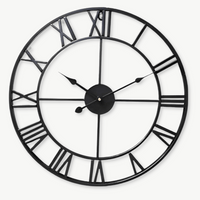
What tends not to work: heavy polished metal (too industrial, too reflective), high-contrast black-and-white graphic dials (too activating), and intricate decorative motifs (your eyes will wander there mid-session, guaranteed).
Size and Placement: Subtle Presence Over Statement
For a dedicated meditation room, a clock of 25-35 cm placed on a side wall at roughly standing eye level gives you a glanceable time check without ever becoming a visual anchor that competes with your practice. This is where a lot of well-intentioned purchases go sideways. Someone wants a calm room, they find a beautiful oversized large wall clock in pale wood, and they hang it as a centerpiece. The problem: a 60 cm clock with visible hands and a central position on the wall is still visually dominant, regardless of how serene the materials are.
For a dedicated meditation room, 25-35 cm (roughly 10-14 inches) tends to work best. It's readable without being commanding. Position it slightly off-center or to the side wall rather than directly in your eyeline when seated. The goal is glanceable, not unavoidable.
Height placement matters too. Hang it at approximately standing eye level (around 150-160 cm from the floor to the center), which puts it just above your seated sightline rather than directly in it. You can check the time when you need to without it hovering in your peripheral vision during every session.
Once you've settled your sizing and placement logic, it's worth thinking about which material and finish actually fits the wall. That's where the product below tends to come up in conversations about getting the material choice right.

| Feature | Works in a meditation room | Works against the space |
|---|---|---|
| Movement | Silent sweep quartz | Step quartz (ticking), pendulum chime |
| Material | Wood, bamboo, acrylic, natural grain | Polished metal, hard plastic, chrome |
| Dial | Minimal, white/cream, few or no numerals | High contrast, busy graphics, second hand |
| Size | 25-35 cm (10-14 in) | Over 50 cm placed as focal point |
| Color | Natural wood tones, white, muted sage, cream | Bold black, high-gloss finishes, warm orange |
| Shape | Round (universally soft), oval | Sharp geometric angles, asymmetric cutouts |
Dial Design: What Your Eyes Find When They Open
The best dial for a meditation room is clean white or cream with simple hands, no second hand, and minimal or absent numerals, so the clock reads as calm texture rather than information demanding your attention mid-session. Meditation isn't a completely eyes-closed practice for everyone. Many traditions use soft open-eyed focus, on a candle, a point on the floor, or simply the middle distance. Zazen, the seated practice central to Zen Buddhism, specifically uses a soft downward gaze rather than closed eyes. In those moments, your clock is in your visual field. What it asks of your attention matters enormously.
A clean white or cream dial with simple hands and no second hand is the gold standard. No second hand means no visual motion to track (which your nervous system will track involuntarily, even if you try to ignore it). Minimal or absent numerals let the dial read as shape rather than information. The clock stops being a readout and becomes part of the room's texture. For yoga nidra practitioners who lie down and occasionally open their eyes toward the ceiling or a side wall, a dial without busy graphics is even more important, since peripheral awareness is heightened in that state.
Minimalist Zen wall clocks with hour and minute hands only, no second hand, no date window, no additional complications, are genuinely rare in the mainstream market. They're worth seeking out specifically. The absence of those extra elements isn't laziness in design; it's restraint, which is exactly the design vocabulary meditation spaces need.

The Case for Celestial and Nature-Motif Designs
Celestial and nature-motif clocks work in a meditation space when their imagery speaks symbolically rather than informationally, sun and moon or botanical shapes that the eye reads as "cycle and rhythm" rather than as data competing with your focus. Strictly minimalist isn't the only path. Some people find that a clock with organic, symbolic imagery, sun and moon motifs, the Tree of Life, botanical shapes, actually deepens the meditative quality of a space rather than disrupting it. The key distinction is that these designs work symbolically rather than informationally. Your eye reads "cycle, nature, rhythm" rather than "3:47 PM."
Sun and moon clocks in particular connect to circadian awareness, the natural rhythm of light and dark that many meditation traditions draw from. This resonates especially in mindfulness-based practices that emphasize anchoring to natural rhythms as an antidote to screen culture. A wooden clock with a carved or etched celestial motif doesn't fight the room's intention; it extends it, quietly. If your practice involves candle-gazing or working with symbolic objects, a clock with this kind of visual language belongs in the room the same way a singing bowl does.
If you've been drawn to nature motifs elsewhere in your space, from botanical prints to driftwood shelves, this is the clock category most likely to feel like a natural fit rather than a compromise.

What About a Meditation Room Shared With Another Purpose?
In a shared meditation and bedroom or office space, the silence requirement stays firm while the visual minimalism can flex slightly: a white-dialed wooden clock in 30-35 cm threads both roles without compromising either. Most of us don't have a dedicated room with nothing but a cushion and a candle. The meditation corner is more likely a sectioned-off part of the bedroom, a home office alcove, or a living room nook with a rug and some plants. That's completely real, and it shifts the criteria slightly.
In a shared-use space, your clock needs to serve both functions without compromising either. The silence requirement stays firm; a ticking clock in your bedroom is a sleep disruptor as much as a meditation disruptor. But the visual minimalism can flex slightly. A bedroom clock that reads cleanly from bed while remaining visually quiet during morning practice is achievable, and it doesn't require any compromise on movement quality.
White-dialed wooden clocks tend to thread this needle well. The natural wood frame, whether light Scandinavian oak or warmer walnut, gives the room warmth for general use; the clean face stays unobtrusive during quiet moments. Size still matters here: even in a bedroom, 30-35 cm tends to balance readability with calm presence better than going large. If you're decorating a home office that doubles as a yoga or breathwork space, the same logic applies; the clock should read clearly from your desk without visually dominating the wall behind your mat.

"The room does not need a clock. The practice needs the room. The clock should serve the room, not the other way around."
Principle from Wabi-sabi interior philosophy
The White Minimalist Option: Simple, Clean, Completely Unobtrusive
A white wood clock with a silent sweep movement, clean face, no second hand, and 30 cm diameter is the most versatile choice for any meditation space: visually weightless on a pale wall, warm enough not to feel clinical, and unobtrusive in every tradition from Zen to Scandinavian to wabi-sabi. Sometimes the answer is straightforward. A white wood clock with a clean face, no second hand, silent sweep movement, and a 30 cm diameter is almost architecturally invisible on a pale or neutral wall. It reads as a circle of negative space rather than an object. Several people who've set up dedicated meditation rooms report choosing this style specifically after trying more decorative options and finding them distracting. The decorative version looked right in the shop; the plain version actually worked in the room.
Silent white wall clocks in natural wood are the most versatile choice if you're uncertain. They work in Zen spaces, Scandinavian-style rooms with birch plywood and linen, Japanese-inspired interiors built around wabi-sabi, and simple modern spaces alike. The material warmth keeps the room from feeling clinical; the quiet dial keeps it from feeling cluttered. If you're just starting to build a practice space and want one decision you won't need to revisit, this is probably it.

Building the Full Picture: Clock as One Piece of a Calm Space
A well-chosen meditation room clock quietly earns its place by confirming silent sweep movement, a still dial, and a size that stays glanceable without dominating; a poorly chosen one announces itself every 60 seconds. The clock you choose won't make or break your practice by itself, but it's a meaningful piece of a larger decision about what gets to exist in the room. Every object in a meditation space either adds to the calm or competes with it. A well-chosen wall clock for a Zen or meditation room quietly earns its spot. A poorly chosen one announces itself every 60 seconds.
A few simple tests before you buy: confirm the movement is silent sweep (not just "quiet"). Check the second hand; if there is one, will you notice it moving during practice? Look at the dial from across the room. Does it read as calm texture, or as information demanding attention? Trust that instinct. Your nervous system knows before your brain catches up.
If you're still browsing across styles and aren't certain which direction fits your room best, the full silent wall clock collection covers everything from the most stripped-back minimalist rounds to wood-carved nature motifs, all with sweep movement. That's where the right option usually shows up for spaces that need this kind of intentionality.
Silent Wall Clocks
Every clock in this collection runs on sweep movement, no ticking, no interruptions, just unbroken quiet for the room you've carefully built.
179 references
Browse the collection →FAQ
Does a meditation room actually need a wall clock?+
It depends on how you practice. If you time your sessions (most people do, 15 minutes, 20 minutes, a set period), a wall clock lets you check progress with a glance rather than reaching for your phone. Keeping the phone out of the room is often part of the intentionality. A simple clock handles that function without introducing screen light, notifications, or the pull of connectivity.
What is sweep movement and why does it matter for silent clocks?+
Standard quartz clocks use a stepping motor that fires once per second, producing the familiar tick sound. Sweep (or continuous) quartz movement uses a different motor that turns the hands in a smooth, near-continuous arc. The mechanism is essentially silent. In a quiet room, especially one where silence is the point, this difference is immediately noticeable. Look for "silent sweep," "sweep movement," or "no ticking" in product descriptions when shopping for a wall clock for a Zen or meditation room.
What size wall clock works best in a meditation room?+
For a dedicated meditation room, 25-35 cm (10-14 inches) tends to strike the best balance. It's large enough to read from a seated position without needing to focus hard, but small enough to avoid becoming a visual anchor point. In a shared bedroom or office that doubles as a meditation space, you might go up to 40 cm if the room is larger, but the general principle holds: smaller and quieter serves the space better than larger and decorative.
Are wooden clocks better than metal for a Zen space?+
Generally, yes. Wood has a lower visual "temperature" than metal: it absorbs light rather than reflecting it, reads as organic rather than industrial, and connects to the natural materials typically found in Zen interiors (linen, stone, rattan, plants). Polished metal can work in a modern minimal space, but it tends to catch the eye and create a harder focal point. Matte metal finishes are a middle ground. Raw or lightly oiled wood is usually the safest bet for spaces where calm is the priority.
Where should a clock be placed in a meditation room?+
Place it on a side wall or slightly off the direct eyeline of your seated position, not directly in front of you where it sits in your resting gaze. Height-wise, hanging it at approximately 150-160 cm from the floor to the clock center puts it just above your seated sightline, meaning it's accessible with a deliberate glance but not hovering in your peripheral vision. Avoid placing it above or near any altar, focal point, or candle arrangement you use during practice.
Should I choose a different clock for Zen, mindfulness, or yoga nidra practice?+
The silent sweep requirement is universal across all three. Where traditions diverge slightly is on visual presence. Zazen practitioners using a soft downward open-eyed gaze benefit most from a clock placed low and to the side, well out of that gaze angle. Mindfulness practitioners who occasionally open their eyes to "reset" find a clean, numeral-free dial least disruptive. Yoga nidra sessions involve lying down, so the clock's position on a side wall (rather than ceiling-adjacent) matters most. In all cases, a smaller diameter (25-30 cm) and a pale, unbusy face serve every tradition equally well.