
You finally settle in. Coffee's hot, notebook's open, browser tabs are under control. Then you hear it. Tick. Tick. Tick. That small plastic clock on the wall, doing its job perfectly, eating your concentration one second at a time.
A quiet wall clock for office concentration isn't a luxury add-on. It's a basic environmental decision, the same way you'd choose a comfortable chair or decent lighting. The difference is that most people don't realize the clock is the problem until they swap it out and feel the shift on the very first afternoon.
Here's what works, why the science makes sense, and how to pick something that looks intentional rather than like an afterthought from the stationery cupboard.
⭐ À retenir
- A standard stepping quartz movement produces an audible tick with every second; a sweep movement runs continuously with no sound.
- Even low-level repetitive noise raises cortisol and reduces working memory, according to research on open-plan office acoustics.
- Silent clocks cost roughly the same as ticking ones at every price point; there's no real trade-off here.
- Dial legibility and frame weight matter as much as silence when choosing a clock for a focused workspace.
- Round, mid-size (30-40 cm) designs read best from a desk without pulling visual attention away from your work.
Why a Ticking Clock Disrupts Concentration
The brain is wired to notice rhythmic, repetitive stimuli. It's a survival mechanism, not a flaw. When sound follows a predictable pattern, the auditory cortex keeps a thread open to monitor it, which means part of your cognitive bandwidth is permanently occupied tracking a sound that carries zero information.
Research on open-plan office noise shows that even intermittent sounds at 50-55 dB reduce performance on reading comprehension tasks. A standard wall clock ticks at roughly 40-55 dB depending on its movement quality. That puts it squarely in the zone where it's not loud enough to consciously bother you, but absolutely loud enough to cost you focus.
The effect compounds during deep work. When you're writing, coding, reading, or thinking through a complex problem, you're asking your working memory to hold multiple threads simultaneously. Any background sound that demands monitoring narrows that capacity. People often describe it as "I can't quite get into the zone today" without ever identifying the clock as the culprit. That's why a well-chosen quiet wall clock for office use isn't a minor upgrade; it's a genuine shift in your acoustic environment.

💡 Did you know?
The stepping quartz movement, which produces the classic tick, was introduced in the 1960s and became the global standard because it was cheap to manufacture. Sweep movements existed before that, used in high-end mechanical watches. Silent quartz sweep technology essentially brought that premium behavior down to an accessible price point, which is why there's genuinely no cost penalty for choosing silence today.
Sweep Movement vs. Stepping Movement: The Mechanical Difference
All the silence talk comes down to one thing: how the second hand moves. In a stepping (or stepping-quartz) mechanism, a small electromagnet fires once per second, physically jerking the gear forward. That jerk is the tick. It's mechanical, it's real, and it happens 86,400 times a day on your wall.
A sweep movement, sometimes called a continuous sweep or silent quartz movement, drives the gear with a series of much smaller, faster pulses. The hand glides rather than steps. There's no jerk, no impact, no audible sound. The clock keeps exactly the same time because it's still regulated by a quartz crystal oscillating at 32,768 Hz. The only change is in the delivery.
Some higher-end versions use what manufacturers call an "ultra-silent" or "micro-step" movement, which breaks each second into 8 or 16 sub-steps. These are virtually indistinguishable from true sweep to the ear, and they're often used in clocks with a more architectural, large-format design where a smooth second hand movement also looks better visually. If you're specifically hunting a sweep movement clock for a demanding work environment, looking for that "micro-step" or "ultra-silent" label on the spec sheet is worth the extra thirty seconds of reading.
| Feature | Stepping Movement | Sweep Movement |
|---|---|---|
| Sound level | 40-55 dB audible tick | Near-silent (<25 dB) |
| Second hand motion | Jerky, one step per second | Continuous glide |
| Timekeeping accuracy | Quartz accurate | Quartz accurate |
| Battery life | 12-18 months (AA) | 10-18 months (AA) |
| Visual appearance | Slight hand jump visible | Smooth, elegant |
| Best for | Hallways, kitchens, utility rooms | Offices, bedrooms, studies |
How to Choose the Right Silent Clock for a Work Environment
Silence is the starting point, not the whole answer. Once you've filtered for sweep movement, you still need to match the clock to your actual workspace. Here's what matters in practice.
Size and Reading Distance
The standard rule of thumb for wall clock sizing: add 1 inch of diameter for every foot of viewing distance. So if your desk sits 8 feet from the wall, a 30-35 cm (12-14 inch) clock is about right. Bigger is only better up to a point. A 60 cm clock in a small home office starts reading as a statement piece rather than a functional timepiece, which can itself become a visual distraction.
For shared offices or open workspaces, a 40-50 cm dial strikes the balance: readable from across the room without dominating the wall. This sizing logic applies whether you're looking for a personal office clock or outfitting a full meeting room.
Dial Clarity vs. Decorative Complexity
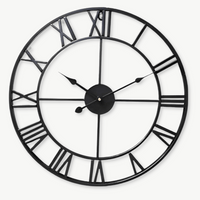
This is where a lot of people get it wrong. A heavily decorated dial, with ornate Roman numerals, complex patterns, or multiple sub-dials, forces your eyes to process more information every time you glance at it. That's a small tax, but it adds up across a workday. For a focused environment, clean Arabic numerals or simple index markers on a high-contrast background (dark hands on a light dial, or vice versa) are the practical choice.
That doesn't mean boring. Scandinavian-style clocks, minimalist Japanese-influenced designs, and Bauhaus-derived faces are all visually interesting while remaining instantly legible. The aesthetic payoff comes from the materials and proportions, not from a cluttered dial.
Frame Material and Visual Weight
Wood frames in walnut, bamboo, or light oak add warmth without visual heaviness. They work particularly well in home offices where you want the room to feel habitable rather than purely functional. Metal frames, especially matte black or brushed steel, suit more industrial or contemporary setups and tend to read as more precise and formal. Glass or acrylic bezels make a clock feel lighter on the wall, which is useful if your space is already visually busy.
Avoid mirrored or highly reflective surfaces in spaces with windows behind the desk. Glare becomes a real issue when afternoon light hits at an angle.

The Best Styles of Silent Clock That Work in an Office
There's no single "office clock style." The right choice depends on what kind of room you're putting it in and what you want the space to say about how you work.
Minimalist White or Light-Dial Clocks
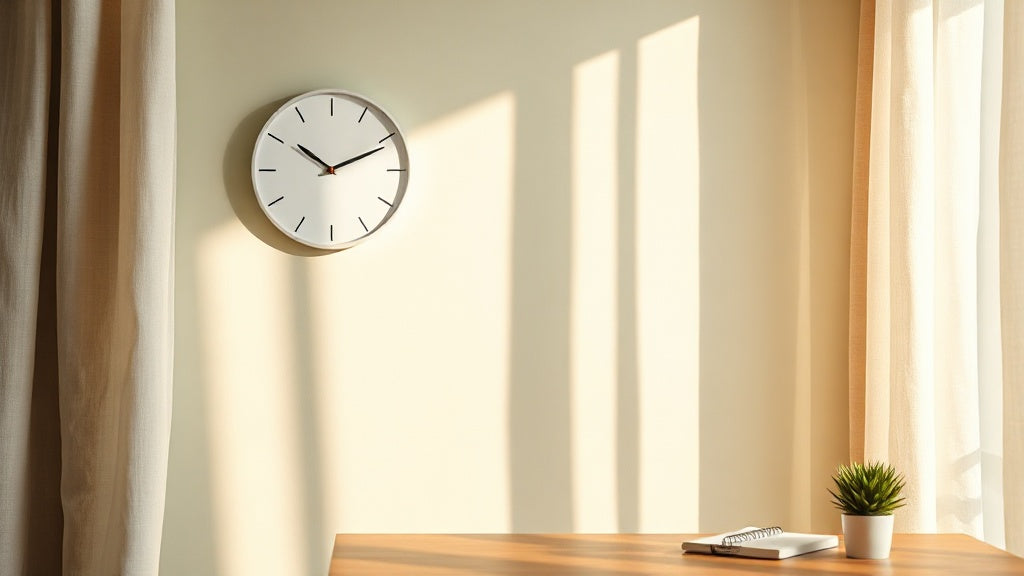
These are the workhorses. A silent minimalist wall clock with a white or pale dial and slim hands disappears into the background when you don't need it and reads instantly when you do. The white wood minimalist format in bamboo or MDF at around 30 cm is a particularly good fit for bright, neutral workspaces. It adds presence without competing with anything else on the desk or shelves.
If your setup already leans Scandinavian, with light wood surfaces, a neutral wall palette, and clean lines throughout, this is the format that closes the loop. The clock slots in as though it was always part of the plan, which is precisely what a good quiet wall clock for office environments should do.

Wood-Grain Dials and Natural Materials
For home offices that lean into a warmer, more lived-in aesthetic, a wood-dial silent clock does something clever: it bridges the gap between decor object and functional timepiece. The texture of the wood draws the eye gently, so the clock reads as intentional wall art rather than a utility item. Crackled wood finishes and walnut veneers work especially well against exposed brick, dark-painted walls, or gallery-style shelving.
This style also solves a common problem in home offices: the room that's meant to be professional but also has to feel like home. A natural-material sweep movement clock with a walnut or crackled wood dial fits both registers without compromising either. It says "I work here" and "I live here" at the same time, which is genuinely hard to pull off with most office accessories.

Glass-Faced Designer Clocks for Contemporary Workspaces
If your office runs on clean lines, matte finishes, and neutral tones, a glass-front clock with a European-style dial holds the wall without tipping into maximalism. The glass bezel catches light differently throughout the day, which gives the piece a quiet dynamism that's interesting without being distracting. These tend to suit standing desks, modernist furniture, and spaces that lean toward a gallery or studio aesthetic.
The glass-front format is also one of the better answers to the "my office feels cold and corporate" problem. The way a quality glass bezel refracts afternoon light introduces just enough warmth and movement to make the space feel less like a co-working hot-desk. It's a small thing, but when you're sitting in that room eight hours a day, it registers.

Where to Hang It: Placement That Supports Focus
The clock's position in the room affects concentration almost as much as whether it ticks. Here's what works in practice.
Avoid Direct Sight Lines from the Desk
If you can see the clock without moving your head from your normal working posture, it will pull your eyes to it. Not constantly, but regularly. For focused work sessions, the clock should require a slight, deliberate glance, something you do on purpose rather than reflexively every few minutes. Position it at a 30-45 degree angle from your primary screen, or above and slightly to the side of your main focal point.
Height Relative to Eye Level
Clocks hung too low (at eye level when standing) feel like they belong in a hallway. Too high (near ceiling height) and they're hard to read without tilting your head. The sweet spot for an office clock is roughly 20-30 cm above seated eye level, which is usually somewhere between 160-180 cm from the floor depending on your chair height. At that position, a glance up from your screen is natural and quick.
Acoustics and Surface Material
Even a sweep movement has a faint mechanical hum in very quiet rooms. Hard, bare walls reflect sound slightly better than walls covered with textiles, bookshelves, or acoustic panels. If you work in a room with hard plaster walls and no soft furnishings, and you can hear your current sweep clock at all, the room acoustics are amplifying it. Adding a rug, some books on the wall behind the desk, or even a fabric pinboard can reduce that residual hum to nothing.

Shared Offices and Meeting Rooms: Slightly Different Rules
In a private home office, you get to optimize entirely for yourself. Shared spaces add one layer of complexity: the clock needs to work for everyone in the room, which usually means prioritizing legibility over personality.
For shared offices, meeting rooms, and co-working setups, here's what performs consistently well:
- High-contrast dials: black numbers or hands on white or cream backgrounds read from across the room without ambiguity.
- Larger format: 40-50 cm for rooms up to 5 meters wide; 50-60 cm for larger open-plan areas.
- No seconds hand: in a meeting context, a visible sweeping seconds hand is the one element that can distract people during a presentation. Some clean-lined sweep clocks omit it entirely, which is worth looking for.
- Neutral framing: matte black or natural wood suits most commercial and residential office palettes without clashing.
If you're outfitting multiple rooms, the office clock collection is worth browsing as a filtered starting point. It pulls together formats sized and styled specifically for productive environments, rather than purely decorative living-room pieces.
Silent Wall Clocks
Every clock in this collection runs on sweep movement: no ticking, no stepping, no audible interruption to your workday.
179 references
Browse the collection →What Real Users Say About Switching to a Silent Clock
The pattern that comes up repeatedly from people who've made the switch: they don't immediately notice the silence. What they notice instead is that they feel less tired at the end of the day. That's consistent with what we know about low-level cognitive load. The absence of a draining sound isn't dramatic; it's cumulative.
People working from home who previously used kitchen clocks in their office spaces report the biggest difference. Those clocks are designed for a room where noise doesn't matter, meaning they often use cheaper, louder stepping mechanisms. Replacing one with a dedicated silent wall clock in the same spot produces a noticeable shift in room feel within the first hour.
A few things that come up consistently from users who've thought carefully about the purchase:
- The absence of ticking makes the room feel larger, acoustically. There's less "stuff" in the sonic space.
- Sweep clocks look more considered on video calls. The smooth hand movement is visible on camera and reads as intentional decor rather than an afterthought.
- People who use the Pomodoro technique (25-minute focused blocks) find that not being able to hear the clock improves their ability to lose track of time within each interval, which is the whole point of the method.
"Silence isn't the absence of sound. It's the presence of attention."
Paraphrase of acoustic environment principles in workplace design research
One More Thing: Style as a Productivity Signal
There's a case to be made that how your workspace looks affects how you work in it. Not in a mystical sense, but in a practical one. When a space feels considered, that signals to your brain that it's a space for focused activity. A clock that fits the room, that was chosen rather than just placed, contributes to that signal.
This is why the best quiet wall clock for office concentration isn't necessarily the most expensive one or the most minimal one. It's the one that makes your workspace feel like it was put together on purpose. That feeling has real functional value.
If you're already committed to a particular aesthetic, whether that's Scandinavian minimalism, industrial warmth, or classic European style, finding a silent clock that fits that language is worth the extra twenty minutes of browsing. The clock is on the wall every time you sit down to work. It should feel right.
FAQ
Are silent wall clocks worth it for an office?+
Yes, straightforwardly. A sweep-movement clock costs about the same as a standard stepping one at every price point, so the only real question is whether the ticking bothers you. Most people who work in quiet rooms find it does, often more than they realized. The shift to a silent movement is one of those changes that people consistently say they should have made sooner.
What is a sweep movement clock and why does it matter for focus?+
A sweep movement clock drives the second hand with rapid, tiny pulses instead of one jerk per second, which eliminates the audible tick entirely. For focused work, that matters because the brain monitors repetitive sounds in the background even when you're not consciously aware of it, consuming a small but real slice of working memory the whole time. Remove the tick, remove the drain.
What are the best quiet wall clock types for a home office?+
For most home offices, a 30-40 cm round clock with a sweep movement, a clean dial, and a wood or matte metal frame performs best. Minimalist designs with high-contrast hands read quickly without demanding attention. If your workspace has warmer materials such as wood shelving, linen curtains, or plants, a wood-frame or wood-dial clock will feel more at home than a cold metal one. If your setup skews contemporary and minimal, a glass-faced European-style design is the cleaner fit.
Can I make an existing ticking wall clock quieter?+
To some extent. Adding a thin rubber pad between the clock body and the wall reduces vibration transmission, which can soften the sound slightly. Placing the clock on a wall with soft furnishings nearby (bookshelves, fabric boards) also helps. However, none of these modifications eliminate the tick. The only reliable fix is replacing the movement with a sweep module, which is possible on some clocks but not all, or replacing the clock itself.
Which clock shape works best in an office?+
Round clocks are the most legible format because our visual system reads angles on a circle faster than positions on a square or rectangular face. In an office where quick, accurate time-checks matter, round wins. Square and rectangular formats can work aesthetically, particularly in grid-heavy modernist interiors, but they require slightly more cognitive processing to read quickly. For pure function in a focused workspace, round is the practical default.
Does the size of the clock affect concentration in a workspace?+
Indirectly, yes. An oversized clock in a small space becomes a visual anchor that pulls the eye, which is the opposite of what you want from a functional office timepiece. A clock that's too small for the room forces you to squint or lean forward, which breaks flow. Matching size to viewing distance (roughly 1 inch of diameter per foot of distance) gives you a clock that's instantly readable without demanding any visual effort.