
You hang a new clock on the wall, pop in a battery, and it just... works. Accurately. Quietly. For years. Most of us never wonder what's going on behind the dial, but once you understand the wall clock quartz movement, you'll never look at a ticking hand the same way. It's a surprisingly elegant piece of engineering, and knowing how it works actually helps you buy smarter, maintain your clock better, and appreciate why certain movements sound or feel different from others.
Here's what's really happening inside that slim module on the back of your clock.
Key takeaways
- A quartz crystal vibrates at exactly 32,768 Hz when current passes through it, that frequency is what makes quartz clocks so accurate.
- The two main types of wall clock quartz movement are step (ticking) and sweep (silent). Choosing between them is a real quality-of-life decision.
- A standard AA battery can power a quartz wall clock movement for 12 to 18 months under normal conditions.
- Quartz movements drift by roughly 15 seconds per month at worst, mechanical movements can drift that much in a single day.
- The movement grade (standard, high-torque, radio-controlled) matters as much as the clock's design when buying for precision.
The Tiny Crystal That Keeps Everything on Time
At the heart of every wall clock quartz movement sits a sliver of synthetic quartz crystal, usually shaped like a small tuning fork and no larger than a grain of rice. When you send a small electrical charge through it, from a AA or AA-equivalent battery, the crystal vibrates. Not randomly, but at a very precise frequency: 32,768 vibrations per second.
That number isn't arbitrary. It's 2 to the power of 15, which makes it easy for the clock's integrated circuit to count down using binary division. The circuit divides that signal in half, then in half again, fifteen times over, until it outputs exactly one pulse per second. That pulse activates the motor, the motor advances the gear train, and the hands move. The entire sequence, from crystal oscillation to hand position, completes in fractions of a millisecond.
This is why quartz replaced mechanical movements for everyday use so completely after the 1970s. The accuracy isn't a matter of skilled craftsmanship or regular servicing; it's baked into the physics of the crystal itself.

Did you know?
The quartz clock was first demonstrated by Warren Marrison and J.W. Horton at Bell Telephone Laboratories in 1927. Their original prototype occupied an entire room. By 1969, Seiko had shrunk the technology into a wristwatch. Wall clock movements followed, and by the early 1980s quartz had become the global standard for household timekeeping.
Step Motor vs. Sweep Motor: The Difference You Actually Hear
This is the distinction that matters most for real-world use, and the one most product listings gloss over. Both movement types use the same quartz oscillator and the same counting circuit. What differs is how the motor delivers power to the hands.
A step motor (also called a stepping motor or tick-tock movement) fires one short electrical pulse per second. The second hand jumps forward in discrete steps: tick, tick, tick. You hear each step. In a quiet bedroom at 2 a.m., that sound becomes a metronome you didn't ask for.
A sweep motor (often marketed as "silent quartz" or "continuous sweep") runs almost continuously, dividing each second into multiple micro-steps, typically between 6 and 360 depending on the quality of the movement. The result is a second hand that glides smoothly and a clock that produces virtually no audible sound.
| Feature | Step Motor (Ticking) | Sweep Motor (Silent) |
|---|---|---|
| Sound | Audible tick every second | Near-silent operation |
| Second hand motion | Discrete 1-second jumps | Smooth, continuous glide |
| Battery life | Typically 18-24 months | Typically 12-18 months |
| Best for | Kitchens, hallways, offices | Bedrooms, studies, nurseries |
| Price range | Budget to mid-range | Mid-range to premium |
| Accuracy (monthly drift) | ±10-15 seconds | ±5-15 seconds |
If you're placing a clock in a bedroom or a home office where silence genuinely matters, a sweep movement isn't a luxury, it's just the right call. Many customers who've bought silent quartz clocks describe the experience almost as relief: the room feels calmer without that persistent tick they hadn't even consciously registered before.
How Accurate Is a Quartz Movement, Really?
The honest answer: accurate enough that you'll never notice the drift in daily life. A standard consumer-grade wall clock quartz movement typically drifts between 5 and 15 seconds per month. Over a full year, that's a maximum error of around 3 minutes, easily corrected with one manual adjustment.
Compare that to a mechanical movement, where a well-adjusted pendulum clock might drift 30 seconds per day, and a cheaper mechanical piece can lose or gain several minutes daily without regular servicing. Quartz wins on accuracy by an order of magnitude, and it does it without any maintenance beyond replacing the battery.
Temperature affects accuracy slightly. A quartz crystal oscillates marginally faster in cold conditions and slower in heat. Most household environments (between 60°F and 80°F / 15°C and 27°C) fall well within the range where drift is negligible. If your clock lives near a heat source or an exterior wall that gets very cold in winter, that's worth factoring in.

The Gear Train: From Electrical Pulse to Moving Hands
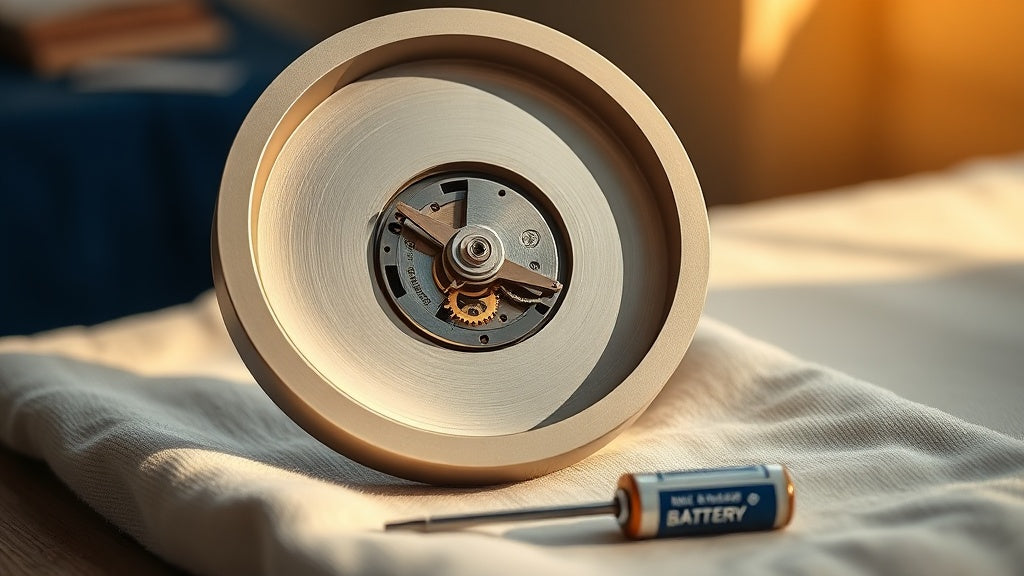
The quartz crystal and the counting circuit handle the timekeeping. The gear train translates that into visible movement. This is the mechanical side of an otherwise electronic system, and it's where build quality shows up most clearly.
Each pulse from the motor engages a rotor, which drives a series of gears in a fixed ratio. For the second hand, the ratio is 1:1, one pulse, one step. For the minute hand, the gear reduction is 60:1. For the hour hand, 720:1. The precision of the gear teeth, the quality of the plastic or metal used, and the lubrication (or absence of it) in the gear train all determine how long the movement lasts before developing wobble, stiffness, or misfires.
Budget movements use injection-molded plastic gears and a thin layer of factory grease that evaporates within a few years. Mid-range and premium movements use tighter tolerances, sometimes metal gears for the high-torque positions, and lubricants rated for longer service lives. This is a real difference, not marketing language. It's the reason two clocks at wildly different price points can both say "quartz movement" on the box and still perform very differently five years in.
High-Torque Movements: Why Large Clock Faces Need More Power
Standard quartz movements are designed for clock hands up to about 8-10 inches from the center pivot to the tip. For large wall clocks, anything with a face diameter above 12 inches, or decorative hands made from heavier metal, a standard movement struggles. The motor simply doesn't generate enough torque to push a long, heavy hand reliably without skipping or stalling.
High-torque quartz movements solve this with a stronger motor coil and a modified gear ratio. They're physically larger than standard modules, require a bigger battery compartment (often a C or D cell rather than AA), and consume more power, but they'll drive hands up to 20 inches long without hesitation. If you're shopping for a 60 cm statement clock or one with ornate metal hands, check specifically that the listing mentions high-torque movement. It matters more than most buyers realize until they've watched a too-weak motor stall at the 12 o'clock position every few hours.
Radio-Controlled Quartz: When "Good Enough" Isn't Enough
Standard quartz is accurate to within a few minutes per year. Radio-controlled quartz, sometimes called atomic-synced or *DCF77* movement in Europe, and *WWVB*-synced in North America, takes that further by receiving a time signal broadcast from a government atomic clock. The movement self-corrects, typically once per day (usually at night), resetting itself to within a fraction of a second of true atomic time.
This technology makes most sense for home offices, studios, or anyone who genuinely needs their wall clock to be perfectly synchronized with phone or computer time. The receiver antenna is built into the movement module; it's not visible from the front. The main limitation: the radio signal has a range of roughly 1,000-1,500 km from the transmitter, and thick concrete walls or metal building frames can weaken reception. Placement near a window generally solves this.

Battery Life and What Drains It Faster Than Expected
Most quartz wall clock movements run on a single AA alkaline battery. Under typical conditions, room temperature, standard-size clock hands, normal indoor humidity, you can expect 12 to 18 months per battery. Some sweep movements are slightly thirstier than step motors; some radio-controlled movements consume a bit more due to the nightly sync cycle.
Three things genuinely shorten battery life faster than expected:
- Cold environments. Batteries lose effective capacity below 50°F (10°C). A clock in a garage or unheated mudroom might drain a battery in 4-6 months.
- Oversized hands on an underpowered movement. When the motor has to work harder to turn heavy hands, it draws more current. This is the most common cause of "my clock keeps stopping" complaints.
- Cheap carbon-zinc batteries. They have lower capacity than alkaline and a much steeper voltage drop curve. Stick to name-brand alkaline cells, or use lithium AA batteries if the clock is in a hard-to-reach location, lithium cells can last 3 to 5 years in low-drain applications.
Quartz vs. Mechanical Movement: Choosing Deliberately
Quartz movement wins on accuracy, low maintenance, and quiet operation. Mechanical movement wins on craftsmanship, heritage, and the pleasure of a visible mechanism. Neither is universally better, they serve different purposes and different relationships with time.
For a kitchen clock you check six times a day while cooking, quartz is the obvious answer. For a statement pendulum clock in a living room where the gentle swing and the chime are half the point, a mechanical pendulum clock delivers something quartz simply can't.
"A mechanical clock measures time. A quartz clock just tells it."
Common sentiment among horologists, a reminder that accuracy and meaning aren't the same thing.
That said, the idea that quartz is somehow less "serious" is outdated. High-end watch manufacturers, Seiko, Grand Seiko, Citizen, produce quartz movements with thermocompensation circuits that rival atomic clocks in accuracy. The technology scales from a $20 kitchen clock to a $5,000 precision instrument.
When browsing our full wall clock collection, look at each product's movement description. Silent quartz means sweep motor. Standard quartz usually means step motor. If the listing doesn't specify, it's worth asking before buying for a bedroom or study.
What to Check Before You Buy: A Practical Movement Checklist
Movement specs rarely headline a product listing, but they're the difference between a clock you love for a decade and one you replace in two years. Here's what actually matters when reading a product page:
- Step vs. sweep: If the room is quiet and you're noise-sensitive, sweep (silent) is the call. Period.
- Battery type required: AA is universal. C or D batteries usually indicate a high-torque movement, appropriate for large-format clocks with heavy hands.
- Movement brand: Miyota (Japan), Seiko Instruments (Japan), and Hermle (Germany) are the most respected consumer-grade movement manufacturers. Their modules carry tighter tolerances than unbranded generic units. Some listings name the movement supplier; most don't, but it's worth checking.
- Clock face diameter vs. hand length: A 60 cm face with hands reaching 28 cm from center needs a high-torque movement. A 30 cm kitchen clock with short plastic hands works fine on standard torque.
- Radio-controlled or standard: For absolute precision synced to atomic time, radio-controlled is worth the small premium. For decorative use, standard quartz is more than sufficient.
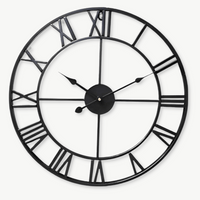
If you're choosing between a vintage wall clock with Roman numerals and a contemporary Scandinavian minimalist design, the aesthetic decision is entirely personal. But whichever direction you go, knowing the movement underneath means you're making a fully informed choice, not just buying a pretty object.
FAQ
What does "silent quartz movement" actually mean on a clock label?+
"Silent quartz" refers to a sweep motor rather than a step motor. Instead of firing one discrete pulse per second (which produces that audible tick), a sweep motor runs the second hand in continuous micro-steps, producing no perceptible sound. The quartz crystal and counting circuit are identical in both types; only the motor and its pulse delivery differ.
What's the best quartz movement type for a bedroom clock?+
A sweep (silent) quartz movement is the clear winner for bedrooms. Because the second hand glides in continuous micro-steps rather than jumping once per second, it produces virtually no sound. Step motors, while perfectly accurate, generate that familiar tick-tock that becomes very noticeable in a quiet room at night. If you share a bedroom or are a light sleeper, a sweep movement isn't optional, it's the only sensible choice.
How often should I replace the battery in a quartz wall clock?+
Plan on replacing the battery every 12 to 18 months using a quality alkaline AA cell. If the clock is in a cold space (below 50°F / 10°C), check it every 6 months. Lithium AA batteries last significantly longer, up to 3-5 years in low-drain movements, and are worth the extra cost for hard-to-reach installations.
Why does my quartz clock keep stopping even with a new battery?+
The most common cause is a mismatch between a standard-torque movement and heavy or oversized hands. When the motor can't generate enough force to turn a long or dense hand, it stalls, usually at the 12 o'clock position where the hand is hardest to push. Other causes include a worn gear train, inadequate battery contact (check for corrosion on the terminals), or a very cold environment draining the cell faster than expected.
Can a quartz wall clock movement be replaced if it breaks?+
Yes, and it's usually straightforward. Most consumer wall clock movements use a standardized shaft diameter (the most common being 16mm total shaft, fitting cases up to about 8mm thick). Replacement modules are widely available. The key is matching the shaft length to your clock case thickness and ensuring the torque rating suits your hand size. Many clockmakers and craft suppliers sell modules individually for under $15.
Is a quartz movement better than a mechanical one for a wall clock?+
"Better" depends on what you value. Quartz is more accurate (drifts seconds per month vs. potentially minutes per day for mechanical), requires no regular servicing, and is significantly quieter when using a sweep motor. Mechanical movements offer visible craftsmanship, no batteries, and a heritage quality that quartz can't replicate. For everyday functional timekeeping, quartz is the practical choice. For a statement piece where the mechanism itself is part of the appeal, mechanical has a character of its own.