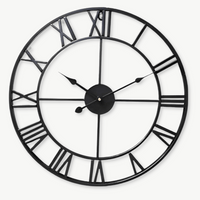


There's a moment - usually after you've rearranged a room for the third time - when you realize the wall is still missing something. Not a gallery wall. Not a mirror. Something smaller, quieter, and more precise. A minimalist clock with thin metal hands is often exactly that thing: the piece that makes the wall feel intentional without pulling focus from everything else you've curated.
It's a specific kind of confidence. A clock that doesn't shout. One that earns your attention by asking for very little of it. I've had customers tell me they spent months looking for "the right thing" for a particular wall, tried prints, tried sconces, tried floating shelves - and then a minimalist clock with thin metal hands went up and the wall was simply done. That's the power of the right quiet object in the right place.
⭐ Key things to know
- Thin metal hands (typically 1-2 mm wide) create visual precision without visual weight on a wall.
- The hand finish - black, brass, or silver - should echo at least one other metal already in the room.
- A silent quartz movement is the standard for minimalist clocks: no ticking, just a clean sweep.
- Dial size matters more than you think: for most rooms, 30-40 cm (12-16 in) hits the sweet spot.
- Placement at eye level (roughly 150-165 cm from the floor to dial center) reads best in lived-in spaces.
What Makes a Minimalist Clock with Thin Metal Hands Different from Standard Designs
The difference is in the hands themselves: at 1-2 mm wide, thin metal hands register as lines rather than shapes, making the clock feel like a composition on your wall rather than a competing visual object. Most mass-market clocks use hands that are wide enough to be legible from across a room, which makes sense functionally. But that width comes with a cost: the hands become the dominant visual element, competing with the dial, the numerals, and whatever's on the wall around them.
A minimalist clock with thin metal hands flips that relationship entirely. At 1-2 mm wide - sometimes even less on high-end pieces - the hands register as lines rather than shapes. Your eye reads the time, but it also reads the space between the hands, the negative space of the dial, the subtle grain of the material underneath. The clock becomes less of an object and more of a composition.

There's also a tactile quality worth mentioning. Quality thin hands are cut or stamped from steel, brass, or aluminum, then either lacquered or left with a brushed finish. That small detail - you can see it when light catches the edge of the hand at a certain angle - is part of what separates a genuinely well-made piece from a budget imitation that just looks thin in product photos.
💡 Did you know?
The Bauhaus school in Germany, active from 1919 to 1933, is widely credited with popularizing the ultra-thin clock hand in European design. The principle was simple: every element should serve its function at minimum visual cost. Clock hands, in that philosophy, exist to point - not to decorate.
The Three Hand Finishes and Which Rooms They Suit
The three standard finishes, matte black, brushed brass, and brushed silver, each carry a different visual temperature, and the right choice comes down to matching the metal family already present in your room. Choosing between black, brass, and silver isn't just an aesthetic preference. Each finish carries a different visual temperature and pairs differently with the materials already in your space.
| Hand Finish | Visual Temperature | Pairs Best With | Rooms That Shine |
|---|---|---|---|
| Matte black | Cool, graphic, high contrast | White or pale grey walls, concrete surfaces, light oak | Living room, home office, studio |
| Brushed brass | Warm, refined, with a subtle glow that's earned rather than flashy | Off-white plaster, linen tones, walnut wood, terracotta | Bedroom, dining room, hallway |
| Brushed silver / gunmetal | Neutral, versatile, slightly industrial | Stainless steel fixtures, grey textiles, birch or maple wood | Kitchen, bathroom, Scandinavian-style spaces |
The rule that holds across all three: your clock's hand finish should echo at least one other metal already in the room. A brass-handed clock placed in a room with chrome tap fittings and silver picture frames creates a quiet tension that reads as unfinished. Match the metal family first, then worry about everything else.

Dial Design: Where a Minimalist Clock with Thin Metal Hands Either Works or Gets Lost
The dial is the stage the hands perform on: a completely bare dial creates the purest minimalist effect, while minimal index markers at 12, 3, 6, and 9 o'clock keep the clock practical without cluttering the face. The hands don't exist in isolation. Their impact depends entirely on the dial they move across. A few dial choices matter more than most people realize.
No numerals versus minimal markers on a clean-dial clock
A completely bare dial - just a circle, no numbers, no markers - creates the purest version of this aesthetic. The minimalist clock with thin metal hands becomes almost abstract, closer to a piece of wall art than a functional timepiece. It works best in spaces where you're not actually checking the time often: a bedroom, a reading nook, a hallway.
If you need to actually read the clock quickly (kitchen, office, living room near where you work), minimal index markers at 12, 3, 6, and 9 o'clock give your eye an anchor without cluttering the face. Raised metal dots or short line markers in the same finish as the hands are the cleanest solution.
Dial material and surface texture
A matte white dial is the classic pairing for thin black hands. It's high contrast, easy to read, and works against almost any wall color. But it's also the most common version, which means it reads as "minimalist" without necessarily reading as distinctive.
Slightly more interesting choices: a warm ivory or off-white dial (which pairs beautifully with brass hands), a light grey or concrete-effect dial (which suits silver or gunmetal hands), or a translucent dial that lets you see the movement behind the face. That last option adds a layer of visual depth that a flat dial never achieves. For a Scandinavian-influenced interior, a pale birch veneer dial with matte black hands is genuinely hard to beat - the warmth of natural wood grain against the crispness of the hands is one of those combinations that just works.

Size and Scale: Getting the Proportions Right for Your Thin-Handed Clock
Getting the size right means resisting the urge to go small: for most living rooms, a 40-45 cm dial gives thin metal hands enough presence to anchor a wall without dominating it. Minimalist doesn't automatically mean small. That's probably the most common mistake people make when shopping for a minimalist clock with thin metal hands. A 25 cm clock on a large expanse of wall doesn't read as refined - it reads as underpowered. Worse, if the dial is too small, those beautifully precise thin hands become nearly invisible from across a room, which defeats the entire point.
Here's what works in practice:
- 30-35 cm (12-14 in): Works for bedrooms, small hallways, or walls with competing decor. Intimate scale, reads well from 2-3 meters.
- 40-45 cm (16-18 in): The sweet spot for living rooms and open-plan spaces. Enough presence to anchor a wall without dominating it.
- 50 cm and above: Statement territory. Works on large blank walls, above sofas, or in loft-style spaces with high ceilings. A larger dial actually helps thin hands, because the contrast between hand width and dial size becomes part of the aesthetic.
One useful calibration: the clock should occupy roughly one-third to one-half the width of the furniture or architectural element it sits above. A 180 cm sofa pairs well with a 40-60 cm clock. A narrow console table pairs better with a 30-35 cm piece.
Where to Hang a Minimalist Clock with Thin Metal Hands (and Where to Avoid)
The best position centers the dial between 150 and 165 cm from the floor, keeps it away from direct glare, and gives it enough breathing room on the wall to read as intentional rather than incidental. Wall position changes how the clock reads from every seat in the room. Thin hands are legible - but only when they're not fighting glare or shadow.
The eye-level rule
Center the dial between 150 and 165 cm from the floor. That's the average standing eye level, and it's the position where the hands register immediately without any head tilt. For clocks hung above furniture, you can go slightly higher - 170-180 cm - since the furniture fills the visual gap below.
Light and glare considerations
A clock with a glossy dial and polished metal hands can create distracting glare near windows. Matte or satin finishes handle natural light far better. If your preferred wall gets direct afternoon sun, a matte dial is worth prioritizing over a polished one, regardless of how good the polished version looks in product photos.
Walls that work especially well
- A single-color painted wall with no other large decor elements. The clock becomes the focal point by default.
- Above a fireplace, centered on the mantel. Classic placement that suits the clock's quiet authority.
- In an entryway on the first wall you see when entering. Functional, but also sets the design tone for the whole home immediately.
- In a home office, at eye level from your seated desk position. Checking the time becomes a glance rather than a search.

⭐ One placement mistake worth avoiding
- Don't center a minimalist clock on a wall that already has multiple framed prints or photos at the same height. The clock needs breathing room to read as intentional rather than just another item in a busy gallery arrangement.
- If you love gallery walls, place the clock off-center within the arrangement - slightly higher and to one side - so it reads as anchor rather than afterthought.
Pairing a Minimalist Clock with Thin Metal Hands to Specific Interior Styles
A minimalist clock with thin metal hands crosses style categories with ease, the pairing changes with each aesthetic, but the core principle stays the same: match the hand finish to the room's dominant metal tone. A minimalist clock with thin metal hands is one of the few pieces that genuinely crosses style categories. But the way you pair it changes significantly depending on your room's aesthetic.
Scandinavian interiors
This is the natural home for a minimalist clock. Light wood, white walls, natural textiles - thin black or brushed silver hands on a pale dial feel completely organic here. The clock doesn't need to work hard. It belongs without any justification.
If your Scandinavian space runs slightly warmer (blond wood, linen, amber candles), try brass hands instead of black. The warmth reads as coherent rather than contrived.
Browse the Scandinavian wall clock collection if you want to see this aesthetic applied across a range of sizes and finishes.
Modern minimalist interiors
Think monochrome palette, concrete or plaster walls, architectural furniture with hidden hardware. Here, a silent minimalist wall clock with black steel hands on a pure white dial functions almost like punctuation - it's the one analogue element in a very considered space. Keep the frame thin or frameless entirely. The clock should look like it grew out of the wall.
Japanese-influenced (wabi-sabi) interiors
Wabi-sabi spaces embrace natural materials and quiet imperfection. A clock with a natural wood dial or a lightly textured face (rather than a perfectly smooth industrial surface) works better here than a hard-edged metal disc. Thin hands in aged brass or matte black read as organic rather than mechanical. The Wood and Acrylic Wall Clock in Japanese style is a good example of how that balance plays out.
Industrial interiors
Exposed brick, steel shelving, Edison-bulb lighting - this style often reaches for oversized clocks with thick hands, but it doesn't have to. A large-format (50 cm+) minimalist clock with gunmetal or matte black hands on a dark concrete-grey dial can hold its own against industrial texture without competing noisily. The key is scale: go bigger, keep the hands razor-thin, and let the contrast do the work.
Contemporary and transitional spaces
If your home doesn't fit neatly into one style camp - and most homes don't - the versatility of a thin-handed minimalist clock actually becomes its biggest asset. A 40 cm clock with brushed silver hands and a clean grey dial can sit comfortably in a room that mixes mid-century furniture, modern art, and natural materials. It doesn't fight any of it.

Silent Movement: Why It Matters More Than You Might Expect
A silent quartz sweep movement is the right choice for any minimalist clock: the second hand moves in a continuous fluid arc with no ticking, preserving the quiet presence the design is built around. A minimalist clock is, by definition, a quiet presence. A ticking movement breaks that entirely. The rhythmic click every second doesn't just make noise - it draws attention to the clock in a way that contradicts the whole point of the design.
The alternative is a silent quartz sweep movement. The second hand, if there is one, moves in a continuous fluid arc rather than a series of discrete steps. No ticking. No clicking. Just the visual of the hands moving through time.
For bedrooms and home offices especially, this matters practically. Many people who've switched from ticking clocks to silent ones describe not realizing how much the tick was sitting in the background of their awareness until it disappeared. One customer wrote to us after receiving her first silent-movement clock: she'd been working from home beneath a ticking clock for two years and hadn't consciously noticed it until the new one went up. Then she noticed the absence, immediately. If you're spending 8 hours at a desk beneath a wall clock, that's worth paying attention to.
The silent wall clock collection covers the full range from small bedroom pieces to large statement formats - all with sweep quartz movements that keep the visual experience as clean as the aesthetic.
How to Care for Metal Hands (and Keep Them Looking Sharp)
Thin metal hands need very little maintenance, dry dusting with a microfiber cloth, occasional wax on unlacquered brass, and always moving the hands clockwise when setting the time keeps them looking sharp for years. Thin metal hands are more durable than they look, but a few habits keep them in good condition over the years.
- Dusting: Use a dry microfiber cloth or a soft brush (the kind sold for camera lenses works perfectly). Don't use damp cloths on bare metal hands - moisture accelerates oxidation, especially on brass.
- Brass hand care: Lacquered brass needs nothing beyond dusting. Unlacquered brass will develop a patina over time, which many people find desirable. If you prefer the original finish, a very light application of Renaissance Wax every 6-12 months keeps oxidation at bay.
- Setting the hands: When changing time or installing a new battery, always move the hands clockwise. Moving them counter-clockwise can stress the movement arbor, particularly on lightweight quartz movements.
- Battery changes: Use quality AA or AAA alkaline batteries (the type specified by the movement). Budget batteries can leak and damage the movement from the inside - damage that isn't visible until the hands stop moving accurately.
"A clock that ticks is a clock that announces itself. A clock that doesn't, earns its place on the wall."
Common observation among interior designers working with Scandinavian and minimalist aesthetics
The Handcrafted Option: When Precision Meets Material Quality
A handcrafted minimalist clock goes beyond standard production: perfectly balanced hands, a consistent finish that holds over years, and materials like solid walnut or natural stone that age alongside the room rather than against it. There's a category of minimalist clock that goes beyond off-the-shelf production: pieces where the hands are hand-finished, the dial is made from solid wood or natural stone, and every component is selected rather than defaulted. These clocks don't just tell time. They age with a room.
The detail that separates them from mass-market minimalism is consistency. On a quality handcrafted piece, the hands are perfectly balanced (an unbalanced hand will drift or pause under gravity), the gap between hand and dial is uniform, and the finish - whether matte black lacquer or hand-brushed brass - holds its character over years rather than months.
For a handcrafted option in walnut with a silent sweep movement, the Walnut Wood Wall Clock sits at a price point that reflects real material and manufacturing quality, starting from $99.
Ready to find yours?
Whether you're after a Scandinavian-inspired piece for a bright hallway or a glass-dialled design for a contemporary living room, the right minimalist clock with thin metal hands is waiting. Start with your wall's dominant metal tone, then let the dial do the rest.
Frequently Asked Questions About Minimalist Clocks with Thin Metal Hands
How thin is "thin" for clock hands - is there a standard measurement?+
There's no fixed industry standard, but most minimalist clock hands fall between 1 and 3 mm wide at their widest point (usually near the mounting center). Ultra-slim designs used in Bauhaus-influenced pieces can be as narrow as 0.8 mm. As a reference, a standard mass-market clock hand is typically 4-6 mm wide - the difference is immediately visible in person.
Do thin hands make the clock harder to read at a glance?+
In most rooms and at typical viewing distances (2-4 meters), no. The legibility depends more on contrast between the hands and the dial than on hand width. Black hands on a white dial read clearly even at very fine widths. Where thin hands can struggle is in low-contrast setups (grey hands on a grey dial) or at unusual distances above 5-6 meters - in that case, slightly wider hands or stronger contrast makes sense.
Are thin metal hands fragile? What happens if a hand bends?+
Quality metal hands are cut from steel or aluminum with enough tensile strength to resist casual contact. They won't bend from a light touch during installation. If a hand does bend, it can usually be straightened very carefully with flat-tipped tweezers - but work slowly, as the thin cross-section means repeated bending will eventually crack the metal at the stress point. The main risk is during installation when people grip the hands to set the time; always use the crown at the back rather than pushing on the hands directly.
Does a minimalist clock with thin metal hands work in a maximalist or eclectic interior?+
Yes - and often well. In a busy, layered room, a spare minimalist clock acts as a visual rest point. Your eye finds the clean dial and the thin hands and briefly stops scanning. It's the same reason a well-designed room benefits from a few negative spaces. The key is scale: go slightly larger than you would in a minimal room, so the clock can hold its own among more visual competition.
What's the difference between a sweep second hand and no second hand at all?+
A sweep second hand (moving continuously rather than in steps) adds a sense of life and motion to the dial - you can actually watch time moving. Many people find it meditative rather than distracting. A two-hand clock with no second hand is more static and sculptural; it reads as an art object that also happens to tell time. Neither is better. It comes down to whether you want the clock to feel alive or simply present.
Which hand finish is most versatile if I'm buying my first minimalist clock?+
Matte black is the most universally adaptable finish. It holds strong contrast against white, cream, grey, and even dark walls. It suits Scandinavian, industrial, modern minimalist, and transitional spaces equally well. If you already have warm brass tones in your room (cabinet handles, lamp bases, mirror frames), go brass - but if you're starting fresh or decorating a rented space you might change frequently, matte black is the one finish that almost never needs reconsidering.