

Picture a room where afternoon light struggles through thick curtains, books are piled two-deep on shelves, and somewhere on the wall, a clock ticks with the slow, deliberate weight of something old. That's the feeling dark academia chases. And nothing nails it faster than the right wall clock for dark academia interior style.
This isn't a quick fix for a bare wall. A clock in a dark academia room earns its place. It carries the same visual gravity as a leather-bound dictionary or a brass compass. Get it right, and it anchors the whole space. Get it wrong, and even the best bookshelf arrangement looks off.
We put together eight of our favorite picks below, ranging from pendulum statement pieces to celestial carved wood. Every single one has earned its place through real use in real rooms, and we'll show you exactly where each one shines.
⭐ Key takeaways
- Dark academia clock design relies on materials: dark wood, aged brass, Roman numerals, and wrought iron all work.
- Size matters more than you think: a clock too small on a tall dark wall disappears entirely.
- Silent (non-ticking) movements are strongly worth considering for study and reading spaces.
- Placement above a reading chair, fireplace mantel, or entry hallway amplifies the aesthetic the most.
- You don't need to spend a fortune: the right frame shape and finish does far more work than price alone.
What Dark Academia Decor Actually Is
Dark academia decor is an interior aesthetic rooted in old European universities, Gothic architecture, and scholarly romance, built on a palette of deep walnut, forest green, burgundy, charcoal, and brass, with natural textures like leather, raw wood, aged metal, and linen. Dark academia is an aesthetic rooted in old European universities, Gothic architecture, and the romance of intellectual life. Think Oxford libraries, candlelit studies, worn stone corridors, and the smell of old paper. The color palette leans heavily on deep walnut, forest green, burgundy, charcoal, and brass. Natural textures dominate: leather, raw wood, aged metal, linen.
It became a widespread interior design movement around 2020, initially driven by literary and campus nostalgia on social media, but it has since grown into a fully realized approach to home decoration. The aesthetic rewards rooms that look like they've accumulated meaning over time, not spaces that were styled in an afternoon.
A clock fits this world intuitively. Clocks are objects of time, and dark academia is obsessed with time: the passage of it, the weight of it, the centuries of knowledge layered into those shelves of books.

💡 Did you know?
The pendulum clock was invented in 1656 by Dutch scientist Christiaan Huygens. Before that invention, clocks lost or gained as much as 15 minutes a day. The pendulum reduced that error to under a minute. No wonder the swinging pendulum became the defining symbol of scholarly precision.
The Materials That Define a Dark Academia Clock
Dark academia wall clocks earn their place through material: dark-stained wood, aged brass or bronze, wrought iron, and Roman numerals are the non-negotiable building blocks of the aesthetic. You can't fake this aesthetic with the wrong material. A glossy white plastic clock with sans-serif numbers belongs in a Scandinavian kitchen. Dark academia wall clocks have their own material language, and it's worth learning before you start shopping.
Dark Wood and Walnut Finishes
Dark-stained or natural walnut wood is probably the most versatile starting point. It reads warm without being rustic, and the grain adds texture that plain painted surfaces can't match. A round wooden clock with a Roman numeral face works in almost any dark academia room: study, hallway, bedroom, or living room.
Look for clocks with visible grain rather than perfectly smooth veneers. The slight irregularity is part of the appeal. It signals that the material is real, not a printed effect. Our customers consistently report this as the detail they notice first when they hang a walnut clock in a room previously dominated by lighter furniture: the grain grounds everything around it.
Aged Brass and Bronze Hardware
Brass hands and bezels add a warmth that chrome or brushed aluminum simply don't. Aged brass (slightly oxidized, unpolished) looks far better in this aesthetic than mirror-bright brass. If you find a clock where the brass shows a little patina, that's actually the version you want.
Bronze and dark copper finishes work equally well. Both read "antique laboratory" rather than "contemporary hardware store".
Wrought Iron and Gothic Ironwork
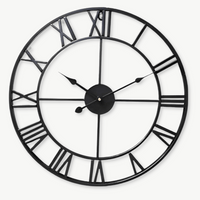
For a more intense Gothic or Victorian register, wrought iron frames and decorative scrollwork bring serious atmosphere. These clocks tend to work best on lighter walls (stone white, cream, worn plaster) where the dark metal reads clearly. Against a very dark painted wall, they can blur into the background.
Roman Numerals: Non-Negotiable
Arabic numerals (1, 2, 3...) are perfectly functional on a dark academia clock, but Roman numerals (I, II, III...) carry centuries of associative weight. They read as academic, classical, ceremonial. Every Roman numeral clock on a dark wall whispers "Oxford common room."
If you're choosing between two similar clocks and one has Roman numerals, go with that one. It does more aesthetic work for the same space on the wall.

Clock Styles That Work Best for This Aesthetic
The styles that work best for dark academia are Victorian mantel-style wall clocks, pendulum wall clocks, large round wood clocks with Roman numerals, Gothic skeleton clocks, and celestial or wrought iron designs, each suited to a specific room and placement. Not every ornate clock is a dark academia clock. Here's how the main styles break down in practice.
| Style | Best For | Watch Out For |
|---|---|---|
| Victorian mantel-style wall clock | Above a fireplace, entryway | Can feel heavy in small rooms |
| Pendulum wall clock | Living room, home library | Ticking sound; choose silent versions for bedrooms |
| Large round wood clock (Roman numerals) | Study walls, above desks | Needs a wall with breathing room around it |
| Gothic skeleton clock | Bedroom, moody corner | The exposed mechanism style can read theatrical; pairs better with neutral walls |
| Sun and moon celestial clock | Bedroom, witchy or mystical dark academia spaces | Less "scholarly", more "mystical"; depends on the room's direction |
| Cast iron or wrought iron wall clock | Hallways, stairwells, lofts | Heavy to hang; verify wall anchor capacity |
8 Ornate Picks: Our Favorite Dark Academia Wall Clocks
These eight dark academia wall clocks cover every need in the aesthetic, from a silent celestial wood clock for study rooms to a kinetic pendulum statement piece for rooms with serious ceiling height. I've been sourcing and styling clocks for dark academia rooms long enough to be picky. These eight earned my trust through one simple test: would I hang any of them in my own study? Yes, without hesitation. Each one hits a different need in the aesthetic, so read the short note before each card to find your fit.
Pick 1: The Celestial Wood Clock (for study rooms and bedrooms)
This is the one I recommend most often for people who want their first serious dark academia piece. The carved sun-and-moon motif on warm walnut wood bridges scholarly and mystical without feeling theatrical. One customer who styled it above a sage-green armchair told us: "It transformed the corner completely. It looks like it's been there for twenty years." Silent movement makes it a genuine study-room clock.

Pick 2: The Glow-Dark Silent Wood Clock (for candlelit bedrooms)
Dark academia bedrooms have one specific challenge: you want to check the time at 2am without breaking the spell of the room. Glow-in-the-dark numerals on a silent wooden frame solve this elegantly. Customers who've used this in bedrooms consistently mention that it "earns its place even after the lights go out." The warm wood tone reads beautifully against both dark-painted and neutral walls.

Pick 3: The Large Roman Numeral Dark Wood Clock (for statement walls)
This is the one for people who already have a bookshelf, a reading chair, and a lamp, but the wall above them still feels unfinished. A large-format dark wood clock with Roman numerals fills exactly that gap. The scale is important: nothing under 16 inches will hold its own above a full armchair setup. I'd hang this one at standing eye-level plus one hand's width, on a dark green or charcoal wall. Customer feedback is consistently about scale: "I was worried it would be too big. It was exactly right."
Pick 4: The Victorian Mantel-Style Wall Clock (for fireplace alcoves)
If you have a fireplace, this is the clock for above it. The Victorian mantel-style proportions, dark frame, and brass detailing were designed for exactly this position. I often pair this recommendation with the suggestion to flank it with two taper candlesticks at different heights: the asymmetry keeps the arrangement from feeling staged. Customers who've used this above a working fireplace note that the warm light from the fire makes the brass details "come alive in a way you can't replicate with a wall lamp."
Pick 5: The Gothic Skeleton Clock (for bedrooms and moody corners)
The exposed mechanism of a skeleton clock is one of the most visually specific things you can do in this aesthetic. It says "I find clockwork beautiful in itself, not just as a tool." The trick is placement: this clock works best against a neutral or slightly warm wall where the intricate movement reads clearly. Against a very dark wall, the mechanism blurs into shadow. Customers in converted Victorian apartments report that skeleton clocks "fit like they were always there." For anyone who wants a dark academia wall clock that doubles as a conversation piece, this is it.
Pick 6: The Wrought Iron Scroll Clock (for hallways and stairwells)
A narrow hallway or tall stairwell is one of the most underused canvases in a dark academia home. A wrought iron scroll clock, hung high on a cream or stone-white wall, creates an architectural moment before you've even reached the living room. The key is height: position it so the center sits at least 6 inches above standard door-frame height. It guides the eye up, makes the ceiling feel taller, and sets the tone for everything beyond. Multiple customers have described this as "the first thing anyone mentions when they come over."
Pick 7: The Botanical Illustrated Clock (for cottagecore-adjacent dark academia)
Not everyone's dark academia is pure Gothic severity. If your shelves lean toward natural history rather than philosophy, if you have pressed botanicals on the wall alongside the books, this is the clock for you. A hand-illustrated face with botanical motifs reads artisanal in the best possible way: it's a clock that looks like it belongs in a Victorian naturalist's study, not a corporate boardroom. Customers who style theirs alongside dried flower arrangements frequently say it "ties the whole nature-meets-academia corner together perfectly."
Pick 8: The Pendulum Wall Clock (the full commitment)
This is the pick for rooms with ceiling height and an owner who has decided, fully and without reservation, to commit to the aesthetic. A pendulum clock is kinetic. It moves. Light catches the pendulum mid-swing and creates a small moment of drama that no static clock can replicate. If a single customer review could sum up the experience, it would be this one: "I walked past it at 11pm and stopped to watch it for a full minute. That's never happened with a clock before." Browse the pendulum clock collection if you're ready to make this choice.
Size and Placement: Where the Aesthetic Lives or Dies
For a dark academia room, clock size and placement determine whether the piece anchors the space or disappears into it: aim for 12 to 18 inches above a reading chair, larger above a fireplace, and always hang slightly higher than instinct suggests. Dark academia rooms tend to have tall walls, heavy furniture, and layered textures. A small clock gets swallowed. This is one space where going bigger almost always pays off.
Above a Reading Chair or Desk
This is the most natural placement. The clock becomes a focal point above a dedicated intellectual corner. Height of hanging matters: center the clock roughly at standing eye level, or slightly above. If the chair is low and the ceiling is high, you can go higher and use the vertical space deliberately.
Size guide: for a wall behind a standard chair, a clock between 12 and 18 inches in diameter reads well. Smaller gets lost; much larger starts competing with the furniture. Customers who've tried both consistently report that they wish they'd sized up first.
The Hallway Wall: Atmospheric Entry
A dark academia hallway clock does something slightly theatrical. Every person who enters your home sees it first. A narrow hallway with a moody Victorian wall clock immediately signals the aesthetic of the whole home.
In tight hallways, a vertically oriented clock (think tall case clock proportions, or a rectangular framed timepiece) works better than a wide round one. You want it to guide the eye upward, not compete with the walls.
Above the Fireplace
If you have a fireplace, put the best clock above it. Full stop. This is the traditional mantelpiece position, and dark academia fully embraces tradition. A large ornate wood or brass clock above a fireplace, flanked by candlesticks and a few small objects, is one of the most powerful moments in this aesthetic.
Where Not to Hang a Dark Academia Clock
A few placements actively undermine the effect:
- Above the bathroom mirror: too functional and clinical for this aesthetic. Save the bathroom for more minimal pieces.
- On a white or very light wall in an otherwise bright, modern room: the ornate clock will look like a costume rather than a natural part of the space.
- Clustered into a gallery wall with unrelated frames: the dark academia clock needs its own space to breathe. Pairing it with a mix of family photos and travel prints dilutes the mood entirely.
- Directly over a TV screen: the two objects compete for attention and neither wins.
Pairing Your Clock with the Rest of the Room
An ornate wall clock for dark academia rooms works best paired with books nearby, brass and candlelight accessories in the same material tone, and a deep forest green, charcoal, or dark navy wall that lets the warm wood or brass stand out dramatically. A dark academia clock doesn't live in isolation. It's part of a visual conversation with everything else on the wall and below it. Here's what works well alongside an ornate timepiece.
Books as Supporting Players
A clock positioned above or near a bookshelf is the quintessential dark academia combination. The books provide the intellectual context; the clock provides the focal point. If the books are arranged with some spines facing out and others turned inward (pages out, creating a neutral texture), the overall composition gains depth without feeling too "arranged."
Brass and Candlelight Accessories
Brass candlesticks, small bronze figurines, a letter opener on the desk: these objects speak the same material language as a brass-handed wall clock. Repeating the metal tone across the room (even in small accents) ties everything together. You don't need much. Two or three brass objects in a room and a brass-detailed clock is more than enough to create cohesion.
Dark Painted Walls
A deep forest green, charcoal, or dark navy wall makes an ornate clock stand out dramatically. The contrast between the wall color and the warm wood or brass of the clock creates exactly the kind of moody, deliberate atmosphere this aesthetic is after.
If repainting isn't possible, deep-toned wainscoting or a large dark textile (a linen drape, a dark velvet panel) behind the clock area works almost as well. I've seen customers achieve a genuinely convincing dark academia corner using only a dark velvet curtain panel as a backdrop, which is considerably less commitment than painting the entire wall.

Silent Movements: A Practical Note for Readers and Sleepers
For any dark academia clock going into a reading room or bedroom, a silent quartz movement is strongly worth prioritizing: the ticking sound that feels charming for five minutes becomes genuinely distracting after an hour of concentrated reading. Dark academia rooms are often reading rooms or bedrooms. Both environments have one thing in common: the sound of a ticking clock can go from charming to maddening fast.
Many ornate clocks now come with silent quartz movements (sometimes called "sweep" movements) that produce no audible tick. The second hand moves in a continuous smooth sweep rather than a step-by-step tick. It looks more elegant, too.
If the clock is going in a study where you concentrate for long periods, or in a bedroom, prioritize silent movement without compromise. The aesthetic doesn't require the sound. And if you ever want the atmosphere of a ticking clock, a small desktop clock with an audible tick can provide that on demand.
I asked a group of customers who use dark academia wall clocks in their home offices about this specifically. Nearly every response mentioned that they'd switched to a silent movement after a ticking clock interrupted a long reading session once too often. The lesson: don't assume the ticking adds to the atmosphere. In a study, it usually subtracts from it.
The Pendulum Clock: Dark Academia's Most Dramatic Option
A pendulum wall clock is the most atmospheric dark academia option available: the rhythmic swing is visually hypnotic, light catches the pendulum mid-movement for a kinetic moment no static clock can replicate, and it rewards rooms with 10-foot or higher ceilings. If you want to commit fully to the aesthetic, a pendulum wall clock is the most atmospheric choice available. The rhythmic swing of the pendulum is visually hypnotic. When light catches the pendulum mid-movement, it creates a small kinetic moment that no static clock can replicate.
Pendulum clocks work best in rooms with ceiling height. In a standard 8-foot room, a pendulum clock with a long case can feel cramped. In a room with 10-foot or higher ceilings (think older apartments, converted period properties), the pendulum clock feels exactly right.
Position it where the pendulum has clearance on both sides. A pendulum clock wedged into a tight corner won't swing properly. Give it the visual space it deserves. If your space allows it, the pendulum clock collection is worth browsing for a piece that truly commits to the mood.
"A clock is not merely a machine for measuring time. It is an instrument for experiencing it."
Attributed to clockmakers of the Vienna Regulateur tradition, 19th century
Unusual Materials Worth Considering
Beyond wood and brass, handmade resin clocks with dried botanicals, smoked acrylic skeleton dials, and illustrated ceramic faces all bring genuine dark academia atmosphere through material curiosity and craft rather than price. Beyond wood and brass, a few less obvious materials deserve attention in a dark academia context.
Resin with Dried Botanicals
Handmade resin clocks encasing real dried flowers have appeared in dark academia communities with good reason. They combine the craft aesthetic of the movement with the naturalist curiosity cabinet energy that dark academia loves. These clocks tend to be one-of-a-kind pieces: no two are identical. The preserved flowers inside add a memento mori quality that fits the aesthetic's relationship with time and impermanence.
Acrylic Skeleton Dials
A skeleton-style clock (where the clock face is open and the movement is visible) traditionally uses brass or steel. Modern versions use clear acrylic to achieve a similar exposed-mechanism effect at a lower price point. When the acrylic is tinted dark (smoked grey or dark amber), the result reads more naturally in a moody room than crystal-clear versions.
Ceramic and Painted Faces
Clocks with hand-painted or illustrated faces, particularly those depicting celestial maps, botanical drawings, or architectural motifs, work well in spaces that lean toward the more artisanal, cottagecore-adjacent end of dark academia. The illustrated face becomes a small piece of art that happens to tell time.
Unique Wall Clocks
Every clock in this collection carries a character of its own: ornate designs, unusual shapes, and statement materials that suit a dark academia room far better than anything generic.
153 products
Browse the collection →Building the Dark Academia Corner Around Your Clock
Build the dark academia corner backward from the clock: choose the clock first to set the material vocabulary, then match the lamp, add one textile layer, bring in exactly three small objects, and leave breathing room around the clock on the wall. The clock is rarely the first thing you buy when building this aesthetic. More often, someone has a reading chair they love, a bookshelf that's been slowly filling up with interesting spines, and a bare wall above it all. The clock becomes the final piece that gives the corner intention.
Here's a practical approach to building the corner backward from the clock:
- Choose the clock first: material, shape, and size. This sets the material vocabulary for everything nearby.
- Match the lamp: if the clock is brass, find a lamp with a brass base or an aged metal finish. Not matching exactly; just speaking the same material language.
- Add one textile layer: a linen throw on the chair, a dark velvet cushion, or a small wool rug underfoot. Textiles soften the space and stop it reading like a museum.
- Bring in exactly three small objects: a stack of books, a small sculpture, one practical object (a cup, a magnifying glass, a letter seal). Three is enough. Four starts to feel cluttered.
- Leave space: dark academia is atmospheric, not maximalist. The wall around the clock should have room to breathe.
This five-step process might sound deceptively simple. It is. The difficulty is in the restraint: every time I work through this with a customer, the instinct is to add one more object. Resist it. Customers who've followed the three-object rule consistently describe their corners as feeling "curated," while the ones who added five or six small pieces tend to say it feels "busy." The clock needs visual silence around it to work properly.
What Actually Makes a Wall Clock Feel "Dark Academia" vs. Just "Old"
A wall clock reads as dark academia when it combines dark or warm natural material, classical ornate details like Roman numerals and decorative bezels, subdued muted tones, a sense of craft and weight, and a complete absence of digital or backlit components. This is a real distinction worth making. Not every antique or vintage-style clock reads dark academia. A kitschy "Café de Paris" clock with faded typography reads French bistro. A plastic-framed "distressed" farmhouse clock reads rustic country. A neon-edged industrial loft clock reads entirely different again.
The specific combination that signals dark academia in a wall clock:
- Dark or warm natural material (wood, metal, stone effect) rather than light or synthetic
- Classical or ornate details (Roman numerals, decorative bezels, engraved faces) rather than stripped-back minimalism
- Subdued, muted tones rather than bright contrast
- A sense of weight and craft, even if the clock is lightweight in practice
- No backlit LED displays, no digital components, nothing that reads "smart home"
That last point matters. A dark academia wall clock should look like it belongs in a room that has never seen a smartphone. The digital world and this aesthetic are fundamentally incompatible on the wall. Save your screens for the desk.
If you're still building out the rest of the room and want to explore how other wall clock styles can anchor a space before committing to one direction, the designer wall clock collection covers a wide range of ornate and architectural styles worth comparing side by side.
Frequently asked questions
What is dark academia decor?+
Dark academia is an interior aesthetic inspired by old European universities, Gothic architecture, and the romance of scholarly life. It favors dark woods, leather, brass, aged metals, rich colors like forest green, burgundy, and charcoal, and objects that feel inherited rather than bought new. Books, candles, maps, globes, and ornate clocks are all recurring elements. The goal is a room that feels like it has accumulated meaning over decades, not one that was styled all at once.
What kind of wall clocks are in style for dark academia rooms?+
Ornate wooden clocks with Roman numerals, Victorian-style pendulum wall clocks, skeleton clocks with visible mechanisms, and celestial or botanical-motif clocks all fit. The key is dark or warm material, classical detailing, and an absence of anything digital or tech-influenced. Brass hardware, aged finishes, and visible craftsmanship are all strong signals of the aesthetic.
What is the ideal size for a dark academia wall clock?+
For a study wall above a desk or reading chair, 12 to 18 inches in diameter is the practical sweet spot. Anything under 12 inches tends to disappear on a tall or dark wall. For a hallway, living room feature wall, or above a fireplace, sizing up to 20 to 24 inches or more is almost always the better call. Dark academia as an aesthetic rewards scale: when genuinely uncertain, choose the larger size. A clock that feels slightly large on delivery will almost always look exactly right once it's on the wall.
Where should you not hang a wall clock in a dark academia room?+
Avoid placing an ornate dark academia clock directly above a television (the two elements compete), in a bathroom where the humidity and clinical context undercut the atmosphere, or clustered into a gallery wall with unrelated prints and family photos. An ornate clock needs its own visual territory to read properly. Give it wall space on all sides.
Should a dark academia wall clock have a ticking sound?+
It depends entirely on the room. For a reading space or bedroom, a silent (sweep) movement is strongly worth prioritizing. Ticking sounds that feel charming for five minutes can become distracting after an hour of reading. Many ornate clocks now come with silent quartz movements that look identical to traditional versions. If you want the audible tick occasionally, a small desktop clock gives you that option without committing the room to the sound permanently.
What are the best materials for a dark academia wall clock?+
Dark-stained or natural walnut wood is the most versatile choice: warm, textured, and readable against both light and dark walls. Aged brass and bronze hardware (hands, bezels, pendulum bobs) add the warm-metal tone that is almost essential to the aesthetic. Wrought iron works especially well in hallways and on lighter walls. Avoid chrome, brushed aluminum, glossy white finishes, or anything with a backlit digital display. The material should look as though it could have been made a hundred years ago, even if the movement inside is a modern silent quartz.