
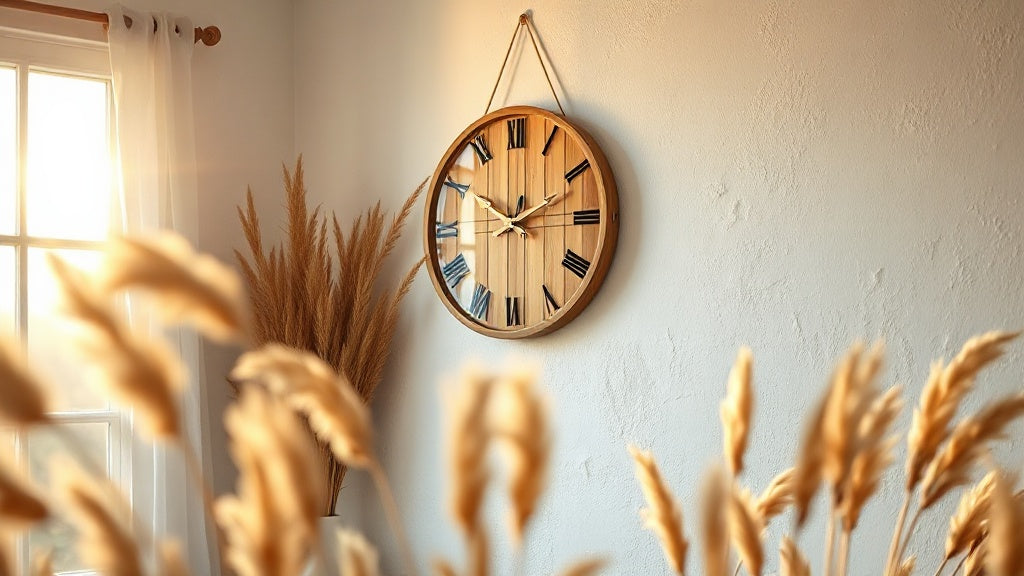
There's a moment when you step back after hanging a new clock and realize it's doing something the old one never did. It's not just marking time. It's anchoring the whole wall, pulling the room together, making the space feel more intentional. That feeling gets even stronger when the clock is made from something real: a slice of solid oak, a panel of pressed bamboo, a frame carved from reclaimed timber. Wall clocks with natural materials have that quality. They carry a quiet honesty that plastic or powder-coated steel simply can't replicate.
And in 2026, more buyers care about what their decor is actually made of. Not in a preachy way, just practically: if you're going to hang something on your wall for the next decade, it's worth knowing whether it was responsibly sourced, whether it'll age gracefully, and whether it fits a home that values substance over novelty.
Here's what actually matters when you're choosing a sustainable clock, and how to read through the marketing to find the real thing.
À retenir
- Bamboo is one of the fastest-renewing materials on the planet, making it a top choice for eco-conscious clocks.
- Solid wood ages better than veneer or MDF, developing character over years rather than wearing out.
- Silent quartz movements are the most practical pairing for natural-material clocks in bedrooms or living rooms.
- The finish matters as much as the material: look for water-based lacquers or untreated surfaces over synthetic coatings.
- Natural material clocks work across Scandinavian, *japandi*, and organic modern interiors without feeling forced.
Why Natural Materials and Clocks Are Such a Good Match
Natural material clocks earn their wall space because wood and bamboo age gracefully, carry a quiet honesty that plastic cannot replicate, and become more beautiful over time rather than wearing out. Clocks are one of the few decorative objects that genuinely earn their wall space. They're useful. They're looked at constantly. So the material they're made from is noticed in a way that, say, a decorative bowl on a shelf simply isn't. That's why choosing a wooden or bamboo wall clock pays off more visibly than swapping out almost any other decor element.
Natural materials also age differently from synthetics. A bamboo clock face will subtly warm in tone over years of exposure to light. A solid walnut frame develops a patina. These aren't flaws; they're the material doing what it's supposed to do. Plastic yellows and looks tired. Wood mellows and looks better.
There's a practical sustainability argument too. Most natural wood and bamboo clocks require only a standard AA battery to run, they don't need electronics to charge, and when they eventually wear out, the casing is biodegradable or recyclable in a way that injection-molded plastic simply isn't.

Bamboo: The Material That Earns Its Reputation
Bamboo earns its reputation as a clock material because it harvests in three to five years, resists moisture better than most wood veneers, and delivers a clean minimalist look that suits contemporary interiors. Bamboo is not a trend. It's been used in architecture, furniture, and craftsmanship across Asia for centuries. What's changed is that Western interior design has finally caught up to what makers in Japan, Vietnam, and China have known for generations: bamboo is extraordinarily strong for its weight, naturally resistant to moisture, and harvests in three to five years compared to the sixty-plus years needed for hardwood forests.
For a wall clock, those properties translate directly. Bamboo dials and frames hold their shape in fluctuating humidity (relevant if you're hanging a clock in a kitchen or bathroom). The material doesn't warp the way thinner wood veneers can. And visually, the fine, tight grain of pressed bamboo gives a clean, minimalist look that suits contemporary interiors without looking sterile.
Did you know?
Bamboo is technically a grass, not a wood, and some species grow up to 91 cm in a single day. That growth rate is part of why it's considered one of the most renewable building materials available. Moso bamboo, the variety most commonly used in home goods, reaches harvestable maturity in just four to five years.
When shopping for a sustainable bamboo wall clock, look at how the bamboo is processed. Strand-woven bamboo (compressed fibers under heat and pressure) is denser and more durable than flat-pressed panels. The adhesives used in manufacturing matter too: formaldehyde-free binders are increasingly standard among quality producers. If a brand mentions FSC certification or low-VOC finishes, that's a genuine signal rather than a packaging claim.
That last detail, the strand-woven construction and formaldehyde-free binders, is exactly why we chose the bamboo source for the clock below. It's not marketing copy. It's the actual spec sheet reason this piece belongs in a home built to last.
Solid Wood vs. Veneer vs. MDF: What's Actually on Your Wall
Solid wood outlasts veneer and MDF in every category that matters: it's repairable, develops character over time, and won't chip or peel at the edges the way composite materials do. A lot of clocks described as "wooden" aren't quite what that word implies. There's a meaningful difference between a clock made from solid hardwood and one made from MDF (medium-density fiberboard) with a thin wood veneer applied to the surface. Both can look similar in a product photo. They don't feel similar, and they don't last the same way.
| Material | Durability | Eco Profile | Aesthetic Over Time |
|---|---|---|---|
| Solid Hardwood | Excellent, repairable | Good if FSC-certified | Develops patina, improves |
| Bamboo (strand-woven) | Very high, moisture-resistant | Excellent, fast-renewing | Warms in tone, stays crisp |
| Wood Veneer over Plywood | Moderate, can peel at edges | Mixed, depends on binders | Consistent but less character |
| MDF | Low, heavy, chips easily | Poor, often high formaldehyde | Fades, chips at corners |
| Reclaimed Wood | High, already proven | Excellent, zero new harvest | Unique character, aged look |
If a listing doesn't specify the wood type or construction method, that's a signal worth noting. Reputable makers generally tell you exactly what their product is made from, because that information sells the product. Vagueness usually means there's a reason for it.

Scandinavian and Japandi Styles: Where Natural Clocks Fit Best
Natural material clocks fit Scandinavian and japandi interiors better than almost any other style because both aesthetics are built on material honesty, functional simplicity, and the quiet beauty of unprocessed surfaces. Two interior aesthetics have defined the natural materials conversation for the past several years. **Scandinavian design**, with its emphasis on function, light wood tones, and absence of unnecessary ornamentation, has long embraced wooden clocks as a core element rather than an accessory. Japandi (the Japanese-Scandinavian hybrid that grew into its own movement) pushes that even further: asymmetry, imperfection, and the beauty of unprocessed materials are central to the aesthetic.
A bamboo clock with a clean dial and minimal numerals sits perfectly in both contexts. So does a solid oak clock with a brushed face and simple hands. What doesn't work in either setting: anything that mimics wood through print or texture-embossed plastic. Those pieces undermine the whole point of the aesthetic, which is material honesty.
For organic modern interiors (think linen sofas, terracotta accents, raw plaster walls), slightly warmer wood tones work better: walnut, teak, cherry. For Scandinavian-leaning rooms that run lighter, birch and ash complement white walls without washing out. You can explore more options in our Scandinavian wall clock collection if you want to see how different wood tones play in that aesthetic.
The leaf-motif clock below is one of those pieces that makes the japandi connection immediately obvious. The organic silhouette printed into the bamboo face isn't decoration for decoration's sake; it's the material and the motif working together to say the same thing.
The Movement Inside: Silent Quartz Is the Right Call
Silent quartz is the right movement for a natural material clock because it runs nearly soundlessly on one AA battery for 12 to 18 months, and its standardized mechanism can be replaced without retiring the whole piece. A clock's sustainability story doesn't end with the casing material. The mechanism matters too, both practically and environmentally. Silent quartz movements (also called sweep movements) use a continuous, near-silent motor rather than the tick-tick-tick of a step motor. They run on a single AA battery that typically lasts 12 to 18 months, and the movement itself can often be replaced independently if it fails, extending the life of the clock without replacing the whole piece.
Mechanical movements, while beautiful in their own right, require periodic servicing and are far more sensitive to temperature and humidity changes. For a natural material wall clock in a living space, silent quartz is the more practical and longer-lasting choice. If you're going into mechanical wall clocks, do it intentionally, knowing the maintenance commitment.
One more thing worth noting: the weight of a solid wood or bamboo clock is meaningfully higher than its plastic equivalent. Make sure your wall anchor can handle it. A clock with a 30 cm solid bamboo frame can weigh 600 to 900 grams. Two screws into a stud, or a proper wall anchor rated for at least 2 kg, and you're fine.

Reading Sustainability Claims Without Getting Burned
The most reliable sustainability signals on an eco-friendly natural material clock are FSC certification on the wood, water-based finishes, a disclosed supply chain, and a replaceable movement that extends the clock's real-world lifespan. The word "sustainable" appears on a lot of product listings right now. Some of those claims hold up. Others are thin. Here's what to actually look for when evaluating an eco-friendly natural material wall clock:
- FSC certification on wood means the timber was harvested from forests managed for long-term ecological health. It's a credible third-party standard.
- Water-based or plant-based finishes are meaningfully better than solvent-based lacquers, both for indoor air quality and end-of-life disposal.
- Country of manufacture isn't a sustainability marker by itself, but brands that disclose their supply chain and production location are generally more transparent overall.
- Repairability counts. A clock where the movement can be swapped out (most silent quartz mechanisms are standardized and cost $8-15 to replace) has a longer real-world lifespan than a sealed unit you'd bin when the motor goes.
- Packaging is a secondary signal: recycled cardboard and paper padding instead of expanded polystyrene suggests a brand that's thought through its environmental footprint beyond the product itself.
No clock on the market is perfectly zero-impact. The battery has environmental cost. Shipping has carbon cost. The question is whether the piece is built to last long enough that those costs get amortized over a decade of use rather than a few years before it goes in a landfill.
Wooden Wall Clock Collection
73 options spanning solid wood, bamboo, and reclaimed styles, all in one place for buyers who want natural materials they can actually feel good about.
73 references
Browse the Collection →Where to Hang a Natural Material Clock for Maximum Impact
For maximum impact, hang a natural material clock at eye level on a feature wall at 150 to 165 cm from floor to center, paired with other organic textures that speak the same material language as the rest of the space. Placement matters as much as the piece itself. A beautiful bamboo clock hung in the wrong spot reads as an afterthought. The same clock in the right position anchors the room.
The classic position is eye level at the center of a feature wall, typically 150-165 cm from floor to clock center. But natural material clocks often work even better above a fireplace, above a console table in an entryway, or centered on the main wall of a kitchen where warm tones can play off cabinetry.
One pattern that works consistently: pair a natural material clock with other organic textures in the same room. A bamboo clock above a rattan chair. A walnut-framed clock on a wall adjacent to exposed brick. The clock doesn't need to match everything exactly. It just needs to speak the same material language as the rest of the space.
"A clock is the one object on your wall that everyone looks at, every day, without thinking about it. Make it worth noticing."
On intentional decor placement
Avoid hanging a natural wood or bamboo clock directly above a radiator or in direct, prolonged sun. Both heat and UV exposure will accelerate color change and, over time, can cause minor warping in thinner pieces. A few feet away from a south-facing window is usually fine. Directly in the sun's path, less so.
The Nordic Black Bamboo Option: When Minimal Meets Natural
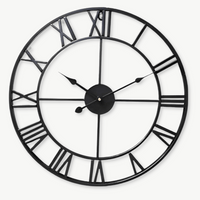
The blackened bamboo finish shifts the mood from cozy-natural to considered-minimal, making it the right choice for moody contemporary rooms where a honey-toned clock would feel too folksy and matte metal too industrial. Not every natural material clock skews warm. The Black Nordic Wooden Wall Clock offers something slightly different: the same Scandinavian design language, but with a blackened bamboo finish that reads as modern and graphic without losing the material authenticity. It's the kind of piece that works in rooms where a honey-toned clock would feel too folksy, but where a matte metal clock would feel too industrial.
The blackened finish comes from a heat or staining process applied to the bamboo surface, not a paint coat. The grain still reads through. The material is still there. It just shifts the mood from cozy-natural to considered-minimal, which suits a lot of contemporary interiors that run dark, moody, and deliberate.
Caring for a Natural Material Clock So It Actually Lasts
A bamboo or wood clock cared for correctly will last 15 to 20 years: dust with a dry cloth, replace the battery every 14 months before it depletes, and apply a light mineral oil when the surface feels dry. A bamboo or wood clock that's well cared for will genuinely last 15 to 20 years. Here's what that actually looks like in practice:
- Dust with a dry or barely damp microfiber cloth. Avoid any spray cleaners with alcohol or citrus-based solvents, which can strip natural oil finishes.
- If the wood looks dry after a few years (surface feels rough or chalky under your fingertip), a very light application of food-grade mineral oil or beeswax polish restores the surface. Buff off completely before re-hanging.
- Replace the battery before it fully depletes. A leaking battery inside a quartz movement will corrode the contacts, and that failure is almost never worth repairing. Set a phone reminder for every 14 months.
- If the movement starts running slow before the battery is due, replace it anyway. Low-voltage running is harder on the motor than a fresh battery.
- For clocks in kitchens, wipe the face occasionally with a dry cloth to remove any fine grease film that builds up over time near cooking surfaces.
The Bottom Line: A Clock That Means Something
A wood or bamboo wall clock is worth choosing because the material is the message: it says a thing should be made honestly, age well, and still be on your wall in twenty years looking better for it. Here's what I keep coming back to, after years of thinking about clocks as both objects and statements: the material is the message. When you hang a wall clock with natural materials in your home, you're not just filling space on a wall. You're saying something about what you value. That a thing should be made honestly. That it should age well. That it deserves to still be there in twenty years, looking better for the time it's spent.
Elena's version of this isn't complicated. It's a bamboo dial, a silent sweep movement, a finish that lets the grain speak for itself. It's the kind of object that stops being noticed as a clock and starts being experienced as part of the room. That shift, from functional to felt, is what good design actually does.
Whatever your interior, whatever your budget, the right natural material clock is out there. Start with the material. Trust the grain. And if you want a shortcut, the wooden wall clock collection is a genuinely good place to spend twenty minutes.
FAQ
Is bamboo really more sustainable than wood for a wall clock?+
Generally, yes. Bamboo reaches harvestable maturity in 3-5 years versus 40-100 years for most hardwoods. It also regenerates from its root system without replanting. That said, FSC-certified hardwoods from well-managed forests are also a responsible choice. Both are significantly better than MDF or plastic alternatives.
Can a bamboo wall clock handle humidity in a bathroom or kitchen?+
Strand-woven bamboo handles moderate humidity well, better than most solid hardwoods. A kitchen with normal ventilation is fine. A steam-heavy bathroom directly above a shower is a harder environment. For those spaces, look for clocks with a sealed finish and avoid hanging directly above a steam source.
What size natural material clock works best in a living room?+
For most living rooms with ceilings at standard height (2.4-2.7 m), a clock between 30-45 cm in diameter reads well. Larger rooms or double-height walls can carry 50-60 cm. Smaller than 30 cm tends to get lost unless the wall is very small or the clock is part of a gallery arrangement.
How do I know if a clock labeled "wooden" is actually solid wood?+
Check the product description for explicit material callouts: "solid oak," "solid walnut," or "solid bamboo" versus vague terms like "wood-finish" or "wood-effect." If you can see the clock in person, look at the cut edges: solid wood shows consistent grain; veneer shows a thin decorative layer over a different core; MDF shows a fine, dense, paperlike cut edge.
How often does a silent quartz movement need the battery replaced?+
Most silent quartz movements run 12-18 months on a single AA battery under normal conditions. Colder environments (below 10°C) can shorten battery life. High-quality alkaline batteries outlast standard batteries noticeably in clock applications. Avoid rechargeable (NiMH) batteries in quartz movements: the slightly lower voltage can cause the movement to run slow.
What is the average price range for a quality natural material wall clock?+
Quality wall clocks with natural materials generally range from $60 to $150 USD for solid bamboo or hardwood pieces with silent quartz movements. Below $40, you're usually looking at veneer over MDF or hollow construction. Above $150, you're entering handcrafted or reclaimed-wood territory, which can absolutely be worth it if the piece is genuinely built to last.